

Партнерка на США и Канаду по недвижимости, выплаты в крипто
- 30% recurring commission
- Выплаты в USDT
- Вывод каждую неделю
- Комиссия до 5 лет за каждого referral
As a result of this and similar measures the average salary in education will grow by 65% in relation to that in 2007; it will reach 73% in 2008, and 75% in 2010.
Approximately 60,000 state and municipal educational facilities will be provided with internet access as part of the educational upgrade program; 3,000 schools and 40 colleges will receive funding to implement innovative educational programs; 20-30 subjects of the Russian Federation will receive government funding to implement a comprehensive education revitalization programs.
In 2008 will see two new universities – Yuzhnyj (Rostov-na-Donu) and Sibirskii (Krasnoiarsk) – 24 new vocational training facilities for individuals conducting military service, and two privately funded international-level business schools.
Considerable attention will be given to increasing accessibility of education to all levels of society, irrespective of geographical location or social standing. An indicator of accessibility of education is the percentage of children and young adults attending preschool, school and vocational training programs:
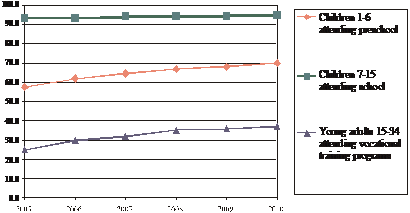
As a result, average expected duration of school training for children of 6 will rise from 15.4 years (in 2006) to 16 years (in 2010) brining the Russian Federation in line with the leading countries of the developed world.
6.3 Science and Innovation
In 2008 the federal government plans to spend 119.3 *****bles on civilian science; 139.8 bln. will be spent in 2009, and 173.7 bln. in 2010, which is an increase from the 2007 figure of a factor of 1.2, 1.4, and 1.7, respectively. (table 6.4)
Table 6.4
Federal Budget Expenditures for Science and Innovations
2007 (budgeted) | Projected | |||
2008 | 2009 | 2010 | ||
Fundamental research | 48.5 | 57.7 | 68.2 | 83.0 |
Space exoloration | 9.1 | 12.5 | 12.7 | 9.5 |
Additionally, Russian Federal Space Program for the years | 18.5 | 19.3 | 19.8 | 20.2 |
FTP Research and Development in Priority Areas of Russia’s Scientific andTechnological Complex for the Years | 11.7 | 14.6 | 18.2 | 22.9 |
FTP Development of Electronic Component Base and Radioelectronics for the Years , Development of Electronic Component Base for the Years | 3.8 | 5.5 | 6.8 | 7.4 |
FTP Infrastructure Development for Nanotechnology in the Russian Federation for the Years | - | 9.5 | 7.9 | 7.5 |
Support for Fundamental Research
In 2009 the salary of research fellows and directors of research institutions administered by the Russian Academy of Sciences will rise to an average of 30,000 rubles, which will result in an improved human capital in native science and attract young talent.
The federal government plans to increase the amount of competitive and program funding for research and development, from 25% (of all funding) in 2005 to 41.6% in 2008 and 45.1% in 2010, which will make funding distribution more objective and result in greater efficacy of such spending.
Development of Contemporary Technologies
Beginning in 2007 the following fields have will be considered top priority in the national science and technology policy: nanotechnology, living systems technologies, sustainable and renewable energy, new technologies in information systems and electronics.
The federal targeted program for Nanotechnology infrastructure will receive 9.5 *****bles from the federal budget, 7.9 *****bles in 2009 and 7.5 *****bles in 2010.
Moreover, in accordance with the injunction of the President of the Russian Federation a nanotechnology corporation will be created, with an endowment of 130 *****bles.
As a result of government support for contemporary technologies the number of corporations involved in technological innovation will grow from 11.5% in 2005 to 13% in 2008, to 14% in 2010. The portion of export production made up of innovative technology products will rise from 5% in 2005 to 7% in 2008 and 9% in 2010.
6.4 Efficacy of Government Agencies
The amount appropriated by the federal budget toward government regulation will drop from 3.8% of the total budget in 2007 to 3.6% in 2008 to 3.5% in 2009.
The greater part of spending on the operations of federal agencies is made up of the costs of various regulatory and monitoring activities, which ensure the safety and the protection of the interests and the rights of citizens: sanitary and phytosanitory measures, veterinary control, transportation oversight, environmental and technological oversight, Federal tax service, Federal treasure, etc.
The federal budget for 2007 has set aside 141.0 *****bles in funding for the operations of such regulatory agencies: it amounts to 44.1% of the total amount appropriated for the financial support of all federal government agencies and judicial powers.
6.5 Protection of Natural Resources
With the objective of renewing and augmenting the reserves of natural resource in 2010 the federal government will spend 22.4 *****bles on geological explorations and study of deposits (vs 19.9 bln. in 2007). Exploratory works funded from extrabudgetary sources (extractors) are also planned for 2010 in the amount of 105.0 *****bles, vs. 95.0 bln. in 2007.
In the federal government will continue to fund activities directed toward the preservation of specially protected sites. Additional funds of 105.3 *****bles annually have been set aside for newly created national wildlife reservations and national parks.
In funds directed toward forestry operations and safety measures in national parks and on wildlife reservations will double in comparisons to 2007.
Over 250 *****bles have been set aside in 2008, as in 2007, for polar expeditions, research and additional observations in the Arctic circle and Antarctica, in preparation to and as part of the activities scheduled for the International Polar Year.
Federal funds and extrabudgetary funds will be directed toward attaining the following objectives:
Unit of measurement | 2006 | 2007 | 2008 | 2009 | 2010 | |
The level of knowledge of the territory and continental shelf of the Russian Federation obtained through general geological and special activities | % | 38.2 | 39.6 | 41.2 | 43.0 | 45.0 |
Availability of information about dangerous geological processes and phenomena | % | 51.5 | 51.5 | 56.1 | 62.0 | 68.3 |
Reforestation ratio | ratio | 0.6 | 0.6 | 0.6 | 0.7 | 0.7 |
Promptness of response to forest fires (ratio of the number of fires extinguished during the first two days to the number of fires that have occurred) | % | 28 | 40 | 45 | 50 | 55 |
Share of water intakes provided with water metering systems | % | 70 | 80 | 90 | 95 | 97 |
Share of waste water treatment facilities provided with waste water metering and quality control equipment | % | 60 | 70 | 80 | 85 | 88 |
6.6 Cultural Potential
One of the most important aspects of maintaining and developing the human capital is a wide potential for spiritual advancement, satisfaction of the need for arts and leisure, and access to the cultural heritage. A unified information and culture environment is the basis for the unity of a nation and advances the standing of the Russian Federation in the international community.
In the government will increase its spending on cultural affairs and mass media by 20 *****bles; in 2008 alone this will amount to 82.5 *****bles (table 6.12).
Table 6.12
Federal Budget Expenditures for Culture and Mass Communications
2007 (budgeted) | Projected | |||
2008 | 2009 | 2010 | ||
Support for museums and permanent exhibitions | 8.0 | 8.7 | 8.5 | 9,3 |
Including the State Hermitage | 1.2 | 1.9 | 2.6 | 1,2 |
Support for libraries | 2.1 | 3.2 | 3.2 | 3,4 |
Support for theatres, circuses, concert and other performing art organizations | 7.9 | 9.1 | 8.6 | 9,1 |
Including the Bolshoi Theatre | 1.9 | 2.3 | 1.9 | 2,0 |
Federal support for film-making | 3.7 | 3.8 | 3.8 | 3,8 |
Federal support for television and radio broadcasting companies | 17.1 | 22.6 | 21.6 | 21,8 |
Federal support for news agencies | 1.4 | 1.7 | 1.7 | 1,7 |
Federal targeted programs | ||||
FTP Russian Culture () | 12.4 | 14.7 | 11.4 | 7,6 |
These funds will be spent on salaries of additional personnel in the newly expanded Mariinsky and Aleksanrinsky theatres and the national museums-preserves Mikhailovskoye and Sholokhov, adjusting the Presidential grant in music, and renovating cultural facilities and restoring national historical and cultural monuments.
The federal budget for also includes funding for library acquisitions and partial funding for the B. N. Yeltsin presidential library.
7. Guarantees of Financial Stability
Transformations in the budget system of the first half of the ‘00s have resulted in a transparent budget policy, its stability and predictability in the medium-range perspective. At present the Russian Federation faces the challenge of instituting long-range budget and macroeconomic stability.
“
7.1 New Principles of Managing Oil and Gas Revenues
as a Mechanism for Long-Term Budget Balancing
At present the favorable environment of the international oil market has continued to generate revenues for the Stabilization fund: in early 2007 it amounted to 8.7% of the GDP. Nevertheless the Stabilization fund does not guarantee a safe level of sterilization for market revenues, since it does not take fully account for oil revenues and does not account at all for gas revenues. Moreover, the Stabilization fund does not fully guarantee long-range stabilization of the budget and steady revenues from non-renewable oil resources for future generations.

|
Из за большого объема этот материал размещен на нескольких страницах:
1 2 3 4 5 6 7 8 9 10 11 12 13 14 15 16 17 18 19 20 21 22 23 24 25 26 27 28 29 30 31 32 33 |
