

Партнерка на США и Канаду по недвижимости, выплаты в крипто
- 30% recurring commission
- Выплаты в USDT
- Вывод каждую неделю
- Комиссия до 5 лет за каждого referral
2.2 Spending Obligations of the Russian Federation
The federal budget for the year 2008, and through 20101, was drafted on the basis of a register of spending obligations of the Russian Federation for the years . The register comprises an “inventory” of legal foundations and calculations for all expenditures included in the federal budget and the budgets of extrabudgetary funds of the Russian Federation.
Funding for Spending Obligations
Directives from the Budget Address | Realized in the Fiscal Code of the Russian Federation |
Unconditional fulfillment of existing obligations must form the foundation of a fiscal policy. Major decision concerning their annulment, termination or restructuring must be worked out before the budget is drafted. | Allocations of funds toward existing and newly assumed obligations are considered separately. Existing obligations are subject to unconditional financial backing in full. |
With respect to newly assumed obligations, a distinct and transparent mechanism must be set in motion for evaluating the financial capabilities to fulfill the said obligations, their extent and content, expected efficacy, and viability of alternative solutions. New state-funded programs shall not be instituted, but that there is full certainty of their financial backing. | All current laws, regulations, treaties, agreements and programs resulting in financial obligations are recorded in the register of spending obligations, along with the amounts appropriated for their fulfillment. |
The procedures involved in the assumption of new spending commitments are yet to be fine-tuned. This especially concerns decisions on long-term programs funded by the federal budget; meanwhile, established budgeting limits are often ignored or abolished. | The fiscal policy dictates the procedures for evaluating long-term earmarked spending and government investments, based on the principle of separation of existing and new obligations. Approved earmark spending programs are reflected in the register of spending obligations of the Russian Federation. |
The most prominent place in the register is funds transferred directly to the population, including public spending and stipends, i. e. “direct” financial obligations of the government to the people (pension payments, benefits, compensation payments and other social guarantees); these are subject to unconditional payment. In 2008 such obligations amount to more than 50% of all spending obligations of the Russian Federation (Fig. 2.1)
Figure 2.1.
Breakdown of Spending Obligations of the Russian Federation
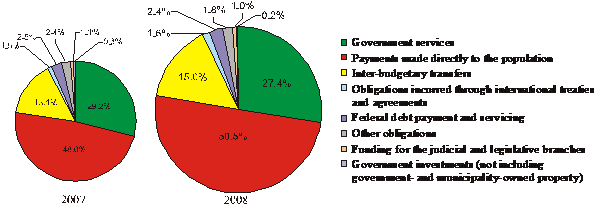
The structure and the extent of over 50% of the obligations of the Russian Federation have been predetermined by existing regulations, which dictate the types and amounts of payments made to the population, by the schedule of payments and servicing of the federal debt of the Russian Federation, and by international treaties and agreements.

The greater part of abovementioned obligations is to be discharged through extrabudgetary funds or subsidies from the Federal Compensations Fund.
Table 2.4.
Main Federal Laws Stipulating the Obligations of the Russian Federation
for Transfers to the Population in
2007 *****bles | 2008 *****bles | Variation | ||
*****bles | % | |||
Out of federal off-budget funds of the Russian Federation | ||||
On labour pensions in the Russian Federation. | 797.5 | 931.2 | 133.7 | 16% |
On government benefits to citizens with children | 62.7 | 76 | 13.3 | 21% |
On employment in the Russian Federation | 1.6 | 1.8 | 0.2 | 12% |
On mandatory social insurance against industrial injuries and occupational diseases | 28.2 | 31.2 | 3 | 10% |
Out of the federal budget (including inter-budgetary transfers to government off-budget funds of the Russian Federation) | ||||
On labour pensions in the Russian Federation (main part) | 559.8 | 707.7 | 147.9 | 25% |
On state pension provision in the Russian Federation | 102.1 | 122.4 | 17.5 | 17% |
On measures to improve the financial position of certain categories of citizens of the Russian Federation in connection with the 60th anniversary of Victory in the Great Patriotic War | 15.2 | 13.7 | 1.5 | -10% |
On covering the budget deficit of the Pension Fund of the Russian Federation | 88.2 | 184.6 | 96.4 | 109% |
On social protection of disabled in the Russian Federation | 147.3 | 189.5 | 42.2 | 28% |
On veterans | 48.3 | 52.0 | 3.7 | 7% |
On government guarantees and compensations for persons working and living in regions of the Far North and equivalent regions | 0.19 | 0.2 | 0.01 | 7% |
On status of Heroes of the Soviet Union, Heroess of the Russian Federation and bearers of the full set of the Order of Glory | 0.9 | 1.0 | 0.05 | 5% |
On social protection of citizens exposed to radiation from the Chernobyl nuclear power station disaster | 19.2 | 22.1 | 2.9 | 15% |
On social protection of citizens exposed to radiation resulting from the Mayak production amalgamation accident and the dumping of radioactive waste into the Techa River | 0.7 | 0.8 | 0.1 | 14% |
On social protection of citizens exposed to radiation from nuclear tests at the Semipalatinsk Test Site | 0.2 | 0.2 | 0.0 | 9% |
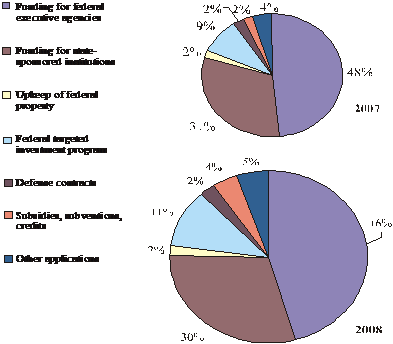
Among the spending obligations to be discharged at the expense of the federal budget the most significant are government services.
Obligations for government services include funding for government-sponsored agencies and institutions, subsidies to government agencies and institutions that are not government-sponsored in compensation of expenses incurred in providing government services, and governmental property investments. All are characterized by the burden of providing government funding. Allocations toward such spending must be evaluated with respect to governmental prescriptions and reflected in the budget requests of government-sponsored organizations. (fig 2.2)
Figure 2.2
Breakdown of Spending Obligations on Government Services for
2.3 Efficacy of Government Spending
Fiscal mechanisms evolved over the period ensure transparency and accountability in the drafting and implementation of the budget, and efficiency and reliability in budget accounting. Strict financial discipline and oversight of targeted budget spending ensure that government money is spent fully in accordance with the needs of the government sector within resources. At the same time, resource budgeting prevents authors of the budget draft from taking into account the aims of national policy, and does not guarantee effective use of existing resources or definite results.
Result-based budgeting, in addition to transparency and control over distribution and use of funds, strives for greater efficacy of distribution and use. The first implies concentrating budget resources on addressing priority issues of the national policy; the second implies a more effective and economical use of funds in attaining prescribed goals.
Improving the Efficacy of Planning Expenditures
Directives from the Budget Address | Realized in the Fiscal Code of the Russian Federation |
Drawn out cumbersome procedures of budget planning and review have been allowed to set in, making it difficult to distinguish between the political and the “technical” aspects of the budgeting process. | The federal budget shall be signed into law after three, rather than four readings. Current obligations are fixed in the budget, with only new commitments are considered with respect to their nature and amount. |
The procedures involved in the assumption of new spending commitments are yet to be fine-tuned. This especially concerns decisions on long-term programs funded by the federal budget. | The procedures for evaluating long-term earmarked spending programs shall be based on the principle of separation of existing and new obligations. Approved earmarked spending programs become outstanding commitments; amounts are subject to review only if the stated outcomes are revised with appropriate amendments to the bylaws governing the approval of this program. |
There is no legally established mechanism for ensuring the stability of funding for program events in the amount determined at their approval. | An approved program is included in the register of obligations and is subject to unconditional funding in the amount specified in that program’s passport |
The level of several federal programs does not meet today’s standards. Program events and the funding required are not always carefully thought out in the planning stages, which causes them to be reconsidered and restructured at a later date. Information gleaned from monitoring of federal targeted programs is not sufficiently utilized in the development of new programs, aimed at similar ends. | Every long-range targeted program is subject to an annual review with respect to its efficacy; reports derived from such evaluations are to be submitted along with the draft of a new budget. |
The established practice of annually reevaluating building investments leads to construction being carried out at irregular pacing; completion dates are regularly pushed back: as a result the cost of construction is constantly higher than supposed at the outset, while the quality is lower. | New procedures for funding capital expenditures shall be put in place, whereby each new major construction project shall be approved by a separate law specifying its complete cost for the entire period of construction; this amount shall be entered in the register of spending obligations. |
The document regulating the relations between the government and a contractor must be a contract, covering the entire duration of the investment. | The new system allows for government contracts of up to three years; for long-term targeted programs the term may be extended. |
The totality of expenditures entailed in an government contract must be included among the government’s spending obligations, and may not be revised. | Investments are approved by separate laws for the duration of contract. Programs and contracts are included in the register of spending obligations and are subject to unconditional funding in the full amount. |
At the implementation stage it is essential that the appropriate agencies possess the necessary range of authority to manage the funds in the most efficient manner for the purposes of attaining the proposed results.
Improving the Quality of Fiscal Management
Directives from the Budget Address | Realized in the Fiscal Code of the Russian Federation |
We have not seen sufficient positive changes in the functioning of government institutions; no satisfactory stimuli aimed at improving their efficacy and frugality have been created. The number of government agencies and the percentage of government employees per capita continues to rise. We must work on transforming government institutions into self-sufficient organizations with respect to those types of social services where this change may yield significant stimuli for improved efficacy. | The new policy allows for the changeover of government institutions into corporate bodies (autonomous organizations). It also proposes that such institutions be reimbursed for concrete government (municipal) services provided, rather than funded in accordance with their estimated spending. |
Main budget-planners are not sufficiently independent, i. e. not sufficiently accountable for the planning and execution of their budgets; this results in lower efficacy of spending and poorer results. | Main budget-planners shall be granted wider authority in managing funds; their accountability shall be increased accordingly. |
Main budget-planners must be granted the authority to independently determine the types of funding required for their services, and the manner in which these services shall be discharged: e. g. whether the specific government service shall be offered by the government agency directly, or outsourced to a private organization in the form of a government contract. | Appropriations for government services with direct outcomes characterizing the scope and quality of services offered. The mechanism of this correspondence shall be government (municipal) assignments. Main budget-planners shall be given greater freedom to manage funds in a goal-oriented environment. |
Financial control only marginally addresses the issues of effective use of government funds and the quality of fiscal management; its results are almost entirely ignored in budget planning or decision-making. | Executive powers have the authority to create internal audit (internal control) divisions, which will address the issue of efficacy. Beginning with this year the Ministry of Finance shall monitor the quality of fiscal management; based on such evaluations main budget-planners may be granted greater freedom in fiscal management within the budget target list. |
We have not been able to attain regularity in spending: the greater part of expenditures are still concentrated in the second half of the year, creating stimuli for spending the resources at any cost, which often results in agencies’ trying to skirt the competition process in purchasing products (goods or services) for government and municipal use. | The new policy allows for government (municipal) contracts for up to three years in spending obligations (for long-range programs), which extends government contract possibilities from the one-year limit. |
Drafting and implementation stages of the budget must be accompanied by exhaustive statements concerning the destination and results of funds; these must serve as basis for changes to fiscal policy, while executive agencies must bear the responsibility for the quality of their services and activities.

|
Из за большого объема этот материал размещен на нескольких страницах:
1 2 3 4 5 6 7 8 9 10 11 12 13 14 15 16 17 18 19 20 21 22 23 24 25 26 27 28 29 30 31 32 33 |
