

Партнерка на США и Канаду по недвижимости, выплаты в крипто
- 30% recurring commission
- Выплаты в USDT
- Вывод каждую неделю
- Комиссия до 5 лет за каждого referral
Main results and trends
of Budget Policy
Table of Contents
Introduction................................................................................................................................... .2
1. Budget strategy objectives and goals: and beyond ..................................................... 3
2. Funding government obligations and national priorities………................................... ……………5
2.1 General parameters of the national budget…………................................................................ 5
2.2 Spending obligations of the Russian Federation……............................................................. .7
2.3 Efficacy of government spending........................................................................................ 10
3. Quality of life………………………............................................................................................... 13
3.1 Adequate compensation…..............................................................................................
3.2 Providing for the retired population..................................................................................... 15
3.3 Social protection………………….....................................................................................
3.4 Improving the quality and accessibility of medical aid……….............................................
3.5 Improved access to comfortable housing and quality housing services............................
3.6 Fiscal support of the regions; incentives to better regional and municipal fiscal management…………………………………………………………………………………………....
4. Stable economic growth……………........................................................................................... 27
4.1 Macroeconomic stability..................................................................................................... 28
4.2 A better quality, competitive tax system……………………………………................................ 29
4.3 Government investments..................................................................................................... 31
4.4 Funding for the industrial sector......................................................................................... 31
4.5 Transportation services and infrastructure............................................................................ 32
4.6 Energy infrastructure......................................................................................................
4.7 Agricultural sector.............................................................................................................. 34
5. National security...................................................................................................................
5.1 Maintaining national defense capabilities and defense against external threats...................... 36
5.2 Combating crime and preventing terrorist threats.................................................................. 37
5.3 Prevention and response to emergency situations and natural disasters................................ 38
6. Confidence in the nation’s future……...................................................................................
6.1 The demographic program.................................................................................................. 39
6.2 Accessibility and quality of education..............................................................................
6.3 Science and innovation...................................................................................................
6.4 Efficacy of government agencies....................................................................................
6.5 Protection of natural resources........................................................................................
6.6 Cultural potential.............................................................................................................
7. Guarantees of financial stability................................................................................................ 49
7.1 New principles of managing oil and gas revenues as a mechanism for long-term budget balancing 45
7.2 National debt...................................................................................................................... 45
Conclusion................................................................................................................................
Appendix....................................................................................................................................... 48
Introduction
“A medium-term budget strategy must be geared toward the social and economic development of the Russian Federation, while taking into full account the criteria of efficacy and productivity of government spending.”
Budget address of the President of the Russian Federation to the Federal Assembly, March
In 2008 the per capita cumulative budget spending at all levels will exceed 906,000 rubles; by 2010 this figure will reach 8,588,000 rubles.
Essentially, this is the price at which the population «purchases» from the government its social services: education, healthcare, social welfare, economic regulation, personal security, law enforcement, protection of foreign interests, civil rights and freedoms, i. e. all the things that cannot be furnished by the market and purchased by every citizen individually.
Our citizens, as taxpayers and consumers of social services, must be confident that the funds they are placing at the disposal of the government will be used transparently and effectively, yield concrete and, wherever possible, quantifiable results for the society as a whole, as well as for each family and each individual taken separately.
The foundation of this strategic task was laid in the early part of the decade, as the government restored the long-term balancing and stability of the national budget system by means of the following actions:
demarcation of spending obligations and elimination of “unsecured pledges,” which amounted to 1.6 times the capability of the budget system;
creation of a Stabilization Fund, which serves as an “airbag” against a drop in export oil prices, and tempers inflation in the event of currency surplus, a product of excess income from high oil prices;
restriction of specific income sources to specific budgets at various levels and introduction of objective criteria for allocating interbudget transfers;
development of the federal exchequer system, issuing funds for budget implementation on the principle of unitary standards and procedures.
The end result of these measures was transparency and accountability in the planning and implementation of budgets, expedient and reliable fiscal accountability. Strict and efficient control has been established over the assumption and fulfillment of fiscal commitments.
Guaranteed fulfillment of all previous commitments on the one hand, and, on the other, the assumption of new commitments only within the limits of actual funding capability and the demands of a long-term balanced budget, transparency, fiscal accountability and discipline – the key to an effective and responsible fiscal policy – these are absolutely necessary if we are to achieve the goals and results set forth in our national policy,
First steps on the way to this strategic goal were made in .
In 2006 the federal budget was for the first time included in a three-year fiscal plan, which allowed the government to move toward approving a budget for the next three years.
Bodies preparing budgets at any level consult registers of spending obligations, which allow them to determine the structure and the total amount of existing obligations.
A system of fiscal accountability and classification, founded on international standards, has been implemented, allowing government agencies to control financial resources to attain necessary results; it likewise allows outside consumers to request necessary information about the government’s allocation of funds.
Amendments to the Fiscal Code of the Russian Federation passed earlier in 2007 signaled the final phase of fiscal reform; several of them have already been implemented within the framework of goal-oriented medium-term budgeting, during the drafting of the 2006 and 2007 federal budgets.
The amendments to the Fiscal Code of the Russian Federation propose:
bringing budgets at all levels to medium-range fiscal planning: i. e. three-year budgets (using a “sliding” three-year term); this includes the federal budget and non-budgetary state funds of the Russian Federation;
compiling a closed list of types of appropriations, differentiated by legal status and how they are reflected in the budget;
changing the protocol for the drafting and reporting of earmark expenditures and investments in state (municipal) property;
introduction into the budgeting process of government (municipal) contracts and other characteristics of direct outcomes of expenditures (such as justifications of budget appropriations);
widening the authority of government agencies at all levels in accordance with the general principles of itemization and integration of fiscal classification and accountability (as set out I the Fiscal Code); and, consequently, determining the format for the drafting and approval of their respective budgets;
implementing stimuli for regional government agencies and local governments toward decreases in fiscal subsidies for their respective budgets;
ensuring independence and accountability among chief administrators, administrators and funds recipients in the drafting and implementation of their respective budgets;
creating a favorable environment for new corporations and restructuring the state-funded sector;
reviewing issues of regulating federal (municipal) debt, loans and guarantees.
Signing these amendments into law will create new opportunities, stimuli and requirements aimed at raising the efficacy of budgetary spending at all levels.
Starting with 2008 the federal budget is drafted in accordance with the registers of spending commitments maintained by chief administrators of federal funds.
Appropriation justifications presented by the administrators of federal funds, containing information about the extent, quality and direct results of government services (appendix) were used in preparing the 2008 federal budget and the outlook through 2010.
Result-based appropriations presuppose greater accountability and greater authority of main budget-planners for the management of funds in accordance with proposed results. Such increase in authority, within the limits of allocated funds, is stipulated in the amendments to the Russian Fiscal Code. In order to effectively achieve the proposed results federal executive agencies must focus their efforts on improving fiscal management.
The proposed budget for 2008, and the outlook through 2010, has been drafted, and will be implemented, on the basis of new budgetary legislature; it accords with internationally accepted practices, standards and procedures that fully guarantee the implementation of principles of goal-oriented medium-term budgeting, as set out in the Budget address of the President of the Russian Federation for the years .
1. Budget Strategy Objectives and Goals:
and beyond
The budget policy is drafted and implemented on the basis of strategic goals for national development, set out in the annual Addresses of the President of the Russian Federation.
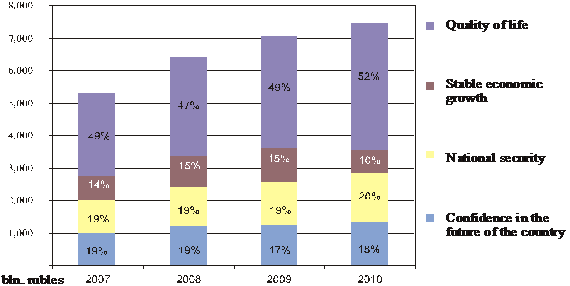
The greatest of these goals is an improved standard of living and quality of life for our population. The government must be instrumental in increasing the actual income and employment levels of the population, facilitating the growth of savings and property ownership among its constituents, and developing the housing market. The government is directly responsible for satisfying the needs of its constituents with respect to adequate and affordable housing, education services, healthcare, cultural and spiritual growth, information, and leisure; as well as fulfilling all social guarantees as prescribed by law, including retirement benefits, social welfare and social security for all citizens in need of government assistance.
The basis for solving social issues is rapid and stable economic growth, resulting in the creation of new jobs, increases in wages and salaries, and expanding the government’s financial opportunities. For this purpose the government must, first of all, maintain financial stability (a low inflation rate and a stable national currency), which, in turn, determines the people’s confidence in the government and their willingness to invest in the national economy. Lowering the tax burden on the economy, decreasing administrative barriers, defending property rights, ensuring economic freedoms and facilitating a free market environment: these are important tools for creating business growth. The government must likewise facilitate the development of the transportation, communications and energy infrastructures, aircraft and sea vessel construction, product export, intellectual services, the space program and other strategic sectors of the economy.
National security and public safety are essential conditions for national development. Social progress cannot take place in a country, whose citizens suffer the burdens of war, terrorism, crime and natural disasters. The destructive potential of violence, natural and industrial disasters is constantly growing: it is the duty of a government to do everything in its power to protect its constituents from such threats. Ensuring a high level of combat readiness of the armed forces, maintaining a modernized weapons system, creating a professional mobile army, combating terrorism, seeking out weapons of mass destruction, preventing local conflicts, preventing and responding to emergency situations and natural disasters: these are among the top priorities of government spending.
Facilitating further growth is the greatest mission of a socially responsible government. People must be confident of the future, secure in the knowledge that their children and grandchildren will show gratitude to the generations that have worked for the prosperity of the nation as a whole, and consequently of every family individually. Developing our nation’s natural and intellectual resources, maintaining a competitive system of education, facilitating an environment of innovation, supporting cutting-edge technologies, protecting the rights and freedoms of the citizens, cultivating democracy and the civil society, effectively structuring the government itself, fighting corruption: all of these are prerequisite for the accomplishment of such a goal. A direct contribution to this accomplishment will come in the form of a comprehensive solution to the demographic problem.
The success of the above tasks is determined not only by financial support, but also by an effective control over the government’s ability to pass just laws and see to their enforcement. Regional and local powers carry significant authority and responsibility in this respect, as dictated by law: a wide selection of social obligations is fulfilled through extrabudgetary government funding.
However, the federal budget is the crucial factor in the attainment of strategic goals of national development. Its basic parameters significantly affect the inflation level, the dynamics of the currency rate, taxation burden and other factors of economic growth. The activities of the government with respect to strategic sectors and the most significant social guarantees are funded by the federal budget. Finally, a significant portion of the federal budget is dispersed through subsidies to the regional budgets and extrabudgetary government funds.
For these reasons every year the President of the Russian Federation sets out concrete demands for the budget policy.
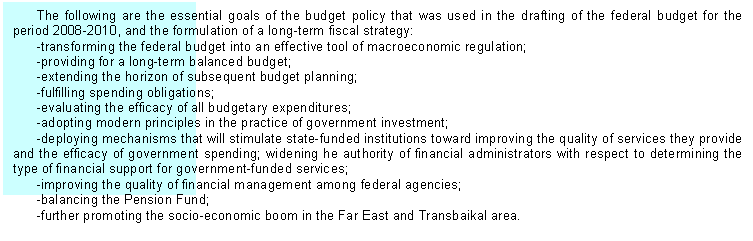
The budget is geared toward improving the standards of living of the population, fulfilling all obligations to the citizens, supporting strategic and innovative industries, ensuring safety and security, and generating the potential for stable national development:
2. Funding Government Obligations and National Priorities
A budget policy must guarantee the fulfillment of all spending commitments, as well as a long-range balance of receipts and outlays; it must likewise ensure that appropriations are made in accordance with the priorities and stated objectives of the national policy.
2.1 General Parameters of the National Budget
The financial capabilities of the government in relation to its avowed responsibilities have grown considerably in the last few years, and continue to increase steadily in the medium term (table 2.1).
Table 2.1.
Basic Parameters of Federal Budget
2006 (reported) | 2007 (ex ante) | 2008 (projected) | 2009 (projected) | 2010 (projected) | |
*****bles | |||||
Revenue, total | 6,276.3 | 6,614.2 | 6,644.4 | 7,465.4 | 8,089.9 |
including oil and gas | 2,954.4 | 2,471.1 | 2,383.1 | 2,351.9 | 2,348.3 |
Including oil-and-gas transfer | - | - | 2,135.0 | 2,103.6 | 2,016.3 |
Non-oil and gas | 3,321.9 | 4,143.1 | 4,261.3 | 5,113.5 | 5,741.6 |
Expenditures, total | 4,281.3 | 5,615.5 | 6,570.3 | 7,451.2 | 8,089.9 |
including non-interest expenditures | 4,112.2 | 5,458.7 | 6,382.5 | 7,052.3 | 7,438.3 |
interest expenses | 169.1 | 156.8 | 187.9 | 212.6 | 247.1 |
provisionally approved expenditures | - | - | - | 186.3 | 404.5 |
Budget surplus | 1,995.0 | 998.7 | 74.1 | 14.2 | 0.0 |
End of table
2006 (reported) | 2007 (ex ante) | 2008 (projected) | 2009 (projected) | 2010 (projected) | |
Percentage of GDP | |||||
Revenue, total, including oil and gas | 23.4 11.0 | 21.6 8.1 | 19.0 6.8 | 18.8 5.9 | 18.1 5.2 |
Including oil-and-gas transfer | - | - | 6.1 | 5.3 | 4.5 |
Non-oil and gas | 12.4 | 13.5 | 12.2 | 12.9 | 12.8 |
Expenditures, total | 16.0 | 18.3 | 18.8 | 18.8 | 18.1 |
Including non-interest expenditures | 15.4 | 17.8 | 18.2 | 17.8 | 16.6 |
interest expenses | 0.6 | 0.5 | 0.5 | 0.5 | 0.6 |
Provisionally approved expenditures | - | - | - | 0.5 | 0.9 |
Primary surplus | 7.4 | 3.3 | 0.2 | 0.0 | 0.0 |
In 2008 federal revenue, expressed in real terms, will drop by 6.6% in relation to that of the preceding year; in 2009 and 2010 revenues will increase by 5.2 and 1.9% respectively. In relative terms federal revenues for the period (as compared to ) will slightly decrease and stabilize at 18-19% GDP.

|
Из за большого объема этот материал размещен на нескольких страницах:
1 2 3 4 5 6 7 8 9 10 11 12 13 14 15 16 17 18 19 20 21 22 23 24 25 26 27 28 29 30 31 32 33 |
