

Партнерка на США и Канаду по недвижимости, выплаты в крипто
- 30% recurring commission
- Выплаты в USDT
- Вывод каждую неделю
- Комиссия до 5 лет за каждого referral
4. Stable Economic Growth
The basic requirement for economic growth is macroeconomic stability: i. e. low inflation rate, predictable national currency rate, general financial stability. Another essential condition for economic growth is a stable and predictable tax and fiscal policy: only in a stable, comprehensible environment does business have the ability to plan and develop its operations, create new jobs, assume long-term loans and invest capital. Facilitating such an environment is the chief contribution of an economic policy to a nation’s economic development.
At the same time infrastructure – land, sea and air transportation, reliable energy supply – play an important role in the development of business.
Directives from the Budget Address | Realized in the Fiscal Code of the Russian Federation |
We must significantly increase traffic capacity and improve the safety of our roadways. Funding for such improvements must come not only for government budgets, but also from other sources. | In the federal Investment Fund will spend 183.8 *****bles on 10 separate investment projects. |
By 2011 appropriations for repair and maintenance of federal roadways must reach the level where these roadways may be maintained in full working order. | The federal budget sets aside 250.6 *****bles in 2008 for roadway construction, repair and maintenance; 261. *****bles will be spent in 2009 and 39.1 bln. in 2010. |
It is necessary to determine critical gaps in the transportation infrastructure of the Far Eastern region and set aside funds to for the development of design plans for such objects by 2008. | We have developed a federal targeted program titled Economic and social development of the Far East and Transbaikal area and through 2010. The budget includes 35.0 *****bles in funds for 2008, 23.7 *****bles in 2009 and 32.3 *****bles for 2010. Currently ad addendum is in the works, proposing a significant increase of the funding. |
The federal budget must set aside funds for developing electric, nuclear and hydro power systems. | The federal budget sets aside 81.1 *****bles in 2008 for the development of electric, nuclear and hydro power systems; 147.4 bln. will be spent in 2009 and 96.8 *****bles in 2010. The funding will be provided through the federal targeted program titled Development of Russia’s energy sector for , and through 2015; separate payments will also be made to the charter capitals of energy companies (30 bln. in 2008 and 60 bln. in 2009). |
The time has come to implement the most advanced mechanisms of government support for sea- and aircraft construction | The federal budget sets aside 2.1 *****bles in 2008 in subsidies to the shipbuilding industry; 2.9 *****bles will be spent in 2009 and 4.4 *****bles in 2010. A federal targeted program is slated to begin in 2009 aimed at developing civilian shipbuilding. Government subsidies to aircraft construction industry will amount o 21.2 *****bles in 2008, 28.5 *****bles in 2009 and 34.0 *****bles in 2010. |
Activities aimed at developing the agricultural industry must be integrated into a federal program for the development of agriculture and regulation of agricultural markets for , and furnished with necessary funds. | The federal government will spend 15.0 *****bles in 2008 as part of the government program for agricultural development and agricultural market control, ; 17.4 bln. will be spent in 2009, and 30 bln. in 2010. |
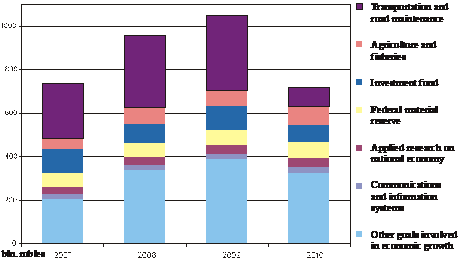
In federal support for various branches of the economy will focus largely on transportation infrastructure and roadway maintenance, agriculture and fishery. Funding for transportation infrastructure and roadway maintenance will grow by 30% in 2008 (compared with 2007). Federal funding for agriculture and fishery will grown by 55% in 2008 (compared with 2007).
The government will continue to fund the advanced technology sector, supporting innovative technology in industrial processes, which adds to the diversification of the economic structure. To this end federal spending on communications and information systems will grow by 14.6% in 2009 (compared with 2008); spending on applied economic research will also increase by 10% yearly in .
As a result, total spending under the program Stable economic growth in 2008 and 2009 will grow by 30% (compared with 2007) and 9.6% (compared with 2008); in 2009 it will account for 15% of the entire federal budget, not counting servicing fees for the federal and municipal loans
4.1 Macroeconomic Stability
Amendments made to the Fiscal Code of the Russian Federation in 2007 became a serious step on the way toward a stable and predictable financial system. The federal budget is the first of its kind to be drafted as a “sliding three-year” budget. New legislature has placed the Russian Federation in line with the greater part of the developed countries, where medium-range budget planning forms the basis of macroeconomic stability.
Sufficiently high prices on oil are expected to remain throughout . On the one hand this creates stable and sufficiently favorable conditions for economic development. At the same time such conditions produce “inflation” pressure on the economy, the national currency is strengthened, which results in domestic products becoming less cost-effective.
Revenues from the oil and gas industry accounted for 38% of the consolidated budget revenues in 2005, and 50% of the federal budget (excluding amortization of tax debt).
 The peculiar nature of oil revenues requires a special management system to guarantee long-range macroeconomic stability. The key objectives of such a management system are: maintaining a stable rate of government spending and private consumption in the long range, and averting fluctuations of macroeconomic indicators, such as inflation, currency exchange rate, amount of federal debt and interest rates on financial markets.
The stability of the budget, in terms of revenues and expenditures, is determined by the stability of these parameters in percentage relation to the GDP.
The procedures for reflecting oil revenues in the budget have been changed, effective in 2008, to address the challenge of maintaining long-range budget stability.
The new system introduces the notion of oil and gas deficit, which reflects the difference between federal revenues without oil and gas revenues and the amount with oil and gas revenues factored in. The oil and gas deficit is financed through oil and gas transfers plus other sources of federal budget deficit financing.
The cutoff amount of the oil and gas transfer for 2008 is set at 6.1% GDP, for 2009 at 5.5% GDP, and for 2010 at 4.5% GDP. Subsequently the oil and gas transfer cannot exceed 3.7% GDP.
These measures will help create a reserve for stabilizing short-term fluctuation in the economic environment; based on best international practices they will ensure that surplus revenues from non-renewable natural resources remain in the National Welfare Fund.
Responsible and rigid policy of tempering spending increase by means of economic growth (in 2008 the non-interest expenditures will grow by 13.3% in relation to the previous year; 6.9% for 2009, and 2.3% for 2010) will allow the government to lower the inflation rate to an economically and socially acceptable level of 3-4%. The inflation rate for 2008 is expected to be 6-7%, with 5.5-6.5% for 2009 and 5%-6% in 2010.
At the same time the greatest challenge facing the Russian Federation is maintaining budget stability over the next 20-40 years, when the budget, and specifically the pension system, will come to feel the stress of a strained demographic situation. To address this challenge it is, first of all, necessary to develop a mechanism for predicting budget status over long periods of time. This challenge was issued by the President of the Russian Federation in the Budget Address to the Federal Assembly for the year 2080 and through 2010.

4.2 A Better Quality, Competitive Tax System
The federal government maintains a taxation policy oriented toward lowering the tax burden, stimulating the economy, and providing incentives for innovative industries.
The following objectives of the taxation policy will be formulated in the medium-range perspective:
· keeping the nominal tax burden from rising in the medium range perspective, on the condition that the budget remains balanced. At the same time considering the option of further lowering the tax burden on the economy, which will be possible in the event of a stable budget system.
· moving toward a universal tax rate, improving the efficacy and neutrality of the taxation system by means of modern method of tax administration, reviewing tax subsidies and waivers, integrating the Russian tax system into international tax relations.
The main objectives of the tax policy are: monitoring transfer pricing, instituting consolidated tax accounting for corporate income tax, introducing a register of VAT taxpayers, adjusting excise rates, introducing a property tax, improving the system of exemptions for personal income tax, improving the extraction tax system, improving the taxation policy for not-for-profit organization corporations.
Directives from the Budget Address | Realized in the Fiscal Code of the Russian Federation |
It would be useful to evaluate the options for further tax breaks, as well as the possibility for eliminating excessively burdensome procedures for registering (refunding) VAT payments. | Over the course of we anticipate changes to the Fiscal Code dealing with the administration of VAT, specifically with lowering taxpayer expenses involved in paying this tax. |
Restructuring of the tax system as it applies to the salary fund must be carried out in conjunction with the reform of welfare and pension systems. | A number of measures in this regard are set out in the Basic objectives of the taxation policy for , and approved by the Government of the Russian Federation. |
End of Table
Directives from the Budget Address | Realized in the Fiscal Code of the Russian Federation |
Applying a flat rate to personal income tax has proven effective. It would behoove us to retain the present order of taxing individual income in the long range and retain the flat rate. At the same time we should continue to raise exemption amounts for personal income tax, perhaps in conjunction with measures aimed at improving the demographic situation in the country. | As of 2007, the existing social tax exemptions for personal income – education and hospital treatment – have been raised from 38,000 to 50,000 rubles. |
We must draft and implement a chapter of the Tax Code imposing taxes on property as a percentage of the market value of said property, at the same time taking care that the tax burden on low-income citizens remain at current levels. | Procedures for introducing this tax amount to assessing property and determining its cadastral value. |
In it imperative to pass a law in 2007 exempting dividends earned by Russian corporations from investments into subsidiary companies. | A bill has been submitted to the State Duma proposing changes to existing tax legislature. |
Within the year we must settle the unresolved issues in the Tax Code concerning the taxation of non-profit organizations with the aim of drawing them into more robust social activity. We must also pass a federal law creating tax incentives for scientific research and innovation. | A bill is presently being considered concerning improved taxation of non-profit organizations and regulation of philanthropic activities and social control mechanisms. A series of initiatives for creating incentives aimed at stimulating innovation is presently being considered; these include a number of amendments to existing tax legislature to take effect in 2007. |
To facilitate fair distribution of funds among the subjects of the Russian Federation we must institute a consolidated tax return throughout the Russian Federation. | The proposed consolidated tax return was approved by the Government on March 2, 2007. The changes go into effect on January 1, 2009. |
It is imperative to make amendments to the Tax Code aimed at regulating taxes imposed on transfer prices to lower taxes. These regulations must be as simple and comprehensible to the taxpayer and the tax authorities as possible. | A number of measures regulating transfer pricing have been approved by the government on March 2, 2007. Changes go into effect throughout |
We must continue to reform the system of excises aimed at encouraging consumption of better quality products. Specifically, we must differentiate excise rates on gasoline with respect to its quality, applying a lower rate to higher quality gasoline, and a higher rate to lower quality gasoline. | As part of currently developing technical regulations, we propose applying surcharges to excises on petroleum-based fuels not conforming to the standards Euro-2, Euro-3, Euro-4 and Euro-5. In addition we propose differentiating rates by applying lower excise rates on motor fuels conforming to certain higher standards. |
4.3 Government Investments
Budget appropriations for government investments into major construction projects of state property (through capital investments into the operations budgets of federal agencies, federal unitary enterprises and joint stock companies) will total 547.2 *****bles in 2008, 577.0 *****bles in 2009, and 453.7 *****bles in 2010.
Construction projects of state-owned or corporation-owned property will be funded across all categories and subcategories of government spending by industry affiliation.
Co-financing of major construction of property owned by one of the subjects or municipalities of the Russian Federation, and funded by investments issuing from the federal budget or from regional or local budgets, will take the form of subsidies to these subjects’ budgets in the amount of 118.3 *****bles in 2008, 105.2 *****bles in 2009 and 68.0 *****bles in 2010 (completing the federal targeted program Modernization of the Russian transportation system, ).
Russian Federation Investment Fund
The total volume of the Investment Fund will reach 273.4 *****bles in : 104.2 *****bles in 2008, 93.3 bln. in 2009, and 75.9 bln. in 2010.
The federal government will fund 10 separate projects from the Investment Fund over the period for a total sum of 183.8 *****bles: 55.3 *****bles in 2008, 37.0 *****bles in 2009 and 26.9 *****bles in 2010.
In the federal government will continue to fund projects begun in 2007, among them are such projects as the Moscow-St. Petersburg highway, a new exit ramp from the M-1 Belarus Hwy (Moscow-Minsk) onto the Moscow Loop, transport infrastructure in the Chita Oblast, development of industrial districts in Nizhneye Priangarye, Nizhnekamsk, etc.
4.4. Funding for the Industrial Sector
The federal budget sets aside funds in support of developing innovative and export-oriented industries and restructuring of unprofitable industries distributed through federal targeted programs. (table 4.3)
Table 4.3
Federal Budget Expenditures on Support for Industry and Energy Sectors
2007 | 2008 | 2009 | 2010 | ||
*****bles | bln. rubles | growth from 2007, % | bln. rubles | bln. rubles | |
FTP Development of the Energy Sector of the Russian Federation in and Up to the Year 2015 | 18.0 | 51.1 | 184.0 | 87.4 | 96.8 |
FTP National Technological Base in | 5.1 | 6.0 | 17.5 | 7.0 | 8.0 |
FTP Development of Civilian Aircraft Technology in Russia in and Up to the Year 2015” | 11.4 | 12.5 | 9.9 | 15.9 | 17.9 |
The Russian Federation’s contribution to the charter capital of aircraft and leasing companies | 6 | 6.0 | 0 | 6.0 | 6.0 |
The Russian Federation’s contribution to the charter capital of power industry organizations | 30 | 30 | 0 | 60 | - |
Subsidizing of credit interest rates for the exporters of manufactured products | 0.9 | 3.0 | 233 | 3.0 | 3.0 |
Coal industry restructuring | 4.9 | 5.4 | 9.0 | 6.5 | 7.0 |
Inter-budgetary transfers to the Russian Federation subjects’ budgets for the implementation of local development programs and re-employment in coalmining towns and settlements | 2.2 | 7.8 | 257.5 | 7.8 | 6.1 |
Coal Industry Overhaul
In 2008 the federal government will set aside 13.2 *****bles toward completing the program for the reorganization of the coal industry and toward programs aimed at local development and creation of new job in mining towns and villages: this is nearly twice as much as that of the previous year; 14.3 *****bles will be spent in 2009 and 13.1 bln. in 2010.
The funds will be used primarily for addressing social, environmental and technical issues, such as
relocation of relieved workers out of the Far Northern regions, unpromising mining towns and villages, and housing that has been compromised due to mining work in the region; locating and creating new jobs for relieved workers, land reclamation and other programs.
Shipbuilding and Aircraft Construction
The federal government supports the aircraft industry through the target program titled Development of civil aviation technology in Russian, , and through 2015. This program is endowed with 11.4 *****bles in 2007, 12.5 *****bles in 2008, 15.9 *****bles in 2009 and 17.9 *****bles in 2010.
Moreover, additional government appropriations are planned, funding specifically projects for the construction and leasing of Russian-made civil aircraft and new technology acquisitions for aircraft building companies. These appropriations will total 8.7 *****bles in 2008, 12.6 bln. in 2009, 16.1 bln. in 2010. In 2008 the federal government will subsidize the purchase of 27 Russian-made aircraft, 32 such aircraft by 2010, as compared with 16 aircraft in 2006.
The federal government also provides funding for military transport aircraft and research work and experimental design work related to military support aviation.

|
Из за большого объема этот материал размещен на нескольких страницах:
1 2 3 4 5 6 7 8 9 10 11 12 13 14 15 16 17 18 19 20 21 22 23 24 25 26 27 28 29 30 31 32 33 |
