

Партнерка на США и Канаду по недвижимости, выплаты в крипто
- 30% recurring commission
- Выплаты в USDT
- Вывод каждую неделю
- Комиссия до 5 лет за каждого referral
· Cost estimation is done once the design is endorsed by the CO by consensus. Often cost estimation is best done through competitive arrangement by making a pre-implementation tendering (Box - XVII)
· Resource availability from within the community in terms of cash and kind is identified and support required from outside agencies is ascertained
· Operation, maintenance and sustainability mechanism is devised (details given in section 8.2 )
Box - XVII: Making Cost Estimation Through Private Company Should a necessity arise to use a private company to make cost estimation, the CO should form a ‘Tender Committee’ (FG could serve as a tender committee if the CO decides so) which will call a tender through proper advertisement. The tender committee shall select the best company through transparent competition. The winner company will submit a detail cost estimate of the micro-project along technical specifications and drawings. The CO will negotiate with the winner company for specific component of the micro-project (e. g. quality, quantity, price, risk factors etc). If necessary, RIU will assist the CO in making negotiation. The final cost estimate should be discussed in the general meeting of the CO. The general meeting will approve the cost estimate for further action. Obviously, the winner company will automatically get the job to implement the micro-project upon funding is available from CBA. This arrangement saves time and resource for dealing two separate entities – one to make market-based cost estimate and the other to implement the micro-project. Details on ‘tender[13]’ is given in Annex - 28: |
5.1.3: Preparing project proposal
Functional group of the CO should prepare draft proposal using the proposal format prescribed by CBA Project (Annex - 29) and the negotiated (final) cost estimate described in the technical documentation. The proposal must clearly define the cost sharing arrangement based on existing practice (Box - XVIII).
CBA offers resources (grants) to COs for the implementation of micro-projects subject to the following considerations:
· For innovative project for energy saving - up to 70% of the cost is contributed by CBA II (i. e. it could be less depending on management decision), up to 30% by local budget and 5% by a beneficiary CO. Therefore, RIU team should first ensure the on-going cost sharing rate and then advise COs to use the same in the cost estimate.
· For communal infrastructural projects related to health protection, water supply, general energy saving, environment (waste management, sewage and sanitation) improvement, – 50% of the costs is contributed by CBA, 45% by local budget and 5% by the CO;
· For CO, which benefited from the CBA project in the past the CBA II contribution is less than 50%;
· Grant limit for communal infrastructure micro-projects is up to US $ 16,000 and for energy efficiency innovative projects will be up to US $ 20,000 (i. e. it could be less depending on management decision). Therefore, RIU team should first ensure the on-going cost sharing rate and then advise COs to use the same in the cost estimate.
Box – XVIII: Cost Sharing Arrangement A minimum of 5% of the micro-project cost must be shared in cash (plus non-cash contribution, if any) by the CO. It may not have total amount at hand while applying to CBA for funding. But there must be adequate evidence to show that by the time 80% of the work gets accomplished, it will have generated (and used) the resource of its share. This should be seen in terms of bank transfer to contracted company or through valid bills of procurement for the cause of the project. Since, CO is responsible for sustainability of the micro-project upon its completion; it must ‘own’ the project. Experience shows that community ownership comes best through cost sharing. Therefore, any proposal to substitute community’s share by any other source must be avoided. Distribution of the cost sharing will be as given in following example: i. Total project cost = A ii. CO’s share = A * 5% (or more than 5% if available) /100 = B iii. Share from local budget (VC/CC+rayon+oblast), A*45% = C iv. Share from others (public/private) as per their commitment A*? = D v. Balance = A – B – C - D (to be supported by CBA i. e. 50% or less) It is to be noted that 50% share of the CBA is limited to US $ 10,000 equivalent UAH. In field reality, a community project may not cost exactly US $ 20,000 always. The cost may be either higher or lower than US $ 10,000. In such case, cost sharing arrangement will be as follows: For micro-project costing less than US $ 10,000 equivalent: CBA will share 50% of the cost. Other partners will share as mentioned above; For micro-project costing more than US $ 10,000 equivalent: CBA will share US $ 10,000 and the remaining cost will be shared by other partners as mentioned above |
The developed proposals of community projects are agreed at CO level and with relevant local authorities. The VC/CC will give his/her consent for support by endorsing the proposal (Annex – 30). The CO submits its request to LDF through a letter (Annex – 31).
Box - XIX: Can a CO Not Share 5% of the Project Cost? It is often argued that community cannot share 5% of the micro-project cost because the members are poor or often they do not have cash at hand. This argument does not match the ground reality. Experience in CIDP, CRDP, MGSDP and CBA-I show that CO-members together share much higher than10% (as much as 13 – 40%) of the project cost. It depends on the intensity of need for the micro-project and time given to collect the required amount. Following case substantiate this argument: A micro-project costing UAH 100,000 requires UAH 5,000 (i. e. 5%) to be paid by the CO, which has 50 members. Each member must pay UAH 100. The CO decides to create a community development fund by ‘50 kopek a day’ slogan. It takes 7 months for the CO to generate enough money to meet its share without any hassle. This time could be reduced to 3.5 months by making ‘a hrivna a day’ slogan. As mentioned in Box – XVIII (above), share of the CO may not come in one go or right at the start of the micro-project. Therefore responsibility should be given to the CO without much worry. It is found that CO-members make rational and innovative decisions on fulfilling their obligation, if given opportunity. |
5.1.4: Mobilising resources
The proposal developed thus is sent to suitable public agency(ies) for funding. Local authorities like village/city councils and rayon and oblast state administrations are among the most suitable ones as they not only can provide some financial support but they are also capable of facilitating linkage with other agencies for support. Therefore, the CO must route the request to CBA through its respective local authorities. For this purpose, the proposal is discussed and agreed with local authorities and further discussed and approved at LDF and sent to CBA for funding (Chart - IV). Upon agreement, each authority issue a letter in support of its commitment to co-finance the micro-project (Annex – 32). This system can prove effective even after CBA ceases to exist.
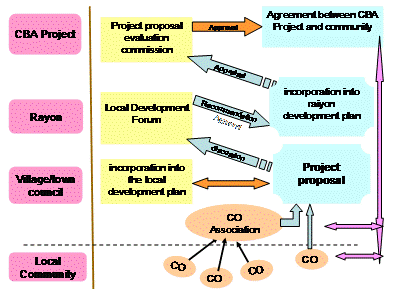
Chart – IV: Resource Mobilisation Process
5.2: Micro-project Approval
Approval of the micro-project involves appraisal of the submitted proposal, approval of the proposal and signing of agreement as follows:
5.2.1: Micro-project Proposal (MPP) submission
The CO should submit the final version of micro-project proposal with a cover letter (Annex - 33) to the RIU for processing. Original or copy of the following documents must be also attached with the proposal:
- Application letter; Statute of the CO; Registration certificate; Protocol on selection of the executive body (i. e. CO-MT) Bank account certificate; Protocol on account operators; Evidence of bank balance; Protocol on authorisation to the chairperson/other to sign MPP and grant agreement with UNDP
· Protocol on formation of functional group and responsibility given to it
- Final or draft technical design (drawings) Detail cost estimate; Technical specification; Protocol on consent of CO-members on the MPP and technical design/estimate Letter from other donors (VC/CC, RSA/OSA and others) conforming their support Report on the CO-maturity (Annex - 23) Tax clearance certificate (if applicable) Audit report (if applicable)
5.2.2: Micro-project Proposal Appraisal
Upon receiving the request, the RIU will review the documents and verify the information there in. If necessary, it may collect additional information and details. Then, RIU will evaluate (evaluation sheet given in Annex - 34) all the documents in the proposal and forward to the PMU office of CBA along with its recommendation, if documents are found satisfactory.
The community development unit of CBA will appraise the proposal from institutional as well as technical perspective. Site visit(s) will be made by the responsible staff(s), if necessary, to verify the information of the ch visits will involve detail discussion with the general members regarding CO-maturity and awareness of the CO-members about the micro-project; commitment to share in the project cost and its maintenance after completion. An appraisal report will be prepared by the appraising officials (community development specialist and the engineer) for submission to the CBA-manager.

|
Из за большого объема этот материал размещен на нескольких страницах:
1 2 3 4 5 6 7 8 9 10 11 12 13 14 15 16 17 18 19 20 21 22 23 24 25 26 27 28 29 30 31 32 33 34 35 36 37 38 39 |
