

Партнерка на США и Канаду по недвижимости, выплаты в крипто
- 30% recurring commission
- Выплаты в USDT
- Вывод каждую неделю
- Комиссия до 5 лет за каждого referral
· Executive summary – reflecting key findings of the main text of the report;
· Main text – contains details sections (with facts, figures, maps, photos, cases etc.) on
Introduction (programme genesis, situation analysis, programme area; development results/targets as envisaged in the annual workplan and results/targets set for the reporting period);
- Result Achieved – include such sub-sections as (a) partnership establishment, (b) institutional development; (c) human resource development/capacity building, (d) micro-project implementation, (e) Energy saving component, (f) small business promotion, (g) knowledge management (academia, knowledge hub, policy related activities) (h) communication, public awareness & advocacy, (i) model replication (g) advisory and management.
- Lessons and opportunities – taking stock of experience during the reporting period; outlook for future (next quarter, next year etc.)
- Annexure - as required
The reporting should be ‘coordinated’. The report should duly reflect the support (cash/kind, direct/indirect) received from other partners (government, non-government). Appreciation to partners and due credit to their support in the results gives a strong foundation for synergy.
Nature of content in the reporting system varies over time. At the outset, description of the main text is focused on process (introduction, institutional development etc.). During second year focus shifts to ‘inputs’ (human resource development, community micro-projects, public awareness etc.) and ‘outputs’. From third year the focus shifts to output and impacts/results and policy recommendation. Type of cases and photographs etc. also shift accordingly.
10.6.3 Establishing communication system, information campaign and media strategy
Proper communication and information system will be established to ensure adequate donors’ visibility and maximisation of CBA impact in terms of awareness among stakeholders. Following activities will be undertaken by the Project team in this context:
a) Public information campaign will include:
- Developing, producing and disseminating brochures on CBA-II
- Regular e-news letter informing about the progress of activities
- Producing visibility tools (flags, presentation banner, stationery, etc)
- Creating and maintaining CBA-II web site containing project data base (regional as well as national), electronic library (documents, reports, films etc. on CBA-II)
- Involving local/national media for CBA coverage
- Applying the EU’s Visibility Guidelines
b) Visibility of micro-projects - RIU team will be responsible for giving adequate donors’ visibility to the micro-project that are implemented by COs under CBA support. Detail information on the base material, message, logos etc. for this purpose will be supplied by CBA/communication unit[23].
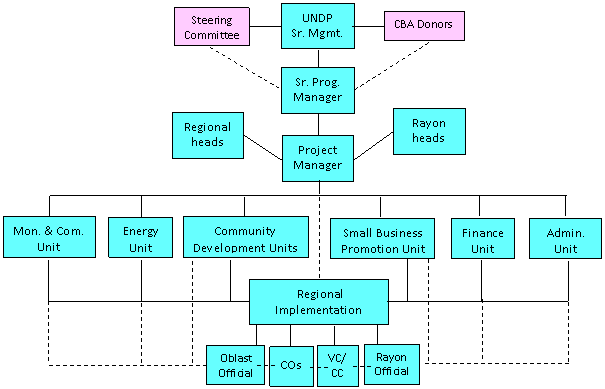
d) Intra-Project communication line - The Project personnel at each level needs to communicate in vertical as well as horizontal line. Vertically, each position is accountable to the immediate supervisor and should communicate accordingly (see Chart - VIII). In terms of day to day operation, each staff will communicate with his/her immediate stakeholders, secondary supervisor(s)[24], if any, and the professional mates. Record of important communications must be maintained by the ‘communicators’ at all level irrespective of the medium of communication followed. In case of emergency situation, innovative idea sharing and crucial Project matters, flexibility will be observed in the line of communication. At national level, communication with the government and donors will be maintained by the senior management of CBA and UNDP.
10.7 Organise Reviews and Evaluations
Review and evaluation are inseparable part of a Project. Review is often internal and it may involve major stakeholders whereas evaluation is often external and independent.
 |
 |
 |
Chart – VIII: Communication Line in CBA
10.7.1 Organise periodical review
Periodical review will be organised on weekly, monthly quarterly, half yearly basis and annual basis. Purpose and depth of review differs from period to period as described below:
· Weekly review: This review is limited between the staff and the immediate supervisor. Review is made about the progress made against weekly plan and projection of activities for the subsequent week.
· Monthly review: RIUs prepare monthly progress report in the format provided by PMU. They make self-review of their achievements for the month and send the report to PMU. PMU prepares a consolidated monthly report using the report of all RIUs and that of PMU and submits the consolidated report to UNDP management for review.
· Quarterly review: RIUs prepare quarterly progress report in the format provided by PMU. They make self-review of their achievements for the quarter and send the report to PMU. PMU prepares a consolidated quarterly report using the report of all RIUs and that of PMU. The quarterly report is reviewed at the level of CBA/PMU, UNDP and EU Delegation Office. The report is also sent to the members of steering committee and regional/rayon partners for their review.
· Tripartite/ad hoc review: Tripartite review (involving donor, authorities and target beneficiaries) is held at rayon level from time to time. It is generally a part of LDF meeting. Similarly, regional level review is made around middle of the year in participation of regional authorities, LDFs, PMU management and UNDP management. This review has proved effective during CBA-I, in setting the course of action for the regional partners. Tripartite review is also held at national level (generally once a year) whereby members of steering committee (government, donor and beneficiaries) review the CBA progress and offer advices as necessary.
· Annual review: Annual review of CBA implementation is made in participation of CBA, regional focal persons and UNDP management. During this meeting critical review of each region is made in terms of physical progress, financial progress, opportunities and challenges and trouble shooting and course of action is set for the subsequent year. In case of budgetary/logistic constraint, this meeting will be held at cluster level during CBA-II.
Annual review is also made upon preparation of annual report of the year. It is at the level of CBA/PMU, UNDP and the donor. Purpose is to enable the Project continue smoothly and effectively towards its objective. The progress report is sent to members of steering committee, regional authorities and rayon authorities for their review.
10.7.2 EU Monitoring mission
In general, EU commissions independent monitoring mission each 3-4 times during the project period designed to review inception, implementation and completion stages of the project. Depending upon the stage, the mission reviews project related documents, interacts with project partners and target beneficiaries to verify the project reports and understand the quality and quantity of progress. Mission may apply any form of review methodology that they deem effective or perceive as the need of the time. For example, they may select the CO or authorities they would like to visit in person or make distant interview (on phone) and project may not even know about it. The exact date of the monitoring mission is decided by the EU Delegation Office.
10.7.3 Organise mid-term evaluation (MTE)
Mid-term evaluation of a project is important in that it assesses whether the project implementation is going on according to plan and procedure. It involves external experts/independent evaluators who have capacity to capture opportunities and challenges facing the project and offer best possible options for keeping the project on track. Often, the evaluators have limited time. They derive conclusions based on limited field visits, limited interaction with stakeholders and heavy reading of Project related documents (e. g. project document, quarterly/annual reports, review reports and special studies, if any). To facilitate MTE further, it is advisable that the Project conducts small studies on its own from time to time on various aspect of the project. MTE of CBA-II is envisaged to take place during 19-28th month of the Project.
10.7.4 Organise final evaluation
Normally, UNDP country office commissions final evaluation of a Project towards end or just after the end of the Project period. The final evaluation will be external and independent. It will assess the results/impacts of the Project activities on the living condition of the target population. The final evaluation might include a team of multi-sectoral experts to deal with multi-dimensional nature of the project. The final evaluation team may carry out rather extensive field visits, stakeholder interactions and in-depth study of the documents (annual progress reports, MTE-report, study reports, project document – original and revised) before making inferences. The PMU and RIU teams must prepare in advance for the final evaluation by gathering maximum information and making case studies, experience documentation, video documentation so that the evaluators could get maximum information in short time. Final evaluation of CBA-II is planned during 44-46th month.
10.7.5 Ad hoc evaluation
Besides various forms of reviews and evaluations that are prescribed within the framework of CBA-II, there exists opportunity for additional evaluation made by UNDP either because Ukraine gets selected as a sample country in global studies or experts in UNDP HQ or UNDP/Regional Bureau on Europe and CIS countries would like to assess projects like CBA in form of a case ch studies are not known a priori.

|
Из за большого объема этот материал размещен на нескольких страницах:
1 2 3 4 5 6 7 8 9 10 11 12 13 14 15 16 17 18 19 20 21 22 23 24 25 26 27 28 29 30 31 32 33 34 35 36 37 38 39 |
