

Партнерка на США и Канаду по недвижимости, выплаты в крипто
- 30% recurring commission
- Выплаты в USDT
- Вывод каждую неделю
- Комиссия до 5 лет за каждого referral
- supporting academia and other educational institutions in curriculum and capacity development for promoting community based approaches to local governance and development
1.3 Strategy
The strategic goal of CBA-II Project is to build capacity of the local communities and local authorities for participation into joint decision making process and using this capacity for multi-stakeholders cooperation and multi-sectoral interventions geared towards strengthening of local governance ultimately leading to sustainable human development. The process is bottom-up and involves stakeholders from grassroots, meso and macro level in the process as it moves upward.
To ensure local ownership of the process, the Project will be implemented through participating rayons, village/city councils, local communities and other stakeholders taking participatory governance and defined priority areas (energy, environment, water supply and public health) as the entry point.
Community - A set of people living in the same territory and facing the same development challenges. For example, people living in a multi-apartment building; people living along a street in a settlement or a city; people living in a micro-rayon of a city, people living in a village/settlement etc.). |
Following strategies will be followed to materialise the objectives of the Programme -
Geographical Coverage
The Project will operate in all oblasts of Ukraine and in Autonomous republic of Crimea[1]. A total of 200 rayons and 900 village/city councils selected through competition based on the criteria of socio-economic hardship especially in the area of energy, health, water and environment with adoption of best performers during CBA-I and extension to new ones. Through the selection process CBA will reach the most suffering rural areas/population. Distribution of rayons in a particular region will be based on regional performance (during CBA-I) and intensity of need for CBA. 900 target communities will be selected with adoption from existing ones as well as extension to new ones based on predefined ratio. The existing ones will be selected based on performance during CBA-I while the new communities will be selected based on the criteria of socio-economic hardship and commitment.
Partnership
Local level activities of CBA will be carried out under the framework of Partnership that will be based on willingness and commitment of the local partners (communities, village/city councils, rayon authorities, regional authorities) for cost sharing, joint decision-making and playing functional role in process implementation. Partnership will be established with universities and national training institutes for promoting human resource development based on willingness and commitment.
Institutional Development
Appropriate support structures will be developed for participatory decision-making and monitoring at local level, rayon level, oblast level and national level.
Social mobilisation[2] tool will be utilised to unleash the potentials of selected communities to help themselves and mobilise local authorities and other development partners in the locality to address common basic needs of the people on participatory basis. To this end –
· Selected communities will be organised into community organizations (COs) founded on norms of good governance (namely participation, transparency, accountability, equity) as well as COs developed during CBA-I will be grafted as necessary. Participation of women and other vulnerable groups in the development process will be ensured;
Community Organisation (CO) - In general, Ukrainian law allows inhabitants of a given territory to assemble and discuss on development agenda pertaining to their community (territory). They may decide and declare formation of their organization through a protocol. CBA Project recognizes this organization as a CO. The inhabitants may register this CO under a particular legal framework (such as BSP, cooperative, ACMB, NGO etc.) and may acquire a specific legal name/recognition as defined by the law of the country. But CBA recognizes them all as a CO in generic form while it identifies them by their legal form in specific context. The word ‘community organisation’ does not exist in legal literature of Ukraine and thus it should be viewed as an informal nomenclature. |
· A networking approach will be adopted to bring together communities, local/regional authorities, private sector and civil societies so that they can hold regular dialogue on envisioning about the development direction in their area, mainstreaming of community plans, mobilizing resources for implementation of local priorities and carrying out participatory monitoring. This will evolve into local development forum (LDF) at rayon level and coordination council (RCC) at regional level. Existing LDFs and RCCs will be adopted if munity resource centre will be established (or existing one adopted) for materializing the vision and decisions of LDFs and RCCs. Similarly, networking approach will be adopted to converge the interest of partner academic institutes to CBA;
· Networking of stakeholders at the national level will be ensured by continuation of existing steering committee to achieve overall monitoring and advisory support.
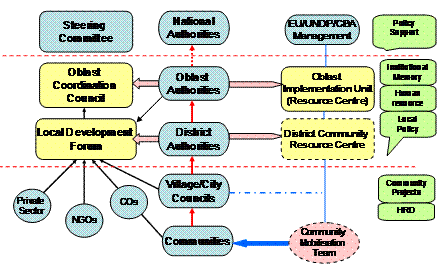
Chart – I: CBA model
Building Capacity
Capacity of the support structures (COs, RCs etc.) and partner agencies (local government, civil servants, academia etc.) and their representative duty-bearers (involved in CBA implementation) will be complemented by various capacity building activities such as training, exposure visits, logistic support etc. so as to enable them to carry out CBA-II implementation effectively. Also, capacity of a selected national partner will be built for knowledge management.
To ensure internalization of the concept propagated by the Project, the Project will provide small grant to COs to implement their priorities on a self-help basis and within the framework of public-private partnership, whereby each partner shares a portion of the development cost. Cost sharing proportion will be variable depending upon nature of micro-project and the level of priority area set for CBA-II. The ratio of cost sharing and maximum grant amount will remain the same for the kind of micro-project supported during CBA-I (i. e. CO:local budget:CBA = 5%:45%:50%) while for innovative energy saving experiments proportion of CBA could be as high as 70% with maximum grant amount up to $16000. 20,000.
Bottom up Cyclical Process
A cyclical process (with 4-stage cycle of interventions) will be established and consolidated to expedite the principles of CBA as depicted in Chart - II. Each stage will promote elements of good governance.
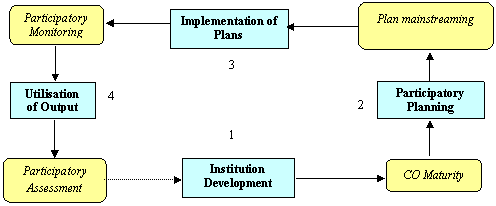 |
Chart – II: CBA Implementation Process
A bottom-up participatory planning process will be a pre-requisite for CBA support. Under facilitation of support organisations (RIU, VC/CC, RC/RSA, LDF, OCC etc.), COs will undertake bottom up participatory planning process. On regular basis, such planning will be done annually during which community development plan will be prepared, debated and approved for implementation jointly.
Appropriate management and information systems (MIS) will be established to make the stakeholders directly involved in the process of monitoring and assessment of the Project ch MIS will include process monitoring, input monitoring, output monitoring and impact monitoring. Flow of information will be bottom-up and participatory. Web-based monitoring system will be promoted to facilitate wider coverage of audience and reviewers.
The process will be followed in a timeline manner as reflected in the CBA-II workplan (Annex – 1)
Sustainability
Sustainability of CBA methodology, support structures (COs, LDFs, RCCs, CRCs etc.) and services established at local community level under support of the Project will be ensured so as not to lose the principles and value propagated by the Project.
The community will take responsibility to maintain, with support from the local authorities, the resulting output and reap benefit from it on a sustained basis. The sustainable mechanism established during CBA-I will be consolidated and made user friendly.
Regional/rayon authorities will be supported with technical support (advisory, training, small grant) in case they replicate CBA methodology on their own. Regional and national level networking of key stakeholders will be sought for making policy dialogues and policy recommendations for internalisation of the approach promoted by the Project in the national system. It will be done through regular and systematic exchange of experiences and lessons-learnt by means of conferences, seminar and workshops, roundtables etc.
For securing benefit in a longer term and for further scaling up of the Project approach, universities, training institutes and national association of local self-government bodies will be supported for curriculum development; small research in the area of community based approach to local development and knowledge management (collection, systematisation and dissemination of experience in CBA.
1.4 Expected Results and Targets
CBA-II aims to achieve following concrete results by end of the project period:
· 900 community organizations developed/grafted and supported with at least ….% new COs; 50% female in management team and 60% COs showing evidence of financial sustainability and proactivity in the local planning process;

|
Из за большого объема этот материал размещен на нескольких страницах:
1 2 3 4 5 6 7 8 9 10 11 12 13 14 15 16 17 18 19 20 21 22 23 24 25 26 27 28 29 30 31 32 33 34 35 36 37 38 39 |
