

Партнерка на США и Канаду по недвижимости, выплаты в крипто
- 30% recurring commission
- Выплаты в USDT
- Вывод каждую неделю
- Комиссия до 5 лет за каждого referral
Besides, making successful implementation of the micro-project, the CO has additional responsibility to acknowledge the contributors and make the participatory approach visible to other communities and stakeholders so that the approach might find wider application. In this context following activity should be carried out:
8.3.1 Establish visibility elements[21]
The CO must express the contribution/support of various donors in a visible way. Key contributors are European Union, UNDP, VC/CC or RSA/OSA, private sponsors and CO itself. In this context, the CO shall make a permanent public display of the project showing brief description of the project, its cost and cost sharing among various donors, including that of the CO as well. Logo of the donors should also be displayed, if available. Whenever possible, inauguration of the project should be organised in participation of the donor representatives.
8.3.2 Disseminate good practices and lessons learned
CO should document its experience, publish in local papers and disseminate it through other local media. It should also be willing to present its experience in the Local Development Forum and share its experience to visitors who will visit the CO to learn from its experience.
8.4 Ensuring CO-sustainability
With completion of the micro-project, life of CO does not come to an end. In fact it should not be so. CBA Project envisages that the CO will undertake subsequent round of activities on its own or with support of other donors (VC/CC, RSA/OSA, private sector, international agencies etc.). With experience, the CO becomes stronger to undertake 2nd (and subsequent) round of micro-projects by repeating steps mentioned in sections above. With completion of each round, living quality of the people increases in one aspect or the other. Thus, the cycle continues and living quality keeps on increasing. But for this, the CO itself has to remain sustainable. Following activities must be undertaken to this end:
8.4.1 Conduct participatory assessment[22]
CO should carry out participatory assessment within a month after completion of the micro-project. In this assessment exercise, CO-members assess activities of the CO in general and the completed micro-project in particular. This exercise guides the CO for better performance. Therefore, CO should conduct this exercise from time to time. Procedure of carrying out participatory assessment in details is given in a separate manual.
Box - XXII: Fourth Dialogue On due date and time, the RIU-staff meets general meeting of the CO. He/she reminds the members about the value of being together and achievements made by the community; describes about the need of measuring empowerment level of the community; introduces various indicators to be used for this purpose and process to be followed. The members are also motivated to observe civic sense in course of putting forward their arguments and responses (as a lot of hot debate is expected to occur during this session). RIU-staff conducts dialogue on each indicator one by one using appreciative approach and asks the general members to respond on each. Average response is recorded on the chart. At the end, level of community empowerment is declared along with contributing indicators. Strengths and weaknesses are identified and the corrective actions are explored. Upon a few such dialogues held by the RIU-staff, the general members become well aware of PAS. Then they select a community monitor for this purpose. A monitor must be impartial and trusted member who is known for his outspoken habit. The monitor is trained by RIU-team about the theoretical and practical aspects of PAS before undertaking the task. RIU-staff will let the monitor conduct the session in his/her presence for a few times before letting him/her carry out this task independently. Result of each successive dialogue will have to be compared with the previous results to see whether the community has reached higher level of empowerment or has remained constant or whether it has become weaker. The reasons for such changes could be seen in the individual indicators. |
Participatory Assessment System (PAS) involves assessing CO in terms of its governance and the services it delivers to the members. PAS may be conducted on half-yearly basis. The assessment is participatory, whereby each member opines on a set of indicators (related with soundness of the CO and its governance, quality of its activities and impact it produces) and gives value to each based on his/her own judgement. Average of the scores shows the empowerment status of the CO. Similarly, a comparison of the PAS of each COs in the VC/CC/rayon helps the RIU-team to identify the COs that require special attention for desired level of community empowerment. PAS involves 6 major indicators and 30 sub-indicators mentioned in Table - V (below).
Table - V: Indicators and Sub-indicators for Community Assessment
Main Indicators | Sub-indicators | |||||
1 | 2 | 3 | 4 | 5 | ||
1 | Organisation Development | Level of household participation | Regularity of meeting | Level of attendance CO - members in the meetings | Participation in discussion | Level of CO-members’ awareness about decisions made |
2 | Leadership Development | Leaders’ evaluation mechanism | Level of shared leadership | Leadership rotation | Remuneration for leaders | Leaders’ performance quality |
3 | Organisational Sustainability | Collection of membership fee and CO-sustenance fees | Clarity about utility of CO | Quality of account book | Trust in safety of amount collected | Following of rules and regulations |
4 | Micro-projects | No. of community initiatives undertaken | Confidence gained to undertake similar projects | Sustainability mechanism in place | Priority given to vulnerable groups | Level of CO-members benefiting |
5 | Change in living quality | Health post related services | Energy saving measures | Environment improvement measures | Water management | Employment opportunity |
6 | Participatory Planning and Linkage | Linkage of CO with local authorities | Linkage of CO with other development agencies | Linkage with similar COs on the territory | Participation of CO-members in CO-planning process | Level of participation of CO/CO-members in planning process of local councils |
8.4.2 Raise awareness on sustainability elements
RIU-team should utilize the information (and conclusion) of the participatory assessment and hold dialogue with the CO-members to make them aware about the need and method of sustaining the CO. The CO will remain sustainable if it follows criteria mentioned below:
· Clarity of vision : The CO-members must recognise that the CO is an indispensable body for them
· Transparency: High level of transparency in decision making and financial transactions is maintained
· Equity: All or most of the CO-members must get benefit out of its activities without excluding vulnerable groups especially, the low income households
· Accountability: CO-MT must be accountable to the CO (general assembly) while CO-members are accountable to the results of the decision made by them
· Financial health: of the CO (reflected in terms of its ability to meet the management cost) must be sound i. e. it must have regular source of income
· Linkage: of the CO with other development agencies must be there so that it can keep on getting support from them.
RIU-team assist the CO in taking corrective action(s) to improve its institutional capacity based on the conclusion of the assessment.
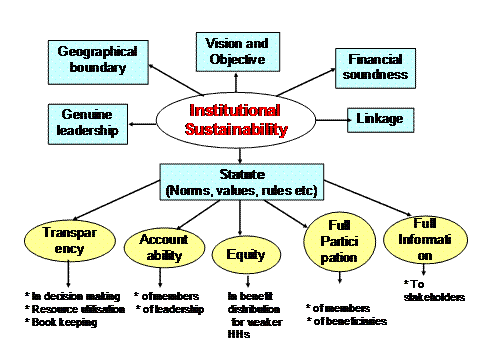
Chart - V: Elements of Sustainability of COs
8.4.3 Build linkage with development agencies
RIU-team should assist the CO-MT to build/strengthen linkage with various donors to whom proposal could be submitted and funding could be expected. If needed, it must provide necessary training. Continuation of local development forum is a strong opportunity for maintaining linkage between the CO and the local/regional authorities.
8.4.4 Organise additional activities through CO
RIU team should explore opportunities within the region or outside suitable for ch opportunities may come in form of small trainings, visits etc. At times, COs may be motivated to undertake small social/economic/environmental activities from time to time on their ch efforts will keep CO active and sustainable.
CHAPTER NINE
KNOWLEDGE MANAGEMENT
Main Activity | Sub-Activities | ||
1 | Establishment of Knowledge Management Hub | 1 | Establish KMH at CBA/PMU |
2 | Transfer KMH to UALRA | ||
2 | Documentation of Good Practices | 1 | Document experience on CBA related efforts |
2 | Maintain e-library | ||
3 | Knowledge sharing | 1 | Publish CBA experience and disseminate |
2 | Organise awareness events for media representatives | ||
4 | Building capacity of stakeholders | 1 | Internalisation of CBA methodology |
2 | Organise training | ||
Provide matching grant | |||
5 | Making policy recommendations | 1 | Commission policy studies |
2 | Initiate policy recommendation | ||
6 | Teaching Students, Training Civil Servants and Elected Authorities | 1 | Build partnership with academia and training institutes |
2 | Organise ToT for teachers and trainers | ||
3 | Provide technical support for curriculum development | ||
4 | Support for knowledge consolidation | ||
7 | Information Campaign and Public Awareness | 1 | Update visibility strategy |
2 | Produce visibility and awareness materials | ||
3 | Conduct public information campaign |
CBA-I and predecessor projects on the theme of participatory governance and local sustainable development, have generated wealth of information that ought to be stored, instilled and passed to current knowledge seekers and future generation. It is essential if sustainability and further scaling up of the CBA principles is aimed for. Following activities have been envisioned on this matter in the framework of CBA-II:

|
Из за большого объема этот материал размещен на нескольких страницах:
1 2 3 4 5 6 7 8 9 10 11 12 13 14 15 16 17 18 19 20 21 22 23 24 25 26 27 28 29 30 31 32 33 34 35 36 37 38 39 |
