

Партнерка на США и Канаду по недвижимости, выплаты в крипто
- 30% recurring commission
- Выплаты в USDT
- Вывод каждую неделю
- Комиссия до 5 лет за каждого referral
It is evident from past experience that the mobilised communities get charged with energy to do lot of things. However, delays in capitalising this energy cause a massive frustration and passiveness. Once this enthusiasm dies out then it becomes very difficult to rekindle. For effective community based development approach, therefore, the management must be highly decentralised – as close to the target population as possible and there should be flexibility in the ‘implementation policy and procedure’ to suit the local specific situation (which is often very dynamic). The regional level of CBA structure is involved in direct implementation while the central level is more involved in facilitation, coordination and policy related activities. But at their own level they are resource persons and coach their target clients to carry out tasks that are geared towards meeting CBA objectives.
Management structure ought to be supported by competent and dedicated human resources that work together in team for a common cause. All are aware of their specific role as well as capable to substitute peer’s role if necessary. As a result, the stream of Project activities continue without disruption thereby keeping the enthusiasm of Project partners and target communities intact. Following sub-activities are envisioned in context of defining management structure for CBA-II:
10.1.1 Carry out functional analysis
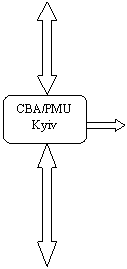
Management structure of CBA-II is in line with the one that existed in CBA-I with some additional features. Improvement in this structure may take place from time to time as necessary. Management structure and key functions of CBA-II are given in Chart – VI.
10.1.2 Set organogram
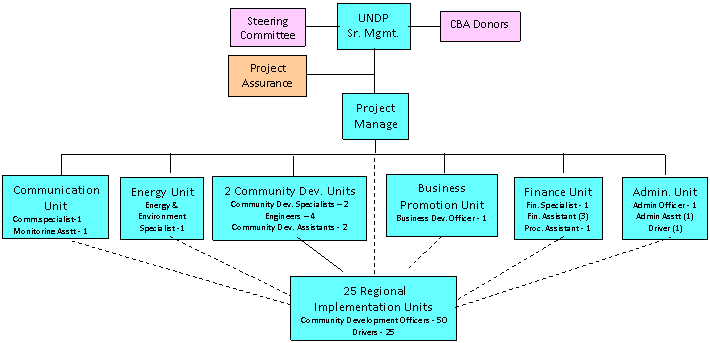
Organogram of CBA Project in its current form is given in Chart – VII. Key job description of each position mentioned in the organogram is given in Annex - 41.
 |
 |
 |
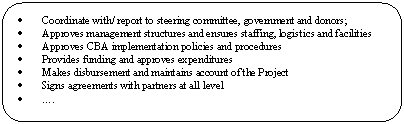

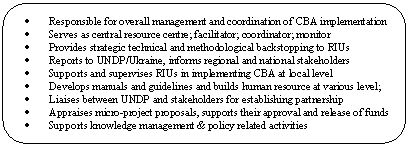
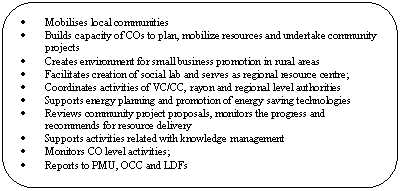
Chart – VI: Functional Analysis of CBA –II
 |
 |
 |
Chart – VII: Organogram of CBA-II
10.2 Personnel Management
Experience of CBA-I shows that success of project such as CBA heavily depends quality and dedication of the project personnel. Lessons of social mobilisation done over time and across the world clearly show that success of activities that depend on social mobilisation technique depends on the human resources involved in the process and implementation – foremost on the staffs with following four qualities:
· Competence: The staff should be well versed in his/her area of specialisation;
· Creative: The staff should be creative enough to convert his/her knowledge (that are often complex, technical, scientific!) into simple (spoken and do-able) form such that the target population (whose education and understanding level is often very low!) could understand and adopt;
· Commitment: The staff must be committed to bring a change in the life of the people and derive satisfaction after seeing happiness on their face;
· Character: The staff should bear exemplary moral character that is respected in the society. Even the first three qualities fail to produce intended results if exemplary character is lacking. General nature of the character is defined by UNDP in term of ‘corporate ethics’
CBA Project operates under direct execution of UNDP and therefore all rules regulation of UNDP is applied for its implementation. Personnel management is one aspect of the management. Under it, the project personnel are recruited to carry out tasks as described in the terms of reference of the individual staff. Salary and other benefits are linked with the ToR and level of competence while, in addition, the periodical extension of service contract depend on the level of performance during the period. Based on UNDP policy on human resource development, the project personnel is provided with necessary training to ensure proper understanding about the corporate policy and tasks to be performed before commencement of and during the job.
10.2.1 Form project team
Availability of sufficient human resources has been recognized as the key to success of the CBA I petent human resources from CBA I will be retained and vacant positions will be filled through standard UNDP recruitment procedures.
Existing project management unit (PMU) in Kyiv and 25 regional implementation units will be strengthened with necessary logistics and facilities for efficient implementation of the Project.
The total number of envisaged project personal is 95 and additional short term international and national experts will be hired for provision of specific technical support if needed. PMU will consist of 12 programme and 8 support staffs led by an international project manager. In due course, the CBA team will be led by a national manager in order to support the development of national ownership.
Each RIU will have two community development officers and a driver. Detailed ToRs of Project personnel are provided in Annex - 41.
10.2.2 Prepare operational manuals/guidelines
Existing operational manuals/guidelines developed during CBA I will be updated and new manuals/guidelines will be developed to meet the requirements of CBA II. Key documents will include – CBA-II operational manual, CO manual, technical manual, financial management manual, PAS manual, communication and visibility guidelines, small business promotion manual, energy saving manual
10.2.3 Organise HRD activities
Experience of CBA-I will be utilised during CBA-II in context of human resource development. All CBA personnel will be given opportunity for adequate and proper understanding of CBA principles, methodology and implementation procedures; mandatory knowledge requirement of UNDP on security, gender, ethics, harassment etc. and growth in professional area. To this end following tools will be used –
· Orientation will be organised before and after recruitment and spot coaching will be done during the job;
· Theoretical and practical training by experts and field exposure;
· Access to online courses offered under HRD policy of UNDP;
· Access to national information hubs/agencies relevant to CBA (e. g. legislation, finance, engineering etc.);
· Participation in workshops and conferences (national/international) directly related to CBA. This activity is more associated with the personal effort of the staffs to find opportunity;
· …………….
10.2.4 Review staff performance
Generally at the end of a year and exceptionally in between the year, staff performance will be assessed using the corporate assessment format. Those CBA-II staffs who come from CBA-I understand well about it. Pattern of performance assessment will be the same as during CBA-I. Broadly it includes –
· Level of adoption of the process prescribed for CBA-II;
· Progress made against target agreed (with supervisor) at the outset of the year/commencement of the task;
· Quality of MIS and reporting to immediate and secondary supervisor(s);
· Quality of documents (prepared/maintained) related with the job;
· Innovative activities carried out beyond ToR that gives additional boost to project implementation;
· Display of ethical behaviour
Beauty of the assessment format is that it allows staffs to agree or disagree with his/her supervisor. In case of conflict, necessary investigation is commissioned by UNDP.
10.2.5 Take performance based action
Task of CBA management will be to take action according to staff performance. It includes extension of contract, recommendation for bonus/promotion (in case of extra-ordinary performance) and recommendation for penalty (in case of unsatisfactory performance).
10.3 Create Support Structure
Like any project, CBA-II requires assistance from non-project experts/entities for advisory/moral/functional support. At times, entities are also required for outsourcing a part or all of the implementation activities of the project. These experts or entities come from public and/or private sector and serve as per the term of reference foreseen by the project and they act at the level defined. In this background, CBA-II will utilise support structures developed during CBA-I to the extent possible and will develop additional support structures as necessary. Details on this subject are given below.
10.3.1 Identify key stakeholders
CBA-II envisages several stakeholders at local, regional, national level with roles supportive to CBA-II implementation.
At Central Level, the main focal agency for the project will be the Secretariat of the Cabinet of Ministers of Ukraine. As the main counterpart of the project, it will:

|
Из за большого объема этот материал размещен на нескольких страницах:
1 2 3 4 5 6 7 8 9 10 11 12 13 14 15 16 17 18 19 20 21 22 23 24 25 26 27 28 29 30 31 32 33 34 35 36 37 38 39 |
