

Партнерка на США и Канаду по недвижимости, выплаты в крипто
- 30% recurring commission
- Выплаты в USDT
- Вывод каждую неделю
- Комиссия до 5 лет за каждого referral
Often the village/city councils announce, in advance, the schedule for planning event and steps involved in the planning process. A CO ought to update itself about this timing and participate in the process accordingly. A planning process often followed is given below:
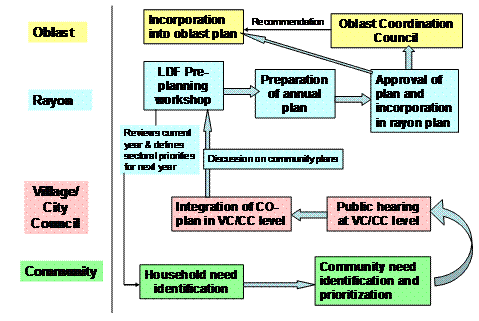
Chart –III: Bottom-up Planning Process
Following steps are recommended for the participatory planning process:
4.1.1 Form Local Development Forum (LDF)
a) In case of new rayons:
RIU-team will carry out process for establishment of Local Development Forum (LDF) in each partner rayon, as per the provision in the partnership agreement signed between the RSA/RC and UNDP/CBA project. This process is initiated once COs are formed in 2-3 councils. LDF is expected to facilitate dialogue, coordination, planning and decision-making at local level between the oblast and rayon authorities and communities for promoting integration and development. Specific objectives of setting up LDF are:
- To promote social, environmental and economic development at local level through participatory consensus-based planning and decision-making and a more effective allocation of financial resources
· To promote decentralized planning and participatory governance at regional level, and
· To promote dialogue between the regional authorities and local communities for promoting community based approach to local development
Structure of the LDF is as follows:
- Head of the Rayon State Administration - Chairperson Head of the Rayon Council - Member
§ Heads of the village/city councils covered by CBA - Member
- Chief of sectoral departments in RSA related with CBA priority areas - Member Representatives (focal persons) of oblast authorities - Member Chairpersons of COs formed by CBA - Member
Ad-hoc members (to be invited if and when required)
Representative of Commercial Banks (where COs have account)
Representative of local NGOs
Representatives of local chamber of commerce or businesses
Municipal utility company representatives
Other organizations, as necessary
Function of the LDF is the followings:
• Coordination of Project implementation at the rayon level;
• Presentation of plans and strategies of rayon development;
• Agreement on plans of community, VC/CC and rayon;
• Identifying rayon development priorities;
• Discussion and elimination of issues arising in the process of Project implementation;
• Development of plans of technical and financial resource attraction for implementation of community initiatives
The rayon-CRC will act as secretariat with support of RIU. CBA will provide technical assistance to the CRCs to functions as secretariat of LDFs. Rayon State Administration provides office space for CRC and for meeting of the Forum.
b) In case of CBA-I rayon:
Some of the VCs/CCs and COs that were partner of CBA-I will continue in CBA-II as well while some of them will not. Similarly, some of the sectoral departments might have got terminated or merged with other departments while some new departments might have been created in course of administrative reform introduced by the Government. In this light –
· Re-initiate the old LDF by adjusting the composition of members. VCs/CCs and COs that were a part during CBA-I should be encouraged to continue during CBA-II;
· Refine the statute of LDF in light of CBA-I experience and tasks envisioned during CBA-II (see Section 4.1.2);
· Get revised decree on LDF signed by RSA head, if necessary
· ……….
4.1.2 Hold regular meeting of LDF
Normally, the meeting of LDF will be held once in every two months or more frequently as required. Tasks of the LDF are to –
- Review community development plans, plans of respective village/city councils and synchronize these plans with regional and sectoral plans and strategies Determine financial and technical resources available at community, village/city council and oblast level to support community development initiatives; Mobilize technical and financial resources in support of community development initiatives from relevant national and international organizations; Coordinate with relevant stakeholders (village/city councils, oblast authorities, technical departments, private businesses and chamber of commerce, local banks, NGOs, national/international donor agencies etc.) for implementation, quality supervision and sustainability of service delivery from such micro-projects; Resolve bottlenecks in implementation of community development initiatives, including provision of necessary permits and approvals from relevant technical departments and other structures in the oblast for design and construction works and for future technical and financial management and maintenance of facilities; Discuss relevant issues and topics related to sustainable social, economic and environmental development of the rayon and agree on plans and actions to address these issues, if required; Share information on new laws and policies relevant to community based approach to social, economic and environmental development; Explore the possibility of replicating CBA methodology in non-CBA territory and propose course of action for it (in case of CBA-I rayon only)
After completion of community development plans by COs, the Forum will meet to enable the COs to present their plans and the others to provide comments, suggestions etc. Also, contributions from local authorities should be agreed upon. After approving the community plans in a number of target rayons, a similar meeting will be organised at the oblast level in the framework of oblast coordination council to determine potential contributions from the oblast budget. However, no approval of the community plans is required at oblast level. |
4.2.1: Organise orientation for CO-MT and local officials from village/city council
RIU organises an orientation on the following issues:
· Participatory planning and bottom up planning process
· The way by which COs' plans can be mainstreamed into rayon/regional/national planning process.
One of the LDF meetings can be devoted for this purpose, which means that representatives of all COs of each target rayon and respective authorities would meet to talk on this subject.
4.2.2: Carry out participatory planning in each target community
First, the RIU holds (second) dialogue in each CO to facilitate participatory planning such that the CO-members identify social/economic/environmental problems to be resolved to make their living condition better. Each household is asked to respond on two questions: immediate needs to improve living condition of the community and the way to meet these needs.
Box - XIII: Second Dialogue Second Dialogue with community is meant for unleashing their potential by expanding vision of the community members to address their needs in the limit of their potentials. This dialogue could be performed in a few phases. First, the RIU-team appreciates the achievements of the CO made so far and reminds the members about the value of being together and thank them for observing mutual respect and cooperation. RIU can still clarify matters related with functioning and management of the CO, if the members look for it. Thereafter, the RIU-team introduces the members with concept of planning – identify needs and not the wants (see Box - XIV); portfolio of opportunities to fulfil needs; resource/support/services required to undertake the portfolio; potential risks and risk mitigation options; process of aggregating household vision into community vision. Next, RIU-team engages the members to identify available resource limit – their own, available with CO and announces the support that could come from local government/state bodies and from the CBA Project. The team reminds them with norms of effective planning such as necessity to respect the need of weaker section; make sacrifices for others; mutual respect etc. to maximise the benefit. Issue of weaker section is important because it is very likely for ‘vulnerable’ population to get excluded (see Annex – 24). The RIU-team must motivate the CO-members to observe human rights based approach to ensure inclusion of the vulnerable groups. It may run a question answer session followed by the planning session. It is to be noted that CBA Project is not for addressing the problems of individual households (e. g. searching job for raising income, repairing the accessories in their house/apartment such as water supply, heating system, gas supply, window replacement, roof repair etc.) rather it is for addressing basic needs facing the whole community e. g. water supply, energy saving in social objects like school and healthpost, waste collection etc. Therefore, the CO-members should identify problems that they are facing but others in the community are also facing. |
Box - XIV: ‘Need’ and ‘Want’ To avoid impractical demands, it is necessary to familiarise the CO-members with ‘need’ and ‘want’ from the perspective of CBA. ’Need’ is met by the community and ‘want’ is to be met by outsider. Following examples will clarify the matter further - 1. In a small town, problem of unemployment was serious. The city council asked dwellers in a micro-rayon to discuss on the agenda. Various options were identified to create employment in the city. Two of them were: (a) initiating self-employment by facilitating petty shop creation, (b) attracting a huge investment from outside. Here, first option could be considered as ‘need’ whereas the second one could be considered as ‘want’ 2. Almost all the inhabitants of a village (located near a city) agreed that ‘vegetable farming’ was the most important enterprise to boost family income. For it they identified ‘irrigation’ as the most crucial factor, for which they proposed (a) micro-irrigation system using available water supply system, (b) a huge irrigation system that required construction of dam and irrigation channel. Here the first one is need and the 2nd one is want. 3. In a village where the many people were psychologically depressed, the villagers identified ‘small gymnasium’ and a big theatre as solutions to keep them active. Here, the first one is their ‘need’ while the 2nd one could be marked as their ‘want’ |
Following to the second dialogue, the CO-members are asked to participate in need identification process. There might be several ways of doing it. However, following two methods were found effective during CBA-I:

|
Из за большого объема этот материал размещен на нескольких страницах:
1 2 3 4 5 6 7 8 9 10 11 12 13 14 15 16 17 18 19 20 21 22 23 24 25 26 27 28 29 30 31 32 33 34 35 36 37 38 39 |
