


Партнерка на США и Канаду по недвижимости, выплаты в крипто
- 30% recurring commission
- Выплаты в USDT
- Вывод каждую неделю
- Комиссия до 5 лет за каждого referral
According to the framework, the presence or absence of consumer knowledge on pricing tactics usage will moderate the consumer response in the short term, while the source of consumer knowledge (externally or internally invoked) will affect the consumer response in the long term when consumers can get additional external information on the pricing tactics usage. Taking into account the specified moderating effects, the marginal effectiveness of product downsizing vs total price increase is expected to be higher in the short term than in the long term.
Figure 1. Conceptual Framework
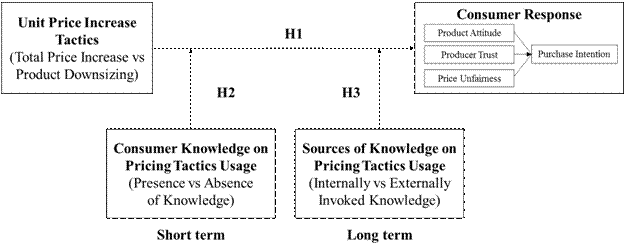
Based on the conceptual framework, the following hypotheses are formulated:
H1. The marginal benefit of product downsizing vs total price increase on consumer response is higher in the short term than in the long term.
H2. The presence or absence of consumer knowledge on pricing tactics usage moderates the consumer response in the short term.
H3. The source of consumer knowledge moderates the consumer response in the long term.
4. Research Design
4.1. Method
To test the specified hypotheses, the study uses an experimental method. Web-experiment including both within-subject and between-subject designs is employed to compare the behavioral and psychological responses of different consumers to overt vs covert price increases over time. The survey structure is represented in Table 1.
Table rvey structure
Time | Description of Interaction |
Time 1 | - All respondents are provided with a concise description of the market situation and the picture of the product with a price (see Appendix 1 (a)): «The Russian company Ostankino sells milk under the brand name "36 cents" on the Russian market. Picture and description of the product are given. Please indicate whether you agree with the following statements» |
Time 2 | - Respondents are randomly assigned to one of the two conditions (product downsizing vs equivalent overt price increase) in the proportion 60/40. Respondents are still provided with a concise description of the market situation (the same for all respondents) and the picture of the product with a price (different pictures depending on the assigned condition (see Appendix 1 (b) and (c) for product downsizing and overt price increase conditions): «The company decided to implement some changes to the product and adjust its price. Prices of other milk brands have not changed. Picture and description of the product, taking into account the changes are given. Please indicate whether you agree with the following statements” - All respondents are asked to evaluate the extent of price change by choosing one of the given options with different percentage changes. - The respondents exposed to product downsizing are asked whether they have noticed the size change. Depending on the answer they are divided in the two groups: Treatment 1 – those who detected the size change, and Treatment 2 - those who did not detected the sized change. |
Time 3 | - All respondents regardless of their previous answers are provided with the information on the extent of price increase. The respondents exposed to product downsizing are also informed that the price increase was partly accomplished through the reduction of the product quantity from 990 to 900 ml: «Price per 1 liter increased by 13.6%. This was achieved by reducing product packaging from 990 to 900 ml (only for product downsizing condition). Have you changed your attitude to the product and the manufacturer after receiving this information? To answer this question, please indicate whether you agree with the following statements». |
At the second interaction (Time 2) the design of the product was slightly changed. It was done to distract consumer attention from the price change. The same redesign was accomplished for both product downsizing and overt price increase conditions. This practice is often used by marketers in the real market settings. Moreover, the general dynamics of the survey resemble the real-world flow of actions: as the prices on the market goes up, consumers modify their market behavior as a response to a price change depending on their personal judgments and perceptions (Time2), and afterwards consumers are provided with the exact information on the market price change that can go from either the official statistical sources, the media or the fellows (Time 3).
At each interaction consumers are offered to evaluate whether they agree with particular statements which are intended to measure several conceptual constructs: purchase intention product attitude, producer trust, and price unfairness. The constructs are the same throughout the interaction timeline. Both unidimensional and multidimensional constructs are used. The reliability of multidimensional constructs are quite high at each time (see Table 2).
Table 2. Reliability of measurement scales
Measures | Items | Time 1 (α) | Time 2 (α) | Time 3 (α) |
Purchase intention | I am ready to pay the stated price for the product. I would purchase this product in the store. I could buy this product on the next visit to the store. | .86 | .89 | .88 |
Product attitude | I find this product interesting. I like this product. | .78 | .84 | .92 |
Producer trust | I trust the producer of this product. | - | - | - |
Price unfairness | I consider the stated price of the product acceptable. The price of the product is unreasonably high. I think this price is unfair to consumers. | .88 | .88 | .88 |
Note. – All items are measured using 7-point Likert scale with the points labeled as 1 = strongly disagree; 2 = moderately disagree; 3 = slightly disagree; 4 = neutral; 5 = slightly agree; 6 = moderately agree; and 7 = strongly agree. The reliability of multi-items scales is measured using Cronbach’s alpha.
Considering all the above consumer response variables, it is hypothesized the variables will behave differently in consumer groups exposed to different treatments (overt price increase vs product downsizing) over the consumer-product interaction trajectory. In addition, the different responses are expected among those consumers who detected the product downsizing vs those who did not detect that. Thus, three consumer groups are identified in the study: a) Control group (respondents who are randomly assigned to the total price increase condition); b) Treatment 1 (respondents who are randomly assigned to the product downsizing condition and detected the product downsizing); c) Treatment 2 (respondents who are randomly assigned to the product downsizing condition and did not detect the product downsizing).
4.2. Sample and Context
The experiment embraced 71 respondents of whom 48 respondents submitted a questionnaire via a social network in March 2015 and 23 respondents submitted the questionnaire in a printed format in April 2015. The purpose of the study is to investigate how the consumer response changes as a reaction to a unit price change. Consumers who initially gave maximum or minimum scores are deprived of a possibility to further change their opinion in a more positive or negative directions respectively, which can confound the results. To eliminate a possible confounding effect, only overlapping observations were taken for the analysis, while the observations with extremely low and high values at the pretest intervention were excluded. Following this logic, 8 observations were excluded from the analysis (4 observations from the Control group; 2 – from the Treatment 1 group, and 2 – from the Treatment 2 group). The analyses proceeds with 63 observations: 19 observations in the Control group, 22 observations in the Treatment 1 group, and 22 observations in the Treatment 2 group.
The questionnaire was provided in Russian and all responded were the residents of Russia. The context of Russia as an emerging market contributes to the research in several ways. Firstly, emerging markets are characterized with high consumer heterogeneity. The diversity with respect to access to products and services tends to be enormous between urban and rural households (Sheth, 2011). Many consumers have no brand or product knowledge. Often, they do not even know how markets operate. Thus, the topicality of the consumer knowledge proves to be very high and managerially relevant. Secondly, the economic turbulence and market changes that take place in Russia in the current time leads to the high price volatility, which put pressure on manufactures, on the one side, and endanger consumers, on the other side. Manufactures have to optimize their market strategies and often raise prices to compensate a high uncertainty. While consumers, in the face of lowering incomes, rationalize their behavior and put a special attention to price-related issues.
5. Results
5.1. ANOVA
To test hypotheses the repeated-measures ANOVA is used as a method appropriate to longitudinal experiments in the marketing literature, in general, and exact research questions under investigation, in particular.
Prior to running repeated-measures ANOVA, the data was checked for the existence of significant between-group differences at the baseline level (Time 1) using between-group ANOVA. The analysis revealed that there are no baseline differences among groups for all dependent variables: purchase intention (F(2,60) = 0.51, p = 0.60), product attitude (F(2,60) = 0.90, p = 0.41), producer trust (F(2,60) = 0.06, p = 0.94), and price unfairness (F(2,60) = 2.23, p = 0.12). As the analysis does not reveal any differences among groups at the pretest interaction (Time 1), any differences among groups at the following interactions can be attributed to the treatment and moderation effects.

|
Из за большого объема этот материал размещен на нескольких страницах:
1 2 3 4 5 6 7 8 9 10 11 12 13 14 15 16 17 18 19 |
