


Партнерка на США и Канаду по недвижимости, выплаты в крипто
- 30% recurring commission
- Выплаты в USDT
- Вывод каждую неделю
- Комиссия до 5 лет за каждого referral
Repeated-measures ANOVA was run on each of the consumer response indicators. Means and standard deviations across groups over time are provided in Table 3. Table 4 presents the test statistics of main effects.
Table 3. Descriptive Statistics on Consumer Response Measures (Means and Standard Deviations)
Dependent variables | Overt price increase (n = 19) | Product Downsizing, Presence of Awareness (n = 22) | Product Downsizing, Presence of Awareness (n = 22) | |||
Mean | SD | Mean | SD | Mean | SD | |
Purchase intention: Time 1 Time 2 Time 3 | 3.51 2.96 2.93 | (0.98) (1.30) (1.23) | 3.86 3.61 3.42 | (1.02) (0.99) (1.02) | 3.73 3.64 2.98 | (1.27) (1.13) (1.13) |
Product attitude: Time 1 Time 2 Time 3 | 4.37 3.82 3.71 | (0.86) (1.45) (1.36) | 4.11 3.64 3.50 | (1.02) (1.01) (0.88) | 3.93 3.84 3.48 | (1.13) (0.99) (1.10) |
Producer trust: Time 1 Time 2 Time 3 | 4.21 4.05 4.11 | (1.40) (1.28) (1.17) | 4.09 4.00 3.77 | (0.90) (0.95) (1.20) | 4.14 4.14 3.36 | (1.01) (1.01) (1.33) |
Price unfairness: Time 1 Time 2 Time 3 | 4.30 5.19 5.26 | (1.37) (1.25) (0.96) | 3.71 4.53 4.56 | (1.19) (1.05) (1.20) | 4.45 4.52 5.05 | (1.00) (1.15) (1.03) |
Table 4. Results of Repeated Measures ANOVA
Dependent variables | Between-group effect | Within-group effect | Interaction effect |
Purchase intention | F(2,60) = 1.14, p = 0.33 | F(2,120) = 17.44, p = 0.00 | F(4,120) = 2.02, p = 0.09 |
Product attitude | F(2,60) = 0.30, p = 0.74 | F(2,120) = 14.58, p = 0.00 | F(4,120) = 0.89, p = 0.47 |
Producer trust | F(2,60) = 0.30, p = 0.74 | F(2,120) = 5.57, p = 0.00 | F(4,120) = 2.08, p = 0.09 |
Price unfairness | F(2,60) = 2.02, p = 0.44 | F(2,120) = 28.65, p = 0.00 | F(4,120) = 3.00, p = 0.02 |
The results of repeated measures ANOVA indicate that there is a statistically significant within-group effect for all dependent variables i. e. there is a tendency of all consumer response variables to change in the same direction over time within all experimental groups. In particular, there is observed a deterioration of product attitude and producer trust, and acceleration of price unfairness perceptions over time, which results in the reduction of purchase intention.
Between-group effect proved to be significant only as a part of interaction effect, which signifies that despite there is a common tendency within all experimental groups to react similarly in response to experimental interventions, the severity of consumer responses to interventions is different among groups.
5.2. Analysis of Mean Differences
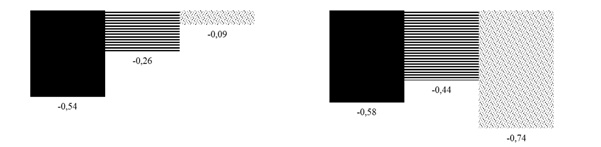
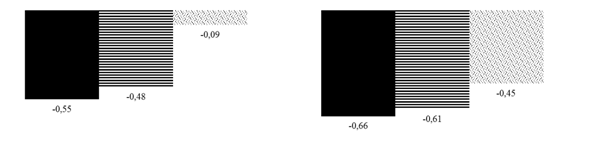
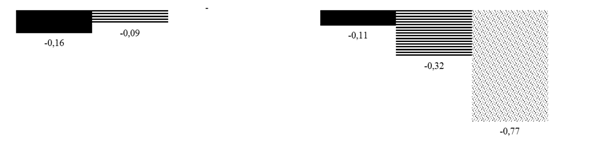
Since the treatment-by-time interaction is significant, there is a need to explain the interaction. For further insight into the hypotheses, the analysis of mean differences is undertaken. Mean differences of consumer response variables in the short term (Time 2 vs Time 1) and long term (Time 3 vs Time 1) in there experimental groups are depicted in the Figure 2. The statistical significance of mean differences among groups is presented in the Table 5.
Figure 2. Mean Differences of Consumer Response Variables across Time
Short-Term Effect (Time 2 vs Time 1) | Long-Term Effect (Time 3 vs Time 1) |
Purchase Intention
Product Attitude
Producer Trust
Price Unfairness
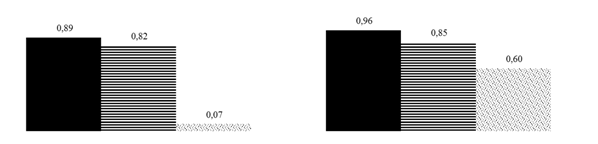

Table 5. Results of Post-Hoc Analysis of Mean Differences
Dependent variables | Overt price increase | Product Downsizing, Presence of Awareness | Product Downsizing, Absence of Awareness |
Purchase intention Time 2 vs Time 1 Time 3 vs Time 1 | -0.54 *** -0.58 *** | -0.26 -0.44 *** | -0.09 -0.74 *** |
Product attitude Time 2 vs Time 1 Time 3 vs Time 1 | -0.55 *** -0.66 *** | -0.48 *** -0.61 *** | -0.09 -0.45 ** |
Producer trust Time 2 vs Time 1 Time 3 vs Time 1 | -0.16 -0.11 | -0.09 -0.32 | 0.00 -0.77 *** |
Price unfairness Time 2 vs Time 1 Time 3 vs Time 1 | 0.89 *** 0.96 *** | 0.82 *** 0.85 *** | 0.07 0.60 *** |
Note. – The significance of mean differences is tested using t-statistics. The asterisks signify the following significance levels: * p < .10; ** p < .05; *** p < .01.
The analysis of mean differences indicates that in the short run a statistically significant reduction in purchase intention in response to price increase is observed only when consumers are exposed to total price increase, while product downsizing does not lead to a significant reduction in purchase intention for both treatment groups. The short-term stability of purchase intention for the Treatment 2 group is explained by the unchanged antecedents of purchase intention (product attitude, producer trust, and price unfairness). On the contrary, the rapid shrinkage of purchase intention for the Control group is driven by the movement of antecedents (product attitude and price unfairness) to a less favorable direction. Despite the same trajectory of intention antecedents is observed in the Treatment 1 group, the intention does not change in the short run analogously to the Control group. The possible explanation of such a contradiction is that even when consumers are able to detect the product downsizing, they tend to err in their judgments regarding the price change and underestimate the scope of price increase (see Figure 3).
Figure 3. Distributions of Consumer Evaluations of Perceived Unit Price Increase (by Groups)
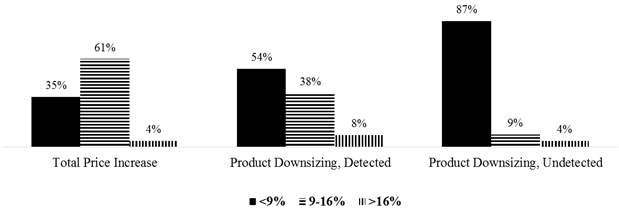
Note. –The multiple-choice question “How would you estimate the extent of unit price change?” was asked after consumers were presented with an increased price. The actual unit price increase accounted to 13.6%. No information on actual price increase was provided to consumers at that moment.
The differences in consumer response to product downsizing depending on the presence or absence of consumer knowledge in the short run support the hypothesis 2 (H2): consumers who detect product downsizing change their product attitude and price unfairness judgements in the short run, while those who does not detect product downsizing keep all consumer response variables unchanged.
In the long run all experimental groups demonstrated a significant shrinkage of purchase intention. However, the Treatment 2 group underwent the most rapid reduction of purchase intention mostly driven by the deterioration of producer trust judgements, which supports the hypothesis 3 (H3) according to that the source of consumer knowledge moderates the consumer response in the long term.
Such variability of consumer response to product downsizing over time supports the hypothesis 1 (H1) according to that the marginal benefit of product downsizing vs total price increase on consumer response is higher in the short term than in the long term.
6. Conclusion
The study can contribute to the existing research in several ways. Firstly, it interprets the existing research contradictions through the introduction of several moderating variables related to consumer knowledge. Secondly, it tries to go beyond the investigation of short-term effect of covert vs overt pricing tactics by simulating the long-term development trajectory of consumer-product relationships.
The analysis revealed that even when consumers are able to detect the product downsizing, they tend to err in their judgments regarding the price change and underestimate the scope of price increase. That could be driven by the limited abilities to conduct valid mathematical calculations when both the nominator and denominator (that is, product size and total package price) change. Even in the absence of product downsizing, consumers did not provide a valid evaluation of price change scope, and product downsizing being a more mentally challenging way to frame a price change accelerates the tendency to make mistakes among consumers. Based on such metal limitations, covert (vs overt) unit price increase is proved to lead to a more positive consumer response in the short term when consumers have no access to external information and can rely only on their internal knowledge on covert pricing tactics usage.

|
Из за большого объема этот материал размещен на нескольких страницах:
1 2 3 4 5 6 7 8 9 10 11 12 13 14 15 16 17 18 19 |
