


Партнерка на США и Канаду по недвижимости, выплаты в крипто
- 30% recurring commission
- Выплаты в USDT
- Вывод каждую неделю
- Комиссия до 5 лет за каждого referral
In the long term, when consumers have access to external information on covert pricing tactics usage, the effect of covert (vs overt) pricing tactics tends to become less favorable for companies. The long-term effect is moderated by the source of consumer knowledge on pricing covert tactics usage: consumers who managed to internally invoke the knowledge on pricing tactics usage react differently to covert unit price increase in the long term than those whose knowledge on pricing tactics usage was externally invoked.
The narrow scope of the study in terms of analyzed sample and product categories being a limitation for the generalization of results becomes an alarm for future research with more broad and representative empirical data.
References
Ajzen, I. (1991). The theory of planned behavior. Organizational behavior and human decision processes, 50(2), 179-211.
Bearden, W. O., Hardesty, D. M., & Rose, R. L. (2001). Consumer self‐confidence: refinements in conceptualization and measurement. Journal of Consumer Research, 28(1), 121-134.
Bolton, L. E., Warlop, L. and Alba, J. (2003). Consumer perceptions of price (un)fairness. Journal of Consumer Research, 29(4), 474-492.
Cakir, M., Balagtas, J. V., & Okrent, A. M. (2013). The Effects of Package Downsizing on Food Consumption. In 2013 Annual Meeting, August 4-6, 2013, Washington, DC (No. 150680). Agricultural and Applied Economics Association.
Carlson, J. P., Bearden, W. O., & Hardesty, D. M. (2007). Influences on what consumers know and what they think they know regarding marketer pricing tactics. Psychology & Marketing, 24(2), 117-142.
Doney, P. M. and J. P. Cannon (1997). An examination of the nature of trust in buyer-seller relationships. Journal of Marketing,61, April, 35-51.
Fournier, Susan, Susan Dobscha, and David G. Mick. 1998. “Preventing the Premature Death of Relationship Marketing.” Harvard Business Review 76 (1): 42-51.
Friestad, M., & Wright, P. (1994). The persuasion knowledge model: How people cope with persuasion attempts. Journal of consumer research, 1-31.
Garbarino, E. and Maxwell, S. (2010). Consumer response to norm-breaking pricing events in e-commerce. Journal of Business Research, 63(9), 1066-1072.
Gourville, J. T., & Koehler, J. J. (2004). Downsizing price increases: A greater sensitivity to price than quantity in consumer markets. Division of Research, Harvard Business School.
Hardesty, D. M., Bearden, W. O., & Carlson, J. P. (2007). Persuasion knowledge and consumer reactions to pricing tactics. Journal of Retailing, 83(2), 199-210.
Haws, K. L. and Bearden, W. O. (2006). Dynamic pricing and consumer fairness perceptions. Journal of Consumer Research, 33(3), 304-311.
Imai, S., & Watanabe, T. (2014). Product downsizing and hidden price increases: Evidence from Japan's deflationary period. Asian Economic Policy Review, 9(1), 69-89.
Kachersky, L. (2011). Reduce Content or Raise Price? The Impact of Persuasion Knowledge and Unit Price Increase Tactics on Retailer and Product Brand Attitudes. Journal of Retailing, 87(4), 479-488.
Manning, K. C., Sprott, D. E. and Miyazaki, A. D. (1998), “Consumer response to quantity surcharges: implications for retail price setters”, Journal of Retailing, Vol. 74 No. 3, pp. 373-99.
McGraw, A. P., & Tetlock, P. (2005). Taboo trade-offs, relational framing, and the acceptability of exchanges. Journal of Consumer Psychology, 15(1), 2-15.
Morgan, R. M. and S. D. Hunt (1994). The commitment-trust theory of relationship marketing, Journal of Marketing, 58, July, 20-38.
Olshavsky, R. W., & Miller, J. A. (1972). Consumer expectations, product performance, and perceived product quality. Journal of marketing research, 19-21.
Palla, P. J., Boutsouki, C., & Zotos, Y. (2010). Quantity surcharges and consumer awareness in a new retail environment. International Journal of Retail & Distribution Management, 38(5), 320-340.
Reichheld, F. F. and P. Schefter (2000). E-Loyalty: Your secret weapon on the web, Harvard Business Review, 78, 105-113.
Sheth, J. N. (2011). Impact of emerging markets on marketing: Rethinking existing perspectives and practices. Journal of Marketing, 75(4), 166-182
Snir, A., & Levy, D. (2011). Shrinking goods and sticky prices: Theory and evidence (No. 2011-03). Working Papers, Bar-Ilan University, Department of Economics.
Sprott, D. E., Manning, K. C. and Miyazaki, A. D. (2003), “Grocery price setting and quantity surcharges”, Journal of Marketing, Vol. 67 No. 3, pp. 34-6.
Xia, L., Monroe, K. B. and Cox, J. L. (2004). The price is unfair! A conceptual framework of price fairness perceptions. Journal of Marketing, 68(October), 1-15.
Zaltman, G., Srivastava, R. K., & Deshpande, R. (1978). Perceptions of unfair marketing practices: consumerism implications. Advances in consumer research, 5(1).
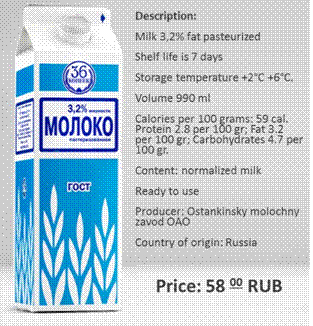
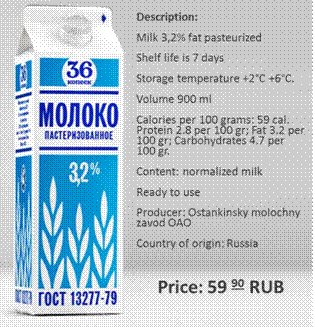
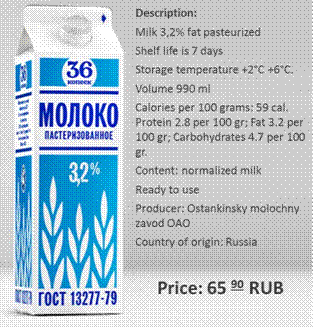
Appendix 1. Experimental stimulus
(a) Stimulus 1
| (b) Stimulus 2(a)
| (c) Stimulus 2(b)
|
Comments (not presented to respondents): Volume – 990 ml Price per 1 liter – 58.60 RUB (Initial baseline level) | Volume – 900 ml Price per 1 liter – 66.50 RUB (+13.6% to the baseline – product downsizing) | Volume – 990 ml Price per 1 liter – 66.50 RUB (+13.6% to the baseline – overt price increase) |
Приложения
Приложение 1. Апробация результатов исследования на XVI Апрельской международная научная конференция «Модернизация экономики и общества», 7-10 апреля 2015 года, Москва, Россия
Consumer Response To Misleading Pricing Tactics: The Case Of Product Downsizing
Author: Kseniia S. Golovacheva, PhD Student (e-mail: *****@***ru)
Contact: Graduate School of Management, Saint Petersburg State University, Volkhovsky Pereulok 3, St. Petersburg, Russia
7. Introduction
The academic literature reports multiple cases of marketing practices that are perceived by consumers as unfair or deceptive: unclear advertising claims, ambiguous packaging labels, hidden costs associated with the product usage (Zaltman, 1978). Consumers face these practices at all stages of their buying process. The examples in the field of pricing especially abound.
Price increases are a widespread phenomenon in a variety of ch increases can be driven by market factors or by a desire of the company to increase profit margins. Regardless of the purpose of price increases, consumers usually negatively react to them as they has a detrimental effect on their wellbeing. Under the unfavorable economic circumstances, when consumer behavior is characterized by the accelerating rationalization, economizing and the weakening of brand loyalty, the consumer response to price increases can be extremely harsh. To mitigate the negative consumer response to a price increase, companies can manage the way a price increase is presented to the market. Instead of raising the price for a product, the company can decrease the quantity/size of a product and remain the price of the product item unchanged. On the one hand, it allows keeping the product available for consumers; on the other hand, it makes hard to compare prices directly, which could be potentially perceived by consumers as unfair or deceptive (Zaltman, 1978; Hardesty, Bearden, Carlson, 2007).
The motivation of marketers behind using pricing tactics that can mislead consumer from making an optimal choice is the possibility to get additional benefits. Marketers may not necessarily be trying to deceive consumers, but they are often affected nonetheless (Manning et al. 1998; Sprott et al. 2003). When describing their lives as consumers, people point out “the confusing, stressful, insensitive, and manipulative marketplace in which they feel trapped and victimized” (Fournier, Dobscha, & Mick, 1998). Similarly McGraw and Tetlock (2005) reason: “Consumers who have been gulled into thinking of themselves as part of a corporate family or partnership may feel especially bitter when they discover that the other party was treating them along purely as objects of monetary calculation”. Thus, misleading marketing practices once successfully implemented can become a source of consumer dissatisfaction over time, as consumers learn and develop their marketing expertise together with marketers. Getting financial benefits at the expense of consumers’ welfare due to consumer’s inattention or limited knowledge in something can bring significant losses to the company, once consumers gain persuasion knowledge in the field.
The questions the study intends to answer are the following: How do consumers respond to price increases framed in a misleading vs “honest” way? Do misleading pricing tactics really allow marketers to get additional gains as compared to “honest” tactics? Does the effect of such practices differ among consumers possessing different levels of market knowledge?
8. Theoretical Background
8.1. The Framing of Price Increases: Product Downsizing vs Overt Price Increase
The price and its impact on consumers has always been a focal point in the economic and management disciplines. The schools of economic thought united under the aegis of neoclassical economics put the price on one of the central places in their research agenda. They focus on how price changes affect consumer demand for a good, but avoid scrutinizing the underlying psychological processes that lead the consumer to a buying or rejecting decision. Rather, neoclassical economics regards the consumer as a rational agent who is capable to make a precise and unbiased decision to maximize his own wellbeing. The blooming of positive economics armed with the psychological methods expands the narrow neoclassical focus. The consumer is not viewed as a purely rational agent anymore. Indeed, positive economics directs its research efforts towards revealing the real consumer behavior and the circumstances under which the predictions of neoclassical economics fail.

|
Из за большого объема этот материал размещен на нескольких страницах:
1 2 3 4 5 6 7 8 9 10 11 12 13 14 15 16 17 18 19 |
