


Партнерка на США и Канаду по недвижимости, выплаты в крипто
- 30% recurring commission
- Выплаты в USDT
- Вывод каждую неделю
- Комиссия до 5 лет за каждого referral
Persuasion knowledge is not the only factor that influences consumer interpretation of marketing stimuli. Figure 2 is a diagram integrating the antecedents and consequences of consumer persuasion knowledge activation, which, in the author’s opinion, provides a comprehensive understanding of the role of persuasion knowledge activation in the consumer response to marketing stimuli. In more detail the model elements will be reviewed in the following paragraphs.
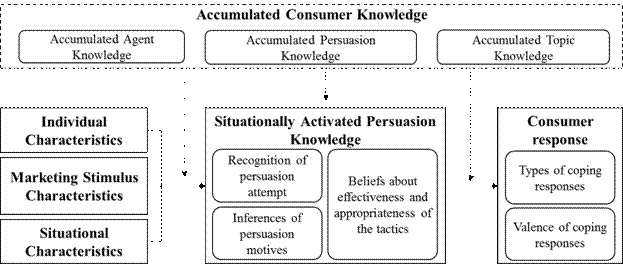
Figure 2. Antecedents and Consequences of Persuasion Knowledge Activation
Source: [Friestad, Wright, 1994; Campbell, Kirmani, 2008]
Persuasion Knowledge: Terminological Analysis
Understanding the role of persuasion knowledge activation in consumer response to marketing stimuli is impossible without a clear understanding of distinctions and relations between the terms “accumulated persuasion knowledge” and “situationally activated persuasion knowledge” as well as their elements. Heretofore, accumulated persuasion knowledge is considered as consumer persuasion-related beliefs which the consumer has at a specific point in time and which have been accumulated on the basis of previous marketplace experiences or external information, and situationally activated persuasion knowledge is beliefs activated at the moment of exposure to a marketing stimulus [Campbell, Kirmani, 2008] (see Figure 2).
When exposed to a marketing stimulus, consumers may activate thoughts about the persuasion nature of a stimulus (How does the marketer persuade me?), about the firm’s motives (Why does the marketer try to persuade me?), about the effectiveness and appropriateness of persuasion attempts (To what extent is a persuasion attempt effective and appropriate?). Undoubtedly, the distinction between the above mentioned elements is conditional and is undertaken in order to facilitate understanding of the possible directions of consumers’ thoughts.
Researchers have shown that the more persuasion knowledge and expertise consumers possess, the more likely they recognize marketing tactics as persuasion attempts [Verlegh et al., 2013]. However, it is not universal. For instance, even when consumers know that firms can exaggerate the positive properties of the product in advertising to influence the consumer's opinion, they can fail to recognize the persuasion attempt at the moment of exposure to a particular advertisement and believe the advertising information on the properties of the product under the influence of other factors.
Reinforcing and developing the ideas set out in the PKM, the researchers operate with a variety of terms, which are to some extent related to the concept of persuasion knowledge. An attempt to systematize the terminology used in the literature is undertaken in Table 1.
Table 1. Overview of the Terms Related to Persuasion Knowledge
Term | Source | Definition | Elements of persuasion knowledge | Nature of the construct | ||||
Awareness of persuasion tactics | Inferred motives | Effectiveness judgments | Fairness judgments | Accumulated | Situationally activated | |||
Suspicion | [Fein 1996; Ferguson, et al., 2011] | Psychological state when a consumer assumes that an agent might have some hidden motive. | + | + | + | + | ||
Advertising skepticism | [Obermiller, Spangenberg, 1998] | General tendency to distrust advertising messages. | + | + | ||||
Situational skepticism | [Foreh, Grier, 2003] | Situational state of distrust to others and their motives. | + | + | + | |||
Dispositional skepticism | [Foreh, Grier, 2003] | General tendency to distrust others. | + | + | + | |||
Sentiment toward marketing | [Gaski and Etzel, 1986] | General tendency to think that firms are customer-oriented or not. | + | + | ||||
Inferred sincerity of the motives | [Yoon, Gürhan-Canli, Schwarz, 2006] | Judgements related to how agent’s stated motives correspond to real motives. | + | + | ||||
Inferences of hidden motives | [Campbell, Kirmani, 2000] | Judgements about the presence of agent’s hidden egoistic motives. | + | + | ||||
Prior knowledge about agents’ motives | [Verlegh et al., 2013] | Consumer knowledge about agents’ motives that has been accumulated prior to a particular episode of consumer-agent interaction. | + | + | ||||
Perceived effectiveness | [Xie, Johnson, 2015] | Consumer judgements related to how a tactic might influence himself and others. | + | |||||
Perceived harm | [Xie, Madrigal, Boush, 2015] | Expected severity of negative consequences cause by a marketing tactics. | + | + | + | |||
Inferences of manipulative intent | [Campbell, 1995] | Consumer judgements that an agent might have an intent to persuade or influence consumer in an inappropriate and manipulative manner. | + | + | + | |||
Perceived deception | [Xie, Madrigal, Boush, 2015] | An extent to which a marketing tactic is perceived as deceptive or misleading. | + | + | ||||
Perceived procedural fairness | [Kukar-Kinney, Xia, Monroe, 2007] | Consumer judgements related to the correspondence of marketing tactics, procedures, and processes to the existing norms and rules. | + | + | + | |||
Subjective persuasion knowledge | [Bearden et al., 2001] | Subjective consumers’ evaluation of their knowledge of marketing tactics. | + | + | + | |||
Pricing tactics persuasion knowledge | [Hardesty et al., 2007] | Consumer knowledge of different pricing tactics used in the marketplace, their influence mechanisms, and agents’ intents behind their usage. | + | + | + |
Terminological analysis revealed a significant number of terms used by researchers to describe consumers' perceptions of persuasion attempts. This terminological diversity can be explained with, at least, several reasons:
a) The use of different terms to describe similar concepts in different contexts
Inter alia, differences in terminology occur due to the existence of different research traditions. For example, researchers in the field of advertising used the construct "skepticism" long before the PKM [Nelson, 1975]. Researchers in the field of pricing have traditionally used the construct "fairness" to describe consumer judgments about the appropriateness of price setting procedures, price presentations, and established price levels [Campbell, 1999]. The later constructs "inferences of manipulative intent" and "perceived deception" are conceptually similar constructs used in another context.
b) The use of different terms to describe different aspects of the phenomenon
Researchers used a variety of ways to categorize consumer inferences of firms’ motives. In particular, in the studies there have been used such dichotomous categories as "private vs public interests“ [Foreh, Grier, 2003], "increase profits vs compensate of costs of production“ [Campbell, 1999], and others.
Similarly, researchers of skepticism revealed a variety of aspects of the phenomenon: situational skepticism, suggesting the presence of the consumer of certain feelings or thoughts at some point of time, and dispositional skepticism associated with the general consumer attitudes to the world [Foreh, Grier, 2003].
c) The use of different operationalization approaches
Using different operationalization approaches is not a problem, per se. The difficulties arise when measurement scales relate to incommensurate concepts that are masked by a single term. For example, persuasion knowledge in the studies of Bearden et al. [2001] and Hardesty et al. [2007] is defined similarly, but operationalized using different scales which essentially measure the two different types of persuasion knowledge - subjective ( "what consumers think they knows") and objective ( "what consumers really know").
The use of different terms to describe similar concepts, due to differences in the historical trajectory of scientific fields, or the desire to highlight a particular aspect of the phenomenon does not bring to complications, provided that there is a clear understanding of the relationships between these concepts. Despite that, researchers have repeatedly argued for a more "economical" attitude towards the usage of terminology to avoid the theoretical and empirical contradictions caused by terminological negligence [Campbell, Kirmani, 2008].

|
Из за большого объема этот материал размещен на нескольких страницах:
1 2 3 4 5 6 7 8 9 10 11 12 13 14 15 16 17 18 19 |
