


Партнерка на США и Канаду по недвижимости, выплаты в крипто
- 30% recurring commission
- Выплаты в USDT
- Вывод каждую неделю
- Комиссия до 5 лет за каждого referral
11. Results
11.1. Sample and Context
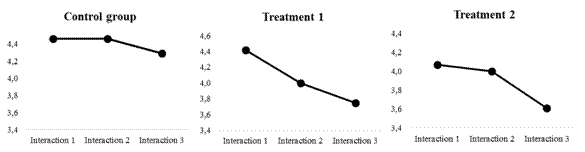
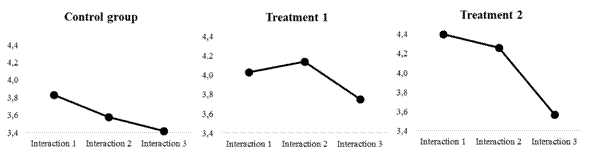
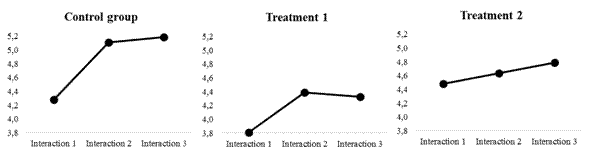
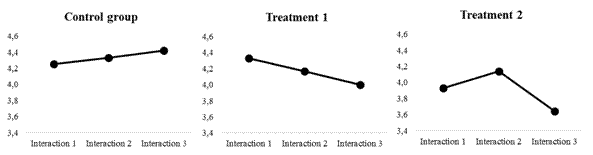
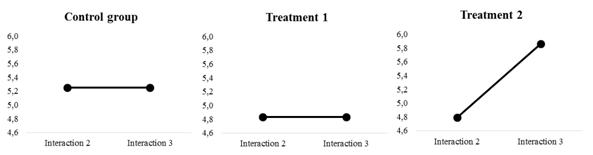
42 respondents answered the questionnaire distributed via a social network in March 2015. At the first interaction there were identified 4 observations with considerably lower ratings on all the dependent variables. At the consequent interactions these observations showed the same pattern. These 4 outliers all being in the control group were deleted from the sample. The analyses proceeds with 38 observations: 12 observations in the Control group, 12 observations in the Treatment 1 group, and 14 observations in the Treatment 2 group. Figure 1 illustrates typical development trajectories across the experimental conditions for all dependent variables characterizing the consumer response.
The questionnaire was provided in Russian and all responded were the residents of Russia. The context of Russia as an emerging market contributes to the research in several ways. Firstly, emerging markets are characterized with high consumer heterogeneity. The diversity with respect to access to products and services tends to be enormous between urban and rural households (Sheth, 2011). Many consumers have no brand or product knowledge. Often, they do not even know how markets operate. Thus, the topicality of the consumer knowledge proves to be very high and managerially relevant. Secondly, the economic turbulence and market changes that take place in Russia in the current time leads to the high price volatility, which put pressure on manufactures, on the one side, and endanger consumers, on the other side. Manufactures have to optimize their market strategies and often raise prices to compensate a high uncertainty. While consumers, in the face of lowering incomes, rationalize their behavior and put a special attention to price-related issues.
Figure 1. Consumer Response Trajectories across Experimental Conditions
Control group (overt package price increase) | Treatment 1 (package downsizing – detected) | Treatment 2 (package downsizing – unrdetected) |
Product attitude |
|
|
Buying intention |
|
|
Price unfairness |
|
|
Producer trust |
|
|
Pricing unfairness |
|
|
11.2. ANCOVA
To analyze the data, ANCOVA is used. The choice of the analytical tool is driven by the fact that there may be baseline differences between those in treatment and control groups at the Interaction 1. An imbalance between groups at baseline leads to the biased estimation of treatment effects at the following interaction when the data are analyzed using mixed-design ANOVA. ANCOVA has two major advantages over ANOVA in randomized group experiments. First, it generally has higher power. Second, it reduces bias associated with chance differences between groups that exist before the experiment is carried out. These advantages are realized because the dependent variable means are adjusted to partially account for chance pretreatment differences between the groups.
Thus, a set of 3 (control and 2 treatment groups) x 3 (interaction) repeated-measures ANCOVAs was run on each of the consumer response indicators to test hypotheses using methods appropriate to longitudinal studies of relationship development in the marketing literature (Aaker, Fournier, Brasel, 2004). Simple effects that examined the nature of each interaction at single points in time were run; two-tailed tests were used. Means are provided in Table 3; Table 4 presents the simple effects tests.
Table 3. Descriptive Statistics on Consumer Response Measures (Means and Standard Deviations)
Dependent variables | Control group (n = 12) | Treatment 1 (n = 12) | Treatment 2 (n = 14) | |||
Mean | SD | Mean | SD | Mean | SD | |
Product attitude: Interaction 1 Interaction 2 Interaction 3 | 4.46 4.46 4.29 | (.29) (.34) (.33) | 4.42 4.00 3.75 | (.26) (.26) (.23) | 4.07 4.00 3.61 | (.30) (.27) (.33) |
Buying intention: Interaction 1 Interaction 2 Interaction 3 | 3.83 3.58 3.42 | (.28) (.32) (.36) | 4.03 4.14 3.75 | (.31) (.24) (.31) | 4.40 4.26 3.57 | (.29) (.24) (.22) |
Price unfairness: Interaction 1 Interaction 2 Interaction 3 | 4.28 5.11 5.19 | (.38) (.26) (.27) | 3.81 4.39 4.33 | (.39) (.37) (.41) | 4.48 4.64 4.79 | (.24) (.25) (.21) |
Producer trust: Interaction 1 Interaction 2 Interaction 3 | 4.25 4.33 4.42 | (.37) (.31) (.26) | 4.33 4.17 4.00 | (.19) (.29) (.43) | 3.93 4.14 3.64 | (.38) (.35) (.39) |
Pricing unfairness: Interaction 1 Interaction 2 Interaction 3 | - 5.25 5.25 | - (.28) (.39) | - 4.83 4.83 | - (.21) (.47) | - 4.79 5.86 | - (.37) (.27) |
Table 4. Simple Effects Analysis Using A General Linear Model (With Repeated Measures) Procedure
Dependent variables | Treatment 1 (Treatment 1 vs Control) | Treatment 2 (Treatment 2 vs Control) |
Product attitude: Interaction 2 vs Interaction 1 Interaction 3 vs Interaction 2 | -.35* -.05 | .01 -.19 |
Buying intention: Interaction 2 vs Interaction 1 Interaction 3 vs Interaction 2 | .55** -.17 | .34 -.47* |
Price unfairness: Interaction 2 vs Interaction 1 Interaction 3 vs Interaction 2 | .26 -.01 | -.21 .19 |
Producer trust: Interaction 2 vs Interaction 1 Interaction 3 vs Interaction 2 | -.10 -.03 | .27 -.37 |
Pricing unfairness: Interaction 3 vs Interaction 2 | .25 | 1.33*** |
Note. – Values in the table are the coefficients in the regressions where each dependent variable is regressed against its lagged value (i. d. the value of the same variable at the previous interaction) and binary dummy variables for between-subjects groups: Y (Interaction N) = Y (Interaction N-1) + Dummy (Treatment 1) + Dummy (Treatment 2). A dummy variable for the control group is omitted as its coefficient is reflected in the base value before the lagged variable. The constant was suppressed from all regressions.
* p < .10
** p < .05
*** p < .01
For insight into hypotheses 1 and 2, which are concerned with the dynamic of buying intentions in different treatments groups if compared with the Control group, the pattern of buying intention at times 1, 2, and 3 is analyzed. The analysis partly support the hypothesis 1 by revealing that the Treatment 2 group rapidly shrinks their buying intentions when they are notified of the tactic usage (-.47*). The first part of the hypothesis that claims that product downsizing leads to a less reduction in buying intentions for the Treatment 2 group, if compared with the Control group, is supported (insignificant coefficient .34). The hypothesis 2 is not supported as well: unlike the hypothesis, the Treatment 1 group reacts less negatively to price increase than the Control group (.55**).
The hypotheses 3 and 4 which covers the dynamics of psychological response (i. d. product attitude and producer trust perception) in different treatments groups are also supported only partly. In particular, it was revealed that the Treatment 1 group modifies their product attitude in a more negative direction when faced with downsizing (-.35*), and do not change their response when they get external information which confirms the usage of a tactic. Any significant difference in producer trust perception was not observed for the Treatment 1 group if compared with the Control group. The Treatment 2 group did not show a significant differences from the Control group in both product attitude and producer trust perception throughout the interactions (coefficients before product attitude and producer trust variables are insignificant in all regressions).
The pair of hypotheses related to price and pricing unfairness judgments in different consumer groups come to several conclusions. Firstly, price unfairness have a tendency to raise in all three groups equally from Interaction 1 to Interaction 2: there is a significant coefficient 1.08*** before the base value and no significant coefficients before both treatment dummy variables, which shows that treatments do not deviate from the main tendency. Secondly, there is significant leap in pricing unfairness perception in the Treatment 2 group (1.33***) as compared to the Control group, which means that consumers who do not immediately detect the product downsizing increase their pricing unfairness perceptions rapidly upon an external notification.

|
Из за большого объема этот материал размещен на нескольких страницах:
1 2 3 4 5 6 7 8 9 10 11 12 13 14 15 16 17 18 19 |
