


Партнерка на США и Канаду по недвижимости, выплаты в крипто
- 30% recurring commission
- Выплаты в USDT
- Вывод каждую неделю
- Комиссия до 5 лет за каждого referral
11.3. t-test
To test whether there are differences in the persuasion knowledge among consumer treatment groups, a simple t-test for mean difference between two independent groups was accomplished. The persuasion knowledge means and standard deviations in two groups are presented in the Figure 2.
Figure 2. Persuasion knowledge in Treatment 1 and Treatment 2 groups (means and standard deviations)
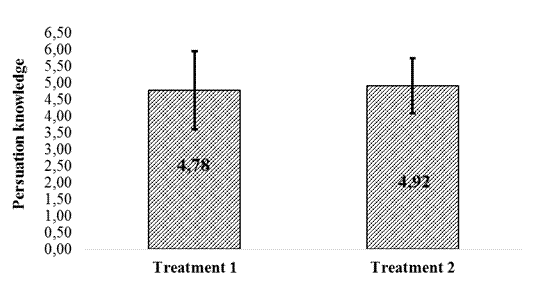
Two-tailored t-test for two independent groups provides the following statistics: t = - 0.35, df = 24. The null hypothesis about mean equivalence is not rejected (p > .10). Thus, there are no significant differences in the persuasion knowledge between consumers who are able and unable to detect the product downsizing by themselves. So the hypothesis 7 is not supported for the current sample.
12. Conclusion
In general, the study can contribute to the existing research in several ways. Firstly, it deepens the understanding of price framing by interpreting the existing research contradictions through the introduction of consumer ability to detect a misleading tactic (i. d. product downsizing) as a moderating variable. Secondly, it links a consumer ability to detect a misleading tactic with the level of consumer persuasion knowledge.
In particular, the analysis revealed that even when consumers are able to detect the product downsizing, they tend to err in their judgments regarding the price change and underestimate the scope of price increase. That could be driven by the limited abilities to conduct valid mathematical calculations when both the nominator and denominator (that is, product size and total package price) change. Even in the absence of product downsizing, consumers did not provide a valid evaluation of price change scope, and product downsizing being a more mentally challenging way to frame a price change accelerates the tendency to make mistakes among consumers.
The study identified that consumers who do not immediately detect the product downsizing increase their pricing unfairness perceptions and decrease buying intentions rapidly upon an external notification. As the same effect is not observed for the price unfairness construct, it can be assumed that price and pricing unfairness should really be treated as separate constructs, which is propagated in some academic literature on consumer fairness judgments (Haws, Bearden, 2006).
The study did not reveal a significant difference in the level of consumer persuasion knowledge among consumers who were able and unable to detect a product downsizing. That could raise the questions on the validity of the persuasion knowledge scale used in the study and appeal to the development or adaptation of other scales which are more relevant to the purposes of the study. The possible alternative is the Pricing Tactic Persuasion Knowledge (PTPK) scale developed by Hardesty, Bearden, and Carlson (2007) which tests more objective, rather than subjective persuasion knowledge in the domain of pricing by testing consumer knowledge of concrete pricing tactics used in a particular market.
As the current empirical study is initially conducted as a pilot study, an obvious limitation of the research is its small scope which likely resulted in the insignificant effect sizes for some studied variables. The specified limitation is expected to be handled when a full-scale study will be conducted.
References
Aaker, J., Fournier, S., & Brasel, S. A. (2004). When good brands do bad. Journal of Consumer research, 31(1), 1-16.
Ajzen, I. (1991). The theory of planned behavior. Organizational behavior and human decision processes, 50(2), 179-211.
Bearden, W. O., Hardesty, D. M., & Rose, R. L. (2001). Consumer self‐confidence: refinements in conceptualization and measurement. Journal of Consumer Research, 28(1), 121-134.
Bolton, L. E., Warlop, L. and Alba, J. (2003). Consumer perceptions of price (un)fairness. Journal of Consumer Research, 29(4), 474-492.
Cakir, M., Balagtas, J. V., & Okrent, A. M. (2013). The Effects of Package Downsizing on Food Consumption. In 2013 Annual Meeting, August 4-6, 2013, Washington, DC (No. 150680). Agricultural and Applied Economics Association.
Carlson, J. P., Bearden, W. O., & Hardesty, D. M. (2007). Influences on what consumers know and what they think they know regarding marketer pricing tactics. Psychology & Marketing, 24(2), 117-142.
Doney, P. M. and J. P. Cannon (1997). An examination of the nature of trust in buyer-seller relationships. Journal of Marketing,61, April, 35-51.
Fournier, Susan, Susan Dobscha, and David G. Mick. 1998. “Preventing the Premature Death of Relationship Marketing.” Harvard Business Review 76 (1): 42-51.
Friestad, M., & Wright, P. (1994). The persuasion knowledge model: How people cope with persuasion attempts. Journal of consumer research, 1-31.
Garbarino, E. and Maxwell, S. (2010). Consumer response to norm-breaking pricing events in e-commerce. Journal of Business Research, 63(9), 1066-1072.
Gourville, J. T., & Koehler, J. J. (2004). Downsizing price increases: A greater sensitivity to price than quantity in consumer markets. Division of Research, Harvard Business School.
Hardesty, D. M., Bearden, W. O., & Carlson, J. P. (2007). Persuasion knowledge and consumer reactions to pricing tactics. Journal of Retailing, 83(2), 199-210.
Haws, K. L. and Bearden, W. O. (2006). Dynamic pricing and consumer fairness perceptions. Journal of Consumer Research, 33(3), 304-311.
Imai, S., & Watanabe, T. (2014). Product downsizing and hidden price increases: Evidence from Japan's deflationary period. Asian Economic Policy Review, 9(1), 69-89.
Kachersky, L. (2011). Reduce Content or Raise Price? The Impact of Persuasion Knowledge and Unit Price Increase Tactics on Retailer and Product Brand Attitudes. Journal of Retailing, 87(4), 479-488.
Manning, K. C., Sprott, D. E. and Miyazaki, A. D. (1998), “Consumer response to quantity surcharges: implications for retail price setters”, Journal of Retailing, Vol. 74 No. 3, pp. 373-99.
McGraw, A. P., & Tetlock, P. (2005). Taboo trade-offs, relational framing, and the acceptability of exchanges. Journal of Consumer Psychology, 15(1), 2-15.
Morgan, R. M. and S. D. Hunt (1994). The commitment-trust theory of relationship marketing, Journal of Marketing, 58, July, 20-38.
Olshavsky, R. W., & Miller, J. A. (1972). Consumer expectations, product performance, and perceived product quality. Journal of marketing research, 19-21.
Palla, P. J., Boutsouki, C., & Zotos, Y. (2010). Quantity surcharges and consumer awareness in a new retail environment. International Journal of Retail & Distribution Management, 38(5), 320-340.
Reichheld, F. F. and P. Schefter (2000). E-Loyalty: Your secret weapon on the web, Harvard Business Review, 78, 105-113.
Sheth, J. N. (2011). Impact of emerging markets on marketing: Rethinking existing perspectives and practices. Journal of Marketing, 75(4), 166-182
Snir, A., & Levy, D. (2011). Shrinking goods and sticky prices: Theory and evidence (No. 2011-03). Working Papers, Bar-Ilan University, Department of Economics.
Sprott, D. E., Manning, K. C. and Miyazaki, A. D. (2003), “Grocery price setting and quantity surcharges”, Journal of Marketing, Vol. 67 No. 3, pp. 34-6.
Xia, L., Monroe, K. B. and Cox, J. L. (2004). The price is unfair! A conceptual framework of price fairness perceptions. Journal of Marketing, 68(October), 1-15.
Zaltman, G., Srivastava, R. K., & Deshpande, R. (1978). Perceptions of unfair marketing practices: consumerism implications. Advances in consumer research, 5(1).
Приложение 2. Апробация результатов исследования на конференции 6th EMAC Regional Conference, WU Vienna, Austria, September 16-18, 2015
Consumer Response To Misleading Pricing Tactics: The Case Of Product Downsizing
Abstract
The study investigates how consumers respond to equivalent price increases framed in a misleading vs “honest” way at the example of overt price increase vs product downsizing. The analysis reveals that consumers who detect the product downsizing deteriorate their attitude to the product, but do not decrease their buying intentions, while consumers who do not immediately detect the product downsizing increase their pricing unfairness perceptions and decrease buying intentions rapidly upon an external notification about downsizing.
Key words: pricing tactics, product downsizing, misleading effect.
13. Introduction
Price increases are a widespread phenomenon in a variety of ch increases can be driven by market factors or by a desire of the company to increase profit margins. Regardless of the purpose of price increases, consumers usually negatively react to them as they has a detrimental effect on their wellbeing. To mitigate the negative consumer response to a price increase, companies can manage the way a price increase is presented to the market. Instead of raising the price for a product, the company can decrease the quantity/size of a product and remain the price of the product item unchanged. On the one hand, it allows keeping the product available for consumers; on the other hand, it makes hard to compare prices directly, which could be potentially perceived by consumers as unfair or deceptive (Zaltman, 1978; Hardesty, Bearden, Carlson, 2007).
The motivation of marketers behind using pricing tactics that can mislead consumer from making an optimal choice is the possibility to get additional benefits. Marketers may not necessarily be trying to deceive consumers, but consumers are often affected nonetheless (Manning et al. 1998; Sprott et al. 2003). McGraw and Tetlock (2005) reason: “Consumers who have been gulled into thinking of themselves as part of a corporate family or partnership may feel especially bitter when they discover that the other party was treating them along purely as objects of monetary calculation”. Thus, misleading marketing practices once successfully implemented can become a source of consumer dissatisfaction over time, as consumers learn and develop their marketing expertise together with marketers. Getting financial benefits at the expense of consumers’ welfare due to consumer’s inattention or limited knowledge in something can bring significant losses to the company, once consumers gain persuasion knowledge in the field.

|
Из за большого объема этот материал размещен на нескольких страницах:
1 2 3 4 5 6 7 8 9 10 11 12 13 14 15 16 17 18 19 |
