


Партнерка на США и Канаду по недвижимости, выплаты в крипто
- 30% recurring commission
- Выплаты в USDT
- Вывод каждую неделю
- Комиссия до 5 лет за каждого referral
Теоретическая значимость исследования. На основании обзора существующих теоретических и эмпирических работ, во-первых, раскрывает сущность феномена осознания потребителем воздействия маркетинговых стимулов и, во-вторых, обобщает факторы, обуславливающие возникновение феномена, и последствия его возникновения для потребителей и фирм.
Практическая значимость исследования. С учетом выявленной в работе значимости осознания потребителями воздействия маркетинговых стимулов для функционирования фирм, представляется логичной и актуальной рекомендация включить данный феномен в число изучаемых и постоянно контролируемых показателей со стороны фирм.
Глава 1. Теоретические основы проблемы осознания потребителем воздействия маркетинговых стимулов
По материалам научного доклада «When Consumers Activate Persuasion Knowledge: Review of Antecedents and Consequences». Working Paper # 5 (E)–2016. Graduate School of Management, St. Petersburg State University: SPb, 2016.
Companies invest significant resources in consumer research. Understanding the peculiarities of consumer behavior in the market allows companies to take strategic and tactical actions that are more convincing for consumers and, as a consequence, more effective for the firm. Consumers, like companies, accumulate information and knowledge about the market mechanisms through personal experience, media exposure or other sources. A special type of knowledge consumers develop over time is persuasion knowledge that includes consumer beliefs about marketing tactics used by firms to influence consumers.
Interest in research on persuasion knowledge is constantly increasing, as evidenced by the growing number of articles in this area (see Appendix 1). Existing research on the role of persuasion knowledge in consumer response to marketing stimuli embraces a wide range of marketing tools used in the field of advertising [Jewell, Barone, 2007], pricing [Hardesty et al., 2007], public relations [Foreh, Grier, 2003], interpersonal selling [Williams et al., 2004], brand management [Van Horen, Pieters, 2012], retail marketing [Lunardo, Mbengue, 2013], and others.
In spite of the fact that the studies are linked by common theoretical construct "persuasion knowledge", they are mostly fragmented and cover different aspects of the construct. Moreover, research results are quite diverse and there is a need of systematization.
The purpose of this article is to develop an integrated model that clarifies the role of persuasion knowledge in consumer response to marketing stimulus. The article gathers empirical evidence on the problem of persuasion knowledge activation for the purpose of further theory development. Firstly, it sheds light on how different aspects of phenomenon are addressed in the extant studies, and shows how the studies are connected. Secondly, the author systematizes the antecedents and consequences of persuasion knowledge activation. Ultimately, future research directions are highlighted in the article.
In the first section of the article the author introduces persuasion knowledge model (PKM) [Friestad, Wright, 1994] as well as its adaptation to the consumer behavior context. The second section includes analysis of key concepts related to PKM and their relationships. The third and fourth sections summarize the antecedents and consequences of persuasion knowledge activation respectively. The article concludes with possible practical implications and promising directions for future research in this area.
Consumer Response to Marketing Stimuli: Persuasion Knowledge Perspective
Interactions with consumers are the core of marketing practice. Inter alia, interactions include marketers’ attempts to persuade and influence consumers using stimulus related to 4Ps [Kotler, Keller, 2012]. Consumer response to this stimulus is dependent upon a variety of individual and external factors, and persuasion knowledge is one of them.
The term “persuasion knowledge” was firstly coined in the seminal article by Friestad and Wright [1994]. The authors positioned persuasion knowledge as a part of a broader model – Persuasion Knowledge Model (PKM) – that embraces the key elements and mechanisms involved into persuasion episodes (see Figure 1).
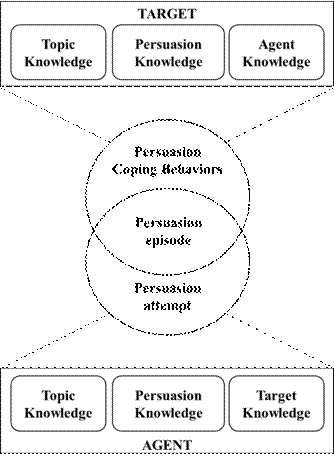
Figure 1. Persuasion Knowledge Model
Source: [Friestad, Wright, 1994]
Persuasion (and influence) is a process that involves an agent and a target. The term "targets" refers to those people for whom a persuasion attempt is intended (e. g., consumers, voters). The term "agent" represent whomever a target identifies as being responsible for designing and constructing a persuasion attempt (e. g., the company responsible for an advertising campaign; an individual salesperson). Persuasion attempt describes the target's perception of an agent's strategic behavior in presenting information designed to influence someone's beliefs, attitudes, decisions, or actions (e. g., ad, sales presentation, or message). Persuasion episode implies a directly observable part of persuasion attempt, from consumers’ point of view. For instance, if a consumer, when confronted with a particular advertising message, treats it as a company's attempt to persuade the consumer to buy the advertised product, the contact with an advertising message, per se, is regarded as a persuasion episode impacts and consumer thoughts about the nature, motives, and causes of persuasion tactics are perceived persuasion attempt. When the target recognizes persuasion attempt, he tries to cope with it. Coping can be in form of maintaining control over the outcome or more active resistance to a persuasion attempt.
Whether the consumer recognizes persuasion attempt or not, depends on consumer knowledge about an agent, topic, and persuasion, per se. Agent knowledge may be information regarding manufactures’ credibility [Artz, Tybout, 1999]; topic knowledge may be information about brands [Wei, Fischer, Main, 2008] or issues raised in the message (e. g. environmental issues) [Xie, Kronrod, 2012]. The authors pay special attention to persuasion knowledge which is “a set of interrelated beliefs about (a) the psychological events that are instrumental to persuasion, (b) the causes and effects of those events, (c) the importance of the events, (d) the extent to which people can control their psychological responses, (e) the temporal course of the persuasion process, and (f) the effectiveness and appropriateness of particular persuasion tactics” [Friestad, Wright, 1994]. The following elements (aspects) of persuasion knowledge are worth being highlighted:
· Recognition of persuasion attempt implies beliefs related to a mere acknowledgement that the marketing stimulus is used as a persuasion tool;
· Inferences of persuasion motives are beliefs about the possible end goals of marketer;
· Beliefs about the effectiveness of marketing tactics relate to how much the marketing stimulus may affect his mental processes and behavior;
· Beliefs about the appropriateness of marketing tactics are based on the comparison of the marketing tactics with the "rules of the game", including notions of fairness which are typically built into the culture, meaning they are shared by many members of the socio-cultural environment in which the consumer lives.
Persuasion knowledge is an important construct for consumers, because almost every interaction with marketing stimulus can be regarded as a persuasion episode, in which the company is trying to convince consumers that the product possesses some qualities, that the company is socially responsible, etc. and, thus, influence consumers’ behavior (for example, to persuade consumers to purchase the product). At the moment of interaction with a specific marketing stimulus consumer may use his accumulated knowledge to interpret the marketing stimulus and form an appropriate response to it.
Consumers differ in the volume and content of persuasion knowledge (between-subject differentiation), which partly explains the differences in the interpretations, and consequently, in the reactions of different consumers to the same marketing stimulus. Furthermore, persuasion knowledge is a dynamic structure that may change over time due to various factors, so the consumer may have different volume and content of persuasion knowledge (within-subject differentiation) at different times, and interprets and responds to the same marketing stimulus differently.
To illustrate how consumer knowledge can influence the perception of a marketing stimulus, we refer to the study of Kasherski and Kim [2010], who examined consumer perceptions of different price presentation. They asked respondents "Why do you think some retailers indicate the price taking into account the cost of delivery (inclusive prices), while others indicate the cost of delivery separately (partitioned prices)?”. Some respondents interpreted inclusive prices as a deliberate concealment of price structure that prevents the correct assessment of the price, and preferred partitioned price presentation; others perceived partitioned prices as a format that makes the consumer focus on the base price of the product and leads to an underestimation of the total costs, and preferred inclusive prices. Differences in interpretations suggest that different consumers have different views how different pricing tactics affect them and why firms use some tactics, which is, inter alia, due to differences in persuasion knowledge.
Consumer response to a marketing stimulus depend on whether the consumer perceives it as a deliberate persuasion attempt. Recognition of persuasion attempt entails a change in the consumer reaction to a given stimulus (“change of meaning” [Friestad, Wright, 1994]). To demonstrate this principle, we can refer to research on children perceptions of advertising. For example, Robertson and Rossiter [1974] found that when watching television commercials children can identify two types of advertising intents: informational ("commercials are designed to transmit facts and information") and persuasive ("commercials are designed to affect consumer attitude to the product or consumer buying behavior"). It was found that with age children more often prescribe to the advertising persuasive intents as opposed to informational intents, thus changing the interpretation of the commercial over time. Along with the change of meaning there are changes in children’s reaction to commercials: reduced confidence and deteriorating attitude towards commercials, decreased motivation to buy the advertised product, etc.

|
Из за большого объема этот материал размещен на нескольких страницах:
1 2 3 4 5 6 7 8 9 10 11 12 13 14 15 16 17 18 19 |
