

Партнерка на США и Канаду по недвижимости, выплаты в крипто
- 30% recurring commission
- Выплаты в USDT
- Вывод каждую неделю
- Комиссия до 5 лет за каждого referral
c) Архитектура протокола
Система глобальной широкополосной спутниковой связи определяет три группы протоколов:
• протоколы сети IETF IP;
• адаптированные протоколы системы глобальной широкополосной спутниковой связи, не зависящие от спутника; и
• протоколы, зависящие от технологии спутниковой связи.
Архитектура протокола системы глобальной широкополосной спутниковой связи определяет интерфейс независимой от спутника точки доступа к услуге, SI-SAP, который находится между уровнем IP-сети и нижними уровнями. Непосредственно выше и ниже интерфейса архитектура определяет два новых уровня адаптации, которые выполняют функции системы глобальной широкополосной спутниковой связи, связанные с этим интерфейсом, как показано на Рисунке 19.
Рисунок 19 – Архитектура протокола системы глобальной широкополосной спутниковой связи
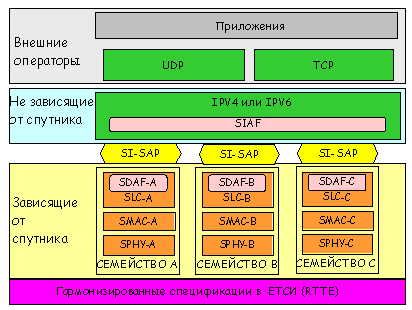
На Рисунке 19 показано, как архитектура системы глобальной широкополосной спутниковой связи поддерживает множество различных семейств протоколов нижнего уровня, зависящих от спутника. Каждое семейство соответствует своей технологии спутниковой связи, включая как прозрачные и регенеративные спутники, так и ячеистую, и звездообразную топологии. Каждое семейство нижнего уровня, зависящее от спутника, может поддерживать эти общие функции SI-SAP различными способами. Каждое семейство определяет зависящую от спутника функцию адаптации (SDAF), которая используется для преобразования сигнала в сигнал SI-SAP интерфейса и наоборот.
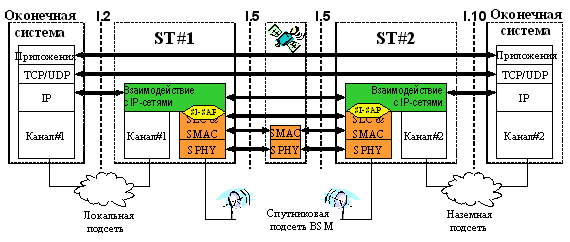
SI-SAP определяет интерфейс, не зависящий от спутника, который может использоваться для предоставления одних и тех же услуг для всех вариантов реализации BSMS. Текущая работа сфокусирована на взаимодействии наборов протоколов IP. Как показано на Рисунке 20.
Рисунок 20 – Взаимодействие с IP-сетями
I.3.2 Матрица сети терминалов с малой апертурой (VSAT)
Сети спутниковой связи VSAT, развернутые в сельской местности обычно работают в полосе частот 10-20 ГГц.
Сети VSAT имеют звездообразную топологию с множеством удаленных станций, которые связываются через центральный узел по схеме доступа DAMA с частотным или временным разделением каналов FDMA/TDMA.
Современная скорость передачи данных достигает 256 кбит/с в канале от узла до удаленных станций (Канал исходящего трафика – нисходящий - прямой), с модуляцией QPSK и скоростью 38,4 кбит/с в канале от удаленных станций до узла (Канал входящего трафика – восходящий - обратный) с модуляцией MSK. Как правило, в интерфейс с другим оборудованием предусмотрен также и порт LAN Ethernet.
Основными компонентами сетей VSAT являются следующие: i) множество удаленных станций, ii) узловая станция (Хаб), iii) подсистема предоплаты22, iv) система управления сетью. На Рисунке 21 показана упрощенная диаграмма сети VSAT.
Рисунок 21 – Упрощенная схема сети VSAT

Удаленные станции состоят, главным образом, из двух модулей: внешнего блока (Outdoor Unit – ODU) и внутреннего блока (Indoor Unit – IDU), которые включают в себя VSAT. А также подсистемы питания и подсистемы защиты.
Внешний блок (ODU) состоит из антенны и радиочастотных элементов, которые обеспечивают связь между внутренним блоком (IDU) и спутником. Некоторые его компоненты включают в себя: i) антенну, размер которой варьируется от 1,2 до 1,8 м23, ii) высокомощный преобразователь, мощность которого варьируется от 500 мВт до 1 Вт24, и iii) малошумящий блок преобразования.
Предоставляемые услуги25 могут включать в себя следующие: i) голос, ii) факс (Группа 3) низкоскоростную передачу данных, iii) бесплатные звонки в центры экстренной помощи и iv) доступ в интернет в столицах сельских территории со скоростью 9600 бод.
ANNEX I
General Broadband Matters
I.1 Social and Economic Benefits of Broadband in Telecommunications
Broadband is extending greater access to the information society, at a lower cost, to more people worldwide. Furthermore, broadband is delivering multiple applications (voice over IP telephony, Internet applications, television/video applications and audio applications) over a single network.26 For developing countries, access to the internet helps to provide previously unattainable services such as e-learning cheap telecommunications and medical know-how, and broadband has the potential to make these benefits even more achievable by bringing down costs and increasing the quantities of information exchanged. The Internet Report “The Birth of Broadband”27 identifies some of the ways that broadband is impacting societies around the world:
• The sharing of knowledge is enhanced by ensuring equitable access to the Internet, which is considered as a source of information for educational, scientific, economic, social, political and cultural activities.28
• Broadband is becoming a more significant tool that is accessible to all for the attainment of truly pervasive telecommunications. This goes some way towards the fulfilment of access to knowledge for all as a basic human right – a goal that has been evoked in a number of regional and international declarations and that forms one of the main tenets of the Principles developed as part of the United Nations World Summit on the Information Society (WSIS).29
• The development of broadband is also bringing about a paradigm shift in levels of informatization, and therefore, accountability, particularly in government processes. Wider public access to government information, and the opening up of information on public networks, underscores a commitment to democracy and good governance.
In addition to its impact on social issues, broadband is considered an accelerator of economic development. With broadband access, it is very common that worker productivity increases. Broadband creates opportunities for bundling services together and enables telecommunication operators to offer more services to consumers at lower prices, creating added efficiencies in both time and money. In addition, new or offshoot industries are created as a result of broadband. As telecommunication broadband penetration rates grow, there will be resulting demand for computer and home network equipment, as well as wireless handheld devices and other equipment that facilitate broadband use. The economic benefits of broadband also can be attributed to indirect factors, including “increased e-commerce applications, reductions in commuting, increased consumption of entertainment, Internet telephony and savings in healthcare as a result reducing the cost of sophisticated telemedicine”30. For the distribution enterprise sector, the economic benefits result from efficiencies in the distribution of goods, services and information. Thus, the economic benefits of broadband transcend from both direct and indirect sources.
In the United States, for example, several studies have been released detailing the prevailing economic benefits of broadband deployment. A July 2001 study conducted in the U. Robert Crandall and Charles Jackson has estimated the benefit of broadband to the United States to be upwards of USD 500 billion per year within the next fifteen to twenty-five years, if broadband were to become nationally available.31 In addition, the Corporation for Network Initiatives in California (CENIC) projects the benefits of broadband for the state to be quite substantial. California’s “One Gigabit or Bust” broadband initiative promises to add 2 million jobs and an estimated USD 376 billion growth in gross state product (GSP) by 2010. This would equate to a 17 per cent increase in GDP per capita, as opposed to a mere 3 per cent increase without expanded broadband deployment.32
Many countries and governments around the world may be concerned about the expenses of deploying broadband networks; however, with economic incentives and a favourable regulatory policy, it may be done both cost effectively and efficiently. Potential fiscal incentives for broadband build-out, such as tax credits, grants, subsidized or low-interest loans, support for research and development on broadband technologies – particularly for rural and underserved areas – can make broadband network deployment a reality.33
I.2 Broadband Applications in Telecommunications
With the advent of broadband technologies, a myriad of applications become possible or are enhanced beyond their current capabilities limited only to dial-up Internet access. Some of the applications include:
• E-Health
• E-Working
• E-Government
• E-Agriculture
• E-Learning
• Public Safety
• Applications for persons with disabilities
• Utility applications
• Small business assistance
• Information gathering
• E-Tourism
• E-Commerce
• Entertainment
While this is not an exhaustive list, these applications are some of the most important for broadband use. The next section describes some of the most commonly used broadband applications and provides real-life examples of how broadband has been used globally to facilitate these services.

|
Из за большого объема этот материал размещен на нескольких страницах:
1 2 3 4 5 6 7 8 9 10 11 12 13 14 15 16 17 18 19 20 21 22 23 24 25 26 27 28 29 30 31 32 33 34 35 36 37 38 39 40 41 42 43 44 45 46 47 48 49 |
