

Партнерка на США и Канаду по недвижимости, выплаты в крипто
- 30% recurring commission
- Выплаты в USDT
- Вывод каждую неделю
- Комиссия до 5 лет за каждого referral
To that end, it is critical that BWA solutions designed for the license-exempt bands address this issue head on. It is also clear that in order to do so, proper design at a very detailed level must be accommodated in the core of the product. Solid, reliable BWA networks do not happen by chance; they are a result of keeping a focus on the issues and delivering the right solutions.
The BWA Canopy solution has the following characteristics:
– Access Method: TDD/TDMA
– Modulation: High Index BFSK (Optimized for interference rejection)
– Data Rate: 10 and 20 Mbit/s (signalling rate)
– Frequency Band: 2 400-2 483.5 MHz, 5 250-5 350 MHz, 5 725-5 850 MHz
– Channelization: 3 non-overlapping channels at 2 400-2 483.5 MHz (18 overlapping channels)
– 3 non-overlapping channels at 5 250-5 350 MHz (11 overlapping channels)
– 6 non-overlapping channels at 5 725-5 850 MHz (22 overlapping channels)
– Network Standard: IPV4, UDP, TCP, ICMP, Telnet, HTTP, FTP, SNMP
– Transmitter power: Meets FCC ISM/UNII EIRP limits.
The interference effectiveness of Canopy is accomplished by:
• Employing BFSK for modulation. With this modulation the C/I ratio necessary to operate properly with an error rate of 1 × 10–4 bits per second is only 3 dB; i. e. the wanted signal needs to be only 3 dB higher in power than the unwanted interferers. A system operating with 16 QAM at these levels would require a C/I ratio of roughly 12 to 14 dB.
• Deploying networks in a cellular topology; the performance of the antenna in rejecting unwanted signals from behind is an important feature. The Canopy system, with its integrated antennas at the AP, has a front-to-back ratio of 20 dB. Coupled with the excellent C/I ratio, this means a Canopy AP receiving a signal at threshold (the weakest signal it can still detect) can be hit with an interfering signal from behind, either internal or external, on the order of –60 dBm and still support connections at an acceptable error rate.
• Delivering tight synchronization across potentially hundreds of square miles. With the Canopy system, designed for large scale, dense network deployments, TDD synchronization is a critical requirement. This has been solved with the use of a GPS signal. These precise satellite signals are used for timing and, ultimately, transmit/receive synchronization, thus tying all sectors in a Canopy network to the same “clock”.
Recognizing the dilemma of combining TCP/IP with wireless networks and the attendant error rates, the Canopy system solves the problem with a feature called Automatic Retransmission request or ARQ. ARQ actually inspects the RDPs that come into the receiving SM and looks for errors. If an error is detected, the SM (or AP) will send a request to the sending entity to re-send the RDP.
II.1.1 Airstar: A Multi-Service Broadband Fixed Wireless Access System
Summary of the “airstarTM” system
airstarTM is a point-to-multipoint fixed wireless access system specially designed for residential, Small Offices/Home Offices (SOHO) and Small and Medium-sized Enterprise (SME) users in urban, suburban and rural areas.
airstarTM is a high capacity solution for service providers that effectively handles applications ranging from toll-quality voice and data transmission to mobile base station backhaul on a single platform. Operating in the 3.5, 10, 26 and 28 GHz frequency bands, the system uses an ATM/TDMA/FDD air interface with dynamic bandwidth allocation delivering a high level of Quality of Service (QoS) for voice and data.
airstarTM is a field proven solution: more than 80 systems have been deployed in 37 countries and are in operation for now more than 5 years.
Applications
The airstarTM system is a high flexible platform that supports multiple applications.
• 2G/3G mobile backhaul.
Mobile operators upgrading to 3G technologies face significant increases in the capacity requirements of their transmission networks, as well as a need to migrate from TDM to ATM and IP. The system provides the transmission link to backhaul 2G and 3G mobile base stations from a single customer premises equipment. In addition, the native ATM air interface provides a future-proof backhaul infrastructure solution for supporting future 3G mobile services.
• Access for Small and Medium-sized Enterprises (SMEs).
Given the large variety of equipment and applications within a typical SME, delivering multiple services is an essential part of any service provider’s business case. The system enables the delivery of E1/T1‑based voice, Internet access, virtual private network (VPN), and Frame Relay services from a single Customer Premise Equipment (CPE).
• Multi-tenant unit access.
In residential multi-dwelling units, the system provides scalable and versatile solution for multi-tenant unit access and enables the delivery of Internet access and toll-quality voice or VoIP services.
• Wireless local loop backhaul.
At 3.5 and 10.5 GHz, it provides backhaul links up to 20 Kms, enabling remote towns and villages to be served with the wireless local loop and backhauled to a larger city for connection to the Public Switched telephone Network (PSTN).
• Wi-Fi hotspot backhaul.
The system also provides backhaul for Wi-Fi hotspots using the CPE 10/100 Mbit/s Ethernet interface. All backhaul links are aggregated over the airlink and delivered on a single ATM network connection at the base station. The ATM QoS implemented on the airlink guarantees the necessary bandwidth for Wi‑Fi hotspots.
Architecture
Figure 23 represents an example of the Architecture of “airstarTM” system.
Figure 23 – AirstarTM Architecture
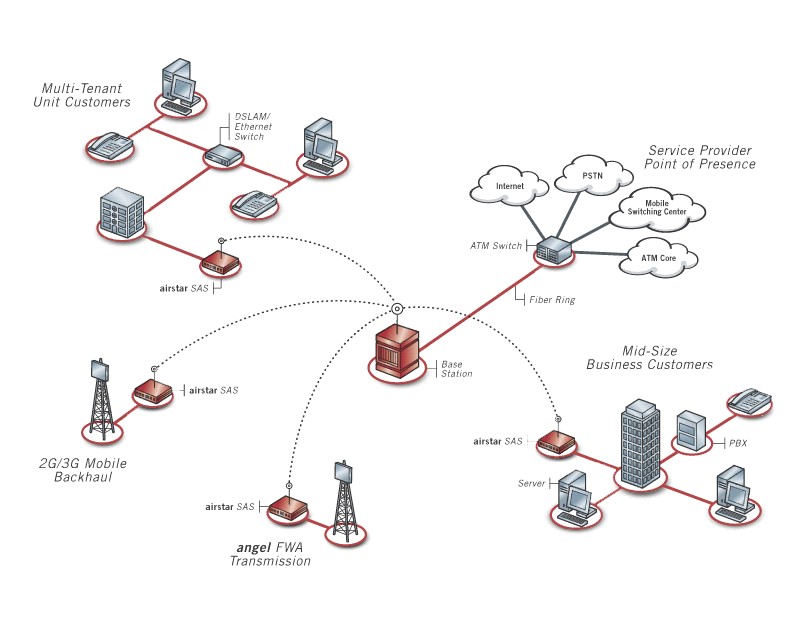

Main features and benefits
• Service flexibility
The platform efficiently supports the following voice and data services, enabling service providers to offer personalized solutions to their customers:
Voice Services:
– E1 Lease Line – Both unstructured and structured modes are supported. For structured E1s, only provisioned time slots are carried over the air.
– PRI-ISDN – with dynamic bandwidth allocation on a call by call basis.
– Voice over IP/FR/DSL – with statistical multiplexing gain and differentiated QoS to enable POTS and BRI-ISDN services.
Data Services:
Dynamic Bandwidth Allocation is provided for all data services.
– Internet Access – Without the need for external router
– LAN to LAN Interconnection – Through bridged Ethernet or a Frame Relay service
– Frame Relay – Over E1 or X.21/V.35 Serial interfaces
– VLAN – For providing IP services to dozens of end customers while maintaining individualized QoS.
Unique Service Offerings via Wireless
– 4xE1 Leased Line – For an AirStar CPE, the incremental cost per customer is less than 20% for providing 2xE1 per building or 4xE1 per building.
– 8 Mbit/s IP Service – With the 3000 Series SAS-XP, the AirStar system can deliver near wirespeed throughput on the SAS Ethernet interface.
• The Wireless + ATM benefits
Quick to deploy High speed switching and transport
Low initial costs One network for all traffic types
Flexible and scaleable Bandwidth sharing of services
Easy to maintain Simple network management
Long architecture lifetime
• Service level agreement
The platform enables service providers to reserve bandwidth for their different customers according to the service level agreement they have purchased.
• Service availability equivalent to fibre
Features such as base station redundancy and error correction algorithms are combined to achieve a high level of reliability. This allows the system to provide up to 99.999% availability.
• Ease of deployment
CPE configurations can be pre-provisioned prior to installation to accelerate the deployment.
• Efficient spectrum utilization
The system features dynamic bandwidth allocation to enable dynamic bandwidth sharing over the airlink for the delivery of bandwidth-on-demand applications such as voice and Internet traffic.
“Airstar TM” technical characteristics
• Access method: TDMA

|
Из за большого объема этот материал размещен на нескольких страницах:
1 2 3 4 5 6 7 8 9 10 11 12 13 14 15 16 17 18 19 20 21 22 23 24 25 26 27 28 29 30 31 32 33 34 35 36 37 38 39 40 41 42 43 44 45 46 47 48 49 |
