

Партнерка на США и Канаду по недвижимости, выплаты в крипто
- 30% recurring commission
- Выплаты в USDT
- Вывод каждую неделю
- Комиссия до 5 лет за каждого referral
A broadband application economy, which affectively promotes broadband supply, can be characterized by:
a) Competition
Multiple providers offering multiple broadband technologies is key to driving prices down and increasing the broadband options available to users. Furthermore open access policies can help promote service competition. It is also beneficial to have players in the market that are capable of rivalling the incumbent operator.
b) Maximum utility of current networks and new network investment
Existing networks must be utilized to their full extent alongside new network investment. Innovative broadband networks such as wireless, satellite, railway and electrical can be used to supply broadband applications. Schools, hospitals, and community access centres can serve as initial broadband anchors in areas, eventually becoming the network access points from which future networks.
I.3.4.2 Flexibility
Establishing an appropriate regulatory framework is essential to promoting the deployment and market adoption of high-speed data applications. The convergence of services, such as data and voice should not lead to additional unnecessary regulations. The importance of technology flexibility is further described below.
Importance of Technology Flexibility
Technology flexibility (also known as technology neutrality or operator choice) is an important aspect in promoting broadband deployment. Technological flexibility in the policy arena means that policies and incentives do not create a preference for any specific technology platforms or modes of providing broadband applications (e. g. satellite, wireline, wireless, etc). Also within a given platform or mode of providing a service, technology neutral policies and incentives do not create a preference for any specific technology products or standards – e. g., circuit - or packet-switched networks, various mobile or cellular telecommunications standards, etc. If possible, it is important that service providers have the flexibility to independently choose the most suitable technology based on commercial and competitive considerations. A transparent regulatory framework, in which the market selects the most appropriate technologies for deployment, may encourage competition, spur innovation and accelerate the deployment of advanced services.
I.3.4.3 Universal Access
A transparent universal access policy aims to promote the availability of quality services at just, reasonable, and affordable rates, increase access to advanced telecommunications services and to advance the availability of such services to all consumers, including those in low income, rural, insular, and high cost areas. It is important that countries continually evaluate their universal access strategies in the face of technological advances and changing market conditions in order to maximize the size, scope, variety and efficiency of telecommunication networks. It is also important that universal access policies encourage the availability of affordable education and health and safety applications to citizens, businesses and government.
Universal access policies that are competitively neutral do not favour any one participant or group of participants. As no one technological solution is necessarily appropriate for an entire country or region, the variety of available technology platforms gives new and innovative alternatives to expanding access to services in developing countries.
I.3.4.4 Public Role in Promoting Broadband
a) Government programs that serve to accelerate broadband supply
Several government sponsored programs at the local, national and regional levels have been successful at increasing the overall supply of broadband. Specifically, governments can invest directly in broadband infrastructure as well as provide tax credits, low-interest loans and subsidies to the industry players looking to provide broadband networks in underdeveloped areas. It is important that in promoting development of broadband “for all” to avoid any direct or cross-subsidy by the country which would give an unfair advantage to some market stakeholders. Governments are invited to assist with the provision of broadband infrastructure and services in areas that are not served by the public sector due to unfavourable market conditions.
b) Public institutions as effective anchors for broadband demand
In areas where individual household connections are not yet viable, schools, hospitals, and community access centres can be utilized to offer broadband connections. The network can then expand incrementally from these key points as the technology and economy allows. Wireless broadband also offers a viable community economic alternative to fixed line solutions such as broadband via DSL or cable modem.
c) Government participation at all levels
National, regional and city-wide initiatives and community participation projects have been successful in expanding access. In some cases, governments have chosen to provide, or to subsidize, infrastructure to stimulate the economic development of a particular area.
d) Best Practice Guidelines for the Promotion of Low-Cost Broadband and Internet Connectivity
In December 2004 the Best Practice Guidelines for the Promotion of Low-Cost Broadband and Internet Connectivity were produced at the Global Symposium for Regulators (organized by the ITU‑D on a yearly basis). These guidelines describe what the foundation for an enabling regulatory regime should be and how governments can help to stimulate growth in the telecommunications market for broadband applications. (Full guidelines can be found in Annex IV.) Some of these are as follows:
• “We encourage political support at the highest government levels with such support expressed in national or regional policy goals. These include an effective, separate regulator insulated from political interference, a transparent regulatory process, and adoption and enforcement of clear rules.”
• “We encourage regulators to set policies to stimulate competition among various technologies and industry segments that will lead to the development and deployment of broadband capacity. This includes addressing barriers or bottlenecks that may exist with regard to access to essential facilities on a non-discriminatory basis.”
• “We encourage regulators to allocate adequate radio spectrum to facilitate the use of modern, cost effective broadband radiocommunications technologies. We further encourage innovative approaches to managing the spectrum resource such as the ability to share spectrum or allocating on a license-exempt non-interference basis.”
• “We urge regulators to conduct periodic public consultations with stakeholders to inform the regulatory decision-making process.”
• “We recommend that regulators carefully consider how to minimize licensing hurdles.”
• “We encourage regulators to provide a clear regulatory strategy for the private sector in order to reduce uncertainty and risk, and remove any disincentives to investment.”
ANNEX II
Technology Matrices (Standardization in Progress)
II.1 Canopy Solution for Fixed Broadband Wireless Access Matrix
For many businesses, domestically and, especially, internationally, reasonably priced broadband is not readily available, sometimes not at any price. The expense of building out new DSL networks, re-working or conditioning the lines that exist, or converting existing cable plants to carry two-way traffic might be expensive. This section provides information on BWA technology characteristics which make this broadband approach accessible.
The majority of the world is still unable to receive reliable high-speed data and/or voice connections. The promising access medium to meet this need, broadband wireless access (BWA), accounts for less than five per cent of the total broadband access connections.
Nevertheless, BWA is developing new approaches to solving the issues that had previously stalled its growth. A big issue for service providers, for example, has been the lack of ability to avoid RF interference. This has resulted in higher costs due to additional equipment and an inability to meet service agreements with their customers.
The key challenge to making BWA ubiquitous broadband access is interference. Customers must be assured that the technology chosen is hassle-free and always available. With BWA, the number one threat is interference.
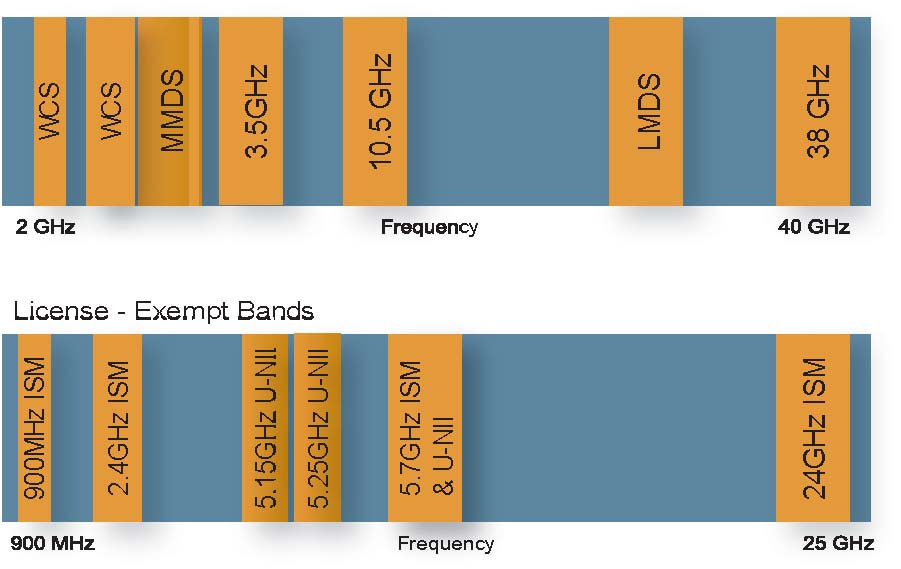
When licensed bands are designated for BWA, typically a limited number per region are granted. On the surface, this means that BWA will only be deployed in those places where the license fee can be recouped and only by a few ch a situation effectively reduces the number of potential competitors and, hence, reduces options available to the end customer, freezing out competing BWA options. The rules should be designed to allow multiple networks to co-exist with minimal interference, enabling multiple operators to serve a given geographic region. The bands below in Figure 22 are examples of such use on a national level in a few countries.
Broadband Wireless Frequencies Licensed Bands
Figure 22 – Global Frequency Bands
The overriding design goal of the Canopy technology has been to deliver an interference robust simple-to-use BWA system. Interference lies at the heart of the reliability design challenge, and interference in the license-exempt bands can be a much greater factor than that faced by licensed band systems.

|
Из за большого объема этот материал размещен на нескольких страницах:
1 2 3 4 5 6 7 8 9 10 11 12 13 14 15 16 17 18 19 20 21 22 23 24 25 26 27 28 29 30 31 32 33 34 35 36 37 38 39 40 41 42 43 44 45 46 47 48 49 |
