

Партнерка на США и Канаду по недвижимости, выплаты в крипто
- 30% recurring commission
- Выплаты в USDT
- Вывод каждую неделю
- Комиссия до 5 лет за каждого referral
Its research pointed to the slow rollout of DSL technology only planned for towns with a population in excess of 6 000 persons.
Since the majority of towns in South West Ireland have populations far less than 6 000, the SWRA further looked at the growing preference for wireless around the globe, and the availability of broadband from satellites. The SWRA decided to try and combine both, with an intelligent interface. In late 2002, the Regional Authority made a proposal to the European Space Agency to undertake a research program relating to the combined usage of Satellite and wireless technologies, the results of which would be of value to many regions experiencing difficulties in getting broadband to remote towns. This proposal was accepted and the SWRA began work on the South West Broadband Project, in February, 2003.
The proposal was to test satellite as a means of accessing broadband, to validate the technology across a range of field trials in areas of e-government, business support, e-Medicine and Distant Education. SWRA was fortunate to receive many offers from major players in the satellite and wireless communications field to participate in the program. Fourteen field trials are now operational and satellite technology is used in conjunction with wireless local area networks to provide broadband access.
A principal economic advantage of its program is that typically a satellite/ wireless system can be installed in just a few days and the total cost of creating a satellite fed wireless LAN is of the order of € 25 000. The SWRA contrasted the rollout of this technology with that of fibre where the cost of laying a plastic duct is of the order of € 150 000 per kilometer and then further substantial costs are involved in providing the fibre, lighting it and then making the “last mile” connection to users. The economics of SWRA’s approach are such that the annual cost, including installation, of operating a satellite/wireless local area network, can be as low as € 20 000 per annum. On this basis with a total of 40 customers, connection charges can be as low as € 25 per month for home users and € 60 per month for small businesses.
The SWRA market approach is one of product and service sustainability, on a not for profit basis, reinvesting revenues from the service into the rollout of Satellite and Wireless Broadband to even smaller communities. The SWRA has also adopted a highly inclusive approach with local communities, who will partner with them in each town, to develop and agree on terms and conditions of service, in consultation with local community representatives. The Local Authorities in the region are also partners and provide premises for housing the equipment. The success of the broadband program undertaken by the South West Regional Authority has led the agency to seek its own telecom operator license and one of its main conclusions is “think about doing it for yourselves” and advises any interested partners to speak to them for more information.
III.4.3 Norway
1) eNorway Action Plan
Also in Norway, according to the eNorway Action Plan, the government’s goal is that broadband is available on the market in all regions of Norway. Primary schools, public libraries and local authority administrative services shall be given the option of broadband connection at a competitive price during the course of 2005.
By the end of 2003, all colleges of secondary education shall also be offered an equivalent scheme118. A key priority of the government also will be to stimulate broadband rollout in Norwegian municipalities for use by local authorities. The public sector’s extended use of broadband communication is supposed to significantly contribute to a well-functioning broadband services market, making the broadband services more available for small and medium-size enterprises, as well as consumers.119
2) Modalen Project, Norway
In Norway, the Modalen Project, which was started in 2000-2001 by a consortium of information technology companies in Modalen, Norway, provides Internet through broadband networks. Because the closest major city to Modalen is over an hour away, the project’s intent was to provide every family, company, public department, organization, school and institution in the 400-person city access to broadband technology using the TV set as its user interface. As a result of the project, a May 2001 Gallup poll showed that Internet access on the job, at home and at school was higher in Modalen than in the rest of Norway, and Modalen residents were online more than the rest of Norway.120
III.4.4 Sweden
Sweden has a long and strong tradition in IT and Telecommunication. It was an early user and a leader in fibre optics in the end of 80:ies and beginning of the 90:ies very much depending on efforts made by Ericsson and Telia in cooperation with University Research. Sweden was early in using PC :s at home and has today one of the highest PC penetrations per capita in the world.
In mobile communication Sweden was one of the early adopters together with the other Nordic countries and Ericsson together with Nokia from Finland are among the leading suppliers in mobile system and terminals. During the 90:ies the government took a number of steps to deregulate the market in telecommunication and Sweden is today one of the most deregulated countries in the world with the market supervised by the regulating authority PTS (Post och Telestyrelsen).
The situation in Sweden today is characterized by a fierce competition in the broadband marketplace, 20% of the private households have got broadband and the biggest operator is TeliaSonera with a market share of 42%. TeliaSonera uses dominantly DSL and has almost monopoly on the cupper access network but must by law offer it to its competitors. The second largest operator is Bredbandbolaget with 23% and the biggest FTTH network in Sweden. In the enterprise sector TeliaSonera, Song Network and Telenor are the major players. Sweden has more than 200 operators, the majority of them are owned by communities or their energy companies serving the local city region. The major access technologies are DSL (market share of 55%) and FTTH, (almost 20%, based on LAN and Ethernet technology). In connection with the government supported broadband program a separation exists between the role of being a network owner and a service provider i. e. an end user can choose between many different service providers and vice verse.
Sweden is on the threshold to introduce a multi service converged network offering Internet, telephony and TV, triple play, all based on IP. Some DSL operators include VoIP in their service package today and are even discussing TV, the TV operators on the other hands that today offers normal TV and Internet access have started to implement VoIP over their coaxial network.
FTTH access with triple play services is available for some small scale commercial operations.
Broadband access is in Sweden a cornerstone for implementing 24 h e-governance services, to be able to rationalize the health sector by e-health, to offer remote education and to strengthen the local democracy and access to local information.
The introduction of triple play has opened up a market for companies developing IP based Set Top Boxes and Home Gateways as spin off from Ericsson and Telia research activities. As example 42 networks together with Ericsson developed an end-to-end broadband access solution for the connection of various types of subscriber equipment to the Internet.
The move to a broadband network based on IP that is a convergence between Internet, Telecommunication and Broadcasting creates of course a number of challenges for the research community. To verify the service and infrastructure requirements various testbeds with real end users have been implemented in Sweden. As example the research institute Acreo’s national broadband testbed involves more than 15 vendors, more than 15 operators, more than 10 universities and a number of public authorities.
As an example of a broadband installation in the north of Stockholm Sollentuna Energy provides a network with more than 12 000 installed broadband access terminals. Examples of current services are: Internet (with 4 ISP:s), TV (up to 18 channels), movies (video on demand), Intranet for local information and broadband telephony.
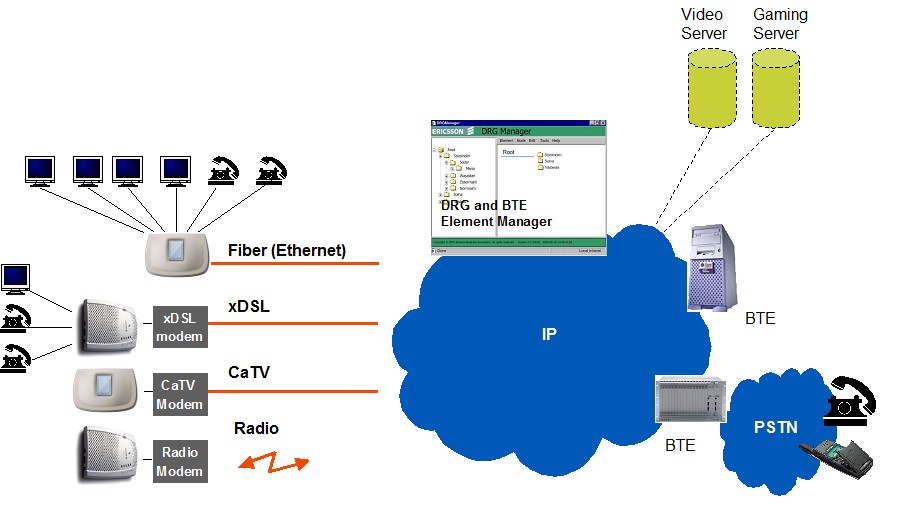
Typical broadband access installations are based on a 42 Networks broadband access solution providing end-to-end quality, security, simplicity and management. Ericsson’s end-to-end broadband solutions enable operators and service providers to build a base for Fast Internet, Video on demand, telephony (VoIP) and other broadband services. The portfolio consists of 3 parts: the Digital Residential Gateway (DRG), the Broadband Telephony Enabler (BTE) and Device Management System (DMS), as illustrated in Figure 28.
Figure 28 – 42 Networks Managed Broadband Telephony Solution
Digital Residential Gateway (DRG)
Digital Residential Gateway (DRG) units can be connected to the IP-network either with modems (e. g. for xDSL, CaTV or Radio transmission) or optical/electrical converters for single or multimode fibres (e. g. for Ethernet connection). DRG units allow end users to continue with their existing analog phones or fax machines, while calling with high quality over an IP-Network. To each telephony port up to 5 telephone sets can be connected in connecting a set top box to one of the Ethernet ports e. g. Video on Demand can be delivered simultaneously with telephony and fast Internet. The ports also give the end user possibility of connecting several computers and printers to the unit. DRG units with built-in optical/electrical converters allow fibre To The Home/SoHo installations.
For various applications a number of different DRG versions of plug-and-play units have been developed with up to four Ethernet ports and two telephone ports suitable for the connection with Unshielded Twisted Pairs (up to 100 m ) or multimode fibres (up to 2 000 m ) or single mode fibres (up to 15 000 m).

|
Из за большого объема этот материал размещен на нескольких страницах:
1 2 3 4 5 6 7 8 9 10 11 12 13 14 15 16 17 18 19 20 21 22 23 24 25 26 27 28 29 30 31 32 33 34 35 36 37 38 39 40 41 42 43 44 45 46 47 48 49 |
