

Партнерка на США и Канаду по недвижимости, выплаты в крипто
- 30% recurring commission
- Выплаты в USDT
- Вывод каждую неделю
- Комиссия до 5 лет за каждого referral
III.1.2 Deployment of Mobile Broadband Wireless Access in South Africa
Wireless Business Solutions (WBS) is a dynamic South African company established to provide mobile data network services to meet corporate, government and domestic requirements. It was licensed by SATRA in 1997, to provide National Mobile Data Services and is South Africa’s fourth Telecommunication licensee. WBS has deployed a wireless packet switching network with 700 point-to-multipoint radio base stations. This network currently supports over 8 000 radios with which WBS has been providing a service to Uthingo, for the data telecommunications of their Lotto terminals to the Host system. A VSAT network is used to backhaul the traffic from the base stations to the Network Host.
Having gained knowledge and success by being the backbone network behind the National Lottery and providing nationwide wireless data services covering 95% of the population, WBS is rolling out a commercial mobile wireless broadband data network using iBurst technology (see Section II.2.3.3.3). This network will provide customers with high-speed access to the Internet and corporate information wherever and whenever they using the iBurst system, WBS intends to unshackle broadband and to liberate data telecommunications in the same way the mobile phone liberated voice telephony. WBS operates as a wholesale provider of iBurst connectivity, concentrating on its strengths of establishing and managing the infrastructure. It will rely on its channel partners to disseminate the service to the community. This will be the second implementation of iBurst in the world following the successful launch in Australia by Personal Broadband Australia early in 2004.
III.2 Americas
III.2.1 Brazil
1) Introduction
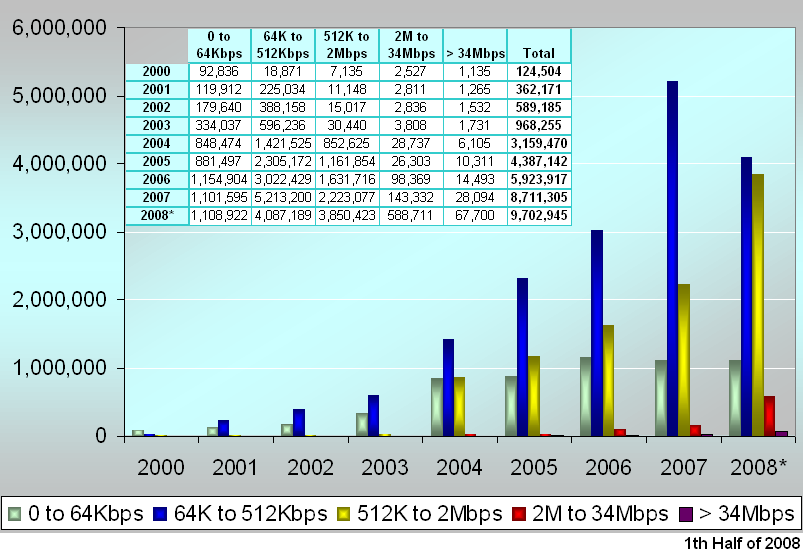
Recent poll shows that Brazil has reached 10 million broadband accesses88. Considering that Brazil has a population around 180 million inhabitants living in 45 million homes89, it’s noticeable that this kind of Internet access hasn’t spread much in Brazil. This is true, even knowing that Brazil had a 48% growth in the amount of access in relation to the first half of 2007, as suggested by the research.
Data available on the National Telecommunication Agency – Anatel’s web site show that, by the first half of 2008, more than 50% of access in Brazil had transfer rates up to 512 kbps90. Less than 10% is at 2 Mbps and above, as shown in Figure 1. Therefore, few Brazilians are taking advantage of new applications available on the web (that requires high rates, like streaming video and voice and file exchange).
Access evolution for various transfer rates.
Although Brazil has been experiencing a sharp growth in the amount of broadband access points over the last years, there is still a digital divide scenario present. This paper has the goal of describing some of the broadband access technologies that are reverting this situation. Also, it aims to present actions continuously taken by the Brazilian Government and by the companies acting in the country with means to promote the development and use of these technologies.
Current Broadband access scenario in Brazil
I) Wireless Access
Brazilian regulation defines telephony processes as those that permit communication between determined fixed points, with voice and other signals, making use of transmission technique modes 3.1 kHz-voice or 7 kHz-audio or up to 64 kbit/s unrestricted, by wire, radioelectricity, optical means or any other kind of electromagnetic signals91. Therefore, as Brazil does not define a specific lower boundary rate for broadband access, for the purposes of this study, broadband shall be understood as the service that offers capacity of transmission, emission and reception of multimedia information, using any means, with transfer rate above 64 kbps (56kbps, discarding less significant bit).
In Brazil, wireless technologies capable of delivering broadband access and currently in use are the ones based on: Institute of Electrical and Electronics Engineers – IEEE 802.11 ‘b’ and ‘g’ (Wireless Fidelity – Wi-Fi), 802.16 (Fixed Worldwide Interoperability for Microwave Access –WiMax), Multipoint Multichannel Distribution System – MMDS, Direct To Home – DTH, High-Speed Downlink Packet Access – HSDPA, Enhanced Data rates for GSM Evolution – EDGE, Fixed Wireless Access – FWA, amongst others92.
II) Wired Access
Wired access capable of delivering rate above 64kbps and currently in use in Brazil are: G.992 family (Asymmetric Digital Subscriber Line – ADSL, ADSL2/2+), Hybrid Fiber Cable – HFC, Cable Modem, Fiber To The Home – FTTH, Power Line Communication – PLC93. Those last two on an experimental state.
III) Number of Access Points
Consulting broadband access data available at Anatel’s website (www. anatel. gov. br) and the demographic data available at the Brazilian Geographical and Statistical Institute – IBGE’s website (www. ibge. gov. br), it’s possible to obtain some statistics about broadband penetration in Brazil.
If all Brazilians could use the Internet at the present scenario (180 million inhabitants and 10 million access points), each 18 inhabitants should share the same broadband access point [3]. This is not a high mean, considering that approximately 23% of the Brazilian population has already access the Internet, while the world average rate is around 21%94.
But, the majority of the population is concentrated in the southeast region (Sгo Paulo and Rio de Janeiro mostly). Regions like the north (Amazonas, Acre, Rondфnia etc) and the northeast (Maranhгo, Piauн etc) have a less dense population. This means that those regions are less economically attractive for telecommunication companies. Therefore, the number of broadband access points tends to be unequally distributed throughout the Brazilian territory. For example, the State of Sгo Paulo has a mean value of 11 inhabitants sharing the same broadband access point, while the State of Maranhгo has a mean value of 118 inhabitants/access points95.
2) Technologies
Regulatory strategies for promotion of broadband access technologies amongst less populated areas and small and home offices
The reduction of prices of radio equipment operating in some frequency bands has allowed the emergence of small providers of broadband access, offering telecommunications services where the main operators do not provide them. In these locations, considered, in generally, as being less economically attractive for big companies due to high cost of deployment of a new network, there are a growing number of small offices trying to absorb this demand for broadband access.
I) Regulations applied
The use of radiofrequency ranges 2,400-2,483.5 MHz and 5,725-5,850 MHz are free of charge if the equipments, certified as of Limited Radiation Equipments, operate under several conditions established by Brazilian Regulations. Brazil defines Limited Radiation Radiocommunication Equipments as those that use radiofrequencies for several applications in which emission creates an electromagnetic field bounded by Brazilian law96.
However, this legislation imposes some restrictions depending on the coverage of the telecommunication service: restricted or collective. Collective interest services are those that must be provided to any interested person on a non-discriminatory basis, satisfying the interests of the community. Restricted interest services are those designed for personal use or provided to certain groups of users, selected by the provider through criteria established by itself97.
When the telecommunication activity, using radio communication stations, surpasses the limits of a building or property and these stations operate at frequency ranges 2.400-2.483,5 MHz or 5.725-5.850 MHz using Spread Spectrum or other Digital Modulation technology, the following rules are applied:
i) When the operation of these stations is associated with the rendering of collective interest telecommunications services, an authorization for the provision of the corresponding service is required. The licensing of stations is also required if these stations are intended to:
a) interconnect with the network of another telecommunication service provider; or
b) interconnect with another station of the same network and that other station operates with at least one equipament that is not classified as of Limited Radiation.
ii) When the operation of these stations serves as support for telecommunications network designed to support restricted interest services, no telecommunication service authorization is required. However, if these stations operate in accordance with subparagraphs “a” or “b” of item I above, they must be registered in the database of the Brazilian National Telecommunications Agency – Anatel. In this case, no licensing is necessary.
Especially for the 2.4 GHz band, all stations, including terminals, have to be licensed, regardless of coverage of the telecommunications service, if the equipment operates with e. i.r. p higher than 400 mW and at locations with population greater than 500,000 inhabitants.
II) Main Users
In Brazil the bands mentioned above are intended primarily for providing broadband access in less populated areas and for private networks. Small and home offices offer broadband access using those radiofrequency bands in locations poorly supplied with access points and with little bandwidth available from large companies. This kind of telecommunication service depends on an authorization of the Brazilian Government and on licensing of the radio stations in accordance with Brazilian Regulation98.

|
Из за большого объема этот материал размещен на нескольких страницах:
1 2 3 4 5 6 7 8 9 10 11 12 13 14 15 16 17 18 19 20 21 22 23 24 25 26 27 28 29 30 31 32 33 34 35 36 37 38 39 40 41 42 43 44 45 46 47 48 49 |
