

Партнерка на США и Канаду по недвижимости, выплаты в крипто
- 30% recurring commission
- Выплаты в USDT
- Вывод каждую неделю
- Комиссия до 5 лет за каждого referral
Table 6 – Average prices for both dial up and broadband services on an ITU regional basis
Region | Average Price for Internet Dial Up access (USD per minute) | Average Price for Internet Dial Up access (USD per month) | Broadband average price (USD) | |
Between | In Excess and depending on the bit rate | |||
Africa | 0.03 | 24.08 | 1 011.17 | 19 731.96 |
Americas | 0.02 | 19.69 | 177.36 | 496.28 |
Asia-Pacific | 0.38 | 13.50 | 130.46 | 299.51 |
Arab States** | 0.005 | NA | 64.52 | 189.76 |
Europe | 0.02 | 227.21 | 364.78 |
** It should be noted that only two countries for the Arab States region, Eqypt and the United Arab Emirates provided pricing data and no data was provided for monthly dial up costs. |
Intra-regional variations in pricing models are also common. In the case of Europe the high estimated average monthly costs of broadband access in Armenia (1 000)*125 and Belarus (1 200) raised the average broadband price dramatically, without their inclusion the average service price in Europe for broadband services was just USD 146.98. This figure is in stark contrast to Africa’s average pricing of USD 1011.17 that is also driven to a higher overall average rate as a result of Ethiopia’s higher than average broadband access cost of USD 3 780 per month.
Given that only two Arab State countries answered the question, the figures are possibly misleading for the region as a whole and should certainly not be taken as illustrative of the broadband situation in the Arab States overall.
Further while dial up access is standardized means of Internet access –broadband access includes a variety of technologies ranging from ISDN through to ADSL and dedicated fibre, with ISDN and ADSL or cable typically forming the lower average cost of broadband access and dedicated fibre the basis for high end service pricing.
Unlimited usage plans offered by operators did not show a marked regional bias but rather were governed by the domestic situation facing individual operators. Of the 49 countries that responded to the question, only nine countries did not offer some form of unlimited usage plan, these are:
Chad, Ethiopia, Costa Rica, Dominican Rep., Israel, Maldives, Philippines, Egypt, Bosnia.
Table 7 below describes the most common usage-pricing plans for broadband on an ITU regional basis:
Table 7 – Common Usage pricing models
Rйgion | Common Usage pricing plan |
Africa | Common usage-pricing plans reported by the African respondents included: 1. Time, bandwidth and distance consideration 2. Flat rate, monthly rental, for given bandwidth 3. Per data unit (price per gigabit of transfer capacity). |
Americas | In the America’s region most models were based on the concept of unlimited access at a fixed rate such as 64 or 128 kbit/s for a fixed monthly fee. Where available ASDL is also offered on this model for a fixed monthly fee. In some countries a fixed monthly price plan is established with bandwidth usage limited to a set transfer threshold, for instance data transfer up to 10/15 Gigabytes, if data transfer exceeds this agreed limit then excess charges are then applied. |
Arab States | In the case of Egypt, a fixed fee per minute is charged for access. In the case of the United Arab Emirates a fixed fee per month was charged and differed if the charge was for residential or business connection |
Asia | Pricing plans varied including: Fixed dial up access costs based price per minute but packaged and presented as a combination of paid hours and with X number of additional bonus free hours. Other models include monthly fixed fees linked with specified data transfer limits (e. g. 1 GB per month). If the data transfer rate is exceeded than an excess charge is applied. Another model (where available) employs a monthly fixed fee for unlimited access e. g. ADSL based access. Where this model was operational but customer bandwidth requirements exceeded those offered via ADSL, the speed and nature of service requirement (e. g. E1/T1) would dictate the price of the agreement. |
Europe | In Europe the most common usage plan is unlimited usage time with a flat fixed monthly payment This is used widely for DSL based connections. Following this are models for a monthly price plan with limited usage to a set threshold, for instance data transfer up to 10/15 Gigabytes with excess charges then being applied of traffic exceeding this threshold. |
Barriers to Broadband Access Deployment
This section of the questionnaire sought to identify what are the major barriers to the deployment of broadband services, as well as thee the major cost issues limiting the spread of broadband, the financial (if any) assistance and the difficulties in raising finances for broadband build out facing operators.
Figure 11, below, shows the major barrier to widely deploying broadband services, is the deployment cost of technologies.
Figure 11 – Major barriers to broadband access deployment
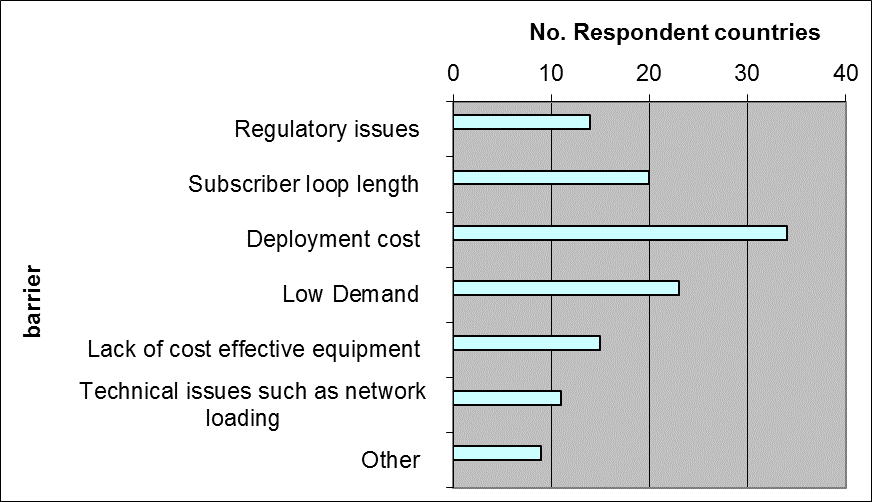
In addition to deployment costs, lack of demand for broadband services seemingly undermines any business case for investigating means to reduce deployments costs and overcome problems such as the subscriber loop length – which is a technical hurdle for the introduction of technologies such as DSL. Of the issues limiting the spread of broadband identified by respondents, the most common was that the monthly associated fee was too high as indicated in Figure 12.
Figure 12 – Major cost issues limiting the spread of broadband
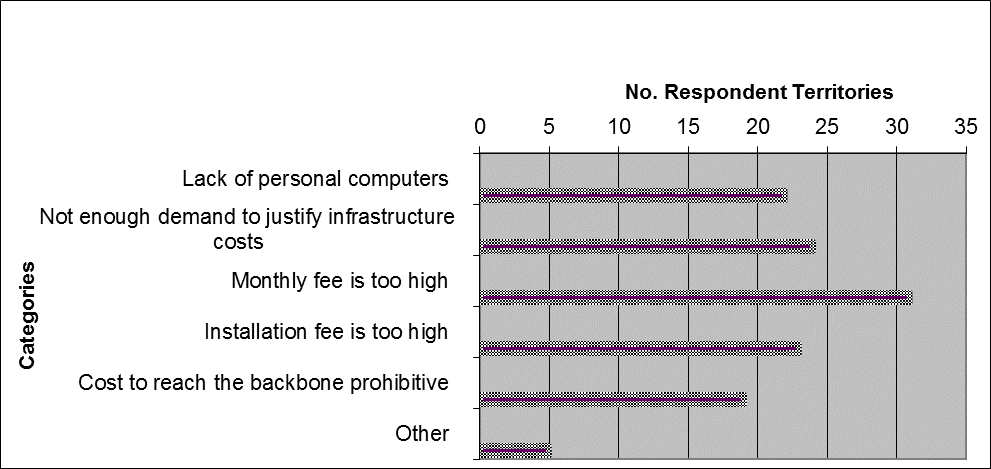
High monthly fees, high installation costs and lack of access to personal computers when combined can result in insufficient demand to justify infrastructure costs and make the business case for deploying broadband services more difficult. Other reasons identified include relatively low levels of education and computer literacy and the respondent from Malta identified the cost of acquiring content in local languages.
Some thirty one countries did not have any form of loans or other financial assistance available to enable operators to provide broad band to the last mile and these are listed in Table 8:
Table 8 – Countries without loans or financial assistance for the deployment of broadband services
Africa | Americas | Arab States | Asia | Europe |
Chad | Barbados | China | Armenia | |
Cфte d’Ivoire | Brazil | Israel | Belarus | |
Ethiopia | Chile | Korea (Rep.) | Belgium | |
Malawi | Costa Rica | Maldives | Bulgaria | |
Mauritius | Ecuador | Myanmar | Estonia | |
South Africa | Guyana | Nepal | Lithuania | |
Honduras | Pakistan | Norway | ||
Sri Lanka | Poland | |||
Spain | ||||
Switzerland |
While 12 countries offered loans and other forms of financial assistance to encourage the expansion of broadband services including: Nigeria, Uganda, Canada, Dominican Rep., Mexico, India, Japan, Tonga, Egypt, Bosnia, Denmark, Hungary; how these loans are facilitated differs widely from country to country. Canada and Mexico, Japan and Egypt all offer government based loans for broadband development schemes. In Uganda offers only private loans are available to operators, where as in Nigeria loans for operators are available as a result of UNDP and WorldBank programmes in addition to private lenders. In Denmark incentives take the form of tax exemptions for data communication related developments and in Hungary corporate tax reductions and direct state subsidies are available for developing broadband-based services. Some developing countries also qualify for international aid – such as loans and grants from USAID.
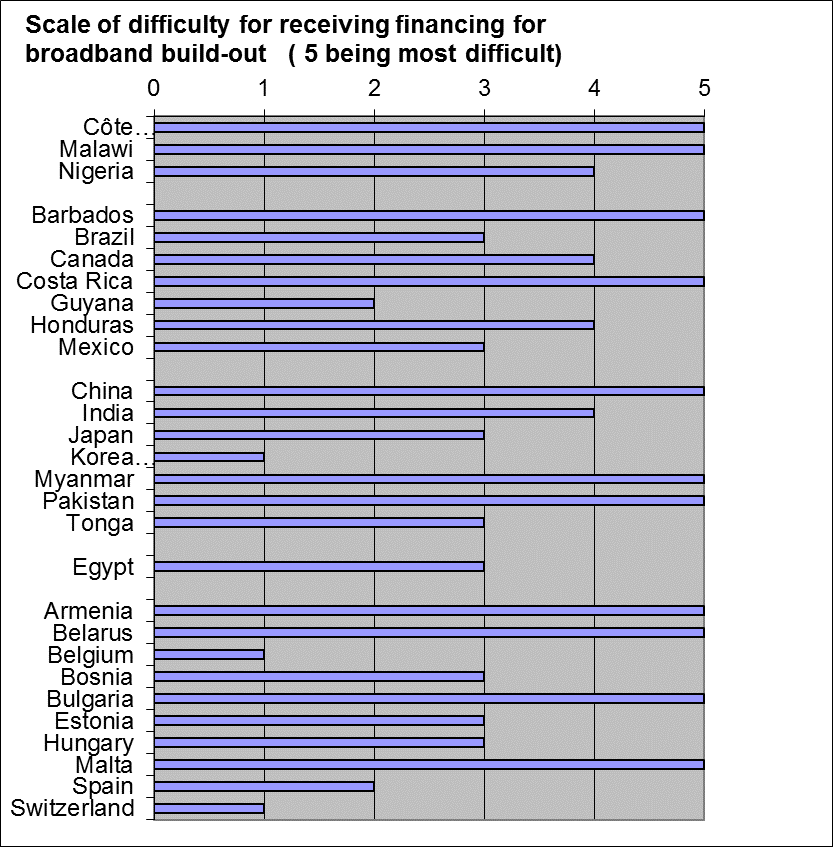
The difficulties facing operators in raising financing for broadband build-out is illustrated in the following graph – where questionnaire respondents rated the difficulties in raising finance on a scale of one to five with five being the most difficult. Unsurprisingly those countries with large rural areas, and dispersed rural populations are among those that face the greatest difficulties in raising finances for broadband build-out.
Figure 13 – Scale of difficulty for financing broadband services
Quality of Service

|
Из за большого объема этот материал размещен на нескольких страницах:
1 2 3 4 5 6 7 8 9 10 11 12 13 14 15 16 17 18 19 20 21 22 23 24 25 26 27 28 29 30 31 32 33 34 35 36 37 38 39 40 41 42 43 44 45 46 47 48 49 |
