

Партнерка на США и Канаду по недвижимости, выплаты в крипто
- 30% recurring commission
- Выплаты в USDT
- Вывод каждую неделю
- Комиссия до 5 лет за каждого referral
The Telecommunications Private Investment Supervising Organization (OSIPTEL) through the Telecommunications Investment Fund (FITEL) designed a series of projects under these guidelines, which aimed at providing fixed telephone services through public telephones and Internet access in district capitals.
FITEL called for International Public Bids, in which participating bidders committed themselves to oversee: i) installation, ii) operation and iii) maintenance of specific services utilizing the most efficient technology to allow them to comply with technical specifications.
Peru has particular characteristics that include a great geographic unevenness. Rural operators in charge of selecting the most adequate technology to comply with technical requirements took this into consideration. In the end, satellite technology through the implementation of VSAT networks was chosen by participating bidders.
This document presents a general perspective of the deployment of VSAT networks in Peru through FITEL.
Description of the VSAT network
The VSAT satellite network implemented in Peru’s rural areas operates in the band 10-20 GHz, with a 11,7 to 12,2 GHz up-link and a 14 a 14,5 GHz down link, utilizing a PAS-1R satellite.
The VSAT network has a star-like topology, with multiple remote stations that communicate through a Main Hub with a FDMA/TDMA DAMA access scheme.
Current data transmission speed reaches 256 kbit/s for the carrier from the Hub to the remote stations (Outbound – up link), with QPSK and 38,4 kbit/s modulation for the carrier from the remote stations to the Hub (Inbound – down link) with a MSK modulation. Additionally, a LAN Ethernet port is included which can reach speeds of up to 10 Mbit/s.
Among the VSAT network’s main components we can mention the following: i) multiple remote stations, ii) nodal station (Hub), iii) prepayment104 subsystem, iv) network management system. Figure 26 shows the simplified diagram of the VSAT network.
Figure 26 – Simplified scheme of the VSAT network
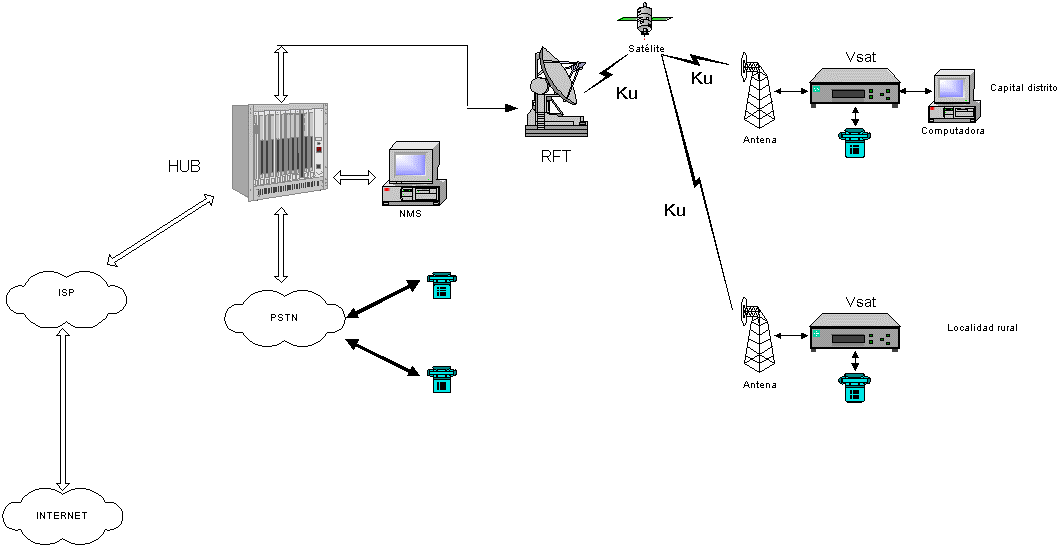
Remote stations are constituted basically by two modules: the external unit (Outdoor Unit – ODU) and the internal unit (Indoor Unit – IDU), that includes the VSAT. Apart from the energy subsystem and protection subsystem.
The external unit (ODU) is comprised of the antenna and radio frequency elements that enable communication between the internal unit (IDU) and the satellite. Some of its components include: i) an antenna that varies in size from 1,2 to 1,8m105, ii) a high potency converter, with potency that varies from 500 mW to 1 W106 and iii) low noise converter block.
Services107 currently being provided include the following: i) voice, ii) fax (Group 3) low speed data, iii) free calls to emergency centres and iv) Internet access in rural district capitals at a speed of 9 600 Bauds.
Rural operators
As a result of the International Public Bids the subprojects have been awarded to two operators: Gilat To Home Peru S. A. (formerly named Global Village Telecom.) and Rural Telecom. S. A.C. Table 2 shows the distribution of subprojects per rural operator.
III.2.6 United States
1) Fibre to the Home Rural Community Project, Grant County, Washington, US108
The Grant County Public Utility District (GCPUD) is building fibre-to-the-home (FTTH) in a rural community in Washington State. According to the GCPUD, FTTH is assisting small business, educational institutions, medical facilities and others where other telecom services are offered in a limited capacity. In March 2000, Washington State passed a state law that allowed public utilities to build fibre-optic networks. As of March 2003, more than 10 000 meters were passed, and more than 9 200 homes were passed by the fibre build-out in Grant County. The Grant County Public Utility District had a 43 per cent penetration rate, with about 4 000 subscribers, as of March 2003. Nearly 100 per cent of the homes have Internet access. And, nineteen ISPs, two video companies, one telephone company and one security company are providing high-speed voice, video and data applications. As a result of its broadband buildout, the economic impact has been significant.
• Over 100 new jobs have been created as a result of the network, creating a USD 9 million economic benefit for the region.
• As a result of the network, 25% of people with access have purchased a new computer or related equipment, 72% of people with access have purchased goods or services online and 62% believe that broadband access improves their children’s education.
• A local chemical plant has reduced executive visits to Sweden from once a month to twice a year because of video conferencing.
• Point-of-service entities, like gas stations, have decreased credit card processing time.
• Farmers are using the applications to track the market prices of their products and do livestock and crop research.
• County schools are using the FTTH connection for distance learning, distributing programming, financial aid information and advising information.
• Medical facilities are transmitting more medical information to doctors and patients faster.
• GCPUD also estimated that every 300 new employees attracted to the region as a result of the FTTH networks would translate into USD 72 million for the local economy because of the multiplier effect of consumer spending.
High Speed Satellite Broadband Service for Medical Purpose, Columbia, South Carolina, US109
On July 1, 2002, Hughes Network Systems, Inc. (HNS), the Advanced Technology Institute (ATI), and the Columbia Eye Clinic launched a high-speed, satellite broadband service linking medical professionals at the Columbia Eye Clinic with patients at Beaufort-Jasper-Hampton Community Health Centre in Ridgeland, South Carolina. The service allows clinic experts to screen the eyes of patients over 100 miles away for diabetic retinopathy. In the coming years, they plan to screen patients in other parts of South Carolina and then expand to screenings for glaucoma and other anterior segment diseases. Broadband access will facilitate the collection of epidemiological data and aid in patient education.
2) Municipal Fibre Optic Network, Kutztown, Pennsylvania, US110
The city of Kutztown, Pennsylvania built Pennsylvania’s first municipal fibre-optic network. It is a USD 4.6 million project, which the city began building in 2001. The network has created competition for high-speed Internet access, cable TV and telephone service in Kutztown. Kutztown is one of only a handful of US cities to run fibre to every home and business. The network offers speeds up to 100 megabytes per second. The network provides residents the ability to monitor home security, pay water and sewer bills and track their electricity use. Officials also envision video-on-demand and music-on-demand, distance learning and e-health as applications to be deployed using the new fibre-optic network. In addition, the network will provide Kutztown’s electric utility the ability to automatically detect the location of power outages and equipment failures. It also will let the utility use automated meter reading technology. That will eliminate the need for time-consuming manual checks of the borough’s several thousand electric meters each month.
3) Point-to-point Wireless Broadband Program Turtle Mountain & Fort Berthold, ND & Fort Peck, MT, US111
Fast Internet access (Mbit/s) has become available within but few of the U. S. Native American Indian Reservations. To accelerate availability, the U. S. National Science Foundation, through its EDUCAUSE (www. educause. edu) affiliate and AN-MSI project (www. an-msi. org), recently funded deployment of wireless fast Internet access to community colleges at several reservations, including necessary feeder/backhaul. At three, including Fort Peck Community College (MT), the Fort Berthold Community College (ND), and the Turtle Mountain Community College (ND), the AN-MSI project, led by Dandin Group CEO Dewayne Hendricks, deployed U-NII band (5 GHz) “Canopy” broadband wireless equipment offered by Motorola, both 20 Mbit/s feeder/backhaul links and 10 Mbit/s access links. Each network soon will be extended to more community sites, perhaps then households.
4) Example of Fixed Broadband Wireless Implementation in the United States
The city of Forth Wayne, Indiana, is the second largest city in the state of Indiana. The local government and private sector of this city concluded that it was necessary to establish a regional capability to provide businesses and residents in the metro area access to high-speed broadband services at reasonable cost as such a capability was essential to economic development. It was considered that ubiquitous broadband deployment would bring valuable services to businesses and consumers, stimulate economic activity, improve local productivity, and improve education.
This was accomplished through the Indiana Data Centre. The criteria for the technology to implement this were: 1) No public financing, but use of public facilities; 2) digital structure; 3) Always on and ubiquitous, 4) able to evolve new users; 5) able to address interference issues.
After much evaluation of alternative technology solutions, the Motorola Canopy product was selected. This BWA concept:
• Uses a cellular-like concept with more access points close to the ground.
• Mitigates interference in unlicensed bands.
• Provides a modular design for expanding the system with ease of installation (one day).

|
Из за большого объема этот материал размещен на нескольких страницах:
1 2 3 4 5 6 7 8 9 10 11 12 13 14 15 16 17 18 19 20 21 22 23 24 25 26 27 28 29 30 31 32 33 34 35 36 37 38 39 40 41 42 43 44 45 46 47 48 49 |
