


Партнерка на США и Канаду по недвижимости, выплаты в крипто
- 30% recurring commission
- Выплаты в USDT
- Вывод каждую неделю
- Комиссия до 5 лет за каждого referral
Main locations: open-plan offices, individual offices, meeting rooms, corridors, store rooms
8.10 Ω Prepare notes for a short talk to brief the project engineer using your ideas from Exercise 8.9. Student A, you are an M&E engineer. Brief the project engineer on your ideas. Student B, you are the project engineer. Listen to the briefing and ask questions about specific details. Swap roles and practise again.
Referring to measurable parameters
8.11 Pair work. Think of monitoring and control systems that are widely used around the home. Discuss how the following parameters are measured and/or controlled in these common domestic appliances.
Parameters: | temperature | pressure | time | actions/movement |
Appliances: | boilers | heating systems | refrigerators | washing machines |
8.12 Match the sensor or measuring system (1-5) to the industrial applications (a-e).
1 | pressure measurement | a | monitoring the speed of water travelling along a supply pipe |
2 | temperature measurement | b | measuring the level of heat generated by an exothermic reaction |
3 | flow measurement | c | monitoring the number of cans moving along a conveyor belt |
4 | level measurement | d | monitoring the amount of ethanol contained in a storage tank |
5 | process recorders | e | checking the force exerted by steam inside a vessel |
8.13 Pair work, think of other uses for the kinds of sensor and measuring equipment in Exercise 8.12
8.14 Ω Jochem and Katerina, two process engineers at a chemicals plant, are discussing the monitoring and control systems that will be needed for a new production line. Listen to three extracts from their discussion and answer the following questions.
Extract 1 a What problem is discussed?
b What mechanical safety precaution is proposed?
Extract 2 с What issue is discussed?
d What three parameters related to consumption are important?
e To calculate the parameters, what does consumption need to be continuously measured against?
Extract 3 f What issue is discussed?
g Which two measurements need to be taken?
h What optimum value needs to be determined?
8.15 Match the words (1-10) from the discussion to the definitions (a-j)
1 | input | a | the best / the most effective/efficient |
2 | output | b | how often something happens |
3 | optimum | c | the amount of supplies/fuel used |
4 | differential | d | the total quantity so far |
5 | consumption | e | a specified period |
6 | cumulative | f | a value often expressed with per, for example units per hour |
7 | rate | g | the exit value, for example at the end of a process |
8 | cycle | h | the entry value, for example at the start of a process |
9 | frequency | i | the gap between two values |
10 | timescale | j | all the steps in a process, from start to finish |
8.16 The following specification was written following the plete the text using the words in Exercise 8.15 Vessel B l: Sensor and Measuring System Requirements Two pressure sensors: one located inside the vessel, and a second situated on the pipe running downstream, to enable any pressure (1) differential to be detected. A flow meter to monitor gas (2) _______. Data will be recorded as a (3) ________ figure (total usage), and as flow (4)__________ , in litres per second. Note: Software will be configured to log flow against the (5) _________ of a system clock, in order to pinpoint peak flow periods occurring between the start and finish of a given reaction (6) ____________ and to assess the (7) __________with which they occur. Two temperature sensors: one at the entry point of the vessel, to measure (8) _________ temperature, and a second at the outlet point to monitor (9) _________ temperature. Note: Precise regulation of the entry temperature will be key to obtaining (10) _________ reaction performance. |
8.17 You and your partner are process engineers working with Jochem and Katerina at the chemical plant. You need to assess the sensors and measuring equipment required for the steam production facility. In pairs, discuss the requirements using the information in the diagram. Make notes of your ideas.
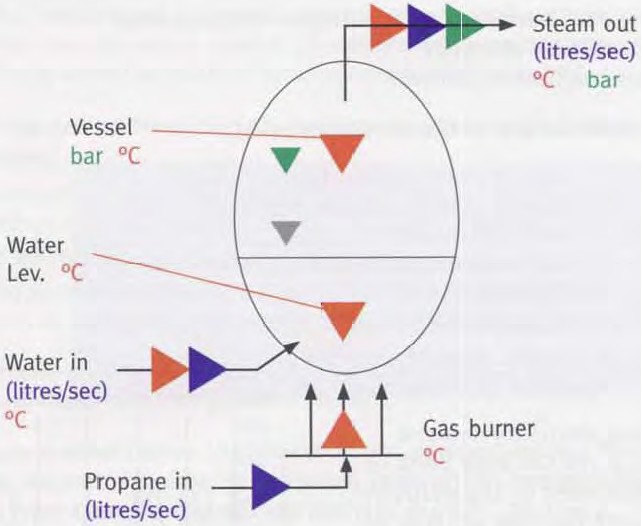
8.18 Pair work. Discuss what parameters can be determined for the installation of a heating cycle using your ideas from Exercise 8.17 You should assume that all the measurements will be recorded against a timescale.
Discussing readings and trends
8.19 Pair work. Discuss the factors that cause mains electricity consumption to vary.
8.20 Ω Helen, an electrical engineer at a power station, is giving a talk to a group of visiting investors. Listen to the talk and note the five factors that influence electricity consumption.
8.21 Complete the following extracts from the talk using the correct form of the words in the box.
decrease | fall | increase | rise |
During periods of very cold or very hot weather, demand increases.
The ________ in demand is obviously due to millions of electric radiators
coming on...
… a key factor which _________ or __________demand, is whether or not it's light or dark... ...on cold, dark, winter evenings, the ________ in demand is significant… Generally, demand ___________during the week, when factories and offices are operational... So demand _______at the weekend. There can be a sudden ________when people rush to switch kettles on,or heat up snacks in microwaves, and then a sudden _______ short afterwards.
8.22 Ω Listen to the next part of Helen's talk and answer the following questions.
1. Why does the company often have significant spare generating capacity?
2. What ideal situation does Helen describe?
3. Why is this ideal situation difficult to achieve?
8.23 Match the words (1-8) from the talk to the definitions (a-h).
1 | continuous | a | maximum power requirement at given time |
2 | fluctuations | b | amount between an upper and lower limit |
3 | Peaks and troughs | c | without interruption |
4 | peak demand | d | high points and low points on a graph curve |
5 | range | e | regular and repetitive |
6 | band and fluctuation | f | momentary rises followed by a fall |
7 | blips | g | changes, movements in general |
8 | continual | h | Zone of up-and-down movement |
8.24 Read the document on energy saving aimed at industrial plant and facility plete the text using the words in Exercise 8.23.
Dynamic demand control systems can be fitted to electrical appliances that operate on duty cycles, i. e. appliances that start up, run for a time, shut down again, and then remain on standby for a while before repeating the same cycle. Heating and refrigeration units are common examples of power-hungry equipment that operate on this start-run-stop-wait basis.
Dynamic systems exploit the fact that duty cycle appliances do not require (1) continuous power. The purpose of the systems is to help smooth power demand for
the benefit of electric utilities. To achieve this, they delay the start-up of the appliances they control during periods of (2) _______. However, only minor adjustments are made to timing as, generally, the appliances concerned can only be held on standby for short periods as they need to run on a (3) ______basis. But this still benefits electric utilities as it helps to avoid problematic, momentary (4) ______on the demand curve.
Dynamic controls work by detecting slight (5) ________in the frequency of the mains AC supply. Although this varies only within a very narrow (6) ______, small drops in frequency indicate that power station turbines are working close to full capacity. The dynamic control system can therefore hold the appliance on standby for a short time until mains frequency increases again.
8.25 Read the text again and answer the following questions.
1. What is meant by duty cycle?
2. What problem is dynamic control designed to avoid?
3. What sensor input do dynamic controls rely on to allow them to function?
4. What does the sensor input in (3) indicate with regard to power stations?
5. To what extent do dynamic systems modify duty cycles?
8.26 Read the extract from the talk and, in pairs, discuss the following questions.

|
Из за большого объема этот материал размещен на нескольких страницах:
1 2 3 4 5 6 7 8 9 10 11 12 13 14 15 16 17 18 19 20 21 22 23 24 |
