


Партнерка на США и Канаду по недвижимости, выплаты в крипто
- 30% recurring commission
- Выплаты в USDT
- Вывод каждую неделю
- Комиссия до 5 лет за каждого referral
Resolution Vocabulary
COMMUNICATE
Some conflicts start because people misunderstand each other. Talking things out and explaining might take care of it.
NEGOTIATE
When two or more people decide to work out a conflict themselves, they might follow a set of steps. The steps help them work out the conflict or negotiate.
MEDIATE
Sometimes people want to work out a problem but have trouble negotiating. They might ask someone to help them. That person is called a mediator. He or she mediates the conflict by helping the people work it out. The mediator does not tell the people what to do; he or she helps them decide for themselves.
ARBITRATE
Sometimes a mediator does solve people's problems. Then he or she isn't called a mediator. He or she is called an arbitrator. When people ask an arbitrator to help them, they must agree to do whatever the arbitrator suggests.
LITIGATE
When people can't work out their conflict themselves, they may go to a court and have a trial. They hire lawyers and go before a judge. A judge is like an arbitrator. The lawyers try to convince the judge that their client is right. The judge decides who is right according to the law and decides what solution there should be.
LEGISLATE
To legislate is to make something the law or a rule. Some kinds of conflicts cause people to try to change laws or rules so the problem won't happen again.
Vocabulary
Workplace - the room or building where you work.
In many cases, conflicts in the workplace just seem to be a fact of life.
Animosity - strong dislike or hatred, hostility
And we've all seen the often-intense personal animosity that can result.
Outcome - the final result of a meeting, discussion etc. especially when no one knows what it will actually be until it happens.
Conflict resolution skills can make the difference between positive and negative outcomes.
Awareness - knowledge or understanding of a particular subject or situation
The discussion needed to resolve conflict expands people's awareness of the situation.
Achieve - to successfully complete something or get a good result, especially by working hard
Conflict resolution helps people achieve their own goals.
Undermine - to gradually make someone or something less strong or effective
They can achieve their own goals without undermining those of other people
Cohesion - if there is cohesion among a group of people, a set of ideas etc, all the parts or members of it are connected or related in a reasonable way to form a whole
When a conflict is resolved effectively, it increases group cohesion.
Renewed - starting again, especially with increased interest or strength
Team members can develop stronger mutual respect, and a renewed faith in their ability to work together.
Sharpen - to improve something so it is up to the necessary standard or quality also to make something have a sharper edge or point.
The recent conflicts have sharpened the group's focus on how to resolve them.
Enhance - to improve something
Improved self-knowledge will help you enhance your effectiveness in resolving conflicts.
Dislike - a feeling of not liking someone or something
Conflicting goals can quickly turn into personal dislike.
Teamwork - when a group of people work effectively together
I want to encourage teamwork in our class.
Break down - to fail or stop working in a successful way
Negotiations broke down when neither side could agree on anything.
Disengage - to stop being involved or interested in something
People disengage from their work when teamwork breaks down.
Vicious - unpleasantly strong or severe, violent and cruel, very unkind
That dog has bitten 2 people. It's a vicious dog.
Downward - spiral a process, usually a harmful one, in which something gradually but continuously gets worse or better
The constant lack of communication at work resulted in a downward spiral of productivity.
Recrimination - when you blame or criticize someone for something that has happened
There were many recriminations after the fatal bus accident.
Deal with - to take the necessary action especially in order to solve a problem
Ralph Kilmann identified five main styles of dealing with conflict.
Assertiveness - behaving in a confident way so that people notice you
She acted more decisively after she took assertiveness training.
Competitive - determined or trying very hard to be more successful than other people or businesses
Competitive people know what they want and operate from a position of power.
Take a firm - stand a strong effort to defend yourself or to oppose something
At this college, we take a firm stand against cheating on tests.
Persuasive - able to make other people believe something or do what you ask
Tom Sawyer was so persuasive that he convinced his friends to paint the fence for nothing.
Unpopular - not liked by most people
Giving a quiz on Monday morning was an unpopular decision the teacher decided to change.
Selfishly - caring only about yourself and not about other people - used to show disapproval
You are being very selfish trying to exploit this situation to your own advantage.
Bruised - to affect someone badly and make them feel less confident
The bitter conflict at work left people feeling badly bruised.
Resentful - feeling angry and upset about something that you think is unfair
He felt resentful when others were promoted at work and he wasn't.
Collaborative - a job or piece of work that involves two or more people working together to achieve something
A collaborative work style tries to meet the needs of all people involved.
Viewpoint - a particular way of thinking about a problem or subject or a point of view
Let's try to find what's common in all these different viewpoints.
Tradeoff - a balance between two opposing things, that you are willing to accept in order to achieve something
The tradeoff of leaving work at 2 pm instead of at 5, but working Saturdays, isn't good for me.
Give up - to stop doing something, especially something that you do regularly and to stop trying to do something
Everyone is expected to give up something in order to reach a compromise.
A Conflict Management Exercise
As a manager you should certainly be able to deal with conflict, even if it means negotiating. The truth, however, is that every member of your team should be able to do the same thing because doing so will mean they’re better able to work together as a team.
One way to teach conflict management is to play a game known as “Divide the Loot.” While we often suggest playing this game with real money, you can take some sort of play money to use instead. Here’s how to play:
- Divide your team into two groups so that one can be the “management” and the other can represent “employees.” Each group will start it’s own “pot” of money. Each person will pay a different amount into the pot but no one will know how much anyone else put into the pot. After a set amount of time, the activity leader will take both pots, combine them into one, and then add his own contribution. He’ll then total the pot and tell everyone how much is in the pot. Everyone will know how much he contributed individually but no one will know how much anyone else, from their own team or the other, contributed. No one knows how much the project manager contributed either. The teams will each have 10 minutes to decide how to fairly split the total of the pot amongst everyone in the room. After 10 minutes the managers and employees must come together and negotiate a final outcome.
The goal here is to encourage everyone to come to a final decision, working together to make a fair negotiation. Try to keep the atmosphere in the room friendly. It is, after all, fake money and no one is going to lose anything at the end of the day!
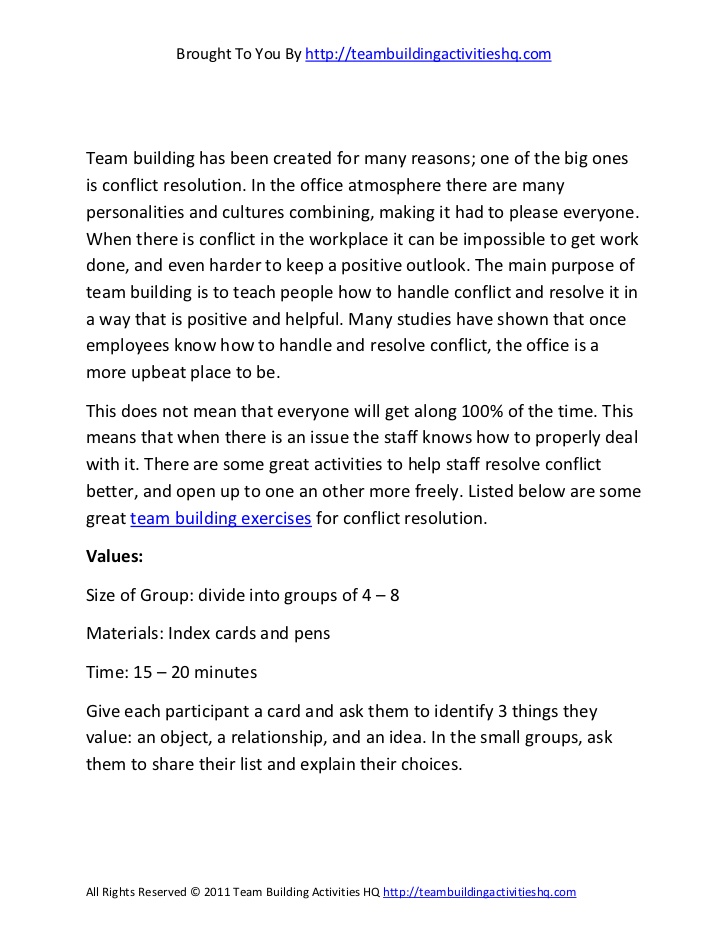
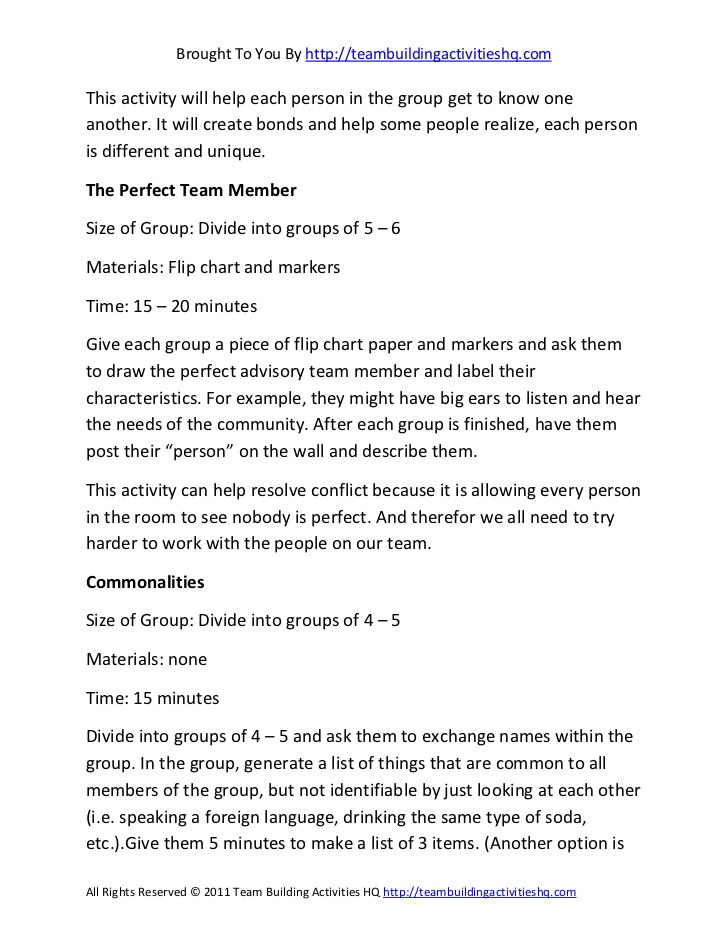
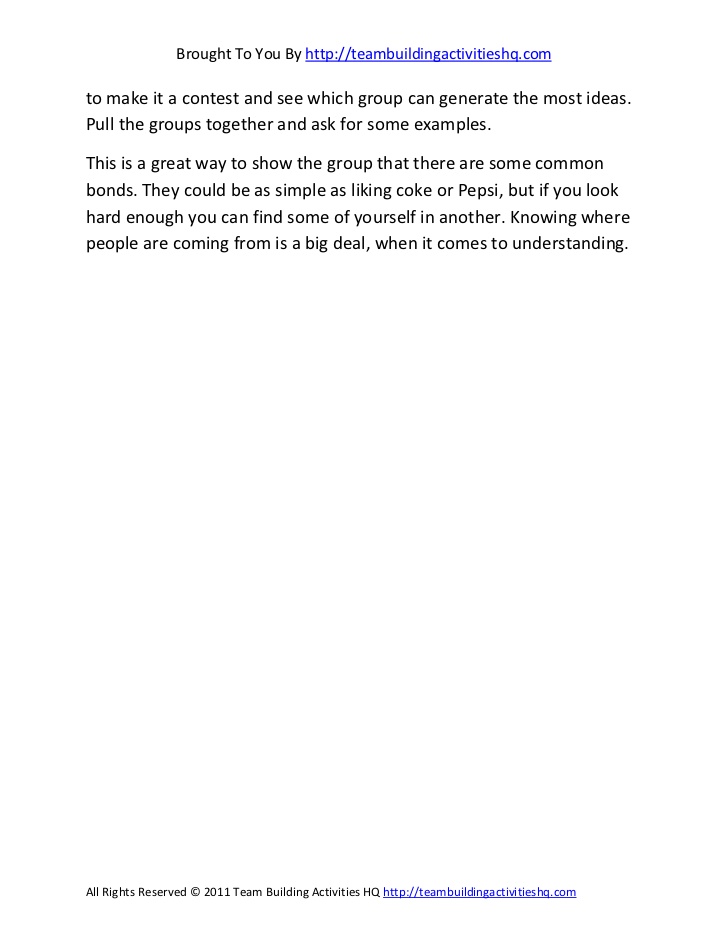
Team building exercises for conflict resolution
Тема 5. Собственный бизнес
Contract Vocabulary
agreement | n. an arrangement between two or more people, countries etc; contract |
appendix | n. additional or supplementary material at end of contract, book etc |
arbitration | n. settlement of a dispute by a person chosen by both parties - to arbitrate v. |
article | n. a particular statement or stipulation in a contract etc; clause |
clause | n. a particular statement or stipulation in a contract etc; article |
condition | n. anything necessary before the performance of something else |
force majeure | perior, power; unforeseeable event excusing one party from fulfilling contract |
fulfil | v: to satisfy a condition; to complete the required task; to fulfillUS |
herein | adv: in here; in this (document etc) |
hereinafter | adv: in the following part (of this document etc) |
hereto | adv: to this (document etc) [eg: attached hereto] |
heretofore | adv: up until now; until the present; before this |
in behalf of | in the interests of (person etc); for (person etc); on behalf ofUK |
null and void | invalid; without legal force; not binding |
on the one hand | on one side - on the other hand on the other side |
party | n. the person or persons forming one side of an agreement |
stipulate | v. to specify as an essential condition - stipulation n. |
terms | n. conditions or stipulations |
warrant | v. to give formal assurance; to guarantee |
whereas | conj: it being the case that; in view of the fact that [in introduction to contracts] |
Vocabulary for Meetings

|
Из за большого объема этот материал размещен на нескольких страницах:
1 2 3 4 5 6 7 8 9 10 11 12 13 14 15 16 17 18 19 20 21 22 23 24 25 26 |
