

Партнерка на США и Канаду по недвижимости, выплаты в крипто
- 30% recurring commission
- Выплаты в USDT
- Вывод каждую неделю
- Комиссия до 5 лет за каждого referral
Lead-zinc skarns occur in distal settings relative to the source intrusions. They commonly grade outward from zones rich in skarn minerals to zones in which the skarn mineralogy is poorly developed. In places skarn mineralogy may be almost totally absent. Almost all minerals in lead-zinc skarns are manganese-rich; the pyroxene: garnet ratio and the manganese content of pyroxenes increase away from the intrusion. These skarns are therefore closely related to the porphyry-related carbonate-base metal-style gold systems outlined in section 6.ii.
Elsewhere in the world, iron skarns are the largest known skarn deposits and although they are mined principally for their magnetite content, they contain subeconomic amounts of Cu, Co, Ni, and Au, Some are these are transitional to copper skarns. Iron skarns occur in back-arc basins of island arcs where they are associated with iron-rich diabase to diorite intrusions (Meinert, 1993).
Molybdenum and tin skarns are not seen in the southwest Pacific rim, and are found in continental rift environments associated with leucocratic and high-silica granites respectively. Tungsten skarns occur in deeply eroded calc-alkaline granodiorite to quartz monzonite batholiths.
iii) Breccia-Hosted Gold Deposits
Gold-bearing magmatic hydrothermal breccias form in volcanoplutonic terrains and display characteristics indicative of a magmatic association. Deposits of this type generally represent large tonnage low grade gold resources. Discrete breccia bodies include: in eastern Australia, Kidston (Baker and Tullemans, 1990; Baker and Andrew, 1991) and Mt Leyshon (Paull et al., 1990); in USA, Golden Sunlight (Porter and Ripley, 1985); and San Cristobal, Chile (Corbett, unpublished, reports; Egert and Kaseneva, 1995). Sillitoe (1991b) distinguishes breccias which are derived from a higher temperature magmatic fluid of the Kidston and Golden Sunlight type, from phreatomagmatic (gas driven) diatreme breccias which are common within carbonate-base metal gold deposits described in Section 7.iii (e. g., Montana Tunnels, USA, Sillitoe et al., 1985; Wau, PNG, Sillitoe et al., 1984). Mineralization associated with the magmatic hydrothermal breccias described above (Kidston, Mt Leyshon, San Cristobal) therefore corresponds to the deeper quartz-sulphide gold + copper classification (Section 7.ii).
Magmatic hydrothermal breccias provide pre-mineral ground preparation overlying porphyry environments from which mineralized fluids are channelled. Sheeted fracture/vein systems commonly provide channelways for fluid transport. The style of mineralization within most magmatic hydrothermal breccia systems might best be described as of the low sulphidation quartz-sulphide gold-type. Kidston is an example of one of these, and is discussed in Section 7.ii. d.
75b
Exploration Workshop "Southwest Pacific rim gold-copper systems:Siructure. Alteration and Mineralization: Corbett GJ & Leach TM. 8/96
iv) Porphyry and Alkaline Gold Deposits
Sillitoe (1979) predicted that a class of gold-rich porphyry copper deposits or porphyry gold deposits would emerge, of which the Marte gold deposit is a good example (Vila et al., 1991). Many of the deposits cited by Sillitoe (1979) occur in association with alkaline volcanoplutonism and so were classed by Bonham (1988) as alkalic gold deposits. This theme was extended by Rock et al. (1989), who applied the essentially textural term of lamprophyre to group geochemically similar calc-alkaline rocks occurring through a wide range of geological time, and suggested that these magmas could display primary gold enrichments (Rock, 1991).
The identification of gold mineralization in the Tabar-Lihir-Tanga-Feni Island Chain in Papua New Guinea (Moyle et al., 1990, 1991; Licence et al., 1987; Nord Resources Prospectus), which Wallace et al. (1983) describe as shoshonitic, and the similarity to host rocks at Emperor Gold mine (Anderson and Eaton, 1990; Eaton and Setterfield, 1993); Porgera (Richards, 1990) and Goonumbla, eastern Australia (Heithersay et al., 1990), prompted the evaluation of potassium-rich rock types during the 1980's (Muller, and Groves 1993, 1995).
The study of granite types evolved the classification of A-type granites (Collins et al., 1982; Clements et al., 1986), which became popularly defined by explorationists as; "anhydrous, alkaline (potassium-rich), anorogenic, aluminous and anomalous", but promoted some controversy in the application of mineral exploration (Hannah and Stein, 1990). In a review, Pitcher (1993) suggests that the key factor in the mineralization of A-type granites is the greater abundances of F, Cl and often B, and goes on to describe alkali fluoride complexes as efficient means of transporting metals, most evident in tin systems. The high temperature and fluxing effect of halogens aid in the transport of these phenocryst-poor intrusions (Pitcher, 1993), commonly seen as dykes.
Recent models (Johnson, 1987; Solomon, 1990; Wyborn, 1992; Solomon and Groves, 1994) suggest that shoshonites are derived by the remelting of mantle derived material and the arc reversal model of Solomon (1992) is consistent with the setting of shoshonitic volcanism in the Tabar-Lihir-Tanga-Feni arc, PNG and Fiji. Miocene volcanic arcs formed north of Papua New Guinea overly a south dipping subduction zone (Fig. 1.2), which became clogged by the Pliocene collision of the Otong Java Plateau. A new north dipping subduction subsequently developed south of New Britain and remelting of already subducted mantle material gave rise to the Pliocene-Pleistocene Tabar-Lihir-Tanga-Feni Island Arc within NS trending rifts formed by the arching of the subducting plate (Fig. 1.2).
It appears that shoshonitic magma types may preferentially give rise to gold and copper deposits in particular tectonic settings. The dry and high temperature mantle-derived melts must rise quickly from considerable depths and so commonly display an association with major crustal structures or rifts. Shoshonite-related southwest Pacific gold-copper deposits occur in a range of low sulphidation intrusive-related settings described in this manual as:
Porphyry Cu/Au - Goonumbla, eastern Australia; Marian, Didipio, Philippines Quartz-sulphide Au - Lihir, Simberi in PNG Carbonate-base metal Au - Porgera, PNG Epithermal Au/Ag - Emperor, Fiji
Thus the "alkaline gold deposits" are not a separate group of deposits, but are porphyry-related gold systems which demonstrate an association with a similar, and possibly prospective, magma source. Arribas (1995) notes that no high sulphidation copper-gold mineralization occurs in association with these intrusive compositions. In a comparison
75c
Exploration Workshop "Southwest Pacific rim gold-copper systems:Structure. Alteration and Mineralization: Corbett GJ & Leach TM. 8/96
of several alkaline gold deposits, Richards (1995) stresses that ore-forming processes are common to many porphyry-related hydrothermal copper-gold systems, and provides a model for possible mechanisms of concentration of chalcophile elements in the magmatic volatile phase in alkaline systems, which illustrate typical zonations from copper to gold-rich.
75d
Exploration Workshop "Southwest Pacific rim gold-copper systems: Structure, Alteration, and Mineralization" Corbett G J & Leach T M, 8/96 Edn.
6 HIGH SULPHIDATION GOLD-COPPER SYSTEMS
i) Characteristics
a) Introduction
High sulphidation gold-copper systems have also been termed acid sulphate (Hayba et al., 1985) or alunite-kaolinite ± pyrophyllite (Berger and Henley, 1989) and included in the epithermal class of gold deposits (Sillitoe 1993b, White and Hedenquist 1995). Bonham (1986, 1988) distinguished the high sulphidation style of gold deposits on the basis of:
* Abundance of sulphur as sulphate and sulphide,
* Zoned alteration as central advanced argillic, to argillic, to peripheral propylitic
alteration zones,
* Dominance of enargite/luzonite in the ore mineralogy,
* An association with calc-alkaline volcanism.
Early work by Urashima et al., (1981) recognised the alteration zonation at Iwato in the Nansatsu deposits, while the alteration and ore mineralogy as well as the association with porphyry copper systems are apparent in work of Sillitoe (1983).
The distinction between high and low sulphidation fluids is described in detail in Section l. iv. and the characteristics of low and high sulphidation deposits in Table 3. High sulphidation alteration systems form as hot acid magmatic-derived fluids which are enriched in reactive volatiles are cooled and neutralised by reaction with host rocks and groundwaters.
Although occurring outside the porphyry environment and hence commonly termed epithermal, high sulphidation alteration and mineralization also occur at crustal levels typified by mesothermal porphyry deposits and so the term epithermal is avoided here. We suggest that the term acid sulphate be utilised for alteration formed by collapsing low pH, surficial fluids discussed in Sections 1 and 4.
b) Classification
High sulphidation systems form at different crustal levels. The recognition of andalusite and corundum in high sulphidation advanced argillic alteration (e. g., Horse-Ivaal, Frieda River, PNG; Lookout Rocks, New Zealand; Cabang Kiri, Indonesia) suggests that some systems formed under very hot conditions, at near-porphyry depths. Central alunite-pyrophyllite alteration (e. g., Nena, Frieda River and Wafi River, PNG) are indicative of mesothermal to epithermal conditions. The dominance of pyrophyllite over alunite (e. g, Pueblo Viejo, Dominican Republic; Temora, Australia; Summitville, Goldfield and Red Mountain deposits in Western USA), all point to deep to moderate epithermal levels of deposition. The occurrence of only pyrophyllite and/or dickite/kaolinite and illitic clays in other systems (e. g., Maragorik, PNG; Mt Kasi, Fiji; Peak Hill and Dobroyde, eastern Australia), demonstrate that these systems formed at shallow epithermal levels.
White (1991) categorised high sulphidation systems on the basis of morphology and alteration mineralogy/zonations to define the type examples as:
* Nansatsu type as high level disseminated deposits,
* El Indio type which display a structural control,
* Temora type as deeper disseminated deposits;
76
Exploration Workshop "Southwest Pacific rim gold-copper systems: Structure, Alteration, and Mineralization" Corbett G J & Leach T M, 8/96 Edn
and also emphasised the distinction between early stage alteration and later mineralization. Much of the morphological differences in Whites classification can be accounted for by whether magmatic fluid flow, and hence alteration-forming reaction, has been controlled by dilational structures (e. g., El Indio, Lepanto in White 1991) or permeable lithologies (Nansatsu, Temora, Peak Hill).
High sulphidation systems are categorized as:
* porphyry-related
* lithologically controlled
* structurally controlled
Lithology and structure are end-members of a continuum of fluid control which in many high sulphidation systems displays a combination or variation between these elements. The distinction between epithermal and mesothermal systems is commonly transitional and refers more to distal of proximal relationships to porphyry source rocks than to crustal levels of formation.
It appears that some high sulphidation systems formed in distal settings to magmatic-source rocks may undergo sufficient mixing with groundwaters to evolve into a low sulphidation style of fluid. Exhalative high sulphidation systems are also distinguished. Thus other high sulphidation systems are categorized as:
* composite
* hybrid
* exhalative.
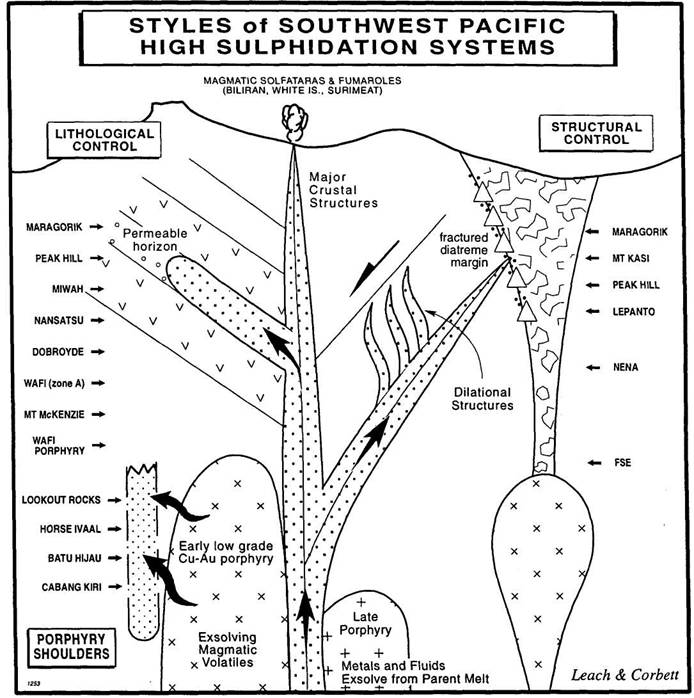
Figure 6.1 illustrates the main styles of high sulphidation systems showing also a relationship to depth of proximity to the magmatic source.
c) Active Analogues
Fluids enriched in volatile components (H2O, CO2, SO2, Cl, F, B), which are channelled up major crustal faults can migrate directly from a degassing magma to the surface and vent as solfataras or fumaroles (Fig. 6.1). Disproportionation of these gases within the fault zones produces very hot and highly acidic fluids. Fumaroles associated with the White Island andesite volcano in New Zealand vent gases and acidic fluids at temperatures of up to 600°C, and actively precipitate native sulphur deposits. The magmatic fluid discharge from the 1988 eruption at White Island, New Zealand has been calculated at 110 tons/year copper and >36 kg/year gold (le Cloarec et al., 1992). Thousands of ppm copper and arsenic, and anomalous gold occur within the deposits derived from the active Surimeat solfatara on the island of Vanu Lava, Vanuatu (Leach, unpubl. data).
At Biliran Island, Philippines, magmatic volatiles vent to the surface at the Vulcan solfatara in the form of superheated steam and magmatic gases, and produce liquid sulphur flows up to 1-2 km long (Mitchell and Leach, 1991). This magmatic, gas-dominated fluid has been emplaced within a pre-existing deep circulating (low sulphidation) geothermal system, which has incorporated some of the magmatic volatiles (e. g., Fl" is an order of magnitude higher than other Philippine geothermal systems). Feeders to the magmatic solfatara were intersected by drilling at depths of 1 km, and encountered fluids at >310°C and pH <2.
77
|
Exploration Workshop "Southwest Pacific rim gold-copper systems: Structure, Alteration, and Mineralization" Corbett G J & Leach T M, 8/96 Edn.
d) Alteration Assemblages
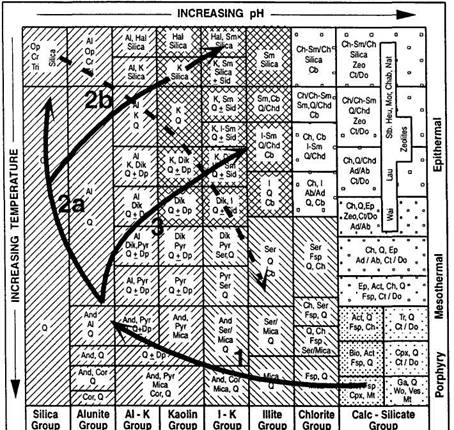
The range in alteration mineralogy encountered in high sulphidation systems is illustrated in Figure 6.2. In porphyry environments, high sulphidation alteration zonations are produced by the progressive acidification, through gradual disproportionation, of reactive magmatic volatiles (mainly SO2 and Cl) as they evolve from a high level intrusion. At shallower levels alteration zonations in high sulphidation systems are formed in response to neutralization and cooling of this hot acidic magmatic-derived fluid through either:
* wall rock reaction, and/or
* mixing with neutral, connate, meteoric or hydrothermal fluids residing in the host
rocks.
The progressive neutralization and cooling of the hot acid fluid results in the formation of zoned alteration characteristic to high sulphidation systems. Although present in both structurally and lithologically controlled high sulphidation systems, the zonation may be complicated by overprinting alteration. Four main alterations groupings are classified within the zoned alteration grading outward from the fluid plumbing system, commonly either a permeable horizon or dilational structure. These are:
i) Vughy or residual silica results of intense host rock leaching by hot fluids at a very low pH (<2). Only silica (usually quartz, but at shallow levels may be cristobalite, tridymite and/or opaline silica) and locally some rutile remain under these conditions. While the vughy texture which is indicative of the leaching generally predominates, silica deposition is locally recognised e. g., Peak Hill, Eastern Australia.
ii) Silica-alunite alteration which rims the silica core contains alunite group minerals (with zunyite-andalusite ± corundum at near porphyry levels), formed under a slightly higher (2-3) fluid pH range, as the fluid becomes neutralized in response to wall rock reaction and/or fluid mixing. The silica and silica-alunite alteration zones comprise what is generally termed advanced argillic alteration.
iii) Argillic alteration characterised by of kaolin group (pyrophyllite, dickite, kaolinite) minerals which are indicative of a formation at a pH of around 4 in turn rims the alunite. These grade outwards to illite group (sericite, illite, illite-smectite, smectite) minerals (pH around 5), as the fluid becomes progressively more neutralized. The mineral assemblages formed in each zone are dependent upon temperature and pH of the upwelling acid fluid, the composition of the host rock, and the physicochemical conditions residing in the host rock.
iv) Propylitic alteration which forms peripheral to the acid alteration assemblages is characterised by sub-propylitic chlorite-carbonate assemblages or propylitic epidote/actinolite-albite-chlorite-carbonate assemblages. In some systems this mineralogy overprints earlier formed calc-silicate mineralogy.
The alteration zonations formed in response to upwelling acidic magmatic-derived fluids are distinct from those formed by descending acid sulphate waters. The latter produces alteration zones which are indicative of a change from cool and acid to hot and neutral conditions (Fig. 6.2). Failure, to distinguish between these two alteration patterns could result in the misidentification of peripheral portions of high sulphidation alteration as caps to adularia-sericite epithermal vein systems.
78
|
High
Sulphidation Systems
Alteration Mineralogy
1- Porphyry high sulphidation systems
2. Structural high sulphidation systems
a. Silica core
b. Peripheral zones
3. Lithological high sulphidation systems
4. Descending cool acid sulphate fluids
Exploration Workshop "Southwest Pacific rim gold-copper systems: Structure, Alteration, and Mineralization" Corbett G J & Leach T M. 8/96 Edn.
e) Two stage alteration and mineralization model
High sulphidation systems are characterised by two separate stages of alteration and mineralization (Fig. 6.3). Initial leaching of the country rock as the fluid becomes progressively cooled and neutralized, is interpreted to have been caused by a volatile-rich acidic fluid (White, 1991). This results in the formation of alteration which grades outward as concentric zones away from the fluid plumbing system, described above as: a vughy or residual silica core, silica-alunite, to argillic, and peripheral propylitic alteration.
This initial phase of volatile leaching is commonly followed by a second phase event which may be polyphasal and comprises an early stage advanced argillic to argillic alteration and associated deposition of gangue phases; mainly quartz, alunite and/or barite, followed by deposition of sulphides in breccia zones, cavities and vughs. This event has been interpreted by White (1991) to be an liquid-rich acidic fluid but a less reactive event. This may be partly because the host rocks are already altered. Native sulphur infills open cavities and fractures in some systems, and is the last phase to be deposited, as sulphur displays a low melting point (113°C).
This liquid-rich phase utilises the same plumbing systems as the earlier volatile-rich phase and focuses mineralized fluids into the vughy or residual silica at the core of the zoned petent residual silica and silica-alunite rocks brecciate well and so host mineralization (e. g., Nena, PNG, Bainbridge et al., 1994). Continuing deformation of dilational structures channels the liquid-phase fluids may enhance the formation of fluidised hydrothermai injection breccias (Section 3.ix. d 1). Gold-copper grades may be proportional to the quantity of breccia matrix in styles of breccias (e. g., Mt Kasi, Fiji, Corbett and Taylor, 1994). The enclosing incompetent clay alteration generally displays more plastic deformation, does not fracture, and so is commonly not mineralized. A skin of barren silica-alunite alteration may rim the mineralized silica core and mask mineralization, especially if this material is relatively hard (e. g., Nena, PNG, Fig. 6.22). In some systems the clay alteration has a damning effect and so the interface between the competent and incompetent rocks may represent a locus for higher metal grades (e. g., Binebase, Sangihe Is, Indonesia; Corbett, unpubl. data). Elsewhere, (e. g., Wafi, PNG) peripheral clay zones formed during the liquid event and became sites of maximum mixing and local high gold grades. Overprinting zoned alteration is recognised in many systems as a result of this two phase alteration (Fig. 6.3).
The sequence of early leaching, zoned alteration and silicification followed by fracturing, brecciation and mineralization suggests that in most high sulphidation systems there has been selective partitioning of metals into the liquid phase during melt crystallization (contrary to the findings of Heinrich et al., 1992). However, significant gold ± copper mineralization is locally encountered in the clay zones formed during the initial alteration event (e. g., Wafi Zone A, Lepanto stratiform ore). This is interpreted to indicate that under certain conditions (i. e., multiple influxes of hot acid fluids), some metals may initially partition into the volatile phase, since the composition of that phase is interpreted to change progressively with time (Candela and Piccoli, 1995).
f) Mineralization
The locally polyphasal sulphide mineralization infills open space and forms breccia matrix comprises early deposition of iron sulphide, followed by copper sulphide phases. Such a sequence of initial iron sulphides and later base metal sulphides is also characteristic of low sulphidation intrusive-related systems, especially in the deeper level quartz-sulphide vein systems. This may reflect sequences of early iron and later copper fractionation from the melt
79
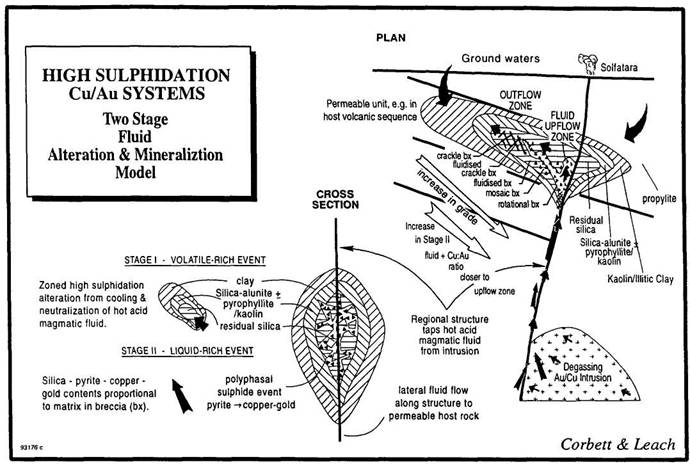
Fig. 6.3
Zonations in Metals and Copper Sulphides in High Sulphidation Systems
Exploration Workshop 'Southwest Pacific rim gold-copper systems: Structure, Alteration, and Mineralization" Corbett G J & Leach T M, 8/96 Edn.
during crystallization.
The iron sulphide phase is composed predominantly of pyrite at all depths, whereas marcasite and melnicovite-pyrite are common only at shallow levels. Arsenean pyrite is encountered only in settings of marginal argillic and propylitic alteration. In some systems the pyrite phase is also polyphasal with early coarse pyrite, overprinted by later fine pyrite-quartz, commonly forming as banded massive sulphide veins or the matrix to breccias.
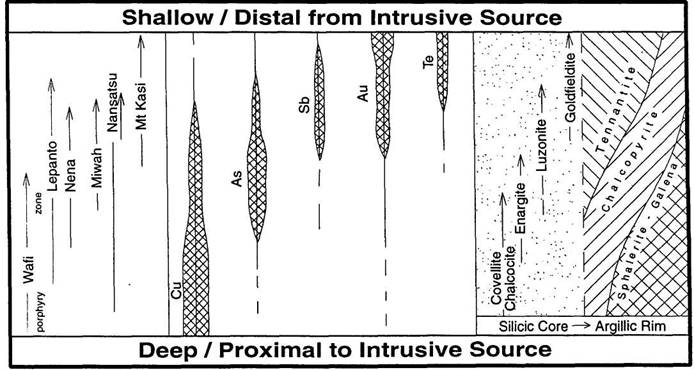
Copper deposition is typically the last event, and occurs infilling open vughs, and within fractures and breccia zones, generally overgrowing earlier pyrite and gangue phases. High sulphidation systems exhibit zonations in metals and sulphide phases, both laterally and vertically from deep levels proximal to intrusive sources to higher crustal levels, and from silica cores to peripheral argillic alteration (Fig. 6.4). The Cu:Au ratios decrease from deeper porphyry levels to higher epithermal levels. At intermediate depths the systems are arsenic-rich, and at very shallow near surface levels, high sulphidation systems commonly exhibit enrichment in tellurium, antimony and locally mercury. The central silicic zones are copper-arsenic-rich, whereas the marginal argillic-propylitic zones are dominated by lead-zinc mineralization.
There is a corresponding zonation in sulphide phases which reflect the metal zonations (Fig. 6.4). Hypogene covellite is commonly the main copper sulphide phase at levels proximal to the intrusive source (e. g., porphyry zone at Wafi), whereas enargite/luzonite are encountered at more distal environments (e. g., Nena, PNG; Lepanto, Philippines). A transition from enargite to its lower temperature polymorph luzonite occurs in cool outflow zones (e. g., Nena, Fig. 6.23). Antimony, tellurium, vanadium and mercury substitute for copper and arsenic at shallow epithermal levels to form phases such as stibioluzonite, goldfieldite, sulvanite and schwazite respectively. The formation of antimony, vanadium, tellurium and mercury phases at epithermal levels in high sulphidation systems is comparable to the abundance of similar metal phases at shallow levels in many intrusive-related low sulphidation systems. This may reflect the extensive dilution of the magmatic fluid at distal settings to the intrusive source, by mixing with groundwaters (e. g., Mt Kasi, Fiji; Leach, unpubl. data).
The copper sulphide phases become progressively more iron rich moving from the central silicic zones to marginal argillic zones (Fig. 6.4), e. g.,
covellite----- > chalcopyrite at deep levels, and
enargite/luzonite------ > tennantite------ > chalcopyrite at shallow levels.
The base metal phases galena and sphalerite are encountered in peripheral zones distal to the silicic cores.
High sulphidation systems in the southwest Pacific are commonly silver-poor. Gold is typically of a very high fineness (> 900), and occurs at deeper levels as submicroscopic inclusions in sulphides, or in the lattice of sulphides, and as free native gold or Au-tellurides at shallower levels. Gold is commonly associated with the copper phases, however in some systems significant gold is also deposited in later pyrite phases (e. g., Zone A at Wafi, PNG), especially those which immediately predate copper mineralization. High sulphidation systems formed at higher crustal levels (e. g., Mt Kasi, Fiji), and the upper oxidised portions of most high sulphidation systems (e. g., Nena, PNG) typically display better metallurgical characteristics.
80
Exploration Workshop "Southwest Pacific rim gold-copper systems: Structure, Alteration, and Mineralization" Corbett G J & Leach T M, 8/96 Edn.
ii) High Sulphidation Systems Formed as Shoulders to Porphyry Intrusions a) Characteristics
Porphyry-related high sulphidation systems may be encountered immediately adjacent to the intrusive source from which the acidic fluids have been derived (e. g., Horse-Ivaal, Frieda River, PNG; Lookout Rocks, New Zealand; Cabang Kiri, Indonesia). As fluids commonly exploit fracture permeability above the margins, rather than the centre of intrusives, the term shoulder is preferred to caps, as a description of the setting for porphyry-related high sulphidation alteration. While these roughly correspond to the porphyry copper lithocaps defined by Sillitoe (1995b), greater emphasis is placed here on the structural control as ledges (also utilised by Sillitoe, 1995b) on intrusion margins than as overlying caps. In these systems magmatic volatiles may be released into the same bounding structures initially utilised by the source intrusive during its emplacement. Through progressive disproportionation of reactive magmatic volatiles such as SO2 and Cl, the fluids become gradually more acidic and cooler, moving away from the source intrusive, both vertically and horizontally. The formation of advanced argillic zones marginal to high level intrusives is interpreted to take place during early stages of development of the porphyry-related hydrothermal system. In active porphyry systems in the Philippines, the production of hot acidic fluids occur after zoned propylitic-potassic alteration (e. g., Alto Peak), but pre-dates the collapse of meteoric waters to form overprinting phyllic alteration.
The gradational increase in fluid acidity results in a zonation of alteration mineralogy away from the porphyry as:
* potassic grading to phyllic alteration proximal to the porphyry,
* advanced argillic alteration dominated initially by andalusite and then pyrophyllite +
diaspore,
* alunite in silicic zones in distal settings.
The silicified advanced argillic zones commonly form ridges (ledges) distal from the intrusive, whereas the potassic-phyllic zones occur in more deeply eroded valleys proximal to the intrusion. Thus, these systems commonly form rugged topography in regions of high rainfall and erosion (e. g., Lookout Rocks, New Zealand; Horse-Ivaal, Frieda River, PNG). Fractured intrusive margins typically act as fluid conduits in dilatant fractures adjacent to the intrusive (e. g., Horse-Ivaal, Frieda River, PNG; Batu Hijau, Indonesia, Meldrum et al., 1994; Lookout Rocks, New Zealand, this manual). The term ledges is commonly used for silicified zones which display tabular morphologies, commonly by the exploitation of a dilatant structure or permeable lithology (Sillitoe, 1995b). Silica tends to form as locally brecciated pervasive silicification and lacks the vughy character of residual silica in ore-related high sulphidation systems. Corundum is locally encountered in high temperature zones immediately adjacent to some intrusions. Very coarse grained muscovite may be associated with the advanced argillic alteration mineralogy, and the mutual intergrowth with alunite is diagnostic of high sulphidation systems at porphyry depths (e. g., in the diatreme at Wafi). Some high sulphidation systems proximal to source intrusives are enriched in halogens derived from the magmatic volatiles. This is pronounced in those systems sourced from felsic intrusives, and may be exhibited by the formation of mineral phases such as: tourmaline, topaz, dumortierite, apatite, and zunyite.
Porphyry-related advanced argillic shoulders are typically barren of significant mineralization, possibly due to the inability of the magmatic volatiles to transport metals (see above). Through careful mapping of alteration zonations it can be determined that these types of high sulphidation systems are genetically associated with the immediately adjacent intrusives. However, as will be outlined in Sections 6.iii and 6.iv, in some cases high sulphidation-style
81
Exploration Workshop "Southwest Pacific rim gold-copper systems: Structure. Alteration, and Mineralization" Corbett G J & Leach T M, 8/96 Edn.
alteration overprints earlier porphyry-related alteration, and therefore the hot acidic fluids are interpreted to be derived from a deeper source than the host porphyry stock. Significant copper-gold mineralization commonly occurs in systems where earlier porphyry-copper intrusives are overprinted by later high sulphidation fluids (e. g., FSE-Lepanto, Philippines; Wafi-Rafferty's, PNG).
b) Examples
i) Horse-Ivaal, Frieda River Copper, Papua New Guinea
The Horse-Ivaal porphyry copper deposit, within the Frieda River porphyry complex of northwest PNG, is described in detail by Britten (1981) and summarised by Asami and Britten (1980) and Hall et al., (1990). The Horse-Ivaal deposit is centred around the fine grained Horse microdiorite which has been emplaced into older diorite porphyry. Copper mineralization, mainly as chalcopyrite, is associated with late sericite-chlorite + anhydrite alteration and veining, which postdates quartz - anhydrite stockwork veins and alteration which is zoned from potassic (biotite ± K feldspar) to propylitic.
Two zonations in alteration mineralogy are evident at Horse-Ivaal (Figs. 6.5, 6.6):
1. There is a gradual change from a potassic zone characterised by biotite, which grades
laterally (in the deeper parts of the system), to a propylitic alteration containing albite-epidote.
These alteration assemblages were formed during the early stages of development of the
hydrothermal system and are indicative of a progressive decrease in temperatures (possibly
conductively) moving away from the main heat source.
2. There is a progressive change south and west from;
* the central biotite zone,
* to a transitional zone characterised mainly by a K-feldspar - chlorite overprint on
biotite,
* grading outward either to a sericite and/or chlorite zone,
* to zoned peripheral advanced argillic alteration.
The change from the sericite to the advanced argillic alteration is characterised by the initial appearance of andalusite, followed by a gradual change from sericite to pyrophyllite ± diaspore and increased silicification. The pyrophyllite-diaspore zone then grades outward to an alunite zone. Figure 6.2 illustrates that this zonation is indicative of an initial progressive decrease in fluid pH, interpreted to be due to the gradual disproportionation of magmatic volatiles, which facilitates the formation of acidic fluids within the shattered carapace to the intrusive stock.
The shoulder of advanced argillic alteration formed peripheral to the Horse-Ivaal porphyry deposit, is typical of many other similar zones of high sulphidation alteration in the southwest Pacific, in which the fluid chemistry is dominated by sulphur in the form of SO2. The unmineralized nature of the Horse-Ivaal high sulphidation alteration is probably due to the inability of the magmatic volatiles to transport significant metals. Local copper mineralization hosted in advanced argillic alteration at Ivaal is associated with later cross cutting chalcopyrite veinlets. However, in some cases the high sulphidation systems in close proximity to porphyry deposits exhibit high grade copper ± gold mineralization (e. g., Wafi River, PNG; FSE-Lepanto, Dizon, Philippines; Butte, USA). As illustrated in the examples below, careful mapping of the alteration zonation is required in order to distinguish barren from potentially mineralized high sulphidation systems formed in association with porphyry systems.
82
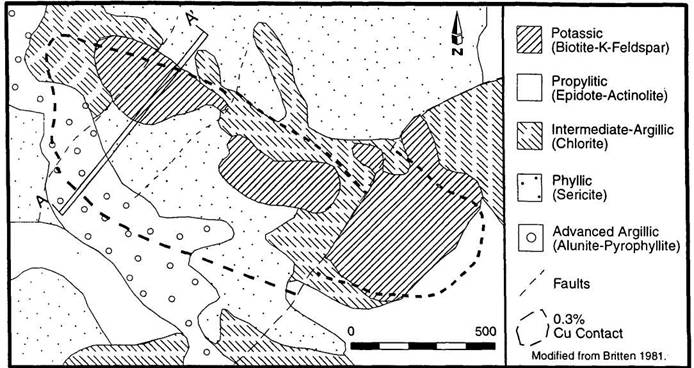
 Alteration Zones in the Horse-lvaal Porphyry Copper System, Frieda River, PNG.
Fig. 6.5
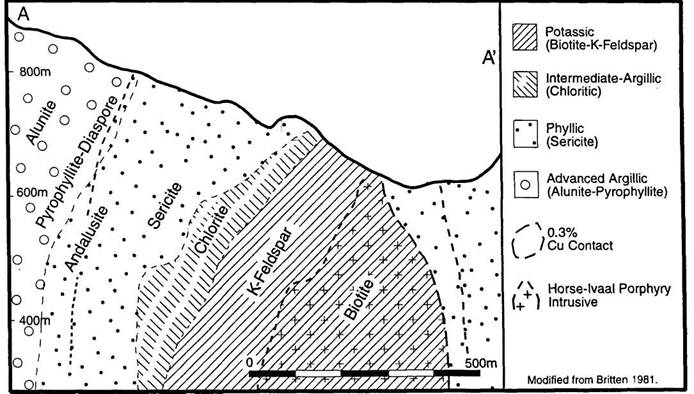
 Alteration Zonational Along NE Section Line A-A' Through North-Western Portion of the Horse-lvaal Porphyry Copper System, Freida River, PNG.
Fig. 6.6
Exploration Workshop "Southwest Pacific rim gold-copper systems: Structure, Alteration, and Mineralization" Corbett G J & Leach T M. 8/96 Edn.
ii) Lookout Rocks. New Zealand
A jog in the Hauraki Graben Fault which separates the Hauraki Graben from the Coromandel Peninsula hosts; the Ohio Creek copper-gold porphyry, the Lookout Rooks high sulphidation shoulder, and the Thames 2 million ounce mesothermal vein system (Figs. 7.44, 7.45). Dextral rotation on the graben structures, associated with plate rotation, has produced a series of dilational fractures which host ledges of high sulphidation alteration formed as shoulders to the Ohio Creek porphyry (Fig. 6.7) and the auriferous mesothermal veins in a more distal setting (Fig. 7.45).

|
Из за большого объема этот материал размещен на нескольких страницах:
1 2 3 4 5 6 7 8 9 10 11 12 13 14 15 |
