

Партнерка на США и Канаду по недвижимости, выплаты в крипто
- 30% recurring commission
- Выплаты в USDT
- Вывод каждую неделю
- Комиссия до 5 лет за каждого referral
In environments of orthogonal compression, radial fractures in the conjugate orientations tend to be dilated and mineralized. Rotation on these fractures may produce higher metal grades in sigmoidal dilatant zones (Figs. 3.10, 3.13). However, significantly more fluids tend to be bled from the porphyry source in settings of oblique rather than orthogonal compression.
40
Exploration Workshop "Southwest Pacific rim gold-copper systems: Structure, Alteration, and Mineralization" Corbett G J & Leach T M, 8/96 Edn.
ix) BRECCIAS a) Introduction
Practically all magmatic arc copper-gold systems discussed herein contain breccias, and so the processes of breccia and ore formation are intimately related. As exploration geologists we seek to further understand the relationship to mineralization of the tremendous variety of breccia types. For instance, the mapping of barren diatreme breccias may point towards the mineralization elsewhere in the hydrothermal system. Yet the terms used are as numerous as the geologists involved. The aim here is to:
* focus on the processes of formation,
* to delineate differing breccia types, and
* describe their role in ore formation.
We attempt to maintain consistency with existing breccia classifications and terminology, albeit in the light of our own personal experience. Readers are referred to the following works, on which this discussion draws, for more detailed and in some instances alternative analyses of breccias; Sillitoe (1985), Baker et al. (1986), and Taylor and Pollard (1993).
What is a breccia?
A breccia is a clastic rock composed of fragments held together by matrix and containing cavities filled by post-brecciation hydrothermal minerals (Taylor and Pollard, 1993).
Fragments or broken rock clasts become progressively milled with increased deformation (brecciation). Some breccias contain only host-rock fragments while others are characterised by introduced fragments, and fragments undergo varying degrees of alteration.
Matrix is the fine rock material between the fragments and, depending on the degree of milling, may be gradational to the fragments. Breccias are either matrix or fragment (clast) supported. The majority of the mineralized component of breccias is introduced as hydrothermal fluid and so occurs within the matrix.
Cavities develop during breccia formation and are infilled with hydrothermal minerals including gold-copper mineralization, and so are an integral part of the brecciation and mineralization processes.
All these fragment and matrix variations contribute towards the development of differing breccia types.
b) Classification
We need to name (classify) breccias in order to map out hydrothermal systems. Breccias may be distinguished by:
* appearance or a descriptive classification,
* mode of formation or a genetic classification.
Which is appropriate?
When we study a breccia it is advisable to start by recognising the differing breccia types or textural variations and map them out using descriptive terms.
41
Exploration Workshop "Southwest Pacific rim gold-copper systems: Structure, Alteration, and Mineralization" Corbett G J & Leach T M, 8/96 Edn.
Descriptive terms are most useful in order to provide the data to map out a breccia at the initial stages of an investigation. However, breccias of similar appearance may be derived from different processes. Thus as the knowledge of a particular system evolves, an understanding of the context may allow a breccia to be put in a more genetic framework. A mosaic breccia, which is described simply as, "one in which the fragments can be fitted back together by removal of the matrix", can be derived by a variety of breccia processes. A mosaic breccia in the carapace to an intrusion may be barren and not vector towards higher grade mineralization in the same manner as a mosaic breccia in a high-sulphidation system.
As the descriptive delineation of a large body of breccia emerges, it may then be possible to determine the geological environment in which the breccia formed and the process of formation. A genetic classification for the breccia might then emerge. Knowing the type of breccia could hasten the analysis that particular style of system.
A genetic term is based on the interpreted manner of formation of a breccia and as such is derived from only the data to hand a that stage. Recording information in using a genetic terminology may result in a loss of the original data-base and inhibits later reinterpretation, especially as the knowledge of the system evolves, such as by the progression from mapping to diamond drilling. The genetic term "diatreme breccia" might be used to describe a breccia formed in association with a maar volcano/diatreme. The descriptive terms "milled matrix fluidised breccia or polymictic muddy breccia" could describe the same rock. There is an obvious tendency to drift towards the shorter and easier genetic terms. However, the milled muddy etc. breccia is noi a diatreme breccia until it has been put in the context of the entire mapped maar volcano/diatreme breccia system.
As a general rule - it important to avoid early genetic descriptions. Decriptive breccia terms
Some descriptive breccia terms are useful, although breccias described in this manner, may form within a variety of genetic settings.
Dilational breccias form by the infilling of open space by later fluid, commonly in brittle rocks in high level settings. A colloform/crustiform banded breccia matrix may indicate repeated fracture opening and rapid infilling by quenched hydrothermal fluid, whereas slower cooling will result in banded crystalline infill. Rebrecciation and cross-cutting infill are characteristic of these breccias. This breccia term is indicative of a dilational ore-forming process.
Mosaic or jigsaw breccias are classified as those in which the fragments may be joined back together by removal of the matrix. Thus, these breccias exhibit no input of exotic fragments and little fragment rotation or rounding. The matrix tends not to be of locally derived milled material, but composed substantially of introduced hydrothermal components. There is obviously an overlap between the use of the terms dilational and mosaic breccias.
Milled matrix fluidised breccias encompass a variety of typically phreatomagmatic breccias composed of milled fragments in which the matrix is made up of comminuted fragment material. This descriptive term applies to breccias which might be also described by a genetic term as belonging to diatreme/maar volcano complexes. Many exploit structures as dyke-like forms and have been termed tuffisite by some workers (Paull et al., 1990).
42
Exploration Workshop "Southwest Pacific rim gold-copper systems: Structure, Alteration, and Mineralization" Corbert G J & Leach T M, 8/96 Edn.
Genetic Groupings
A breccia classification based upon the environment of formation distinguishes groups of breccias according to the relationship with a magma source and partly those formed at differing crustal levels. These as partly illustrated in Fig. 3.14 and classified as:
i) Primary non-hydrothermal breccias.
* Magmatic breccias
* Volcanic breccias
* Tectonic breccias
ii) Ore-related hydrothermal breccias.
* Magmatic hydrothermal breccias
* Phreatomagmatic breccias
* Phreatic breccias
c) Primary non-hydrothermal breccias
Magmatic breccias form in association with porphyry intrusions in which there is little mixing of meteoric waters or fluid degassing. Only with the input of hydrothermal fluid are these breccias inferred to become mineralized. Intrusive or contact breccias develop at the contacts between intrusions and host rocks, while collapse breccias form following the outflow of material from a magma chamber.
Volcanic breccias are the large group of broken rocks which form in subaerial and subvolcanic environments. Although volcanogenic massive sulphide deposits form in association with these breccias, the distal relationship to porphyry source rocks excludes them from this discussion. Readers are referred to texts such as Cas and Wright (1987) and McPhie et al., (1993) for a discussion of these rock types.
Tectonic breccias develop by deformational processes and include fault breccias which vary from milled puggy fault zones to open space breccias and are usually distinguished by a relationship with planar fault surfaces. However, many faults are plumbing systems for hydrothermal fluids as so these breccias are transitional to hydrothermal phenomenon.
c) Ore-related hydrothermal breccias
These are grouped as.
1. Magmatic hydrothermal breccias
2. Phreatomagmatic breccias
3. Phreatic breccias
These three classes of breccias are distinguished using the terminology of Sillitoe (1985) on the basis of crustal level and relationship to porphyry source rocks (Fig. 3.14). Magmatic breccias typically form at deepest or porphyry levels and are eroded to display pipe-like forms, but need not have vented to the surface. Phreatomagmatic breccias typically display associations with high level porphyry intrusions and may vent as diatreme/maar volcanos or remain as milled matrix fluidised breccias. Phreatic breccias form a surficial levels and in this classification do not display a relationship with high level intrusions. Differing styles of low sulphidation gold deposits display associations with varying breccia types developed at different crustal levels (Figs. 7.1, 7.2).
43
Exploration Workshop "Southwest Pacific rim gold-copper systems: Structure, Alteration, and Mineralization" Corbett G J & Leach T M, 8/96 Edn.
1. Magmatic hydrothermal breccias
Magmatic hydrothermal breccias (Figs. 3.14, 3.15) are characterised by a pronounced magmatic involvement in the brecciation process and a hydrothermal ore fluid dominated by magmatic component (e. g., in eastern Australia, Kidston, Baker and Andrew, 1991; and Mt Leyshon, Paull et al., 1990; in Chile, San Cristobal, Corbett, unpubl. reports, Egert and Kasaneva, 1995). The Kidston breccia is described here and within the case study of the associated mineralization (Section 7.ii. d.v).
Subvolcanic breccia pipes, which host hydrothermal magmatic breccias typically form at considerable depths (>1 km) equivalent to high level, commonly felsic, porphyry intrusions, and are generally not expected to have vented to the surface. Breccia pipes commonly overlie apophyses to larger bodies of magma, from which metals at a low tenor may have been concentrated. Thus, as in the case of Kidston, the analyses during exploration of the architecture of buried intrusive source, may assist in the identification of settings for breccia pipes, typically at cross structures (Fig. 7.6). Similarly, the Mt Leyshon gold breccia is localised by the intersection of a regional structural corridor with the margin of a subvolcanic complex (Paull et al., 1990).
The mechanism inferred for breccia formation relies upon the violent explosion of volatiles during retrograde boiling described above. Volatiles, possibly derived from a large magma source at depth, collect and become overpressured in apophyses as intrusions cool. Movement on a controlling structure may fracture the carapace allowing the volatiles to vent explosively.
It is important to stress that most breccia pipes represent pre-mineral explosive venting of volatiles and that metals subsequently exsolve from a deeper parent magma. The breccia formation taps the top of the magma chamber and fractures the overlying country rocks to provide a focus for the degassing fluids. Mineralization partly fills open space within breccias, and (sheeted) fractures, which are best placed as sites for exsolving metals. An understanding of the anatomy of breccia pipes may provide vectors towards mineralization. Baker et al., (1986) distinguish different levels of breccia pipes and Sillitoe (1985) describes upper terminations into collapse breccias and the rarely seen lower contacts as; fissures, source intrusions, or shears. Lateral contacts are commonly sharp and exhibit sheeted fracturing (Sillitoe, 1985).
Sheeted fractures are inferred to have developed during the initial explosive venting related to retrograde boiling and have no doubt been active during later collapse. They dip steeply and are kinked about pipe margins (e. g., Kidston, Fig. 7.7; Cabeza de Vaca, Chile, Sillitoe and Sawkins, 1971).
Two principle facies within breccia pipes related to the mechanism of formation are:
* intrusion breccias
* collapse breccias
The genetic term intrusion breccias describes rocks developed in conditions of intense fluidisation during the explosive venting of volatiles injected from the intrusive into the overlying host rocks, and forms breccias which include those described as milled (Baker et al., 1986), or rock flour (Sillitoe, 1985) breccias. These breccias are generally supported by a matrix of comminuted rock flour and hydrothermal cement, and represent mixes of rounded, commonly competent, intrusive fragments which have been milled during transport. They grade laterally into breccias dominated by subangular locally derived fragments and jigsaw
44
Exploration Wciksitcp *SW Pacf;s K_rr> AiiiCu Systems: Structure Alteration & Mineralization' Corbett G J & Leach T M, 8/96 Edn.
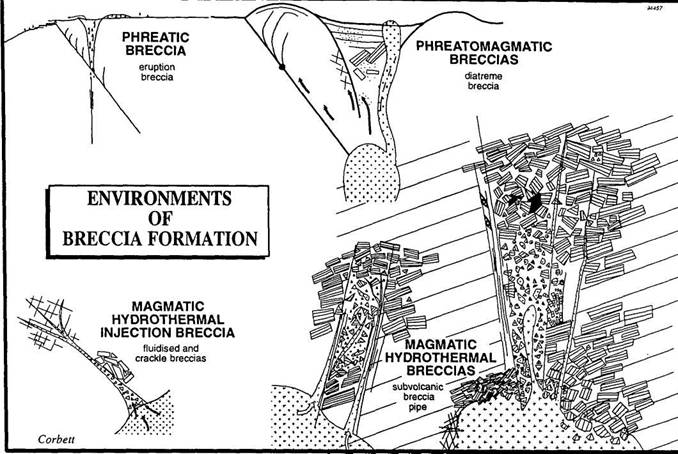
 Fig. 3.14
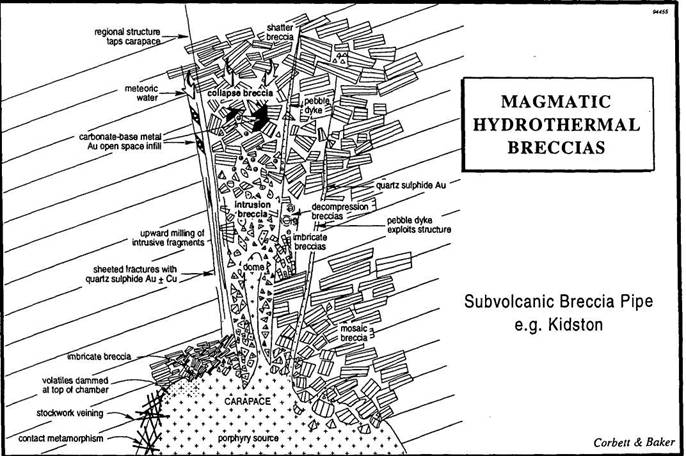
 Fig. 3.15
Exploration Workshop "Southwest Pacific rim gold-copper systems: Structure, Alteration, and Mineralization" Corbett G J & Leach T M, 8/96 Ecln.
breccias, of the collapse type. Milling takes place in highly fluidised environments. These breccias form in the core of the breccia pipe (Fig. 3.15). Early mapping at Kidston (Corbett, unpubl. data) defined a zone dominated by intrusive fragments (termed volcanic breccia in Fig. 7.7), which roughly corresponds to pre-breccia rhyolite early tourmaline breccias of Baker and Andrew (1991). Other breccias of this type rim intrusive dykes (e. g., San Cristobal, Chile). At both Kidston and San Cristobal, early fine grained felsic dykes associated with the intrusive breccias are cut by later coarser grained quartz feldspar porphyry intrusives, possibly reflecting a melt derived from deeper within the magma chamber.
Pebble dykes comprise linear bodies of well rounded, commonly transported fragments in a milled matrix formed by the venting of volatiles in faults or joints. They are common in porphyry environments (e. g., El Salvador, Gustafson and Hunt, 1975), and locally provide ground preparation for mesothermal vein mineralization (e. g., Arakompa, PNG, Corbett et al., 1994b). Sillitoe (1985) however, cites the association with specific intrusive phases to suggest that pebble dykes are more commonly late - to post-mineral in age. Pebble dykes contrast with fluidised breccias (below) which are characterised by transported matrix.
The genetic term collapse breccias is applied to a group of open space breccias formed during relaxation following the initial explosive intrusion breccia event, and are typically best exposed about the outer, particularly the upper, portions of breccia pipes. Only small degrees of transport of country rocks are recognised in many typically jigsaw (Sillitoe, 1985) or shatter (Baker et al., 1986) breccias which can be joined back together removing the hydrothermal cement, and contrast with the introduced fragment of the intrusion breccias. A country rock geological contact can be traced from outside to within the Kidston breccia pipe and the presence of large blocks are indicative of a transition to a margin of the system (Fig. 7.7). Sheeted fractures formed during initial explosion may facilitate collapse.
The terms shingle, domino. (Sillitoe, 1985) or imbricate (Baker et al., 1986) apply to slab-like breccias formed by regular breakage or sheeting about the margins of breccia pipes. While these breccias may dip flatly above a pipe, Sillitoe (1985) emphasises the shallowing in dip moving inward from the pipe margin. These are transitional to the angular shatter breccias of Baker et al., (1986).
Decompression breccias form during the rapid depressurisation of venting fluids or rock masses. They exhibit the appearance of spheroidally weathered and rounded fragments, rimmed by curved and tabular (Baker et al., 1986) fragments, separated by minor open space which may be infilled with hydrothermal minerals (Fig. 3.14). These breccias may be likened to the hypogene exfoliation described by Sillitoe (1985).
Magmatic hydrothermal injection breccias are distinguished as those breccias derived from a magmatic source, but composed of only hydrothermal fluid, hence the name applies to "hot water" breccias. The terminology for hydrothermal breccias parallels with the term hydraulic breccia used in the literature to describe breccias formed by breaking under the influence of pressurised hydrothermal fluids. Many of these breccias form in subsidiary structural environments derived by the rotation of major structures (section 3.iv), and so display transitional relationships to the dilational breccias. Hydrothermal breccia styles may vary according to the degree of mineralized fluid input and therefore display a relationship with metal grades (Figs. 3.16, 6.3). Rotational breccias which are characterised by substantial fragment rotation or transport in association with considerable fluid injection, display the highest metal grades. These pass with smaller quantities of injected fluid to mosaic or jigsaw breccias, characterised by fragments which are separated but have not undergone substantial transport. Fluidised breccias are distinguished on small scales as containing milled fragments
45
 Exploration Workshop 'SW Pacific Rim Au/Cu Systems: Structure Alteration & Mineralization" Corbett G J & Leach T M, 8/96 Edn
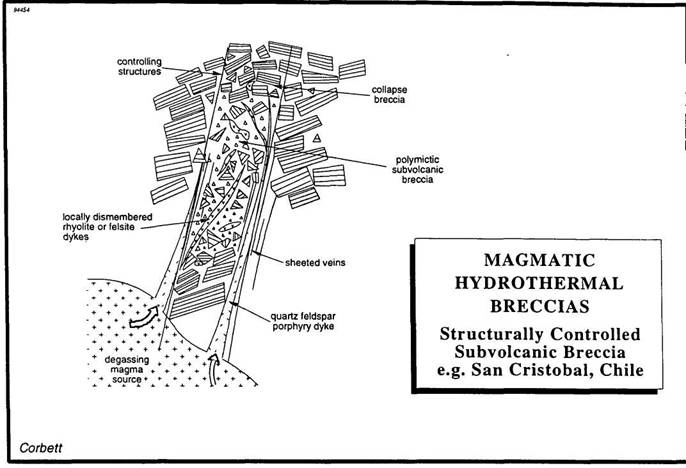
Fig. 3.16
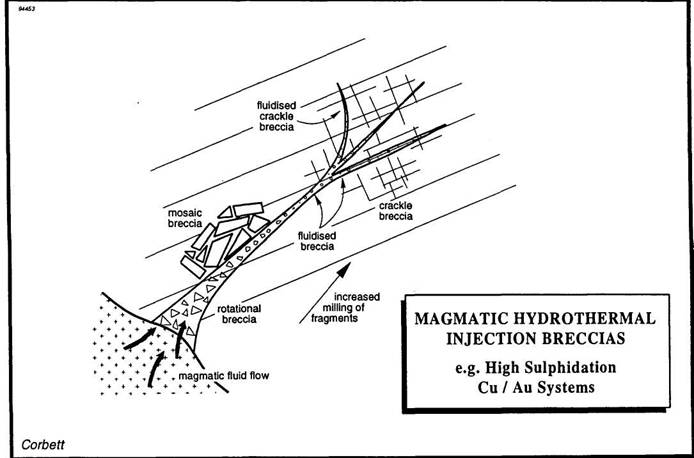
 Fig. 3.17
Exploration Workshop "Southwest Pacific rim gold-copper systems: Structure, Alteration, and Mineralization" Corbett G J & Leach T M. 8/96 Edn.
in a transported and exotic matrix, and commonly exploit fractures, to form dyke-like bodies. Where only minor matrix introduction is recognised within fractures, then mosaic-like crackle breccias are recognised. If crackle breccias are opened and exhibit fluid flow, then a fluidised crackle breccia may result. Thus a pattern emerges where copper-gold grades may be directly proportional to matrix content in breccias, which change with increasing distance from the magmatic source from; rotational -> mosaic -> fluidised -> crackle breccias (Fig. 3.16). An ability to map out zones of breccia types may provide vectors to higher grade ores or magmatic source rocks, particularly in high sulphidation copper-gold systems (Fig. 6.3).
Hydrothermal collapse breccias form during the retrograde phases of porphyry copper development. Magmatic vapour rises above the porphyry environment, condenses, mixing with ground waters and collapses as hot low pH fluids (Fig. 5.7). Pressure draw-down during the waning stages of cooling porphyry may assist in the fluid collapse. The resulting overprinting phyllic to argillic alteration forms clay matrix breccias in which sericite and clays grade from fractures or crackle breccias into the host rock. Remnants of original rock type which remain generally display no rotation, so that the hypogene alteration results in a fabric in which cores of unrotated primary rock are set in a clay altered matrix. Fluids commonly migrate down structures which, as zones of incompetent clay alteration, may be reactivated. Thus, many clay matrix breccias grade to shear zones which may display intense fragment milling in areas of high strain. Hydrothermal collapse and associated retrograde phyllic and argillic alteration may represent a mechanism for the upgrading of the mineral tenor in porphyry systems.
2. Phreatomagmatic breccias
Phreatomagmatic ("phreato" meaning water converted to steam and magma) eruptions are the violent eruptions which may occur when groundwaters are superheated by contact with rising hot magma and rapidly evolve into steam. A non-genetic term "milled matrix fluidised breccia" could be used to describe breccias formed by this process. These breccias commonly exploit pre-existing structures which may also host volatile-rich intrusions. A venting eruption is recognised at surficial levels as a maar volcano, and diatreme breccia complexes may extend to considerable depths, where relationships with high-level porphyry intrusions become more apparent. Thus, the term of diatreme breccias is applied to rocks which develop by phreatomagmatic processes (Fig. 3.17). Although vapour driven, diatreme breccias display a strong association with high level porphyries, commonly within flow dome complexes. Porphyry-related mineralization is generally of the carbonate-base metal style for most low sulphidation systems (Fig. 7.2), described as deeper epithermal by Sillitoe (1985), and diatreme breccias are also common in high sulphidation systems (Fig. 6.1).
Examples of diatreme-related gold/copper mineralization in the southwest Pacific include: in the Philippines at Acupan, 4 M oz Au (Damasco and Guzman, 1977; Sawkins et al., 1979; Cooke and Bloom, 1990); Lepanto, >3 M oz Au (Section 6.iv; Garcia, 1991), and Dizon 3 M oz (Sillitoe and Gappe, 1984); in Papua New Guinea at Wau (Sillitoe et al., 1984), Kerimenge, 1.8 M oz Au (Section 7.iii. j; Hutton et al., 1990), Edie Creek (Section 7.iii. j; Corbett, 1994), Tolukuma (Section 7.iv. d.3; Corbett et al., 1994a), and Wafi (Section 6.iii. b; CRA, 1994); in Indonesia, Kelian, >4 M oz Au (Section 7.iii. j; van Leeuwen et al., 1990, Sillitoe 1995); and Miwah, (Williamson and Fleming, 1995); and Gold Ridge, Solomon Islands (Section 7.iii. j; Sillitoe, 1989, Fig. 7). Others include: in the USA, Cripple Creek (Thompson et al., 1985), Montana Tunnels (Sillitoe et al., 1985), and Pueblo Viejo, Dominican Republic (Vennemann et al., 1993).
Diatreme breccia/maar volcano complexes form in relation to high level porphyry intrusion
46

 Exploration Workshop "SW Pacific Rim Au/Cu Systems: Structure Alteration & Mineralization" Corbett G J & Leach T M, 8/96 Edn.
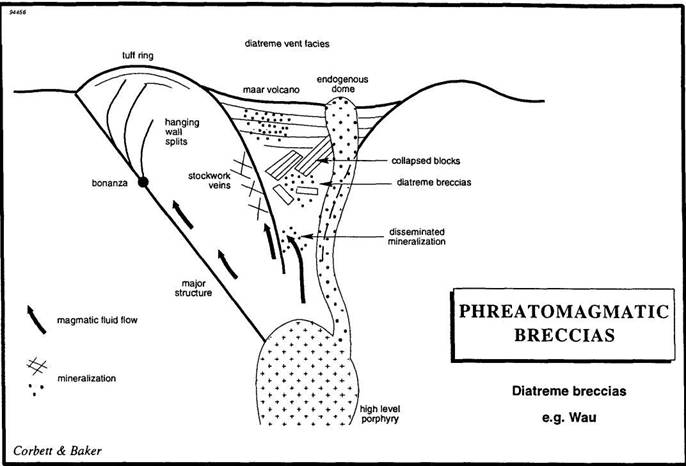
Fig. 3.18
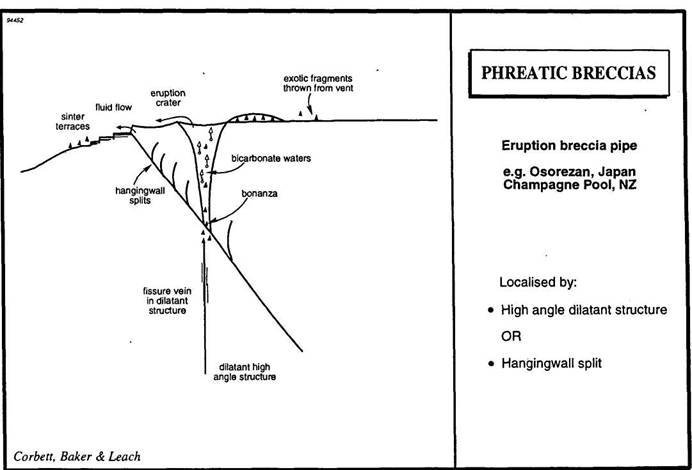
 Fig. 3.19
Exploration Workshop "Southwest Pacific rim gold-copper systems: Structure, Alteration, and Mineralization" Corbett G J & Leach T M, 8/96 Edn.
and so are inferred to have been generated at considerable depth to at least 1 km, as evidenced by the depth of formation of associated carbonate-base metal mineralization. Diameters may range to several hundred metres across and repeated activation results in rebrecciation and overprinting diatremes. Flared margins are inferred to dip steeply inward at depth and shallow closer to the surface to produce the overall funnel shape (Sillitoe, 1985).
Diatreme breccias are commonly localised by major structures along which high level porphyry intrusives have been emplaced and which may have been reservoirs for groundwaters. Examples include: the graben structure at Tolukuma (Fig. 7.47, Corbett et al., 1994a); Escarpment Fault at Wau, (Figs. 7.28, 7.29; Sillitoe et al., 1984); Lepanto Fault at Lepanto (Fig. 6.23; Baker, 1992). Some diatremes are localised by cross structures (e. g., Tolukuma; Fig. 7.47), or by dilational splays from more major structures (e. g., Lepanto; Fig. 6.23).
Breccias within diatreme complexes are characterised by milled matrix fluidised breccias. These vary from well milled hetrolithic breccias comprising country rock and introduced porphyry fragments, typically in the most activated regions of the diatreme complex, to more angular monolithic breccias, typically towards the periphery. Most breccias are supported by a matrix of comminuted rock material which generally displays clay pyrite alteration and so contain no open space. Tuffisite rocks (Cloos, 1941 in Sillitoe, 1985) comprising well milled, intensely altered, commonly bedded, tuffaceous material, are characteristic of diatreme breccias. These may exhibit dyke-like forms and display a genetic relationship to mineralization (e. g., Mt Leyshon, Eastern Australia, Paull et al., 1990).
The distinction between tuff ring and vent facies may be useful when mapping diatreme breccias, as mineralization is commonly localised at diatreme margins (Fig. 3.17). Tuff ring facies or tuff apron (Baker et al., 1986), comprises material ejected from the diatreme and deposited outside the actual vent and is only preserved in systems which are poorly eroded. Various workers (Sillitoe, 1985; Baker et al., 1986; Cas and Wright, 1987) describe base surge deposits derived from the lateral movement of the rapidly expanding gas cloud. The resulting deposits may form as thin laterally extensive layers containing exotic blocks and exhibit local low angle cross stratification. Finer grained tuffisite layers may contain accretionary lapilli formed as the gas cloud condenses and fine grained (mud) particles adhere to a nucleus. The recognition of accretionary lapilli has formerly been taken by many workers as evidence for a surficial origin of diatreme breccias. However, similar features have been generated in subsurface settings in experimental conditions (McCallum, 1985). Accretionary lapilli are recognised in rocks formed in subsurface environments at Nena, PNG (Leach and Corbett, pers. observation) and Mount Leyshon, Australia (I Hodkinson, personal commun.). Sillitoe (1985) also stresses the collapse of base surge deposits into diatremes such as at Cripple Creek (Thompson et al., 1985).
Vent facies comprise the main body of the diatreme vent. The maar volcano represents the surficial portion of the vent and is commonly infilled with lacustrine sediments. Breccias are locally rebrecciated and comprise introduced intrusive fragments, milled rock flour, tuffisite, and blocks slid in from the sides commonly fill the vent (Fig. 3.18). Instances of considerable collapse are noted by McCallum (1985) and Sillitoe (1985) and include; shale fragments transported 1500 m down into the Mule Ear diatreme Utah (Stuart-Alexander et al., 1972), charcoal fragments occur 650 m below the present surface at the Balatoc diatreme (Sawkins et al., 1979), from which probably some 400 m has been eroded, and the base surge deposits at >300 m depth at Cripple Creek (Thompson et al., 1985). Well milled hard intrusive fragments reflecting considerable vertical transport may occur with breccias components dominated by angular, softer, locally derived rocks. Fragment and matrix types reflect the host rock type and
47
Exploration Workshop "Southwest Pacific rim gold-copper systems: Structure, Alteration, and Mineralization" Corbett G J & Leach T M, 8/96 Edn.
the driving intrusive. The recognition of mineralized fragments within diatreme breccias may provide an indication of a target at depth, as with diatreme breccias in the vicinity of Lepanto, (Sillitoe, mun.).
Dyke-like fluidised milled matrix breccias breccias represent non-venting phreatomagmatic breccias. These exploit pre-existing structures and occur adjacent to diatreme breccia complexes. Those at Busai, Woodlark Island (Corbett et al., 1994a), display a gradation from coarser angular fragments at depth to "flinties" at higher levels, characterised by fine rock flour and chalcedonic silica. These breccias prepare structures for later mineralization.
Endogenous domes are indicative of the flow dome association for diatreme breccias and typically form about diatreme margins (Fig. 3.18). Many are dismembered and vary to dykes and intrusive fragment-dominated breccias. The felsic, typically dacitic, compositions reflect the nature of the source intrusive.
Alteration derived from the hot gasses associated with the eruption of diatreme breccias is most commonly characterised as clay-pyrite alteration of the rock flour breccia matrix. Clays vary from higher temperature sericitic at depth, through illite and smectite at highest levels, with local kaolinite in acid conditions, typically at surficial levels.
Mineralization follows the pre-mineral phreatomagmatic diatreme event which taps the top of the magma chamber at depth and fractures the overlying country rocks. Pregnant fluids which evolve from the source magma, as it cools and degasses following emplacement, rise into the fractured overlying country rocks, and locally the lower portion of the diatreme. The setting of diatreme-associated mineralization is in part governed by the level of erosion and structural environment. Diatremes formed at higher crustal levels are dominated by incompetent low temperature clay alteration which does not fracture well, and so these rocks tend to be poorly mineralized (e. g., Gold Ridge, Solomon Islands). Because of proximal relationship to the magmatic source and the ability of competent sericitic clays to fracture, only deeper levels of diatremes tend to host fracture/disseminated gold mineralization (e. g., Montana Tunnels, USA, Sillitoe et al., 1985).
Mineralization more typically occurs within competent fractured country rocks about the diatreme margins, commonly at the intersection with throughgoing structures (e. g., Tolukuma, Fig. 7.50; Kerimenge, Figs. 7.28, 7.30; Lepanto; Fig. 6.24). The G.'W. breccia pipes rim the Balatoc diatreme, Acupan occur at the intersection of throughgoing vein systems and demonstrate an increased fluid flow along the diatreme margin (Damasco and Guzman, 1977; Sawkins et al., 1979).
Mineralization occurs at the diatreme margin as:
* banded fissure veins at Tolukuma, PNG (section 7.iv. d, Corbett et al., 1994a); Wau,
PNG (Sillitoe et al., 1984); and Edie Creek, PNG (Section 7.iii. j; Lowenstein 1982);
* breccia infill in the G. W. breccias, Acupan, Philippines (Damasco and Guzman,
1977; Sawkins et al., 1979); and Lepanto, Philippines (Section 6.iv. b, Garcia 1991);
* stockwork veins at Kerimenge, PNG (Section 7.iii. j, Hutton et al. 1990), or
* disseminated within the diatreme at Montana Tunnels, USA (Sillitoe et al., 1985) and
Gold Ridge, Solomon Islands (Section 7.iii. j; Fig. 7 in Sillitoe 1989).
48
Exploration Workshop "Southwest Pacific rim gold-copper systems: Structure, Alteration, and Mineralization* Corbett G J & Leach T M, 8/96 Edn.
3. Phreatic Breccias
Phreatic (meaning water converted to steam) breccia systems occur as vapour-driven explosions at elevated crustal levels (Fig. 3.19), and are broadly equivalent to the hydrothermal explosion breccia of Baker et al., (1986) and eruption breccia of Nelson and Giles (1985), and Hedenquist and Henley (1985). Most workers (Phillips, 1973; Sillitoe, 1985; Nelson and Giles, 1985; Baker et al., 1986; Hedenquist and Henley, 1985) provide a mechanism for brecciation based upon violent release following a build up of hydrostatic pressure, typically within geothermal terrains. Their models mostly focus upon the development of impermeable barriers through silica deposition by rapid pressure release during previous eruptions. Reactivation of existing structures which may have focused hydrothermal fluids, by earthquakes and magma intrusion (Sillitoe, 1985: Hedenquist and Henley, 1985), may initiate eruption by fracturing the silicified cap to the overpressurised hydrothermal fluids.
Examples of phreatic or eruption breccias in the southwest Pacific are confined to little eroded settings such as the active geothermal districts of the Taupo Volcanic Zone, New Zealand, and associations with mineralization are described more fully in section 8.vii. Anomalous gold and other metals occur at eruption breccia vents at Champagne Pool, New Zealand (Hedenquist and Henley, 1985), and the Beppu district and Osorezan, Japan (section 8.vii; Aoki, 1989). Unmineralized eruption breccias at the Ladolam deposit Lihir Island probably relate to the recent geothermal activity (Fig. 7.5). Fossil geothermal terrains host mineralization associated with eruption breccias at the McLaughlin mine, and other hot spring deposits of western USA (Section 8.vii; Lehrman, 1986; Nelson and Giles, 1985), Puhipuhi, New Zealand (White, 1986), the Yamada veins, Hishikari, Japan (Izawa et al., 1993) and at Toka Tindung, North Sulawesi (Wade, 1996).
Eruption craters or eruption breccia vents vary from a few to typically tens of metres wide by up to several hundred metres deep and commonly lie on regional structures (Fig. 3.19). As these represent surficial to shallow level features, preservation is commonly restricted to young, poorly eroded terrains. Many craters act as outflows for typically neutral chloride fluids, which mix with cool surficial waters to promote the deposition of siliceous sinters (Fig. 8.1). The less common bicarbonate fluids form travertine deposits. At Champagne Pool in New Zealand, eruption breccia vents are localised on fractures which display angular relationships to regional structures and are interpreted to have been dilated by regional strike-slip rotation (Fig. 8.5). Many eruption breccia systems are emplaced in environments of advanced argillic clay alteration (Section 8.v).
Eruption breccias vary from ejecta projected over considerable distances, to insitu brecciation and introduction of a matrix of hydrothermal fluid. In the former case, breccias tend to be massive, poorly sorted (Nelson and Giles, 1985) and supported matrix of milled rock material (Hedenquist and*Henley, 1985). Angularity is dependent upon the degree of milling during transport, and fragment styles are dominated by the rocks through which the eruption has passed. Although lacking the juvenile porphyry fragments which characterise diatreme breccia bodies, eruption breccias may host exotic ejecta. At Osorezan, Japan, where precipitates from recent drilling contain antimony, arsenic and mercury, eruption breccias contain ejected fragments of bladed stibnite and auriferous banded quartz (Aoki, 1989; Section 8.vii). Many more locally-derived breccias exhibit monolithic and angular fragments. Eruption breccias which form fluid outflows are characterised by a predominance of sinter fragments (e. g., Phuipuhi, Toka Tindung). Insitu brecciation results in the formation of breccias classified herein as hydrothermal injection breccias (section 3.viii. c.l), and similar to the vent breccias of Nelson and Giles (1985, Fig. 1, A and B), or the hydraulic fracturing of Hedenquist and Henley (1985, Fig. 11). Here, breccia matrix are infilled with rock flour and sulphides such as

|
Из за большого объема этот материал размещен на нескольких страницах:
1 2 3 4 5 6 7 8 9 10 11 12 13 14 15 |
