

Партнерка на США и Канаду по недвижимости, выплаты в крипто
- 30% recurring commission
- Выплаты в USDT
- Вывод каждую неделю
- Комиссия до 5 лет за каждого referral
ii) Polyphasal quartz tension gash veins transect the silicified zones, commonly as hanging wall splits, best developed near the cross structures (Lindley, 1990; Corbett unpubl. report, 1990). Later mineralization infills open fractures and cavities in the quartz veins, and forms dark bands containing copper mineral phases (chalcopyrite and minor bornite, chalcocite and tennantite), and local Cu-Bi-Pb-Ag sulphides, tellurides and sellenides. Gold is generally restricted to Au-Ag telluride phases (Lindley, 1990), and native 'mustard' gold occurs as an alteration (weathering) product of these tellurides.
Zonations in illitic and smectitic clays and fluid inclusion studies in the late quartz veins suggest that copper-gold mineralization took place in response to the mixing of cool (<200°C) and dilute (<2.0 wt percent NaCl) meteoric waters, with upwelling hot (>280°C) and saline (>15 wt percent NaCl) fluids.
It is interpreted that the prospects in the Wild Dog region are composite high - and low-sulphidation systems. Initial silicification was derived from hot acidic fluids which exsolved from a crystallising high level melt into the Warangoi Structure (Fig. 6.36). These acidic fluids progressively became neutralized at shallower levels as indicated by the zonation from alunite-zunyite-pyrophyllite at Kasie Ridge, through pyrophyllite and sericite, to near surface sericite-chlorite at Wild Dog and Keamgi Hill. This is comparable to the initial vapour-rich leaching event in high sulphidation systems.
Late stage mineralization is hosted in fractured silicified zones and inferred to have been derived from a contemporaneous release of magmatic mineralized fluids from depth (e. g., the parent melt). These fluids mixed with cool dilute meteoric waters within local tension gash structures resulting in the Cu-Bi-Pb-Te-Au mineral deposition which is typical of low sulphidation quartz-sulphide lodes. However, the common occurrence of tetrahedrite and chalcocite is indicative of fluid conditions which are transitional to a high sulphidation type.
High and low sulphidation systems are differentiated on the basis of fluid chemistry (Section l. iii), i. e., whether sulphur SO2 (high sulphidation) or H2S (low sulphidation) is predominant as the main dissolved sulphur gas phase. In high sulphidation systems the upwelling hot acidic fluids are confined within major regional structures. However, these fluids are progressively neutralized and cooled within subsidiary structures or permeable lithologies, where they have
99

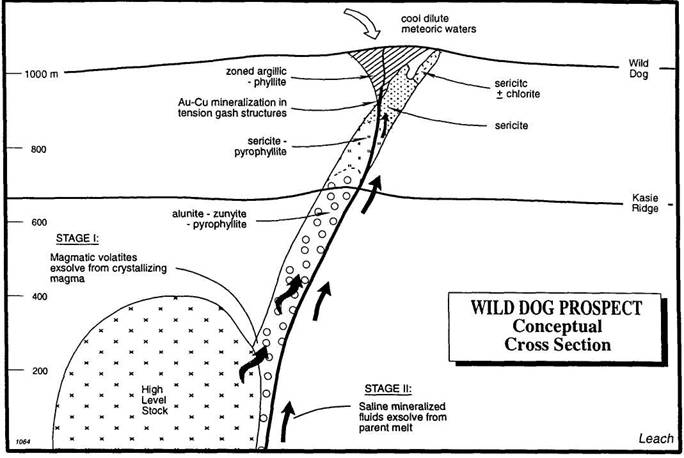
Fig. 6.38
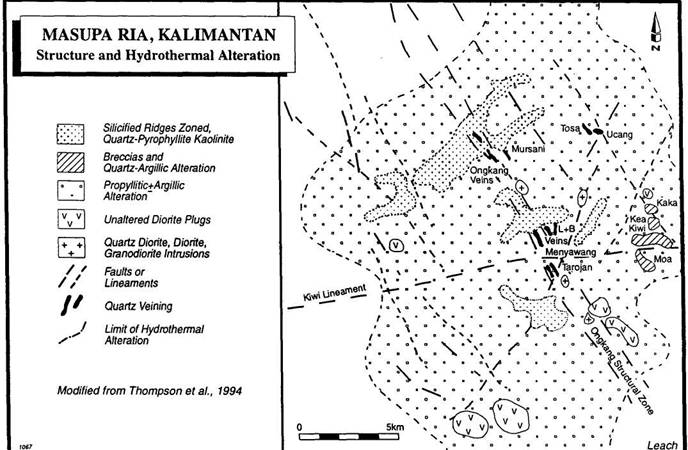
 Fig. 6.39
Exploration Workshop "Southwest Pacific rim gold-copper systems: Structure, Alteration, and Mineralization" Corbett G J & Leach T M, 8/96 Edn.
the opportunity to react with the wall rock and/or mix with neutral circulating surficial waters, and form zoned advanced argillic —> argillic —> propylitic alteration assemblages. Later mineralizing fluids are also typically acidic and deposit metals in the fractured and brecciated alteration zones. Low sulphidation fluids on the other hand are interpreted to be formed either through:
* the neutralization and cooling of low pH magmatic fluids at the base of permeable
circulating meteoric systems, or
* as magmatic fluids which are exsolved from the crystallising magma but are low in
dissolved reactive gases.
ii) Masupa Ria, Central Kalimantan, Indonesia
Overprinting low and high sulphidation systems at Masupa Ria have been described by Thompson et al., (1994) and Leach (unpubl. data). Flat lying ridges of zoned silica and advanced argillic alteration at Masupa Ria extend for up to 7 km within northeast and northwest regional structures (Fig. 6-39). These ridges consist of massive to vughy silica which grade with increasing depth through pyrophyllite-kaolinite-dickite and intense quartz-sericite alteration to regional epidote-chlorite-calcite propylitic alteration. This alteration is hosted in flat lying pyroclastic units which are interpreted to have acted as permeable host rocks for outflowing high sulphidation-style acidic fluids.
Although barren of mineralization, the silica-alunite ridges have locally acted as brittle host rocks and fractured to host later low sulphidation style vein-mineralization. The Ongkang vein system trends parallel to northwest regional structures, and swells at the intersection with Masupa Ria silica ridge. Veins consist of colloform banded quartz (locally after bladed carbonate), typical of intrusive-related low sulphidation gold-silver quartz vein systems formed at epithermal levels (see section 7.iv). Fluid inclusion analyses indicate that coarse quartz was deposited at 250-300°C and under dilute (<3 wt percent NaCl) conditions. Mineralization is restricted to thin sulphide bands composed of fine quartz, low temperature illitic and chlorite clays, rare base metal sulphides and trace silver sulphosalts and sulphides. Gold occurs as minute free grains intergrown in the sulphide bands and in fractures cutting the banded quartz, and exhibits an average fineness of around 820 (see section 7.i). Fractures and cavities are infilled by barite, gypsum, kaolinite and smectitic clays. Gold mineralization is interpreted to have occurred in response to the mixing of hot mineralized fluids with cool meteoric waters.
It is not clear whether the silica ridges formed by high sulphidation fluids, and the auriferous quartz veining deposited by low sulphidation fluids, are different phases of the same magmatic-related hydrothermal system, or completely separate overprinting systems.
100
Exploration Workshop "Southwest Pacific rim gold-copper systems: Structure, Alteration, and Mineralization" Corbett G J & Leach T M. 8/96 Edn.
7 PORPHYRY-RELATED LOW SULPHIDATION GOLD SYSTEMS
i) Classification
a) Introduction
The emplacement of intrusions in magmatic arcs provides heat sources to drive deep circulating hydrothermal systems which are composed of varying proportions of magmatic and meteoric fluids. Magmatic volatiles which evolve from the cooling magma, become entrained at the base of the circulating fluids. Rock reaction and fluid mixing reduce acidic gases such as SO2 to H2S, and Cl" to dissolved salts, mainly NaCl. As outlined in section l. iii, in these systems sulphur is present at an oxidation state of -2, and so this style of hydrothermal system is classified as low sulphidation (Hedenquist, 1987).
In crustal settings where the intrusions are emplaced into thick permeable volcanic piles, the magmatic fluids become diffused within large circulating hydrothermal systems. This diffusion results in the formation of broad alteration zones, characteristic of many active porphyry-related geothermal systems (Section 2.iii), and commonly encountered in porphyry-copper systems (Section 5). Regional structures provide enhanced permeability which channel outflow considerable distances from the intrusion heat source (e. g., 15-20 km at Bacon-Manito, Philippines).
However, in magmatic arcs at continental margins, high level porphyry intrusives are emplaced into impermeable host rocks such as older plutons, sediments and metamorphic basement rocks (see Section 2.iii. c). In these environments circulating hydrothermal fluids migrate along zones of permeability in competent host rocks provided by structures (e. g., dilational jogs or splays in major structures, sheeted fractures, and fracture permeability), breccias (e. g., diatreme margins, intrusive fluidised breccias), or geological contacts (e. g., fractured dome or dyke margins). This focusing of hydrothermal fluids provides an ideal geological and hydrological environment for the formation of porphyry-related gold systems.
b) Sequence of Events
Low sulphidation systems in the southwest Pacific region exhibit similar paragenetic sequences of events at all crustal levels, and this is interpreted to reflect the interaction between melts emplaced at high crustal levels and circulating meteoric waters (Fig. 7.1). The transfer of heat from a melt emplacement at high crustal levels, causes heating of waters residing in structures and permeable units and thereby produces vertically zoned fluidised breccias, diatreme-maar complexes, and pebble dykes, which utilise pre-existing structures (see section 3). The emplacement of melts also provides the heat source for the development of a convective hydrothermal system which is dominated by cool dilute meteoric waters. The hydrothermal system circulates to depths along regional and subsidiary structures, intrusive contacts and/or permeable lithologies. These circulating meteoric-dominated waters deposit vein systems dominated by quartz and secondary K-feldspar, commonly adularia (Henley and Ellis, 1983). Magmatic volatiles, which progressively evolve from the melt as it crystallizes, are entrained within the meteoric waters at the base of the convecting hydrothermal system and become neutralized and reduced as outlined above. CO2 is commonly the dominant magmatic volatile phase (with the obvious exception of water vapour) and is the only major magmatic component which is little effected by secondary processes, although some is converted to methane at low temperatures (Giggenbach, 1987). The increase in dissolved gases lowers the pH of the circulating waters and favours the deposition of sericite/illite over
101
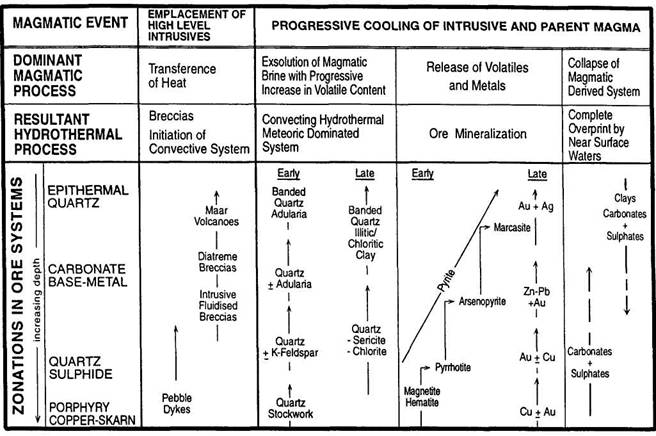
Temporal and Spatial Zonations in Low Sulphidation Gold Systems
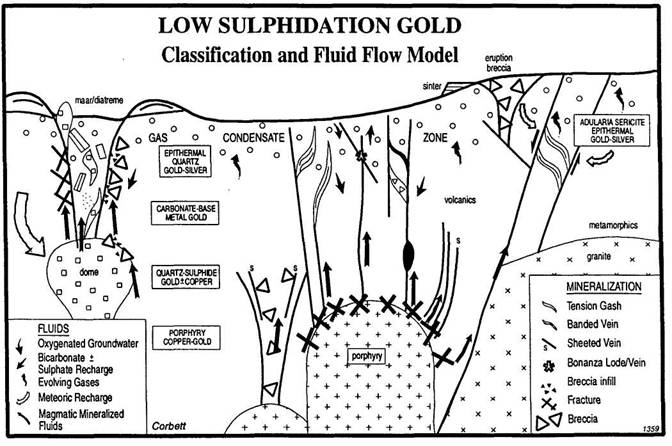
Fig. 7.2 |
Fig. 7.1
Exploration Workshop "Southwest Pacific rim gold-copper systems: Structure, Alteration, and Mineralization" Corbett G J & Leach T M, 8/96 Edn.
K-feldspar (Browne, 1991) in progressively later quartz veins.
As the intrusion continues to cool, pressure drops result in the progressive draw-down of near surface bicarbonate condensate and acid sulphate waters to depths of up to 1.5-2 km into the active hydrothermal system (Reyes, 1990a; Mitchell and Leach, 1991). At cool epithermal levels the downflowing acid sulphate, bicarbonate and dilute groundwaters are oxygenated relative to the deeper circulating hydrothermal fluids (Robinson et al., 1987).
Crystallization of the intrusion and exsolution most of the volatile phase precedes the late stage segregation of metals from the melt (Cline and Bodnar, 1991). Metal-bearing magmatic fluids are released into structures (and other permeable channelways) which are interpreted to contain:
* circulating cool dilute meteoric waters at all levels in the system,
* dilute low pH gas condensate ± acid sulphate waters up to 1.5-2.0 km depth (but
predominantly at >1 km depth),
* relatively oxygenated waters at shallow epithermal levels.
Mineralization at all crustal levels characteristically postdates the
quartz-K-feldspar-sericite/illite veining (see following examples). Iron sulphides are
overprinted by base and precious metal phases. This is also a common feature of high
sulphidation systems (section 6), and is interpreted to possibly reflect an earlier partitioning
from the crystallising melt of iron, relative to base and precious metals.
As the hydrothermal system continues to wane, surficial fluids descend to deeper levels in the hydrothermal system, and result in low temperature clay alteration and carbonate-sulphate deposition, which overprint earlier assemblages.
c) Types of porphyry-related low sulphidation gold systems
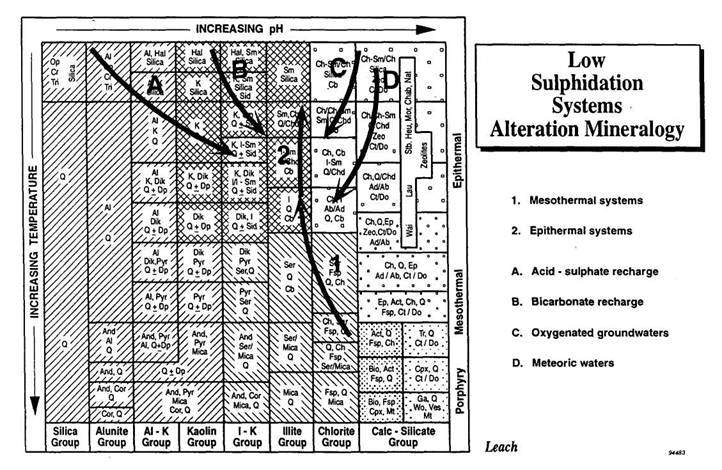
Much of the early geological literature arising from studies in porphyry copper terrains has applied the term "epithermal" to describe porphyry-related gold deposits formed outside the porphyry environment. During the upsurge of gold exploration in the 1980s, it became difficult to place many southwest Pacific gold deposit types in the existing classification. The increased data facilitated comparisons of different deposits, and so the formerly unique Porgera gold deposit (Sillitoe, 1989), has more recently been grouped as part of the carbonate-base metal gold classification (Leach and Corbett, 1994, 1995; Corbett et al., 1995). The group of gold deposits formerly described as epithermal are subdivided as porphyry-related low sulphidation gold deposits according to the crustal level of formation and relationship to porphyry source (Leach and Corbett, 1995). These vary from: deepest porphyry levels, to intermediate or mesothermal depths (quartz-sulphide gold ± copper and carbonate-base metal gold), and shallow epithermal levels (Figs. 7.1, 7.2). Although telescoping is common, and overprinting of alteration zonations may locally obscure the boundaries, deposit types (Fig. 7.3) are distinguished as:
Porphyry copper-gold systems form at deepest levels where magmatic-derived mineralized fluids evolve from a cooling magma and deposit metals within the fractured carapace of porphyry stocks and adjacent competent country rocks (see Section 5).
Quartz sulphide gold ± copper vein systems form at shallower levels peripheral to porphyry copper-gold intrusions. The magmatic-dominated fluids are channelled into permeable features (e. g., sheeted fractures, structures, or magmatic hydrothermal breccias) where they periodically mix with deep circulating meteoric waters (Fig 7.2). The cooling and dilution
102
|
Exploration Workshop "Southwest Pacific rim gold-copper systems: Structure, Alteration, and Mineralization" Corbett G J & Leach T M. 8/96 Edn.
during mixing results in metal deposition within quartz-sulphide vein/fracture systems. Gold mineralization is commonly hosted in massive pyrite/arsenopyrite-chalcopyrite ± magnetite/hematite veins, which postdate quartz veining. The early stage quartz veins are deposited from either dilute circulating meteoric - or saline magmatic-dominated fluids. Lead-zinc phases are subordinate to copper phases.
Carbonate-base metal gold systems form in response to the mixing of upwelling fluids, containing a significant magmatic component, with descending bicarbonate-sulphate fluids derived from surficial gas condensate zones (Leach and Corbett, 1994, 1995). The carbonate-base metal gold systems are encountered at shallower levels, and/or in later vein sequences, than the quartz-sulphide gold ± copper mineralization. Gold mineralization is associated with pyrite-sphalerite-galena and carbonate veins, or breccia infill, with only minimal copper mineralization.
Epithermal quartz gold-silver systems contain precious metals which are inferred to have been deposited by the mixing of upwelling mineralized fluids containing (diluted) magmatic signatures, with descending oxygenated groundwaters. On the other hand, much of the gangue mineralogy comprising quartz, adularia, and quartz pseudomorphing platy carbonate forms in response to the boiling of dominantly meteoric fluids upon periodic, structurally-controlled pressure release, and so develop as characteristically banded fissure vein systems. Epithermal quartz gold-silver systems are encountered at shallow or epithermal levels, and are locally contemporaneous with and/or post date carbonate-base metal gold systems. Many of these systems conform to the adularia-sericite epithermal gold-silver deposits described in the geological literature (e. g., Henley and Ellis, 1983) for which the term adularia-sericite epithermal gold-silver is retained herein. We have applied the term epithermal quartz gold-silver to those epithermal deposits which more clearly demonstrate a magmatic association than the adularia-sericite epithermal gold-silver systems. It is anticipated that as our understanding increases with time, these two groups will coalesce.
ii) Quartz-Sulphide Gold ± Copper Systems a) Introduction
Quartz-sulphide vein systems are encountered peripheral to porphyry copper-gold intrusions (Lowell and Guilbert, 1970; Sillitoe and Gappe, 1984) and are locally mined as small scale deposits e. g., veins peripheral to Bingham Canyon (Babcock et al., 1995). It is speculated that may also be a genetic link with unseen porphyries (in distal settings) in the formation of some structurally controlled gold deposits in older terrains such as the Motherlode deposits (Weir and Kerrick, 1987), some ironstone-hosted gold (e. g., Tennant Creek, Australia, Huston et al., 1993), quartz-sulphide reefs at Telfer, Australia (Goellnicht et al., 1989; Dimo, 1990). Although Slate Belt gold deposits are generally considered to have been derived from a metamorphic fluid (e. g., in eastern Australia Hill End, Seccombe et al., 1993; Victoria, Phillips and Hughes, 1995), evidence is emerging of stronger magmatic associations at Sofala-Hill End, eastern Australia) and elsewhere.
Some quartz-sulphide vein systems extend for up to 5 km from the source porphyry such as at Bingham Canyon, Utah, where mining initially focused upon base metal veins and more recently sediment-hosted gold ores (Peters et al., 1966; Sillitoe 1991b; Babcock et al., 1995). Bingham Canyon displays metal zonations of typical porphyry copper-molybdenum, to copper-gold skarns, Lead-zinc-sliver skarns and lead-zinc-silver lodes which overlap the
103
Exploration Workshop "Southwest Pacific rim gold-copper systems: Structure, Alteration, and Mineralization" Corbett G J & Leach T M, 8/96 Edn.
outer skarns and peripheral sediment hosted gold mineralization (Babcock et al., 1995). Peripheral veins to granitic intrusions in settings such as Cormwall, England were important historical sources of base metals (Edmonds et al., 1975).
In tropical southwest Pacific rim settings quartz-sulphide veins are worked for gold as small scale (commonly illegal) local miners such as the Philippines (Mitchell and Leach, 1991), Indonesia (Tawere Ridge, Sangihe Island, Corbett, unpubl. report) and Papua New Guinea (Arakompa, Corbett et al., 1994b), where gold contents tend to be higher than those in the western USA and Chile (Sillitoe, 1991b), and commonly display substantial supergene enrichment. Sillitoe (1991b) stresses that many porphyry-related quartz-sulphide vein deposits are not of economic importance, in terms of the overall gold content. In many Pacific rim tropical settings, drilling of primary ores often fails to substantiate the apparent rich gold contents won by small-scale (commonly illegal) miners who gouge narrow structures in the supergene weathered environment.
While quartz-sulphide veins are disappointing exploration targets, in favourable conditions this style of mineralization may from large bulk low grade deposits for instance: Lihir, PNG (42 M oz contained Au); in eastern Australia, Kidston (4 M oz Au), Mt Leyshon (>1 M oz Au), and Cadia 10 M oz Au), Ravenswood-Charters Towers (7 M oz Au) and Lake Cowal (2.4 M oz Au). Others (Sillitoe 1991b) include Zhao-Ye, China (approx. 16 M oz Au) and Kori Kollo, Bolivia (5 M oz, Au).
Of interest is that analysis of mineral zonations and fluid plumbing systems may point towards the porphyry source rocks for these systems. Follow up of gold anomalies shedding from peripheral veins led to the identification of the Batu Hijau porphyry copper-gold deposit, Indonesia (R. Burke, mun.; Meldrum et al., 1994) and porphyry targets are apparent from the distribution of peripheral quartz-sulphide vein systems at Bilimoia-Arakompa, PNG (below; Corbett et al., 1994b).
b) Structural setting
Mesothermal veins exploit pre-existing structures which tap fluids venting from porphyry source rocks. These are best developed within dilational structural environments which may contribute towards the formation of ore-shoots within vein systems. Typical structural settings which host mesothermal veins peripheral to island arc porphyries are:
* Sheeted vein systems may become prospective by an increase in the density of veins
(Fig. 3.11), (e. g., Kidston, Fig. 7.7) or more importantly, in settings where deformation
enhances the formation of dilational structural environments within the sheeted vein
systems (Fig. 3.12).
* Fluidised and crackle breccias (Fig. 3.16), (e. g., Lihir Island gold deposit, PNG).
* Tension structures parallel to the direction of compression (Fig. 3.9), (e. g.,
Arakompa, PNG, Fig. 7.10).
* Conjugate fractures formed peripheral to porphyry intrusions in orthogonal
compression or extension (Fig. 3.9), (e. g., Batu Hijau, Indonesia, Meldrum et al.,
1994).
* Arc normal structures (e. g., exhumed deep structures host the vein system at
Bilimoia, PNG, Fig. 7.10).
* Dilational tension vein systems (Lake Cowal, eastern Australia),
* Rotation on conjugate structures may form higher grade sigmoidal portions of
conjugate structures (Fig. 3.9), (e, g., Batu Hijau, Indonesia, Meldrum et al., 1994).
104
Exploration Workshop "Southwest Pacific rim gold-copper systems: Structure, Alteration, and Mineralization" Corbett G J & Leach T M, 8/96 Edn.
c) Alteration and mineralization
As outlined above the authors interpret that mineral deposition in quartz-sulphide gold ± copper systems results from the mixing of hot mineralized magmatic-dominated fluids, evolved from cooling intrusives, with meteoric waters, which circulate to considerable depths along major regional structures (Fig. 7.2). The quartz-sulphide vein systems exhibit a common paragenetic sequence of deposition which may be summarised as:
1. Breccias which range from major magmatic hydrothermal eruptions (e. g., Kidston,
Australia, below), through fault-controlled pebble dykes (e. g,, Arakompa, PNG, below), to
fluidised breccias (e. g., Lihir, PNG, below), commonly form as precursors to the hydrothermal
system, in response to the heating of groundwaters by the initial intrusive emplacement.
2. Quartz veins form commonly medium to coarse grained granular to coxcomb textures
associated with pyrite and early K-feldspar and late sericite. The quartz typically exhibits
strained extinction indicative of deposition within a stress regime. Fluid inclusion data
indicates that quartz has been (see following sections) deposited from either dilute circulating
meteoric-dominated fluids, or in some cases hypersaline magmatic-derived fluids.
3. The sulphide content of veins is interpreted to have been deposited from fluids with a
significant magmatic component, and is categorised as:
i) Fe-sulphide ± magnetite/hematite component, which is commonly massive, and overgrows or infills fractures and breccia matrix. Pyrite is almost ubiquitous, and the other phases are zoned from early and proximal to late and distal settings to the source intrusion as: magnetite/hematite, through pyrrhotite, to arsenopyrite or arsenean pyrite. The Fe-sulphides commonly contain inclusions of chalcopyrite and base metals.
ii) Chalcopyrite postdates the Fe-sulphide/oxide phases and decreases in abundance and significance away from the source intrusion. Bornite is locally encountered in environments transitional to a porphyry copper setting. At depth chalcopyrite infills fractured in shattered and brecciated pyrite; whereas at shallow levels trace chalcopyrite overgrows earlier phases, or occurs as inclusions in late auriferous pyrite. The copper phases are typically accompanied by Bi-Ag-Pb-Te mineralization and locally W-Sn phases, depending on the metal content of the source melt.
4. In some cases the sulphide event continues into, or is postdated by, a late carbonate (or as
at Lihir, anhydrite) event. The carbonate typically occurs as calcite and is inferred to be of
magmatic origin.
Gold mineralization in quartz-sulphide systems is typically associated with the sulphide event. Refractory gold occurs within pyrite or As-rich pyrite distal to the source intrusion, possibly in environments of rapid cooling. Non-refractory gold occurs as inclusions in coarser grained pyrite or chalcopyrite formed under deeper conditions of slower cooling in environments more proximal to the source intrusion. The latter commonly display a relationship to Bi-Ag tellurides. Non-refractory gold in the porphyry^related quartz vein systems typically displays a fineness range of 850-950, transitional between the fineness of gold in porphyry copper-gold and carbonate-base metal gold systems (Fig. 4.8).
105
Exploration Workshop "Southwest Pacific rim gold-copper systems: Structure, Alteration, and Mineralization" Corbett G J & Leach T M, 8/96 Edn.
d) Examples
i) I. adolam gold deposit, Lihir Island, Papua New Guinea
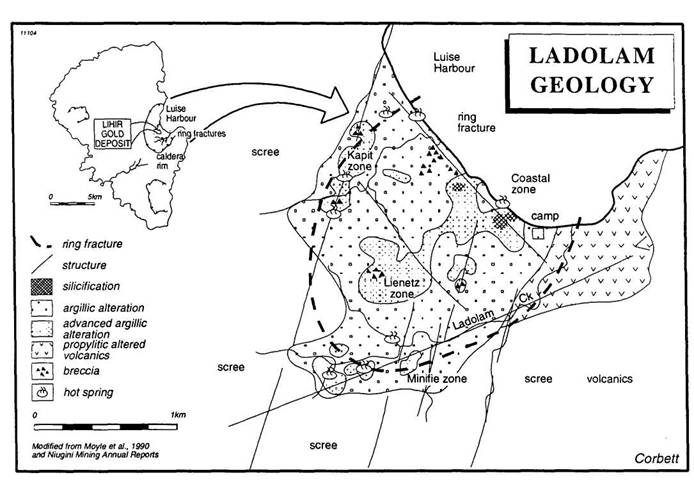
The Ladolam gold deposit, Lihir Island (Fig. 1.2), has a mineable reserve of 14.6 M oz Au, and contained gold of 42.6 million oz (Niugini Mining Annual Report, 1994). The Luise caldera was targeted in 1982 by the Niugini Mining/Kennecott Joint Venture, which at the time was evaluating the adjacent Tabar Island Group in Joint Venture with Nord Resources Limited. Prospecting quickly passed in the 1983 period from the identification of mineralized boulders along the beach, to the delineation of soil geochemistry anomalies and drill testing Coastal (1983) and Lienetz (1984) Zones (Davies and Ballantyne, 1987; Niugini Mining Annual Report, 1994). The Minifie Zone was identified in late 1986 from a weak soil anomaly in a hand dug trench in an area of scree on the caldera wall, and drill tested in the 1987 period.
During the Oligocene-Miocene the northward moving Australian plate was obliquely subducted under the westward moving Pacific plate and the New Ireland and New Britain calc-alkaline island arcs formed above a south dipping subduction zone (Fig. 1.2). The Pliocene collision of the Otong Java Plateau jammed this subduction and a new north dipping arc formed south of New Britain (Fig. 1.2). Most petrogenetic-tectonic analysis of the region favour models of remelting of oceanic crust to give rise to the shoshonitic volcanism which characterises the Tabar-Lihir-Feni-Tanga island arc (Solomon, 1990; Solomon and Groves, 1994, McGinnis and Cameron, 1994). North-south trending rifts in the overlying plate, inferred from seismic and gravity anomalies and the alignment of volcanism, host mantle-derived material which constitutes the Tabar-Lihir-Feni-Tanga island chain (Shatwell, 1987; Lindley, 1988; Marlow et al., 1988; McGinnis and Cameron, 1994).
The Ladolam gold deposit, Lihir Island is hosted by the youngest of several overprinting volcanic edifices, possibly formed by the progressive unroofing by sideways collapse of a volcanic edifice, now evident as the Luise Harbour (Fig. 7.4). The islands of the Tabar-Lihir-Feni-Tanga arc were built up as Plio-Pleistocene shoshonitic volcanoes (Wallace et al., 1983).The structure of the Ladolam gold deposit is dominated by north-south structures which reflect the volcanoplutonism-hosting rift, ring fractures and possible conjugate fractures. Much of the current thermal activity occurs along the ring fractures and the Minifie mineralization is localised at the intersection of a throughgoing structure with the ring fractures (Fig. 7.4).
The Ladolam gold mineralization described as porphyry gold (Sillitoe, 1989), and displaying epithermal gold characteristics (Moyle et al., 1990, 1991), while Carman (1994a, 1994b) emphasises the porphyry-epithermal telescoping. Subdivision of traditional (porphyry-related) epithermal ore systems (Leach and Corbett, 1995) allows the Ladolam mineralization to be categorized here as of the quartz-sulphide gold-style and also displaying alkaline porphyry affinities. Note that the shoshonitic host rocks yield an alteration assemblage enriched in K-feldspar (characteristic of this style) but depleted in quartz.
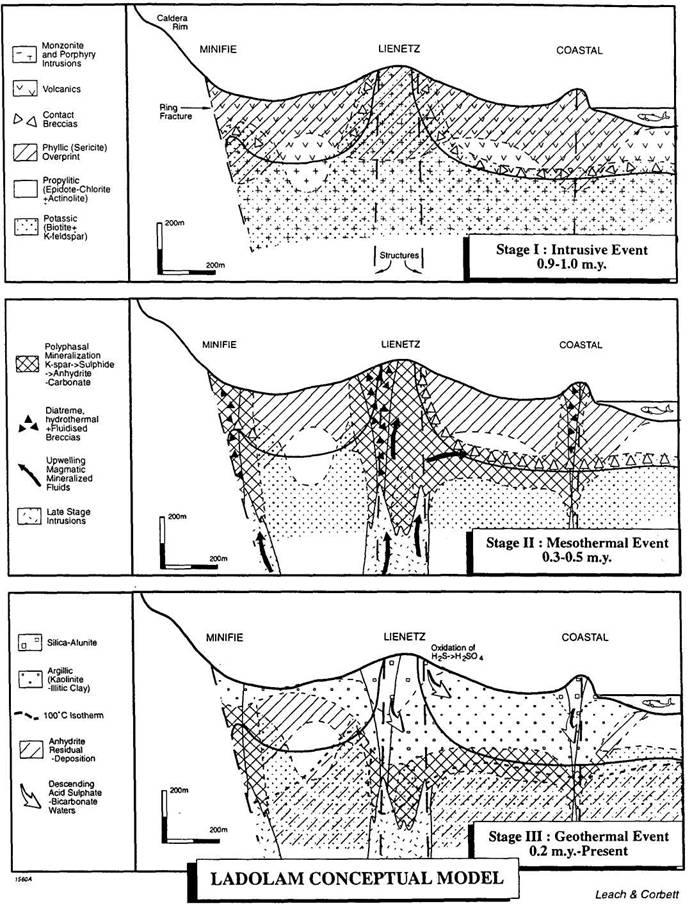
A sequence of three stages of overprinting alteration and mineralization is inferred from reviews of the published literature (Davies and Ballantyne, 1987; Moyle et al., 1990, 1991; Plimer et al., 1988; Forth, 1994; Carman, 1994b) and personal observations as:
Stage I: Host Intrusion Event
Emplacement of differentiated equigranular biotite monzonite, which grades from microdiorite to syenite in composition, pre - and postdates andesite to latite porphyry stocks and dykes. The intrusions have been emplaced into silica-poor alkali-basaltic (shoshonitic) volcanics, locally forming contact breccias. Alteration related to emplacement of the intrusions is zoned from
106
|
Exploration Workshop "Southwest Pacific rim gold-copper systems: Structure, Alteration, and Mineralization" Corbett G J & Leach T M, 8/96 Edn.
potassic (biotite + K-feldspar) at depth to propylitic (epidote-chlorite-calcite + actinolite) at shallow levels and peripheral to the intrusions. Biotite alteration has been dated at 0.9-1.0 m. y. Late stage phyllic (sericite—illite) overprint is inferred to be related to the collapse of meteoric waters onto the intrusion and associated breccias, and is possibly associated with very low grade porphyry-style copper mineralization.
Stage II: Mesothermal Event
Later intrusion (Fig. 7.5) results in an overprinting sequence of events as: early brecciation, followed by alteration and mineralization characterised by the deposition of sequential K-feldspar, sulphides, and then anhydrite ± carbonate ± sulphides. Carman (1994b) describes a second potassic alteration and breccias which appear to be indicative of phreatic and phreatomagmatic (diatreme) eruptions (Section 3.ix. d.2). The latter are typical of environments characterised by high level intrusions. This, locally polyphasal sequence of events is similar to that encountered in most southwest Pacific rim porphyry-related low sulphidation systems as quartz-sulphide mineralization. The host rock composition influences the alteration to K-feldspar-rich and quartz-poor. The diatreme breccias have undergone subsequent extensive K-feldspar alteration and associated leaching of plagioclase, sericite and mafics to produce a brittle, vughy, K-feldspar rock. This leaching is especially intense in the breccias, and has formed a subhorizontal vughy zone along the contact breccia at the top of the intrusive between Lienetz and Coastal zones, which has previously been called 'the boiling zone' (Davies and Ballantyne, 1987). The vughy K-feldspar rock is similar in appearance to the vughy residual silica/quartz zone in high sulphidation systems. However, at Lihir the leaching is postulated to result from rock reaction by neutral pH, silica-undersaturated fluids which are in equilibrium with the potassic and basic volcanics. K-feldspar was also deposited in fractures and open vughs as either orthoclase or adularia, and has been variably dated at 0.2-0.7 m. y. The younger ages are probably related to later hydrothermal events.
The brittle K-feldspar altered volcanics and intrusions have undergone fracturing and associated sulphide deposition in veinlets, fluidised breccias, and sheeted veins, as well as lining or infilling leached vughs. The sulphides are dominated by pyrite and arsenian pyrite, minor marcasite, and rare chalcopyrite, tennantite, sphalerite and galena. Sulphide mineralization continues into later fracturing and breccia events which are dominated by anhydrite ± carbonate deposition. Quartz is absent at Lienetz and Coastal, but occurs as stockwork veins at Minifie. Biotite, locally associated with the anhydrite-carbonate veins, has been dated at 0.34 my and reflects the high temperature of the porphyry-related-style of veins.
Native gold and gold-silver tellurides occur as submicroscopic inclusions in pyrite, mainly in the sulphide phase, but extending into anhydrite-carbonate deposition. On the basis of fluid inclusion, isotope and vein/alteration sequences, Plimer et al., (1988) relate gold mineralization to the mixing of upwelling mineralized fluids, with cool meteoric waters. Gold mineralization occurs at: Minifie as K-feldspar-pyrite alteration of breccias and later quartz stockwork veins (Carman, 1994b), as pyrite coatings on the "boiling zone" breccias at Lienetz and Coastal zone, where fluidised and crackle breccias are recognised at higher levels. Late stage quartz veins are inferred to represent a cooler environment of quenching at the caldera margins.
Stage III: Geothermal Event
The current geothermal system is postulated to be related to the waning of the Stage II mineralization. Cristobalite-alunite alteration at shallow levels in previously formed breccia zones at Lienetz and Coastal, grades laterally and at depth through kaolinite-silica to interlayered illite-smectite alteration. This zoned advanced argillic—argillic alteration overprints earlier mineralogy (Carman, 1994b), and is interpreted to be related to the draw-
107
|
Exploration Workshop "Southwest Pacific rim gold-copper systems: Structure, Alteration, and Mineralization" Corbett G J & Leach T M, 8/96 Edn.
down of low pH acid sulphate ± carbonate waters. These waters probably formed by oxidation and condensation of gases which evolved from upwelling Stage II fluids. At <100°C, the low pH waters could dissolve Stage II anhydrite and carbonate and deposit these phases in hotter environments at depth. Alunite has been dated at 0.15 my., and is currently forming in the acid sulphate springs at the surface. It is interpreted that waning of the hydrothermal system has caused pressure draw-down of the cool acidic fluids, which are postulated to be remobilizing Stage II copper-gold to form luzonite, enargite and locally coarse gold in the Stage III event.
ii) Kidston, eastern Australia
The Kidston gold deposit which contains >4 M oz Au, began production with a resource of 2.7 M oz Au at an average gold grade of 1.58 g/t Au (Baker and Tullemans, 1990), and added >1 M oz at a grade of 1.25 g/t Au in a new ore zone in early 1995. It is hosted within a breccia pipe related to Permocarboniferous volcanoplutonic activity which transects Precambrian basement rocks. In the region between the Wirra Wirra and Lochaber volcanoplutonic complexes (respectively NW and SW of Kidston), an arch of gravity contains outcropping Precambrian rocks which are intruded by quartz feldspar porphyry and rhyolite dykes, indicative of underlying felsic Permocarboniferous intrusive rocks (Fig. 7.6). The Kidston breccia pipe is inferred to have been derived from a magmatic source (Baker and Andrew, 1991) localised at the intersection of a throughgoing structure, the Gilberton lineament, and the margin of the buried arch of inferred Permocarboniferous intrusive. In much the same manner as individual porphyry deposits, mineralized fluids may have migrated to the margin of the buried magma source defined by the arch. The Gilberton Lineament is one of many parallel structural corridors which display protracted histories of movement, including extension which facilitated the emplacement of the Permocarboniferous volcanoplutonism (Fig 7.6; Laing, 1994; Corbett, unpubl. data, 1983).

|
Из за большого объема этот материал размещен на нескольких страницах:
1 2 3 4 5 6 7 8 9 10 11 12 13 14 15 |
