

Партнерка на США и Канаду по недвижимости, выплаты в крипто
- 30% recurring commission
- Выплаты в USDT
- Вывод каждую неделю
- Комиссия до 5 лет за каждого referral
Many carbonate-base metal gold systems are associated with milled matrix fluidised hydrothermal (diatreme) breccias (e. g., Kelian, Sillitoe, 1994; Acupan, Domasco and Guzman, 1977; Kerimenge, Akiro, 1986; Corbett, unpubl. report; Wau, Sillitoe et al., 1984; Woodlark Island, Corbett et al., 1994a; Edie Creek, Corbett, 1994). Phreatomagmatic explosions which form maar volcanoes/diatreme breccias result from the sudden heating of ground waters in contact with a porphyry heat source (Section 3.viii. c.2). Pre-mineral intrusive breccias characterised by milled, fluidised or muddy matrix may exploit pre-existing structures and prepare the plumbing systems subsequently utilised by subsequent mineralized fluids. Major structures commonly host ground waters, and are utilised by rising intrusives, and so may represent the locus of breccia formation. Phreatomagmatic eruptions tap the top of the magma
116
Exploration Workshop ■Southwest Pacific rim gold-copper systems: Structure, Alteration, and Mineralization" Corbett G J & Leach T M, 8/96 Edn.
chamber, which subsequently degasses to evolve off the mineralized fluids, and provide fracture ground preparation of the adjacent competent host-rocks.
e) Structure
As discussed in the examples below, mineral deposition in carbonate-base metal gold systems is promoted by the mixing of rising magmatic fluids with groundwaters in: fissure veins at diatreme margins (e. g., Kerimenge, Edie Creek, PNG; Acupan, Philippines), structures which act as higher grade feeder structures to intervening tension gash vein/breccias which host lower grade ore (e. g., Busai, Woodlark Island, PNG; Antamok, Philippines), to fractured and brecciated intrusive margins (e. g., Kelian, Indonesia; Porgera, PNG), or dilatancy associated with throughgoing strike-slip structures (e. g., Maniape, PNG). While bonanza gold grades are common in lode mineralization, elevated gold grades may also form by repeated deposition in dilational structures (e. g., Acupan, Philippines; Upper Ridges, PNG), especially if proximal to fluid upflow zones. Hanging wall splits are ideal settings for fluid mixing and hence mineral deposition (e. g., Kerimenge, Hidden Valley, Upper Ridges in the Wau district PNG).
Pre-mineral structures control fluid flow and fracturing about the margins of breccia bodies, such as maar volcano/diatreme breccias, which then represent ideal loci for fluid flow and hence mineralization. Thus an ideal setting for carbonate-base metal gold mineralization might be fracturing near the intersection of major through-going structures and diatreme/maar complexes (e. g., Upper Ridges, Kerimenge), or at the contact of veins with diatreme pipe margins (e. g., G. W. breccia pipes at Acupan, Damasco and Guzman 1977). Fluidised breccias prepare pre-existing structures exploited by carbonate-base metal veins at Busai, Woodlark Island (Corbett et al., 1994a).
Rock competency is a critical factor in fracture development and hence mineral deposition. At Porgera, intrusive stocks are inferred from the aeromagnetic data (Henry, 1988) to cap a much larger intrusive system at depth (Corbett et al., 1995). The host Chim Formation shales are extremely incompetent and locally water-bearing. Degassing fluids from depth are preferentially focused into the fractured margins of high level stocks and competent contact baked sediments. The structural tapping of degassing fluids is most evident in the relationship of the later roscoelite mineralization to the Roamane Fault, a bounding structure to the intrusive complex. Similarly, at Kelian, brecciated intrusive margins host mineralization, whereas the incompetent 'muddy breccias' are less well mineralized (van Leeuwen et al., 1990).
Maar volcano/diatreme breccias are gas driven and so display clay alteration of the breccias, and do not fracture well in the upper portions which are characterised by lower temperature clays. Thus, the fractured margins of pipe-like breccia bodies are the locus of fluid flow. Only in deeper portions of diatreme breccias, where higher temperature clay alteration is more competent, do diatreme breccia complexes host gold mineralization (e. g., Montana Tunnels, Sillitoe et al., 1985). The suggestion by some workers (Sillitoe, 1989) that the host rocks to carbonate-base metal gold mineralization at Gold Ridge are diatreme breccias, may account for the poor development of fracturing.
f) Alteration and mineralization
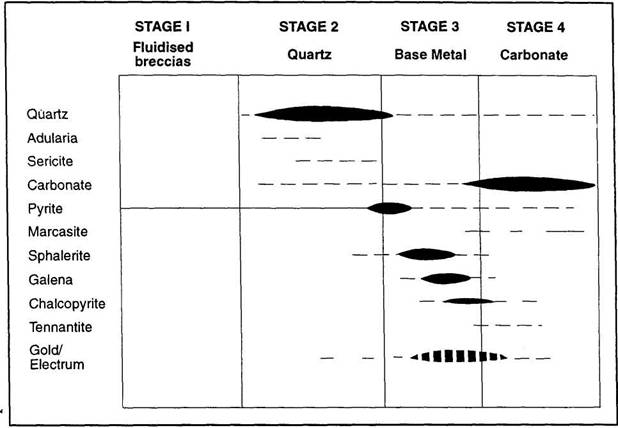
A sequence of overprinting events catagorised (Fig 7.15) for carbonate-base metal gold systems is described as:
Stage 1 fluidised breccias which are interpreted to form in association with initial porphyry
117
Paragenetic Sequence of Veining and Mineralization in Carbonate - Base Metal Sulphide Gold Deposits.
Exploration Workshop "Southwest Pacific rim gold-copper systems: Structure, Alteration, and Mineralization" Corbett G J & Leach T M, 8/96 Edn.
emplacement at depth and localised propylitic alteration of the host rocks. Breccias commonly occur as diatreme breccias (e. g., Wau, Kelian, Acupan, Kerimenge) or intrusive equivalents as fluidised equivalents (e. g., Woodlark Island). Phreatomagmatic breccias provide pre-mineral ground preparation and focus mineralization by tapping the top of the magma chamber.
Stage 2 veining is dominated by quartz and post-dates the breccia event, and in some deposits contains either early adularia and/or late sericite/illitic clay. The quartz veining ranges from: porphyry-related quartz stockwork (e. g., Copper Hill, eastern Australia, Leach unpubl. data; Porgera, Richards, 1992) at deep levels, to quartz-sulphide veining at intermediate levels (e. g., Kelian, Indonesia; Morobe Goldfield, Woodlark, Maniape all in PNG; see examples below), and to crustiform banded quartz-adularia at shallow levels (e. g., Tolukuma, PNG, Corbett et al., 1994c). Fluid inclusion data indicate that the early quartz veining in many deposits was deposited from relatively hot (250-350°C), but dilute (<2-4 wt percent NaCl) fluids (Fig. 7.16).
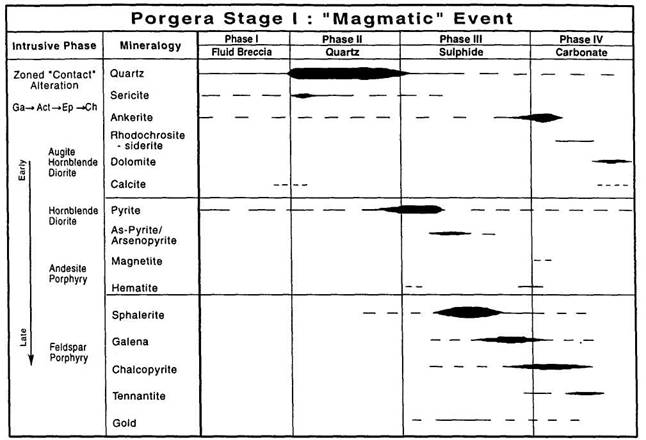
Stage 3 carbonate-base metal sulphide veining typically overgrows and/or crosscuts the earlier quartz veining. The base metal sulphides commonly predate carbonate veining and comprise: early pyrite, followed by sphalerite and galena, overgrown by later copper phases (mainly chalcopyrite followed by tennantite). In some instances, base metal sulphide mineralization extends into the carbonate event.
Stage 4 carbonates may occur as fine crustiform banded veins, locally alternating with thin quartz-rich carbonate bands. Fluid inclusion data indicates that the carbonate and sphalerite in many systems were deposited from a significantly saline fluid (<4-6 wt percent NaCl; up to >20 wt percent in sphalerite at Kelian), but at similar or slightly lower temperatures, to the earlier quartz. High salinity inclusions in carbonate and sphalerite are interpreted to indicate an influx of a fluid with a significant magmatic component during the Stage 2-3 activity.
Gold mineralization predominantly develops during base metal sulphide deposition and extends into the carbonate event. Gold typically occurs in the native state, either as inclusions in pyrite or base metal sulphides, intergrown with carbonate, or infilling fractures and vughs in earlier quartz. Some gold mineralization also occurs within late stage quartz veining, especially where abundant pyrite/arsenopyrite is present (e. g., Kerimenge, Syka and Bloom, 1990; Porgera, Richards, 1992). The average fineness of the gold in carbonate-base metal systems typically lies within the range of 700-850 (Fig. 4.8), intermediate between epithermal quartz gold-silver systems and quartz-sulphide gold veining formed marginal to porphyry intrusions.
Late stage activity is either dominated by surficial fluids which result in the deposition of kaolin, interlayered clay, gypsum, and quartz; or deep fluids characterised by calcite deposition. Gold mineralization may locally persist into the initial stages of this late stage event.
g) Zonations in vein style and mineralization
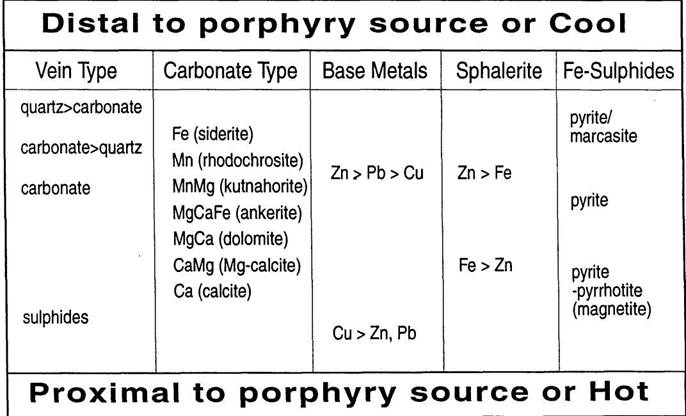
Carbonate-base metal gold deposits exhibit distinctive zonations in styles of veining and mineralization, from regions proximal to a porphyry source or hot conditions, to distal settings where cooler conditions prevail (Fig. 7.17). Carbonate species vary moving towards the porphyry source from: Fe - and Mn-rich (siderite and rhodochrosite) at shallow levels, or distal to the porphyry source; to Ca - and Mg-rich (calcite, Mg-calcite, dolomite) at depth, or proximal to an inferred porphyry source. Intermediate between these carbonate types, are the mixed Mn-Mg-Fe-Ca carbonate species (ankerite and kutnahorite).
118
 |
 |
|
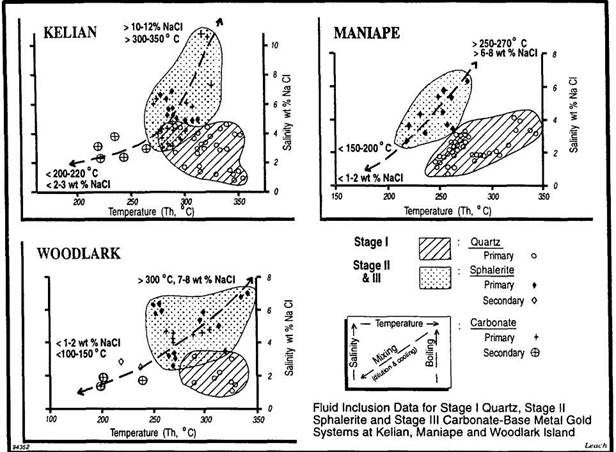
Fig. 7.16 |
 Zonations in vein mineralogy and styles of mineralization in base metal carbonate gold systems.
Fig. 7.17
Exploration Workshop "Southwest Pacific rim gold-copper systems: Structure, Alteration, and Mineralization" Corbett G J & Leach T M, 8/96 Edn.
Limited oxygen and carbon isotope analyses on carbonates at Kelian (van Leeuwen et al., 1990), and Porgera (Richards and Kerrich, 1993) indicate that: the Ca-rich carbonates have strong magmatic fluid signatures, whereas the Mn-Fe carbonates are more likely to develop from a surficial fluid origin, and the kutnahorite and dolomite demonstrate a mixing of the two fluid sources. This zonation in carbonate chemistry is therefore interpreted to represent the descent and heating of cool low pH condensate fluids, and simultaneous mixing of these fluids with upwelling hot magmatic dominated fluids. A similar zonation in carbonate species and modes of formation has been documented for active porphyry-related hydrothermal systems in the Philippines (Leach et al., 1986).
Bulk low grade gold mineralization is usually encountered in the mixed carbonate, kutnahorite/ankerite to rhodochrosite zones, where progressive mixing between descending bicarbonate and upflowing mineralized fluids has taken place, commonly within dilational structural environments. High grade mineralization is encountered in restricted feeder structures where sudden quenching of upwelling fluids has occurred close to the inferred porphyry source.
Veining tends to be dominated by sulphides ± quartz at depth, and becomes more carbonate-rich at the expense of these phases at progressively shallower levels. At shallow levels and/or in outflow zones quartz locally dominates over carbonate (e. g., Karangahake, New Zealand).
Pyrite is the dominant sulphide throughout most systems. However in some deposits, pyrrhotite becomes more abundant at depth, and is in places intergrown with magnetite (e. g., Kelian, Indonesia). Marcasite occurs as shallow levels in many systems and pyrite locally forms colloform bands (melnicovite), and in rare instances is amorphous.
Base metal sulphides (commonly Zn > Pb) dominate over copper phases in most systems. However, copper contents may increase proximal to inferred porphyry sources. Sphalerite typically contains chalcopyrite blebs and stringers, and varies from colourless to yellow (Fe-poor) in cool distal environments, to dark red-brown to opaque (Fe-rich, marmatite) at depth. The increase in Fe-content of sphalerite has been interpreted to be indicative of an increase in the magmatic component to the mineralizing fluid (Simmons et al., 1988), in sulphur fugacity (Weissberg et al., 1979), and/or temperature (Barton and Skinner, 1979).
h) Fluid flow model
Hot mineralized fluids evolve from cooling shallow level porphyry intrusives and rise along permeable zones provided by regional structures, diatreme margins or other lithological contacts such as feeder dykes to domes, or basement plutons (Fig. 7.2). At depth, these fluids mix with circulating meteoric waters and form gold mineralization within quartz-pyrite/arsenopyrite vein systems, in which copper phases dominate over lead-zinc sulphides.
Gases which evolve from these upwelling fluids form gas condensate zones at surficial levels, which are dominated by bicarbonate waters, with a minor acid sulphate component. Fluid draw-down during the cooling of porphyry intrusives promotes the downward migration of bicarbonate fluids prior to the exsolution of most of the metals from the parent melt. Cycling of the hydrothermal system promotes the decent of these cool, oxygenated, moderately low pH bicarbonate fluids deep into the hydrothermal system. Pulses of hot rising mineralized fluids mix with these bicarbonate fluids and deposit gold mineralization within carbonate-base metal
119
Exploration Workshop "Southwest Pacific rim gold-copper systems: Structure, Alteration, and Mineralization" Corbett G J & Leach T M, 8/96 Edn.
sulphide vein/breccia systems, at various crustal levels, depending on available permeability.
In carbonate-base metal gold systems, vectors provided by alteration zonation, paragenetic sequence, and structure, may be used to chart the flow of both upwelling magmatic dominated mineralized fluids, and descending bicarbonate fluids in order to target:
* high grade gold zones resulting from fluid quenching within feeder structures,
* mixing within the progressive cooling environments producing low grade bulk gold
mineralization and in which higher gold grades may develop in settings of repeated
mineral deposition,
* possible gold-copper mineralization associated with the porphyry source.
Carbonate-base metal gold mineralization passes upward to epithermal quartz gold-silver hydrothermal systems. In near surface outflow zones, repeated boiling and cooling of mineralized fluids results in the formation of commonly colloform banded quartz-adularia veining. Gold mineralization preferentially occurs in thin sulphide-rich bands or breccia zones where hot magmatic fluids have been quenched by cool, oxygenated waters (e. g., Tolukuma, PNG, Corbett et al. 1994c; Cracow, eastern Australia, section 8.vii. c.2).
i) Discussion
While carbonate-base metal gold mineralization displays characteristics of both epithermal and porphyry deposits, systems of this type should be distinguished and treated differently during exploration and evaluation. Both bulk mineable low grade fracture/breccia ores and higher grade lode-style ore types are recognised. However, the former are more appropriate to modern mining methods. The nature of fracture-controlled mineralization will be governed by the local structural environment and should therefore be considered in the planning of the orientation of any drilling programme, and the evaluation of that data. Dilational ore zones form at differing orientations to the controlling structures, which may be only weakly mineralized. Drilling directions should take these angular relationships into consideration. Features such as diatreme breccias will have a pronounced influence in any fluid flow models. Of interest is that it is possible to map out the anatomy of these hydrothermal systems using vectors described above to define fluid flow models which aid in targeting zones of best gold mineralization and possibly porphyry sources.
j) Examples
Some examples of carbonate-base metal systems; many of which display transitions with quartz-sulphide, or quartz-illite - chlorite systems, are set out below.
i) Kelian, Kalimantan, Indonesia
The Kelian Mine (5.7 M oz Au), occurs within a linear zone of gold occurrences in Kalimantan Indonesia (van Leeuwen et al., 1990). The position of this zone at the southern portion of an arcuate belt of structures mapped by Pieters and Supritana (1990), and described by Mitchell and Carlile (1994), is indicative of a terrain boundary. This discussion of Kelian is taken from van Leeuwen et al. (1990).
Carbonate-base metal mineralization occurs within a sequence of Tertiary rhyolitic tuffs and epiclastics, and overlying carbonaceous sediments, which are intruded by andesite and rhyolite stocks as well as pre-mineral fluid (muddy) breccias, (Fig. 7.18). The muddy breccias have been interpreted by Sillitoe (1994) as maar volcano/diatreme complexes. Hydrothermal fluids have been focused by enhanced permeability in the shattered margins of andesite porphyry
120

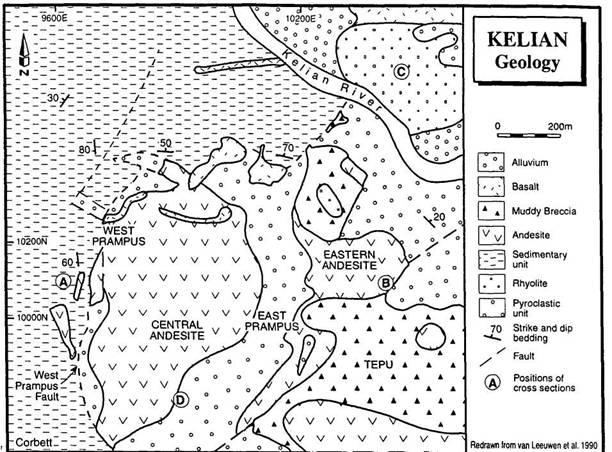
 Fig. 7.18
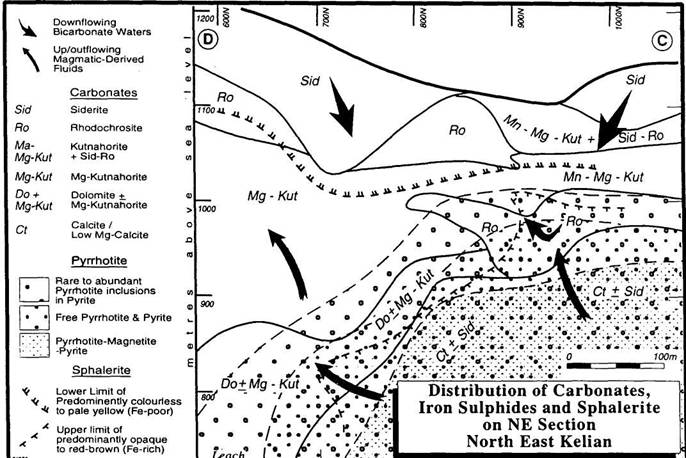
 Fig. 7.20
Exploration Workshop "Southwest Pacific rim gold-copper systems: Structure, Alteration, and Mineralization" Corbett G J & Leach T M, 8/96 Edn.
intrusives, along NS (West Prampus) and NE trending structures.
Two main episodes of hydrothermal activity have been recognised at Kelian (Fig. 7.19). The tuff/epiclastic sequence and shattered contacts of andesite plugs exhibit an early phase of quartz-adularia-sericite + calcite veining, accompanied by intense phyllic (quartz-sericite + adularia) alteration. Chlorite-carbonate + epidote alteration is encountered in the less permeable cores of the porphyritic intrusive. Adularia is recognised at depth in the earlier alteration phases, whereas sericite dominates at shallow levels, and persists in the later phases of this stage of activity. This distribution of adularia-sericite is interpreted to indicate a progressive increase in gas content with time, and condensation of gases upon boiling at shallow levels. Fluid inclusion analyses on quartz and carbonate are indicative of locally boiling, mesothermal (280-350°C), relatively dilute (< 4 equivalent percent NaCl) conditions, during this stage of hydrothermal activity (Fig. 7.19).
Early fractures and breccias have been reactivated during the second stage of mineral deposition, characterised by the deposition of carbonates + quartz and associated base metal and gold mineralization. Localised boiling (indicated by bladed carbonate), and associated brecciation of earlier veining, took place in the vicinity of the blind andesitic intrusives and tension gash fractures in the pyroclastic rocks (Fig. 7.19). The zonation from: carbonate, to carbonate + quartz, and quartz (locally colloform banded) + carbonate, is indicative of cooling and degassing of the fluid as it migrated westward and towards shallower levels.
Gold occurs as: inclusions in base metal and iron sulphides, intergrown with mixed element (Mn, Fe, Ca, Mg) carbonates, or infilling fractures and cavities in earlier quartz veining. Gold fineness ranges from 640-950, with an average of 750, typical of carbonate-base metal gold deposits (Fig. 4.8). Fluid inclusion analyses on sphalerites and mixed element carbonates (Fig. 7.16), indicate that this later phase of activity occurred under a similar mesothermal (270-330°C), but more saline (5 to >10 wt percent NaCl) environment, than the earlier quartz.
Carbonate species exhibit a characteristic zonation with depth, best displayed at the north end of the deposit (Fig. 7.20). Iron (siderite) and manganese (rhodochrosite) carbonates are encountered at shallow levels, whereas magnesium-calcium (dolomite) carbonate persists at depth. Multi-element carbonates (kutnahorite, Mg-Mn-Ca-Fe) are encountered at intermediate depths, where mixing of hot, upwelling Ca-Mg - rich and cool, descending Fe-Mn- rich fluids occurred. This zone of mixing typically delineates the regions of economic gold mineralization. Sphalerite is Fe-poor at shallow levels and in the south, and progressively increases in Fe-content to marmatitic sphalerite at depth and to the northeast.
Hotter conditions at the northern portion of Kelian are apparent from the progression from Fe-Mn carbonates at shallow levels, to Ca-Mg carbonates and pyrrhotite at depth (Fig. 7.20). The local intergrowth of pyrrhotite with magnetite, and change to more Fe-rich sphalerite at depth to the north, are indicative of reducing conditions proximal to a porphyry source. Broad carbonate zonations to the south indicate progressive mixing resulting in low grade mineralization, whereas telescoped narrow carbonate zones to the north are also indicative of rapid the quenching of the hot upwelling fluids, and host local high grade mineralization. Bent and deformed bladed Mn-rich carbonates in these high grade zones are interpreted to illustrate rapid quenching of boiling two phase fluids. Thus, alteration styles provide vectors of fluid flow from an inferred porphyry source and assist in the identification of local higher grade zones.
121


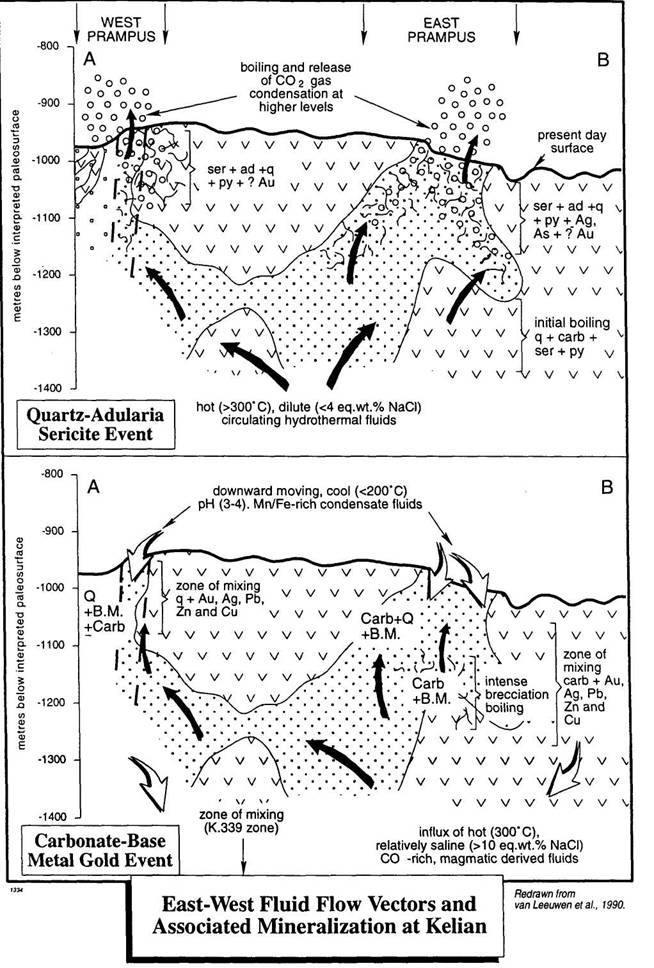
Fig. 7.19
Exploration Workshop "Southwest Pacific rim gold-copper systems: Structure, Alteration, and Mineralization" Corbett G J & Leach T M, 8/96 Edn.
ii) Porgera, Papua New Guinea
The Porgera gold mine (contained gold >14 M oz) essentially represents two mineralized systems: the open pittable carbonate-base metal gold deposit and the epithermal quartz gold-silver system extracted mainly from an underground mining operation (Corbett et al., 1995). From initial panning of gold downstream by the first Government patrols into the district in 1938, and subsequent alluvial miners, exploration of the bulk low grade potential at Waruwari proceeded during the 1970's with boosts from the increase in gold price in 1980, and the discovery of the Zone 7 high grade in 1983 (Henry, 1988). Production from the underground began in 1990 and the open pit in 1992. This discussion is taken from Corbett et al., (1995), Fleming et al. (1986), Handley and Henry (1991), Richards (1990), and Richards and Kerrich (1993).
The Porgera Intrusive Complex (PIC) has been emplaced into locally calcareous shales of the Chim Formation shelf sediments (Davies, 1983) which form part of the uplifted melange of the New Guinea Orogen (Rogerson et al., 1987). Emplacement of the PIC at 6 Ma (Richards and McDougall, 1990), was localised by the intersection of the NNE trending arc normal Porgera Transfer Structure (PTS), with WNW trending structures which parallel the accretionary prism (Figs. 3.1, 7.21, Corbett, 1994). One such WNW structure evident on the Wabag 1:250,000 geological map (Davies, 1983) and landsat imagery, is mapped by Porgera Joint Venture geologists as a prominent shear to the west of Porgera (Fig 7.21, Corbett et al., 1995). Transfer structures separate segments of the subducting plate (Fig. 3.2), and are interpreted by Hill (1990) to locally facilitate a dextral rotation of the accretionary prism. Accretionary structures display a similar rotation across the PTS from normal to the transfer structure, and WNW on the western side of the PTS, to NNW to the east (Fig. 7.21). A set of ENE trending structures formed normal to the rotated eastern portion of the accretionary prism are termed accretionary joints.
Gold mineralization is intimately related to the Porgera Intrusive Complex (Richards and Kerrich, 1993), which comprises stocks and dykes of porphyritic hornblende and augite-hornblende diorite, locally containing olivine, and later more calc-alkaline sills and dykes of andesite and feldspar porphyry (Fig 7.22). The outcropping intrusives are inferred to represent apophyses capping a deeply buried magma source which radiate from a central feeder (Corbett et al. 1995). The Waruwari intrusives do not have a magnetic root and so may have slid-off from an original position prior to mineralization. Later cross cutting feldspar porphyry bodies are indicative of a differentiating intrusive system from which the gold-bearing magmatic fluids also evolved. The upper portion of the PIC appears to be tilted to expose the southern rim as a series of scarp slopes while the north dipping dip-slopes are locally capped by baked sediment.
The structural elements of Porgera (Figs. 7.22, 7.23; Corbett et al., 1995), include:
* NNE trending fractures evident as landsat and air photo lineaments represent the
continuation of the deep crustal Porgera Transfer Structure through the cover of folded
and thrusted sediments. Some fractures have been mapped as shears in the mine area
and much of the early carbonate-base metal gold mineralization appears to be hosted
within NNE fractures which also appear to localise the emplacement of the later stage
feldspar porphyry stocks.
* ENE trending accretionary joint structures, which include the Roamane and parallel
faults, are inferred to have undergone dextral rotation by the regional dextral rotation
on the Porgera Transfer Structure (Corbett, 1994). Local extension associated with
122
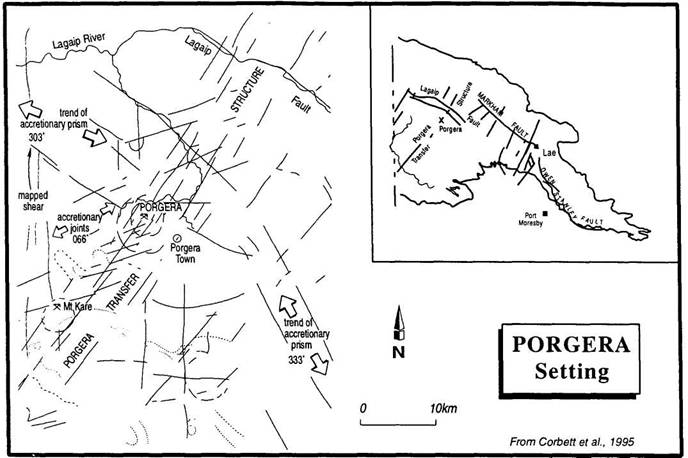
 Fig. 7.21
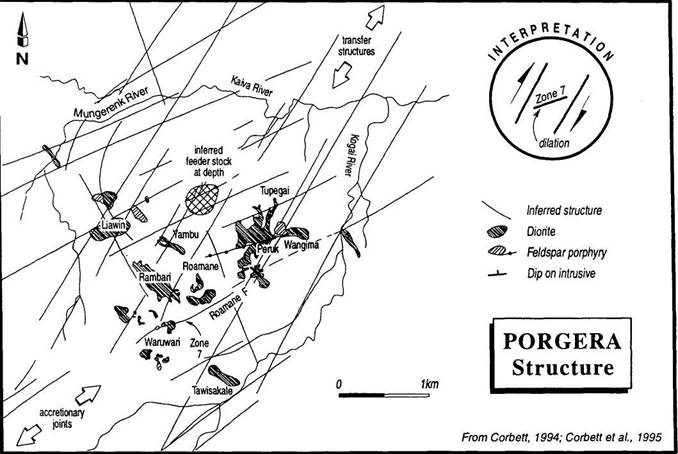
 Fig. 7.22
Exploration Workshop "Southwest Pacific rim gold-copper systems: Structure, Alteration, and Mineralization* Corbett G J & Leach T M. 8/96 Edn.
dextral and normal fault movement on the Roamane Fault provide important ore-hosting dilational environments for the quartz-roscoelite mineralization discussed in Section (7.iv. d.l).
A feldspar porphyry emplaced into the intersection of a transfer structure and the Roamane Fault, displays an inverted cone shape from which it intrudes Waruwari Hill, as well as along the Roamane Fault and into the hanging wall splits (Figs. 7.22, 7.23). A feldspar porphyry at Wangima may have been localised by similar intersection and migrated into the ENE fracture mapped north of the Roamane Fault.
The two styles of alteration, veining and mineralization at Porgera are interpreted to be deposited from fluids which were sourced from the same melt as late stage feldspar porphyry intrusions. The Stage I carbonate-base metal type of alteration veining and gold mineralization, which is exploited in the open pit, is outlined below. The roscoelite-rich epithermal quartz gold-silver system is described in a later Section (7.iv. d.l).
Emplacement of the PIC into incompetent Chim Formation carbonaceous to calcareous sediments resulted in the formation of a zoned brittle contact alteration which extends up to 50-100m from the intrusions (Figs. 7.23, 7.24). Subsequent fracturing of the brittle altered sediments provided permeability for later hydrothermal fluids. Stage I activity occurred at deep epithermal to mesothermal levels and is characterised by early quartz-sericite alteration and veining, followed by massive sulphide mineralization and late carbonate veining (Fig. 7.25). Fluid inclusion data (Richards and Kerrich, 1993) illustrates cooling from early quartz (average Th approx. 318°C) to later sphalerite (average Th approx. 273°C). These veins equate to the type A and B ores of Fleming et al. (1986). The sequence of sulphide mineralization is pyrite —> sphalerite —> galena —> chalcopyrite/tennantite, which continued into the carbonate phase of deposition. Gold occurs as minute (typically >20-40 micron) inclusions in sulphides, and locally as free gold in carbonate. Gold fineness (average 670, Fig. 4.8) is low for carbonate-base metal systems. The gold fineness decreases during progressively later phases, which indicate that cooling occurred during Stage I veining, as supported by the above fluid inclusion data (Richards and Kerrich, 1993). Submicroscopic gold is inferred to be associated with localised early pyrite-arsenopyrite mineralization and equates with type C ore of Fleming et al. (1986).
Changes in carbonate and sphalerite composition provide vectors for fluids during Stage I veining and mineralization. There is change in the Fe-content of sphalerites, as indicated in colour changes of dark red, red-yellow to yellow, from north to south (Fig. 7.26). This zonation is interpreted to indicate higher temperatures and a greater magmatic-component (see section 7.iii. g) of Stage I fluids to the north and east of Rambari-Waruwari. This is supported by the occurrence of pyrrhotite in the Jez Lode, northern Rambari. Copper phases are rare, however significant chalcopyrite ± magnetite mineralization at depth and to the north also provide vectors to a magmatic source for Stage I fluids.
Carbonates are zoned from Mn - and Fe-rich (rhodochrosite ± siderite, with hypogene hematite) at shallow levels and deep in major structures, through transitional Ca-Mn-Fe-Mg-rich phases (early ankerite, and late dolomite), to Ca ± Mg-species (calcite and dolomite) at depth and to the north (Fig. 7.26). This zonation in carbonates is interpreted to reflect the descent of cool, oxygenated, possibly bicarbonate fluids down major structures during Stage I activity. Carbon and oxygen isotope data on Stage I carbonates (Richards and Kerrich, 1993) support the progressive mixing of magmatic and meteoric waters to produce the observed zonations in carbonate species. Late Stage I calcite and dolomite are in close isotopic equilibrium with host calcareous sediments (Richards and Kerrich, 1993), and are
123

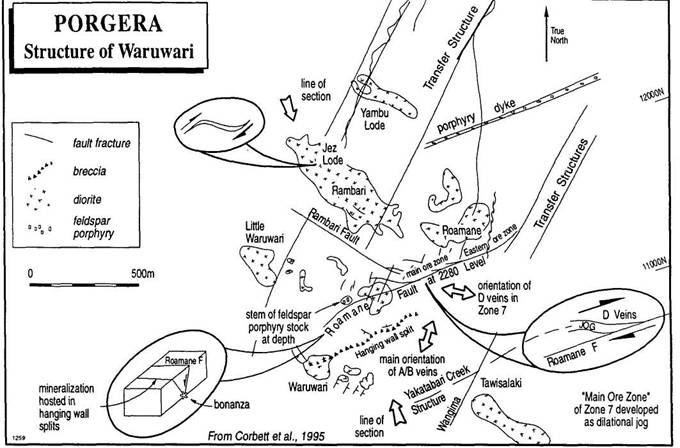
Fig. 7.23
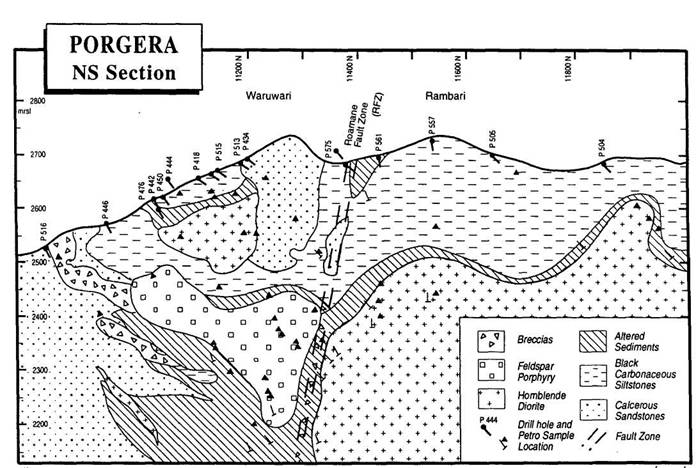
Fig. 7.24
Exploration Workshop "Southwest Pacific rim gold-copper systems: Structure, Alteration, and Mineralization" Corbett G J & Leach T M. 8/96 Edn.
interpreted to have been deposited from surficial bicarbonate waters which have descended, i on waning of Stage I activity, into available open structures.
It is therefore interpreted that Stage I mineralized magmatic fluids have migrated south and west, from the inferred feeder stock (Fig. 7.23), via the NE-trending transfer structures. These fluids are thought to have been cooled and diluted by meteoric waters to produce low grade gold mineralization associated with the carbonate-base metal veining; and quenched in cross-cutting structures by cool, oxygenated bicarbonate waters and resulting in localised higher grade. The occurrence of abundant chalcopyrite at depth beneath the East Zone at Roamane, implies that there has also been localised migration of mineralized fluids, from the magmatic source, south along a major NNW-trending structure (Figs. 7.25, 7.26).
iii) Morobe goldfield. Papua New Guinea
The Morobe Goldfield produced some 3.7 M oz of gold from alluvial and hard rock mining between 1926 and 1977 (Lowenstein, 1982), and still contains substantial gold reserves at: Kerimenge (1.8 M oz Au, Hutton et al., 1990), Hidden Valley (2.4 M oz Au, Pascoe, 1991), and Hamata, (1.3 M oz Au, Wells and Young, 1991). Hard rock gold mineralization in the Morobe Goldfield ranges from quartz-sulphide systems at mesothermal levels at Hamata and Kerimenge, to carbonate-base metal style systems at mesothermal to shallow epithermal levels at Upper Ridges, Edie Creek, Hidden Valley, and higher elevations at Kerimenge (Fig. 7.27). The quartz-sulphide system at Hamata has been discussed previously (Section 7.ii. d).
Structural setting
The Morobe goldfield is hosted by the Bulolo Graben (Fig. 7.28), an intra-arc rift formed by rotation on reactivated structures described by Dekker et al., (1990) as Mesozoic basement transfer structures (Corbett, 1994). Pliocene volcanoplutonism in the environment of extensional tectonism and crustal thinning facilitated emplacement in the Bulolo Graben of Edie Porphyry flow dome complexes, and Bulolo Ignimbrite as extrusive equivalents (Fig. 7.28). Otabanda Formation lacustrine sediments obscure the volcanic and basement rocks in the northern portion of the graben.
Much of the gold mineralization within Bulolo Graben is controlled by graben-bounding and intra-graben structures. At Wau, the Golden Ridges and Upper Ridges, gold mineralization occurs in association with a maar/diatreme (Sillitoe et al., 1984), in the hanging wall of the Escarpment Fault. The Hamata and Hidden Valley deposits similarly occur in hanging wall settings associated with the Upper Watut graben-bounding structure. Brittle deformation caused by the intrusion of diatreme breccias through competent basement rocks has provided fracture vein settings for gold mineralization at Wau (Sillitoe et al., 1984), Kerimenge (Akiro, 1986) and Edie Creek (Corbett, 1994). Kerimenge is localised by the NS trending Kerimenge Fault, an inferred splay from the transfer structures (Corbett, 1994).
Edie Creek
Much of the Edie Creek gold mineralization occurs in a 3 km long NW trending corridor of sigmoidal, en echelon lodes (Lowenstein, 1982), adjacent to the Nauti diatreme (Fig. 7.28; Corbett, 1994). Exposures within Nauti Creek provide a 600 m vertical section through the 5 km long diatreme, which varies from: cobble breccias containing rounded, fresh porphyry boulders in a illite—pyrite altered matrix at the more deeply eroded central portion, to a tuff ring breccia at the southeastern diatreme margin. The Nauti diatreme tuff ring breccias are similar to the Namie breccias at Wau. Basement rocks exposed at an inlier in the tuff ring
124
Paragenetic sequence for Stage I event at Porgera Fig. 7.25
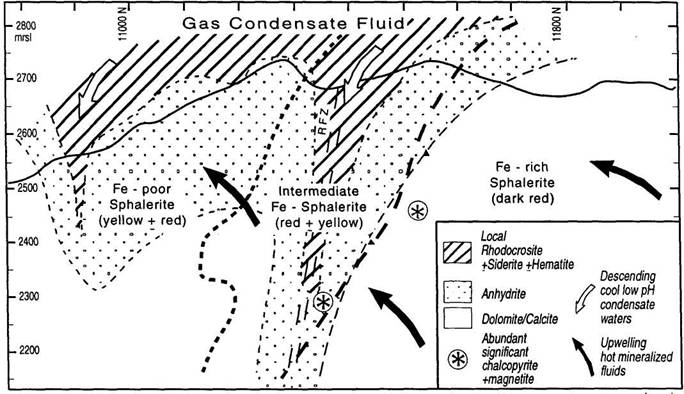
Fig. 7.26
Exploration Workshop "Southwest Pacific rim gold-copper systems: Structure, Alteration, and Mineralization" Corbet! G J & Leach T M. 8/96 Edn.
breccias in Webiak Creek contain fracture-hosted gold mineralization. Some of the cobble breccias in the western portion of the diatreme could be transitional to conglomerate units.
Patterns of vertical and horizontal carbonate zonation are apparent in the vein/lode mineralization formed adjacent to the diatreme. Within the belt of lodes, Lowenstein (1982) records a variation from the NW to SE, moving away from the diatreme margin, of: quartz-pyrite-arsenopyrite with only very minor carbonate at the Enterprise Mine, through increasing carbonate, to a carbonate dominate mineralization at the Day Dawn South Mine. Gold and silver show strong correlations with manganese contents (after manganocarbonate) with some of the highest gold grades contained within the crustiform banded Edie Lodes. Lowenstein (1982) recognised a paragenetic sequence of:
quartz-pyrite —> base metal sulphides —> carbonate + Ag-sulphosalts/sulphides, in banded Mn-carbonate veins from the Karuka Mine. This sequence of deposition is characteristic of shallow level carbonate-base metal gold systems. Gold is commonly associated with the base metal sulphides and carbonate. The multiple deformation and mineralization evidenced by the banding is consistent with the sigmoidal shaped lodes having developed as tension gash features. The dilational ore hosting environment is provided by sinistral movement on NS structures inferred from the regional structural setting (Fig. 7.28; Corbett, 1994).
Further to the SE, and distal to the Nauti diatreme margin, at the Midas workings, rich gold grades have been recorded in association with late crystalline quartz within weathered manganese oxide ore. This is consistent with a lateral zonation as silica predominates towards the periphery of the system see also Karangahake, New Zealand, Section 7.iii. j).
Wau
Veining and mineralization in the Upper Ridges pit, Wau, is hosted in polyphasal quartz-carbonate-base metal veins which crosscut brittle diatreme breccias, termed Namie Breccias (Sillitoe et al., 1984; Fig. 7.29). These rocks have undergone post-mineral hydrothermal brecciation associated with dacite dyke intrusion to form the Davidson Breccia. Two main stages of veining and mineralization are recognised at Upper Ridges (Denwer et al., 1995; Leach, unpubl. reports). These are:
Stage I: Quartz-sericite-pyrite veining is overgrown by massive Fe-rich (marmatitic) sphalerite ± galena. Fluid inclusion analyses indicate that the quartz was deposited over a wide temperature range (210-390°C) and under dilute (<1 wt percent NaCl) to hypersaline (>25 wt percent NaCl) conditions (Syka, 1985; Denwer et al., 1995). These veins have a strong bismuth-tellurium geochemical signature, and gold occurs as inclusions in pyrite (average fineness of 613). The presence of coarse sericite wall rock alteration and high fluid inclusion temperatures indicate that these veins have been emplaced into the breccias at depths of > m below the paleosurface. These conditions are comparable to those which formed quartz-sulphide auriferous veining at Ribroaster (Syka, 1985) at higher elevations at the intersection of a cross structure with the Escarpment Fault (Fig. 7.28).
Stage II: Polyphasal Carbonate-base metal-quartz veining grades from early banded Mn-carbonate through massive carbonate to late quartz ± carbonates. Minor pyrite, Fe-poor sphalerite, galena and chalcopyrite are intergrown with both carbonate and quartz. Traces of late stage tin-phases (canfieldite and stannite) overgrow the base metal sulphides. Low fineness gold (average 468) occurs as inclusions, with base metal sulphides, in pyrite. Stage II quartz and carbonate were deposited under much cooler conditions (198-220°C) than the early
125

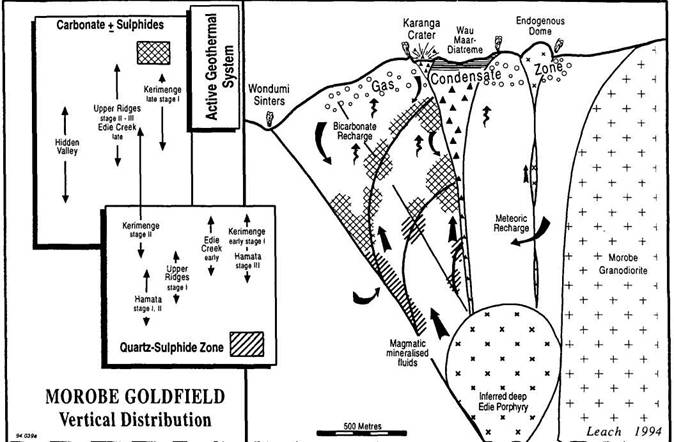
 Fig. 7.27
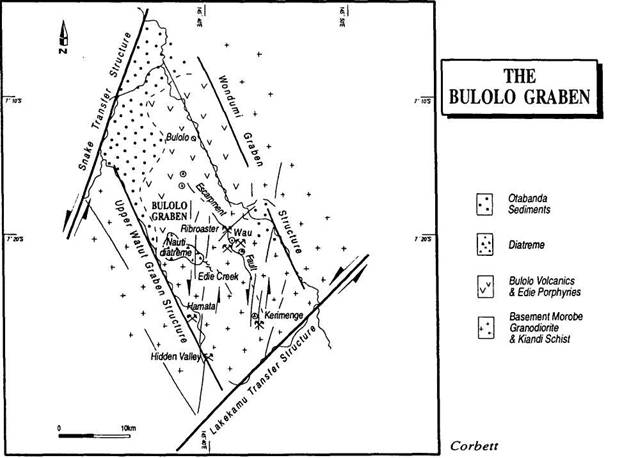
Fig. 7.28
Exploration Workshop "Southwest Pacific rim gold-coppsf systems: Structure, Alteration, and Mineralization" Corbett G J & Leach T M, 8/96 Edn.
quartz-sulphide veining (Denwer et al., 1995; Syka, 1985).
At lower elevations from Upper Ridges, the Wau maar-diatreme complex occurs as a circular feature which is rimmed by endogenous dacite domes and infilled by epiclastic and pyroclastic material (Sillitoe et al., 1984). The presence of very low temperature smectite-kaolinite-cristobalite alteration, current hydrothermal solfataras on the diatreme margins, and reported historical hydrothermal eruptions from Koranga Crater, all suggest that the Wau diatreme-maar complex is very recent. Silica sinters and travertine deposits aligned along the Wondumi Graben Structure (Fig. 7.28) also appear to be related to current geothermal activity in the Wau region.
It is therefore interpreted that hydrothermal activity at Wau occurred over a protracted period and that alteration and mineralization were focused along the Escarpment Fault, and possibly related to emplacement of an Edie Porphyry at depth. Quartz-sulphide gold mineralization occurred early and deep in the system, whereas carbonate-base metal style of gold mineralisation took place later, and possibly at shallower levels. The Escarpment Fault possibly facilitated emplacement of a recent high level Edie Porphyry, and associated formation of the Wau maar-diatreme complex and endogenous dacite domes. Ejecta on the margins of the Upper Ridges pit are inferred to have been derived from eruption of the Wau diatreme and cover material derived from an older source. Rocks similar to the Namie breccias occur along the Escarpment fault (Denwer and Leach, unpubl data) and west on the margin of the Nauti diatreme (Fig. 7.28). Large allochthonous blocks of quartz-carbonate-sulphide veined Namie Breccia (Golden Peaks and Golden Ridges) have slid into the Wau maar, possibly facilitated by recent movements on the Escarpment Fault.
Kerimenge
The Kerimenge prospect is localised at the intersection of the NS trending Kerimenge Fault with a diatreme breccia (Fig. 7.28, Corbett, unpubl. map, 1985; Akiro, 1986). Fracturing at this structural intersection provides an important focus for fluids derived from an inferred porphyry source at depth. Ore-hosting NW trending and SW dipping fractures are inferred to have formed as hanging wall splits, by sinistral rotation and normal faulting on the Kerimenge fault. Denwer et al., (1995) note that the best gold grades occur at the intersection of the fracture/veins and the controlling Kerimenge Fault (Fig. 7.30).
Two main stages of hydrothermal activity have been recognised at Kerimenge (Fig. 7.30, Syka
and Bloom, 1990; Denwer et al., 1995):
Stage I: Low Grade, refractory, polyphasal quartz-sulphide comprises:
* Early quartz-sericite-pyrite veining and locally intense silicification which has
overprinted zoned porphyry-related biotite/potassic and propylitic alteration.
* Fracturing and brecciation of the silicified zones and deposition of
arsenopyrite-pyrite-marcasite-quartz. This is the main gold mineralizing event with a
resource of 51 Mt at 1.0 g/t gold, in which the gold is refractory.
* late manganocarbonate-illitic clay-arsenopyrite/pyrite + base metal sulphides.
The quartz-sulphide veining took place under low temperature (145-240°C) and dilute (<3.3 wt percent NaCl) conditions, in which the environment of deposition became progressively cooler. Pre - or early-Stage I quartz contain daughter phases indicative of hypersaline porphyry-related conditions. The Stage I veining and alteration are zoned from: quartz-sulphide at depth and to the south, through quartz-manganocarbonate-illite/sericite at intermediate levels, to manganocarbonate lodes at high elevation and to the north (Fig. 7.30).
126


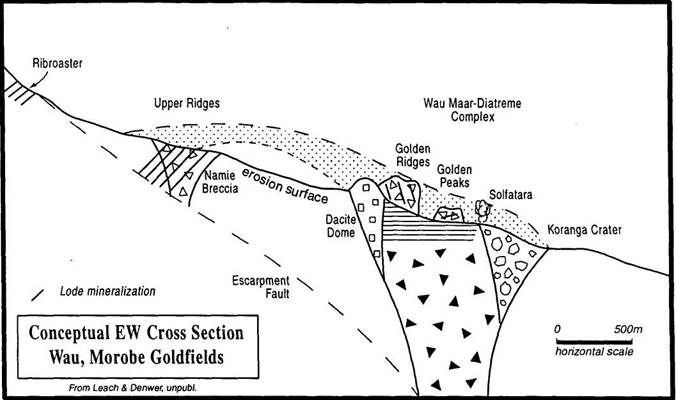
 Erosion of Upper Ridges - Ribroaster Systems offset by faulting in Escarpment Fault; Subsequent emplacement of Wau-Karanga Crater Maar-Diatreme Complexes.
|
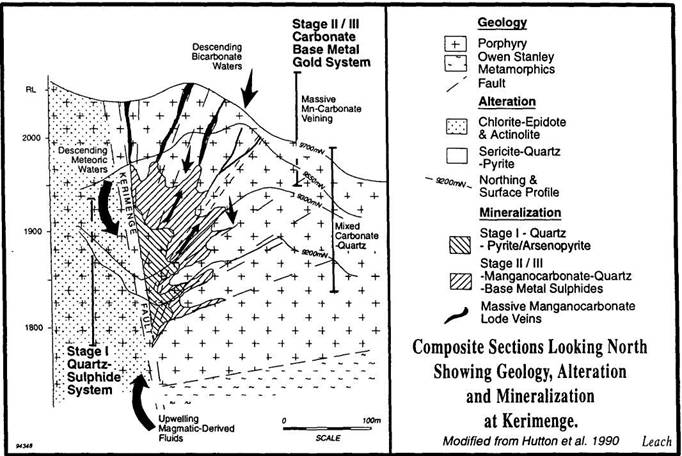
Fig. 7.30 |
Fig. 7.29


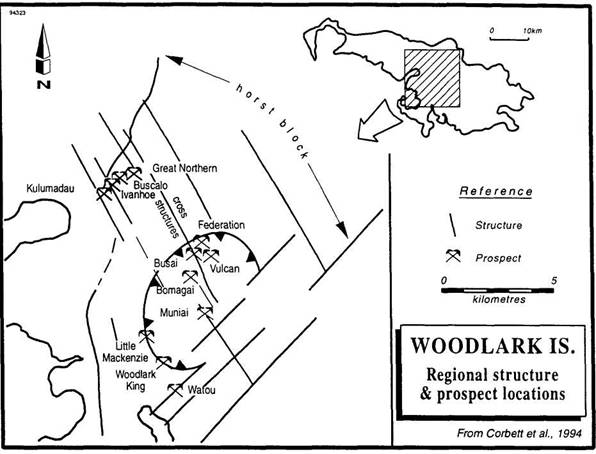
Fig. 7.31
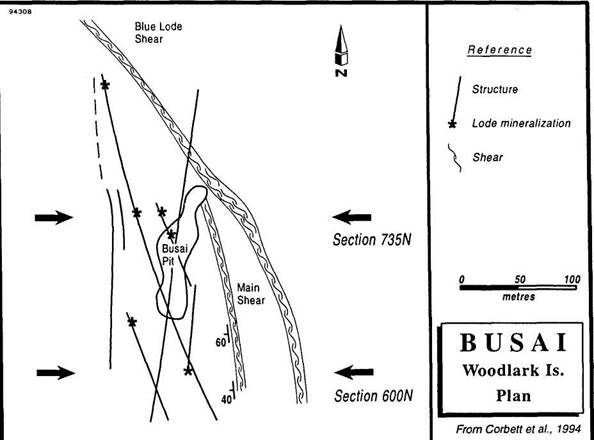
 Fig. 7.32
Exploration Workshop "Southwest Pacific rim gold-copper systems: Structure, Alteration, and Mineralization" Corbett G J & Leach T M, 8/96 Edn.
Stage II: High grade, non-refractory mineralization co-exists with manganocarbonate veining, and comprises quartz-carbonate-sulphide deposition in dark bands alternating with Mn-carbonate, or in breccia zones sealing clasts of Mn-carbonate veining. High fineness (average 837) gold is non-refractory and is associated with hessite, tennantite, chalcopyrite mineralization. Fluid inclusion data (Denwer et al., 1995) indicates that mineralization has taken place in response to the mixing of cool (160-170°C) bicarbonate waters related to manganocarbonate deposition, and hot, but dilute (<2.1 wt percent NaCl) upwelling fluids. Gold mineralization at Kerimenge has changed from a refractory quartz-sulphide style system early and at deep levels in the south prospect area, to a non-refractory carbonate-quartz-base metal sulphide event at shallow levels in the northern prospect area. It is interpreted that Stage II metal-bearing fluids are related to a separate intrusive event than Stage I mineralization.
Hidden Valley
The Hidden Valley deposit (2.4 M oz Au, Pascoe, 1991) occurs as stockwork veining developed in the hanging wall of the Hidden Valley Fault (Nelson et al., 1990), inferred to represent a continuation of the Upper Watut Graben Fault extending from the Hamata deposit (Fig. 7.28). Thus, the hanging wall setting is similar to Wau and Kerimenge. Nelson and co-workers describe the following paragenetic sequence of overprinting veins and fractures:
1. Quartz-pyrite, with chlorite, epidote
2. Quartz-hematite-chlorite-pyrite; rare gold with arsenopyrite
3. Carbonate with
(a) quartz-adularia
(b) base metal sulphides-gold-adularia
(c) kutnahorite-gold-tetrahedrite
Early quartz-pyrite-arsenopyrite with rare gold veining is comparable to the early quartz-sulphide veining at Kerimenge. The sequence of quartz-adularia —> base metal sulphide-gold —> Mn/Mg-carbonate - gold is similar to Stage II/III base metal/carbonate events recognised in other carbonate-base metal systems (Fig. 7.15).
iv) Woodlark Island, Papua New Guinea
Gold was discovered at Woodlark Island, 300 km east to the mainland of Papua New Guinea, in 1895 (Stanley, 1912). Much of the gold production of 100,000 oz from lodes and 83,000 oz from alluvials occurred prior to World War II (McGee, 1978). Although recent coralline limestone deposits obscure much of the geology of Woodlark Island, an analysis of the aeromagnetic data suggests: a central horst block is transected by NW trending cross structures (Fig. 7.31), may be tilted to the north, and most areas of gold mineralization occur within erosional inliers in the cover (Fig. 7.31; Corbett et al., 1994a). Two main mining centres are at Kulumadau and Busai.
Busai
Between 1902 and 1916 the Murua United Mine (known locally as the Busai Pit) produced about 3500 ounces of gold at a grade of 4.3 g/t Au and with an average fineness of 771-846 (McGee, 1978). The Busai Pit is localised at the intersection of a NS structure with a series of NW trending cross structures, which transect a horst block (Figs. 7.31, 7.32). Mineralization occurs in the hanging wall to the arcuate shape NW-dipping the Blue Lode shear where demagnetisation of primary magnetite in the host Okiduse Volcanics is indicative of clay alteration (Fig. 7.31).
127
Exploration Workshop "Southwest Pacific rim gold-copper systems : Structure. Alteration and Mineralization" Corbett GJ & Leach TM. 3/96 Edn.
The bulk of the gold mineralization is hosted in carbonate vein/breccias within shallowly dipping tension gash features, constrained between the steeply dipping NW structures (Figs. 7.34, 7.35). Carbonate vein/breccias also exploit the structures utilised by the milled matrix fluidised breccias. High grade lodes mined by the early miners and intersected in drilling, are interpreted to represent the fissure veins which act as feeder structures for the shallow dipping tension gash veins (Corbett et al., 1994a).
A paragenetic sequence of overprinting structure, alteration and mineralization events has been defined (Figs. 7.35; Corbett et al., 1994b) as:
1. Propylitic alteration of volcanic pile and development of hematitic fracture and breccia fillings,
interpreted to be of deuteric origin.
2. Intrusive milled matrix fluidised breccias fine upwards from coarse grained and angular at
depth to "flinty" chalcedonic silica/pyrite fault fill at higher levels in the system. These exploit
pre-existing structures and provide ground preparation for later mineralization.
3. Polyphasal quartz-pyrite grades from early very fine chalcedonic quartz-pyrite to later coarse
grained quartz-pyrite-illitic clay-carbonate, and is equivalent to Stage I quartz described for other
systems. Local jasperoid reflects shallow oxygenated environments. Fluid inclusion data
indicates late drusy quartz was deposited from a dilute (<2 wt percent NaCl) two phase (boiling)
system at a temperature of around 280°C.
4. Gold mineralization is hosted within carbonate vein/breccias. Fluid inclusion data (Fig. 7.16)
and the vertical zonation in carbonate type from Fe/Mn at shallow levels, to mixed Mn/Mg/Fe/Ca
at intermediate levels, and to Ca/Mg-carbonate at depth, are interpreted to be indicative of mixing
hot (>250°C), relatively saline (>6 wt percent NaCl) fluids, with cool (<150°C) dilute (<2 wt
percent NaCl) bicarbonate condensate fluids. This gradual mixing formed the bulk low grade
gold mineralization as carbonate tensional gash veins. Bonanza gold grades developed as
carbonate-quartz breccias within the lodes or feeder structures, and are interpreted to result from
the quenching of upwelling mineralized fluids by ground waters (Fig. 7.33). Rare base metals are
overgrown by early quartz and form pre - to syn-carbonate deposition. Gold occurs as electrum
mainly intergrown with carbonate, but also as inclusions in sulphides, and has an average
fineness of 830, which is unusually high for carbonate-base metal gold mineralization (Fig. 4.8).
The zonation in the carbonate type from Mn/Mg carbonate at Busai to Mn carbonate at the Federation workings, some 500 m along strike to the north, is consistent with a fluid source to the south (Fig. 7.31). The Muniai area lies in the centre of a circular feature inferred to represent a caldera collapse feature, defined from the aeromagnetic data (Fig. 7.31). Here, lower temperature propylitic alteration (actinolite-chlorite-albite-epidote-carbonate) is coincident with an aeromagnetic high, possibly indicative of magnetite bearing higher temperature propylitic or potassic alteration at depth. Phyllic alteration with a low temperature clay overprint are evident at the adjacent Bomagai prospect (Fig. 7.31). Thus, Busai and the other gold occurrences (e. g., Woodlark King, Little McKenzie, etc; Fig. 7.31), which form a roughly circular distribution, may have been derived from a central porphyry source.
Kulumadau
Between 1901 and 1950 mining at Kulumadau produced 77,000 ounces of gold at an average grade of 15.9 g/t Au and fineness of 776-859 (McGee, 1978). The Kulumadau mining centre is localised on a major horst-bounding structure, possibly by the intersection of a cross cutting structure (Fig.Although similar styles of mineralization and overprinting relationships are recognised at Kulumadau and Busai (Corbett et al., 1994a), the intense post mineral shearing
128

|
Из за большого объема этот материал размещен на нескольких страницах:
1 2 3 4 5 6 7 8 9 10 11 12 13 14 15 |
