

Партнерка на США и Канаду по недвижимости, выплаты в крипто
- 30% recurring commission
- Выплаты в USDT
- Вывод каждую неделю
- Комиссия до 5 лет за каждого referral
 SOUTHWEST PACIFIC RIM GOLD-COPPER SYSTEMS:
Structure, Alteration and Mineralization
WORKSHOP MANUAL
 G J Corbett and TM Leach
Greg Corbett Terry Leach
Corbett Geological Services Terry Leach & Co.
29CarrSt, 54 Ponsonby Rd.
North Sydney, NSW 2060 Ponsonby, Auckland
Australia New Zealand
Ph Ph
Fax Fax
E-mail *****@***com. au.
SOUTHWEST PACIFIC RIM
GOLD-COPPER SYSTEMS:
Structure, Alteration,
and Mineralization.
Manual for an
Exploration Short Course
presented at Baguio,
Philippines November 1996
by
G J Corbett & T M Leach
This Workshop Manual is a minor modification, in the response to reviewers comments, of a presentation for the SEG/SME at Phoenix, Arizona in March 1996, and is part of an upgrade towards eventual publication, presumably as part of the Economic Geology Special Publication Series. Additional copies of the pre-published manuscript are available from Corbett Geological Services above, posted airmail in Australia for $A75 or overseas $A90.
Exploration Workshop "Southwest Pacific rim gold-copper systems: Structure, Alteration, and Mineralization" Corbett G J & Leach T M, 8/96 Edn.
SUMMARY
This workshop classifies differing styles of southwest Pacific rim gold-copper mineralization in an analysis of hydrothermal ore-forming processes. The magmatic arc geothermal systems in the Philippines are used as active analogues in the evaluation of the characteristics of intrusive-related ore systems. Structure and alteration provide information on the direction of fluid flow within evolving hydrothermal systems, in which we interpret that mixing of magmatic fluids with meteoric waters provides a mechanism for metal deposition. Major structures localise magmatic hydrothermal systems in magmatic arc settings and create ore-hosting dilational environments within subsidiary structures. Breccias occur in most gold-copper deposits and may be categorised as a guide to understanding the ore-forming environment.
Porphyry copper-gold systems arejocalised, within volcanoplutonic arcs by regional accretionary (arc-parallel) or transfer (arc-normal) structures. Cooling of intrusions emplaced at high crustal levels results in the initial formation of zoned alteration assemblages, followed by stockwork veining and the exsolution of volatiles and fluids. Pressure draw-down caused by cooling of the intrusion and parent melt facilitates the downward percolation of meteoric waters to porphyry depths, and results in overprinting retrograde alteration. Porphyry copper mineralization is interpreted to develop in the apophyses of intrusions by the mixing of meteoric waters with metal-bearing magmatic fluids derived from larger magma sources at depth. Skarn deposits exhibit similar prograde and retrograde alteration events and the formation of associated mineralization, in response to the emplacement of high level intrusions into calcareous rocks.
High sulphidation gold-copper deposits are derived from magmatic fluids and extend from porphyry to epithermal regimes. Whereas barren high sulphidation alteration forms as shoulders and caps to porphyry intrusions, more distal mineralized systems are classified as variants of predominantly structural or lithological control to fluid flow. All systems exhibit characteristic alteration zonation resulting from progressive cooling and neutralization of hot acid magmatic fluid by reaction with host rocks and ground waters. Variations in the style of mineralization, metal content and alteration mineralogy, depend on depth of formation and fluid composition. A two-stage alteration and mineralization model suggests that initial vapour-dominated fluids develop pre-mineralization zoned alteration, which is overprinted and commonly brecciated by the later mineralized liquid-rich fluids.
Varying styles of low sulphidation gold-copper vein systems predominate in settings of oblique subduction, where magmatic fluids exolve from intrusive source rocks into environments which contain meteoric waters of different compositions and temperatures. Quartz sulphide gold ± copper systems form proximal to magmatic source rocks by the mixing of magmatic fluids with deep circulating cool and dilute meteoric ground waters. Carbonate-base metal gold systems form at higher levels by reaction of magmatic fluids with low pH bicarbonate gas condensate waters. Epithermal quartz gold-silver systems represent hydrothermal systems formed at the highest crustal levels and display the most distal relationship to the magmatic source. Bonanza gold grades develop in these systems by the reaction of more dilute magmatic fluids with oxygenated surficial ground waters. This latter group of deposits is transitional to the classic adularia-sericite epithermal gold-silver vein systems.
Adularia-sericite epithermal gold-silver deposits form at elevated crustal levels and vary with increasing depth from: generally barren surficial sinter/hot spring deposits, to stockwork
Exploration Workshop "Southwest Pacific rim gold-copper systems: Structure, Alteration, and Mineralization" Corbett G J & Leach T M, 8/96 Edn.
vein/breccias, and fissure veins. Basement metamorphic rocks fracture well and so represent competent hosts for fissure veins within dilational structural settings. While traditional boiling models may account for the deposition from meteoric waters of the characteristic gangue minerals comprising banded quartz, adularia and quartz pseudomorphing platy carbonate; much of the gold is interpreted to have been deposited by the mixing of ground waters with magmatic dominated fluids. Telescoping may overprint the varying styles of low sulphidation gold mineralization upon each other or the source porphyry intrusive.
The ore deposit models defined herein are useful in all stages of mineral exploration, from the recognition of the style of deposit, to the delineation of fluid flow paths as a means of targeting high grade ores, or porphyry source rocks. The exploration geologist may be aided by the use of conceptual exploration models which are interpretative and so vary from the more rigorously defined than ore deposit models. Conceptual models should not be applied rigidly but modified using an understanding of the processes described herein to develop prospect-specific exploration models.
Exploration Workshop 'Southwest Pacific rim gold-copper systems: Structure, Alteration, and Mineralization" Corbett G J & Leach T M, 8/96 Edn.
CONTENTS
1. Characteristics of Gold-Copper Hydrothermal Systems
i) Introduction 10
ii) Conceptual exploration models 10
iii) Classification 11
iv) Fluid characteristics 12
2. Geothermal Environment for Pacific Rim Gold-Copper Systems 14
i) Settings of active hydrothermal-geothermal systems 14
ii) Silicic continental and volcanic arc hydrothermal systems 14
iii) Characteristics of Philippine intrusive-related active hydrothermal systems 15
a) Physio-chemical zonations in Philippine geothermal systems 15
b) Waning Stages of active geothermal systems 16
c) Magmatic acid fluid environments 17
d) Analogies to ore-forming systems 17
e) Styles Philippine active hydrothermal systems 18
f) Evolution of active porphyry systems 29
iv) Examples of active intrusion-related hydrothermal systems in the Philippines 20
a) Large disseminated systems in permeable structures or composite volcanic terrains 20
1. Young systems dominated by magmatic vapours 20
2. Circulating hydrothermal systems 21
3. Collapsing hydrothermal systems 21
b) Cordillera-hosted intrusion-related active hydrothermal systems 24
v) Conclusions 25
3. Structure of Magmatic Ore Systems 28
i) Introduction 28
i) Tectonic setting 28
ii) Major structures 30
iii) Framework for dilational structures from active tectonic environments 32
iv) Dilational ore environments 33
v) Fracture systems 37
vi) Shear sense indicators 38
vii) Porphyry and intrusion-related fracture patterns 39
viii) Breccias 42
a) Introduction 42
b) Classification 43
c) Primary non-hydrothermal breccias 44
d) Ore-related hydrothermal breccias 45
1. Magmatic hydrothermal breccias 46
2. Phreatomagmatic hydrothermal breccias 48
3. Phreatic breccias 50
ix) Conclusion 51
4. Controls on Hydrothermal Alteration and Mineralization 51
i) Introduction 51
ii) Temperature and pH controls on alteration mineralogy 51
a) Silica group 52
b) Alunite group 53
c) Kaolin group 53
d) Mite group 54
e) Chlorite group 54
f) Calcsilicate group 54
g) Other mineral groups 55
iv) Alteration zones associated with Ore Systems 55
v) Controls on deposition of gangue phases 56
Exploration Workshop "Southwest Pacific rim gold-copper systems: Structure, Alteration, and Mineralization" Corbett G J & Leach T M. 8/96 Edn.
a) Silica 56
b) Carbonates 57
c) Sulphates 57
vi) Controls on metal deposition 57
a) Gold 58
b) Copper 59
c) Lead and zinc 59
d) Silver 59
e) Gold finenes 59
5. Gold-Copper Systems in Porphyry Environments 61
i) Porphyry copper-gold 61
a) Structural setting 61
b) Early models of alteration and mineralization zonation 61
c) Model of polyphasal overprinting events 63
1. Prograde Events 64
i) Heat transfer 64
ii) Stockwork veins 64
2. Retrograde Events 65
iii) Phyllic overprint 65
iv) Mineralization 67
v) Argillic overprint 68
vi) Magmatic high sulphidation overprint 69
ii) Skarn 70
a) Introduction 70
b) Processes of skarn formation 70
1. Prograde isochemical 70
2. Prograde metasomatic 71
3. Retrograde 72
c) Skarn ore deposits 73
iii) Breccia-hosted gold deposit 74
iv) Porphyry and alkaline gold-copper deposits 74
6. High Sulphidation Gold-Copper Systems 76
i) Characteristics 76
a) Classification 76
b) Active analogues 77
c) Alteration assemblages 78
d) Two stage alteration mineralization model 79
e) Mineralization 79
ii) High sulphidation systems formed as shoulders to porphyry intrusions 81
a) Characteristics 81
b) Examples 82
iii) Lithologically controlled high sulphidation gold-copper systems 85
a) Characteristics 85
b) Examples 85
iv) Structurally controlled high sulphidation gold-copper systems 89
a) Characteristics 89
b) Examples 89
v) Composite structurally/lithologically controlled high sulphidation gold-copper 94
a) Characteristics 94
b) Examples 95
vi) Hybrid high-low sulphidation gold systems 98
a) Characteristics 98
b) Examples 98
Exploration Workshop "Southwest Pacific rim gold-copper systems: Structure, Alteration, and Mineralization" Corbett G J & Leach T M, 8/96 Edn.
7. Porphyry-Related Low Sulphidation Gold Systems 101
i) Classification 101
a) Introduction 101
b) Sequence of events 102
c) Types of porphyry-related low sulphidation gold systems 102
ii) Quartz Sulphide gold ± copper systems 103
a) Introduction 103
b) Structural setting 104
c) Alteration and mineralization 105
d) Examples 106
iii) Carbonate-base metal gold systems 115
a) Introduction 115
b) Definition 115
c) Distribution 116
d) Geological setting 116
e) Structure 117
f) Alteration and mineralization 117
g) Zonations in vein style and mineralization 118
h) Fluid flow model 119
i) Discussion 120
j) Examples 120
k) Conclusion 133
iv) Epithermal quartz gold-silver systems 134
a) Introduction 134
b) Characteristics 134
c) Structural setting 135
d) Examples 135
1. Associated with intrusion-related mineralization 137
2. Peripheral to intrusion-related mineralization 139
3. Associated with adularia-sericite epithermal gold-silver 140
e) Conclusions 142
v) Sediment hosted gold deposits 143
a) Characteristics 143
b) Example 144
8. Adularia-Sericite Epithermal Gold-Silver Systems 147
i) Classification 147
ii) Examples 148
iii) Tectonic setting 148
iv) Structure 149
v) Fluid Characteristics and hydrothermal alteration 149
vi). Mineralization 150
vii). Types of epithermal gold-silver deposits 151
a) Sinter and hydrothermal (hot spring) breccia deposits 151
1. Characteristics 151
2. Examples 152
b) Stockwork quartz vein gold-silver deposits 153
1. Characteristics 153
2. Examples 153
c) Fissure Veins or Reefs 153
1. Characteristics 154
2. Examples 154
9. Conclusions 159
i) Introduction 159
ii) Gold-copper exploration models in project generation 159
iii) Gold-copper exploration models in reconnaissance prospecting 160
iv) Gold-copper exploration models in project development 160
Exploration Workshop "Southwest Pacific rim gold-copper systems: Structure, Alteration, and Mineralization" Corbett G J & Leach T M. 8/96 Edn.
v) If the shoe fits wear it 161
Acknowledgements 162
References cited 162
LIST OF FIGURES
1.1. Pacific rim gold-copper mineralization models
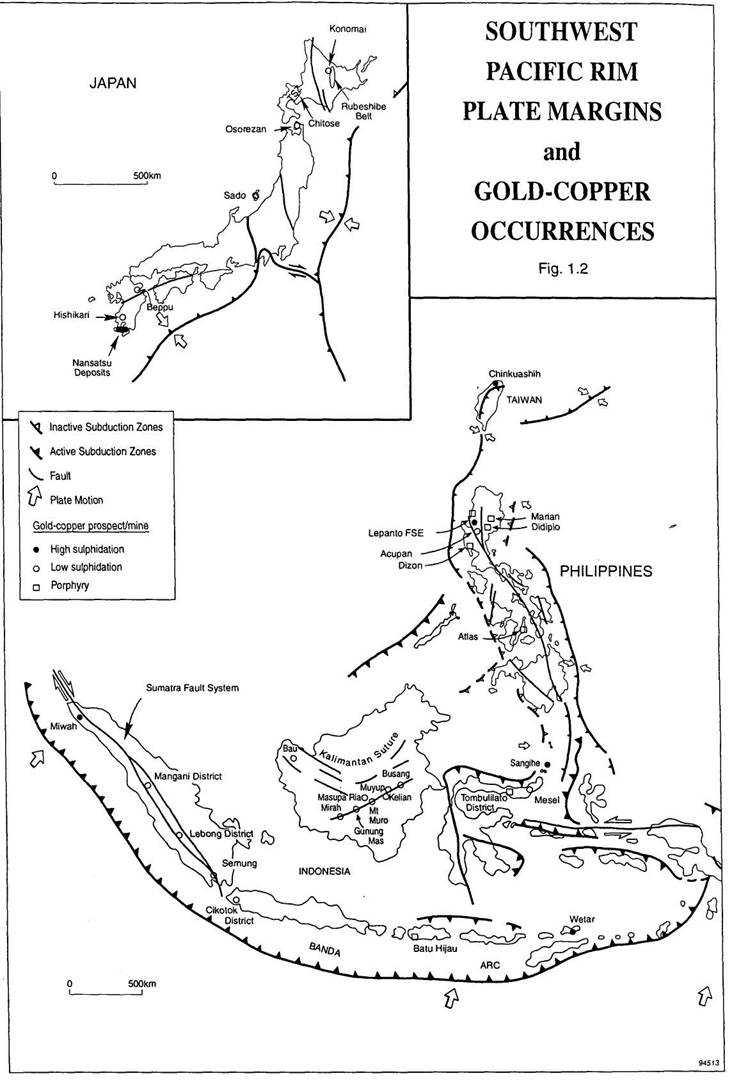
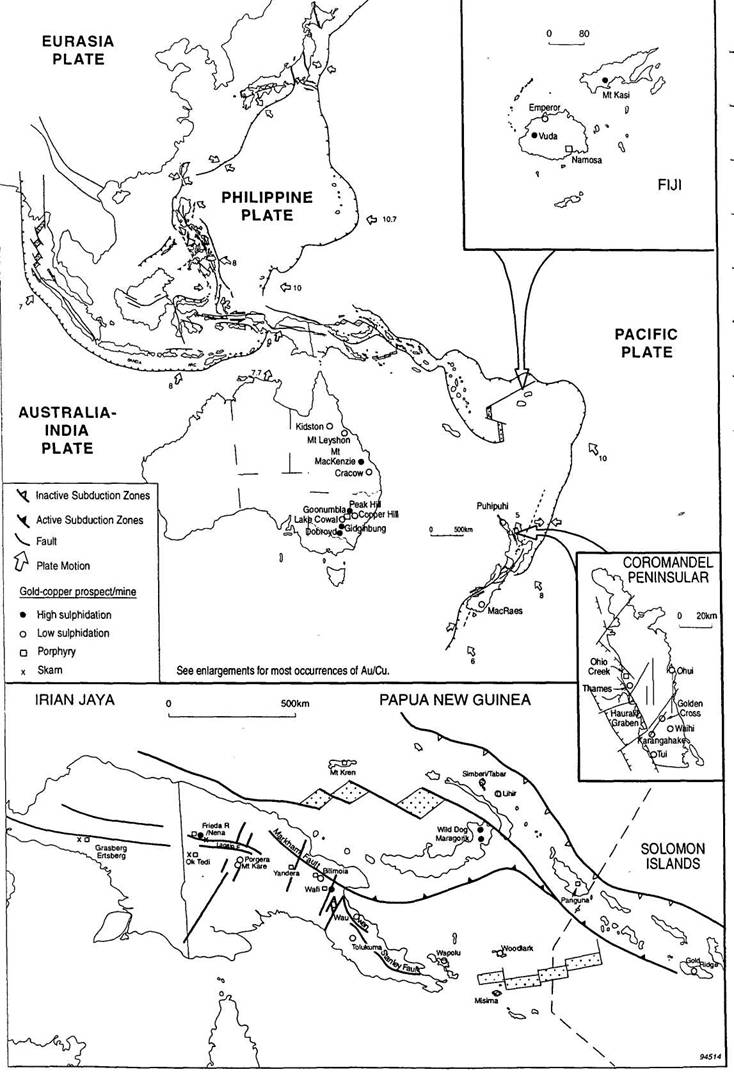
1.2. Southwest Pacific rim gold-copper occurrences
1.3. Size vs grade of some southwest Pacific rim copper-gold occurrances
1.4. Derivation of high and low sulphidation fluids
2.1. Active geothermal systems and hydrothermal ore deposits
2.2. Conceptual model for silicic back-arc rift geothermal systems
2.3. Conceptual model - Volcanic arc hydrothermal systems
2.4. Conceptual Model - Hydrology of shallow levels in geothermal systems
2.5. Geological setting of Philippine geothermal systems
2.6. Tongonan geothermal field - structural setting
2.7. Alto Peak - conceptual hydrological model
2.8. Biliran geothermal field - thermal features
2.9. Biliran geothermal system - conceptual model
2.10. Tongonan geothermal field - conceptual model
2.11. Southern Negros geothermal field - setting
2.12. Southern Negros geothermal field - conceptual model
2.13. Bacon-Manito geothermal field - conceptual model
2.14. Bacon-Manito geothermal field - conceptual model
2.15. Geothermal systems in Volcanic arc-Cordillera settings
2.16. Amacan geothermal system - cross section
2.17. Daklan geothermal field - cross section
2.18. Acupan - geological setting
2.19. Baguio District, Philippines - geology
3.1. Pacific Rim plate margins
3.2. Settings of southwest Pacific rim porphyry copper-gold
3.3. Transfer structures and porphyry systems in PNG
3.4. Structures formed in association with an earthquake in Iran
3.5. Dilational fault systems
3.6. Dilational ore environments
3.7. Riedel's clay model experiment
3.8. Riedel shear model
3.9. Tension gash and domino structures
3.10. Dilational fractures in orthogonal settings
3.11. Fault sense of movement indicators
3.12. Sheeted vein systems - no lateral deformation
3.13. Sheeted vein systems - intrusion under deformation
3.14. Classification of breccia environments
3.15. Magmatic-hydrothermal breccias - subvolcanic breccia pipe
3.16. Magmatic-hydrothermal breccias - structurally controlled
3.17. Magmatic-hydrothermal breccias - injection breccias
3.18. Phreatomagmatic breccias
3.19. Phreatic breccias
4.1. Common alteration mineralogy in hydrothermal systems
4.2. Controls on the solubility of quartz
4.3. Controls on the solubility of calcite
4.4. Controls on the solubility of barite and anhydrite
4.5. Solubility of Au, Cu and Zn relative to temperature and pH
4.6. Controls on the solubility of gold
4.7. Controls on the solubility of zinc, lead and copper
4.8. Gold fineness
5.1. Lowell and Guilbert porphyry copper model
Exploration Workshop "Southwest Pacific rim gold-copper systems: Structure, Alteration, and Mineralization" Corbet! G J & Leach T M, 8/96 Edn.
5.2. Sillitoe and Gappe porphyry copper model
5.3. Gustafson and Hunt genetic model for the El Salvador porphyry copper
5.4. Pressure-temperature environments at El Salvador
5.5. Porphyry copper model stages I and II
5.6. Porphyry copper model stages HI and IV
5.7. Porphyry copper model stages V and VI
5.8. Porphyry alteration minerals
5.9. Evolution of pluton associated skarns
6.1. High sulphidation systems - styles
6.2. High sulphidation systems - alteration and mineralization
6.3. High sulphidation systems - two stage fluid alteration and mineralization model
6.4. High sulphidation systems - metal zonations
6.5. Horse-Ivaal - plan of alteration
6.6. Horse-Ivaal - cross section of alteration
6.7. Lookout Rocks - plan of alteration
6.8. Lookout Rocks - cross section of alteration
6.9. Vuda, Fiji - structure and alteration
6.10. Vuda, Fiji - conceptual cross section
6.11. Wafi-Bulolo region - structural setting
6.12. Wafi, PNG - plan of alteration
6.13. Wafi, PNG - long section of alteration
6.14. Raffertey's copper-gold conceptual cross section, Wafi
6.15. Nansatsu deposits, Japan
6.16. Miwah - alteration
6.17. Miwah - conceptual model
6.18. Frieda-Nena - setting
6.19. Frieda-Nena - alteration and structure
6.20. Nena - alteration
6.21. Nena - cross section 5200N
6.22. Nena - cross section 4700N
6.23. Nena - alteration long section
6.24. Lepanto/FSE - structural setting
6.25. Lepanto/FSE - geology
6.26. Lepanto/FSE - alteration
6.27. Mt Kasi, Fiji - CSAMT/Structure
6.28. Mt Kasi, Fiji - structure and mineralization open pit.
6.29. Peak Hill - structure
6.30. Peak Hill - paragenetic sequence
6.31. Peak Hill - cross section
6.32. Maragorik - setting
6.33. Maragorik - alteration
6.34. Maragorik cross section
6.35. Bawone-Binebase, Sangihe Is, Indonesia
6.36. Wild Dog - setting
6.37. Wild Dog - geology
6.38. Wild Dog - conceptual cross section
6.39. Masupa Ria - geology
7.1. Low sulphidation gold-copper systems - temporal and spatial zonations
7.2. Low sulphidation gold-copper systems - classification
7.3. Low sulphidation gold-copper systems - alteration
7.4. Ladolam gold deposit - geology
7.5. Ladolam gold deposit - conceptual model
7.6. Kidston - setting
7.7. Kidston - geology
7.8. Kidston - paragenetic sequence
7.9. Kidston - distribution of gangue and ore phases
7.10. Bilimoia - structure
Exploration Workshop "Southwest Pacific rim gold-copper systems: Structure, Alteration, and Mineralization" Corbett G J & Leach T M, 8/96 Edn.
7.11. Bilimoia - paragenetic sequence
7.12. Bilimoia - conceptual model
7.13. Arakompa -/paragenetic sequence
7.14. Arakompa -j fluid inclusion data
7.15. Paragenetic/sequence for carbonate-base metal gold systems
7.16. Fluid inclusion data for carbonate-base metal gold systems
7.17. Zonation in carbonate base metal gold systems
7.18. Kelian - geology
7.19. Kelian - fluid flow vectors
7.20. Kelian - carbonate species line 250 E
7.21. Porgera - setting
7.22. Porgera - structure
7.23. Porgera - Waruwari structure
7.24. Porgera - cross section
7.25. Porgera - paragenetic sequence
7.26. Porgera - distribution of carbonate species
7.27. Morobe goldfield - vertical distribution of systems
7.28. Bulolo Graben
7.29. Upper Ridges-Wau diatreme-maar complex
7.30. Kerimenge - composite cross section
7.31. Woodlark Island, PNG - regional structure
7.32. Busai, Woodlark Island - Plan locations of cross sections
7.33. Busai - mineralization cross section
7.34. Busai - alteration cross section
7.35. Busai - paragenetic sequence
7.36. Maniape - structure
7.37. Maniape - paragenetic sequence
7.38. Mt Kare - carbonate-base metal cross section
7.39. Gold Ridge - carbonate-base metal cross section
7.40. Karangahake- cross section
7.41. Porgera Zone VII - paragenetic sequence
7.42. Porgera Zone VII - alteration cross section
7.43. Mt Kare - paragenetic sequence
7.44. Structural setting of the Coromandel Peninsula
7A5. The Thames goldfield, Ohio Creek Porphyry and Lookout Rocks alteration
7.46. Arakompa-Maniape - fluid flow model
7.47. Tolukuma - vein system
7.48. Tolukuma - cross section
7.49. Tolukuma - paragenetic sequence
7.50. Tolukuma - fluid flow model
7.51. Mesel - structure
7.52. Mesel - paragenetic sequence
7.53. Mesel - conceptual fluid flow model
8.1. Models for low sulphidation epithermal vein systems
8.2. Setting of Champagne Pool, Taupo Volcanic Zone, New Zealand
8.3. Golden Cross - structural setting
8.4. Golden Cross - alteration cross section
8.5. Golden Cross - alteration long section
8.6. Waihi New Zealand - structure
8.7. Cracow eastern Australia - structural setting
8.8. Hishikari Japan - structure and alteration
LIST OF TABLES
1. Characteristics of Pacific rim gold-copper mineralization
 |
 |
|
Exploration Workshop "Southwest Pacific rim gold-copper systems: Structure, Alteration, and Mineralization" Corbett G J & Leach T M. 8/96 Edn.
1 CHARACTERISTICS OF GOLD-COPPER HYDROTHERMAL SYSTEMS i) Introduction
This is the manual utilised at the short course of the same name presented at the SME/SEG Meeting in Phoenix in March 1996, with some modifications in response to reviewers comments. The manual is designed so that the figures can be followed during the presentation, in which the slides of rocks etc further support the concepts delineated herein. I also provides some additional information not covered in the lectures.
ii) Conceptual Exploration Models
This workshop demonstrates and describes conceptual models as an aid to the exploration and evaluation of Pacific rim magmatic arc mineral resources. However, we must carefully consider the nature of these conceptual exploration models before we place any reliance upon them.
As exploration geologists we compare, contrast and classify mineral occurrences in order to build up empirical patterns from data such as field observations. We develop deposit models as descriptions of individual deposits, or of more use to the exploration geologist, styles of deposits. Exploration models are derived from interpretations, focusing upon those characteristics of a deposit model which aid in the discovery of ore deposits of a particular style. Progressively lateral interpretations depart from rigorously reviewed science and so become conceptual exploration models. Such a conceptualisation may give the explorationist petitive advantage (Henley and Berger, 1993) in the increasingly difficult search for ore deposits.
Structure and petrology are tools which the explorationist may utilise in the development of conceptual exploration models by comparisons of active and extinct hydrothermal systems with exploration examples. Major structures localise intrusions and minor structures provide ground preparation. The study of petrology delineates styles of alteration and mineralization, fluid characteristics and mechanisms of ore deposition. The synthesis of structure and petrology may define fluid flow paths in hydrothermal ore systems. Similarly, models may assist in ranking projects and aid in the abandonment of lower order targets.
Conceptual exploration models evolve through application to exploration examples and are refined by research, many being abandoned during this process. Although luck plays a part, the competitive nature of the search for ore bodies encourages explorationists to be the first to develop or utilise a conceptual exploration model. The very innovative nature which makes a conceptual exploration model of use to the explorationist, precludes the lengthy process of rigorous evaluation of many of the concepts by exhaustive research studies. It is important that models must not be applied rigidly, but should be modified to become project-specific and great care must be taken to abandon or modify inappropriate models. It is intended in this workshop to instruct the participant in the processes involved in the derivation of conceptual exploration models rather than in the rigid application of existing models.
10
|
|
Exploration Workshop "Southwest Pacific rim gold-copper systems: Structure, Alteration, and Mineralization" Corbett G J & Leach T M, 8/96 Edn.
iii) Classification
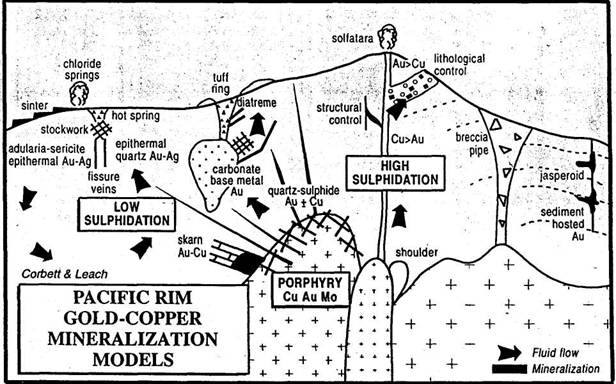
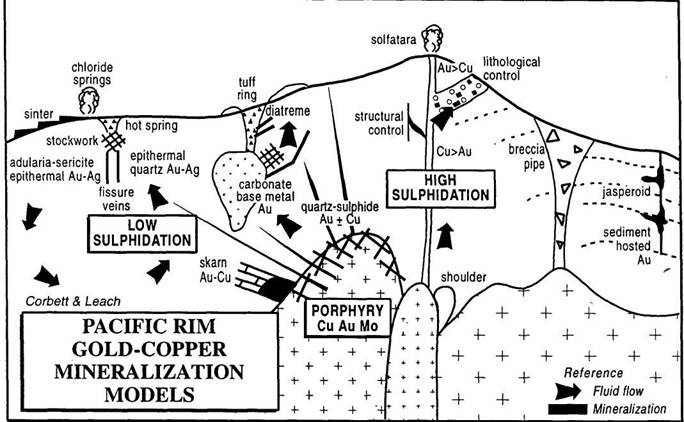
A simple classification is used to distinguish and evaluate differing styles of southwest Pacific rim gold-copper mineralization (Fig. 1.1, Table 1). Elements of this classification are:
* Crustal level which reflects the proximity to the magmatic source,
* Degree of sulphidation classified as high or low sulphidation as discussed in detail below.
Varying crustal levels of formation provide the primary basis for the distinction of different styles as:
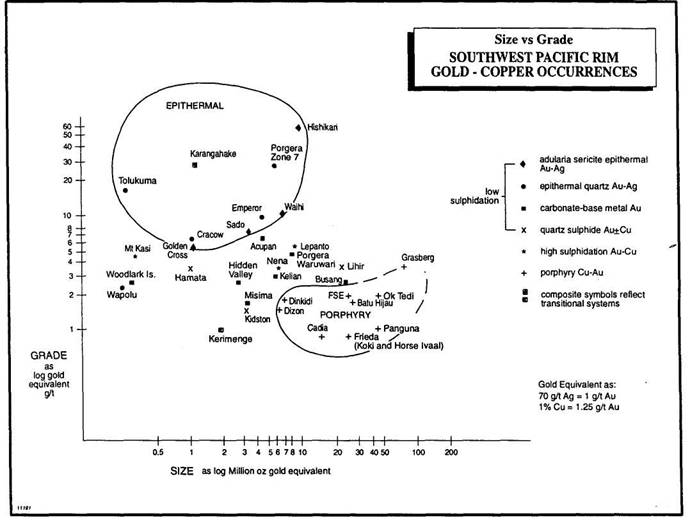
Porphyry systems are hosted within intrusive rocks at depths of typically greater than 1 km. Cox and Singer (1988) provide a mean depth of 3.6 km for plutonic copper-molybdenum porphyry deposits, mainly of the eastern Pacific, and median depths of about 1 km for gold-copper porphyries typical of the southwest Pacific rim. Sillitoe (1993a) emphasises the vertical extent (1 km to >2 km) and cylinder shape of the latter deposits. These deposits may contain the greatest metal contents but at lower grades than deposits formed at shallow levels (Fig. 1.3), and so commonly represent prime exploration targets for bulk low grade mineralization.
The term porphyry is utilised in this manual to describe a high level intrusive rock with a porphyritic texture, and not necessarily a porphyry copper-gold body in the strict sense.
Mesothermal deposits are described by Lindgren (1922) as "formed... at intermediate temperature and pressure" and in this classification includes those which developed at temperatures higher than for epithermal deposits, that is >300cC (Hayba et al. 1985). Morrison (1988) also utilises Lindgen's mesothermal term for veins of the Charters towers district, Eastern Australia, while Henley and Berger (1993) recognise the difficulties of continuing with the term epithermal for a ranger of deeper deposits such as Kelian, Indonesia. Southwest Pacific rim mesothermal deposits are herein described as quartz-sulphide gold ± copper (including Charters Towers) or carbonate-base metal gold (including Kelian), in order to avoid confusion with the use of the term mesothermal with slate belt and Mother Lode deposits (Hodgson, 1993), to which these may be related (Morrison, 1988). The quartz-sulphide gold ± copper and carbonate-base metal gold deposits may form resources of considerable size and moderate gold grades (Fig. 1.3).
Epithermal deposits form at shallow depths and temperatures less than 300°C (Hayba et al. 1985) and encompass a variety of low and high sulphidation deposits. Some display elevated silver contents and others are characterised by bonanza metal grades exceeding 30 g/t Au (Fig. 1.3), which facilitate extraction by underground mining techniques.
The different styles of southwest Pacific rim gold-copper systems are therefore classified here as:
* Porphyry-related which includes:
# porphyry copper-gold
# skarn copper-gold
# breccia gold-copper
# porphyry and alkaline gold
* High sulphidation gold-copper. Although commonly described as epithermal in the
geological literature high sulphidation systems extend to the mesothermal and porphyry
regimes, and vary from:
11
|
Exploration Workshop "Southwest Pacific rim gold-copper systems: Structure, Alteration, and Mineralization" Corbett G J & Leach T M, 8/96 Edn.
# barren porphyry shoulders (i. e., on the margins of porphyry systems)
# structurally controlled gold-copper
# lithologically controlled gold-copper
# composite structurally-lithologically controlled gold-copper
# hybrid systems high-low sulphidation gold
* Low sulphidation systems are grouped as:
# porphyry-related deposits which demonstrate the closest relationship to magmatic
source and form a continuum as:
# quartz-sulphide gold ± copper
# carbonate-base metal gold systems
# epithermal quartz gold-silver,
# sediment-hosted gold
# adularia-sericite epithermal gold-silver systems are subdivided with increasing depth
as:
# sinter and hydrothermal breccia gold-silver (hot spring deposits in Sillitoe
1993b)
# stockwork quartz vein gold-silver
# fissure vein gold-silver
Many of these terms are defined below, the characteristics of different deposit types and some examples are summarised in Table 1.
iv) Fluid Characteristics
The physio-chemical characteristics of the hydrothermal fluids control the:
* type and quantity of metals transported,
* processes which produce mineralization,
* location of the mineralization,
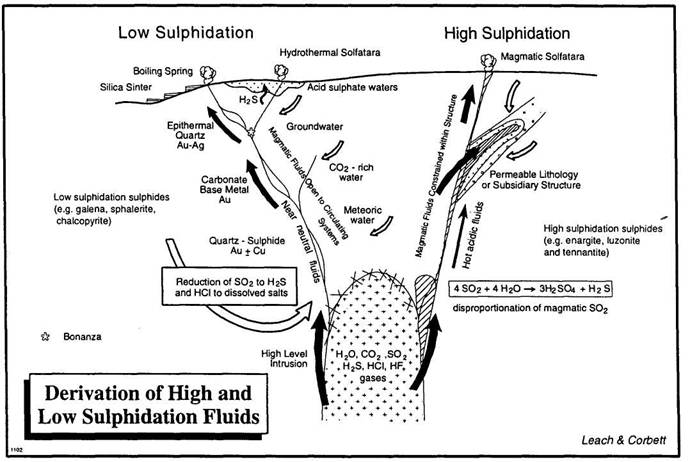
whereas the characteristics of the host rock control the mechanisms of fluid flow (Hedenquist, 1987). A conceptual model for the transportation of fluids from a degassing magma to porphyry, high sulphidation and low sulphidation systems is illustrated in Figure 1.4.
Country rocks become more competent (brittle) as a result of contact metamorphism during the initial emplacement of high level porphyry intrusions. Fracturing is initiated at the cooled margins of the intrusion and extends into the host country rocks. Cooling, of the porphyry intrusion and the parent melt is accompanied by the progressive exsolution of dissolved salts, magmatic volatiles (mainly H2O, SO2, CO2, H2S, HF, and HCl), metals, and their transfer into the fractured carapace during the evolution of the porphyry systemH(Henley and McNabb, 1978). Dispersion and the local mixing of these magmatic fluids with circulating meteoric-dominated fluids, results in the zoned alteration and mineralization which characterises porphyry copper deposits (Henley and McNabb, 1978; e. g., Grasberg and Batu Hijau in Indonesia; Ok Tedi and Panguna in Papua New Guinea). Skams form where mineralizing porphyry intrusions are emplaced into calcareous host rocks (e. g., Ertsberg, Indonesia; Frieda River Copper, PNG; Red Dome, eastern Australia).
Volatiles may become overpressured where confined within the intrusion. Tectonic movements may fracture the carapace and facilitate venting as breccia bodies (e. g., Kidston, eastern Australia), and the formation of fracture systems which host later mineralized magmatic fluids.
High sulphidation deposits form if magmatic volatiles and brines are channelled up deep-
12
|
Exploration Workshop "Southwest Pacific rim gold-copper systems: Structure, Alteration, and Mineralization" Corbett G J & Leach T M, 8/96 Edn.
seated fracture/fault zones and rise rapidly with minimal rock reaction or mixing with circulating meteoric fluids. At temperatures below 400°C the progressive disproportionate of magmatic SO2 into H2S and H2SO4 within the vapour plume produces a hot acid fluid (Rye et al., 1992). As the temperature decreases, increasing amounts of H2S and H2SO4 are produced (Rye et al., 1992). These hot acid fluids mix with circulating meteoric waters and react with country rock within dilational structures or permeable lithologies to form gold-copper deposits (Rye, 1993). Hedenquist (1987) initially termed these hydrothermal systems "high sulphidation" because sulphur is in a high oxidation state of +4, due to the dominance of magmatic SO2. However, more recently (Hedenquist et al., 1994; White and Hedenquist, 1995) thelermH'h'igh sulphidation" has been used to indicate the presence of characteristic alteration and a mineral suite including enargite, luzonite and tennantite. The abundance of sulphur cannot be used as a criteria to distinguish between high and low sulphidation systems. Sulphur species are commonly abundant in most, but not all, southwest Pacific high sulphidation systems. Examples of high sulphidation gold-copper deposits include: Lepanto, Philippines; Nena and Wafi, PNG; Mt Kasi, Fiji; Temora and Peak Hill, eastern Australia.

|
Из за большого объема этот материал размещен на нескольких страницах:
1 2 3 4 5 6 7 8 9 10 11 12 13 14 15 |
