

Партнерка на США и Канаду по недвижимости, выплаты в крипто
- 30% recurring commission
- Выплаты в USDT
- Вывод каждую неделю
- Комиссия до 5 лет за каждого referral
49
Exploration Workshop "Southwest Pacific rim gold-copper systems: Structure, Alteration, and Mineralization" Corbett G J & Leach T M, 8/96 Edn.
pyrite.
Alteration in eruption breccias characteristically occurs as a flooding of silica and varying degrees of fine grained commonly massive pyrite. This silicifiction, which is most common in fluid outflows, contracts with the clay and disseminated crystalline pyrite alteration in diatreme breccias.
Mineralization is described from matrix in eruption breccias in the Nansatsu gold deposits of Japan and hot spring-style gold deposits of Nevada by Nelson and Giles (1985). Sinter deposits which form as surficial outflows of fluid from eruption breccia vents typically display anomalous mercury, gold, silver, antimony and arsenic contents. Mineral deposition is promoted by sudden quenching as hydrothermal fluids mix with surficial waters adjacent to the breccia vent, whereas sinter deposits further from the vent tend to be barren. The precipitate adjacent to Champagne Pool, New Zealand has yielded anomalous gold to 80 ppm and silver to 175 ppm (Weissberg, 1969) and explosion breccia-related sinter deposits from the Kinruyu Hot Spring, Beppu, Japan yielded; 0.47 ppm Au, <1 ppm Ag, 12.2 percent As, 1290 ppm Sb and 9990 ppm W (Austpac Gold unpubl. data). The McLaughlin gold mine, USA (Tosdal et al., 1993) and Puhipuhi gold prospect, New Zealand (Brown, 1989; White, 1986) each have recorded histories of mercury production from sinter deposits adjacent to explosion breccia vents and have since undergone exploration for underlying gold mineralization, leading to production in the ease of McLaughlin (Section 8.vii).
Much of the gold mineralization mined at McLaughlin lies mostly within veins below the explosion breccia (Sherlock, 1993; Tosdal et al., 1993). Similarly, the setting of the Yamada veins, Hishikari, Japan, immediately underlying the explosion breccia (Izawa et al., 1993), may have promoted downward movement of groundwaters and mineral deposition by quenching (Section 8.vii). Vein mineralization is interpreted to also underlie explosion breccias at Osorezan, Japan (Aoki, 1989) and at Toka Tindung, North Sulawesi (Wade, 1996). Thus, gold mineralization is most likely to occur below eruption breccias (Sillitoe 1985), as veins of the stockwork, sheeted or fissure vein type, or matrix to breccias.
ix) Conclusion
Pacific rim gold-copper systems require fractured rocks to provide open space for the flow of magmatic mineralized fluids. Mineral deposition may be promoted by the mixing of these fluids with ground waters present within the same plumbing systems. Differing styles of fractured host rocks may be modelled by comparisons with: active fault systems, experimental data, and field observations of many mineralized systems. Models may point towards the better mineralized portions of hydrothermal systems and the best orientation for drill testing.
50
 Exploration Workshop "SW Pacific Rim Au/Cu Systems: Structure Alteration & Mineralisation" Corbett G J & Leach T M, 8/96 Edn.
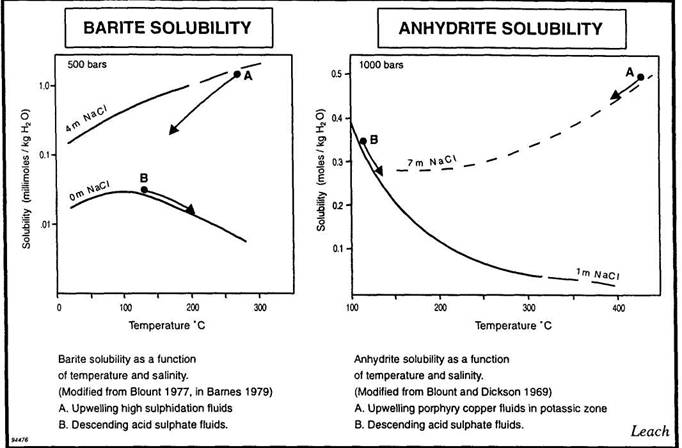
 Fig. 4.4
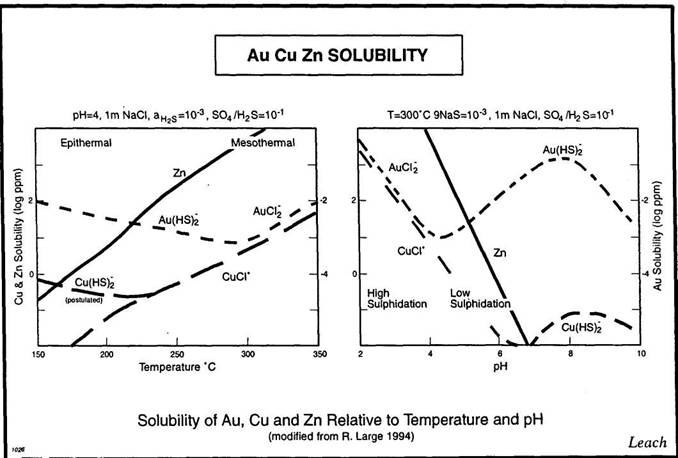
 Fig. 4.5
Exploration Workshop "Southwest Pacific rim gold-copper systems: Structure, Alteration, and Mineralization" Corbett G J & Leach T M, 8/96 Edn.
c) Sulphate minerals
The solubilities of sulphate minerals are also strongly controlled by temperature, and like carbonate minerals exhibit an inverse relationship with increasing temperature (Fig. 4.4). Gypsum deposits in preference to anhydrite at low temperatures (<100-150°C). In highly saline porphyry environments, anhydrite solubility decreases proportionally to temperature, causing the common occurrence of (biotite) anhydrite in porphyry environments. At high activities of sulphur, and/or low fluid pH, alunite will deposit in preference to anhydrite (Reyes, 1985).
Barite is the least soluble of the sulphate minerals and will preferentially deposit upon heating at low temperatures of a barium-bearing solution (e. g., circulating sea water). However, unlike other sulphate minerals, barite exhibits a reversal in solubility in relation to temperature at higher temperatures (150-200°C in very dilute fluids), and therefore becomes increasingly more soluble at higher temperatures (Fig. 4.4). In the saline environment of upwelling hot high sulphidation systems, barite solubility decreases with temperature and is therefore commonly deposited in the central, highly silicified zones.
v) Controls on Metal Deposition a) Gold
Gold is transported as a bisulphide complex (Au(HS)'2) over almost all conditions within mesothermal and epithermal environments (<300-350oC), and probably as a chloride complex (AuCl") at higher temperatures (Fig. 4.5; Seward, 1982). Gold is transported as a bisulphide complex over pH ranges characteristic of low sulphidation systems (pH >4), and as chloride complex under the acidic environment of high sulphidation systems (Large 1994; Fig. 4.5). This is supported by the common occurrence of gold with copper mineralization in high sulphidation deposits (Section 6.i. e). AuHS0 has also been identified as one of the principal gold complexes in high temperature acidic solutions (Bening and Seward, 1994; Arribas, 1995). Elsewhere (Seward, 1982), it has been postulated that under low pH (<3-4) conditions gold may be transported as either a thio-bisulphide or as a combined chloride-bisulphide complex.
In high temperature porphyry environments gold is transported as a chloride complex and is commonly intergrown with copper phases. Its deposition is controlled by decreases in temperature, pressure, and salinities. At lower telnperatures, gold is transported as a bisulphide complex and its solubility actually increases with increasing temperature and salinity (Henley 1985a; Figs. 4.5, 4.6), [although Seward (1982) illustrated that gold solubility actually decreases with cooling]. Gold mineralization in these environments can be given by the following equation:
Au + 2H2S = Au(HS)-2 + 1/2H2 + H+
Therefore, in mesothermal to epithermal environments gold will be deposited from an upwelling mineralized fluid upon:
1. Boiling,
2. Mixing with low pH fluids,
3. Mixing with oxygenated fluids.
1. Boiling causes exsolution of H2S and associated gold deposition. However, this is somewhat modified by an associated increase in pH and decrease in temperature which actually increase
58
Exploration Workshop "Southwest Pacific rim gold-copper systems: Structure, Alteration, and Mineralization* Corbett G J & Leach T M, 8/96 Edn.
gold solubility_during boiling (path A in Fig. 4.6). Brown (1986) illustrated that flashing of deep hydrothermal fluids to atmospheric pressure at Broadlands Geothermal Field, New Zealand, deposited percentages of gold and silver in scales in surface pipework. However, only 14 percent of gold calculated to be in the deep fluid was deposited, due to effects of temperature loss, pH increase, and gold completing with bisulphide remaining in fluid after boiling. The extreme pressure drops in these experiments are unrealistic in natural environments, and therefore are considered to illustrate (only) that boiling can deposit some gold, under unique conditions (see Sections 7 and 8). The decrease in activity of sulphur is an important factor which promotes gold mineralization, and can also be achieved by deposition ofjibundant sulphides (e. g., Fe-sulphides in high sulphidation systems).
2.  Mixing with low pH fluids such as descending acid sulphate or bicarbonate fluids will
deposit gold (path C in Fig. 4.6). However, this is offset by dilution and cooling effects.
3. Oxidation of a fluid by mixing with descending oxygenated groundwaters is an excellent
mechanism for the deposition of gold (path B in Fig. 4.6). Slight drops in the fO2 of ascending
mineralized fluids in the region of pyrite/hematite phase boundaries can decrease gold
solubility by orders of magnitude,(Romberger, 1988; Fig. 4.6). The oxidation of pregnant
fluids in an epithermal environment is therefore probably the most effective mechanism of
gold deposition, and is considered the main mechanism for the formation of bonanza-grade
gold deposits. This is supported by the common occurrence of hypogene hematite in these
deposits (Sections 7 and 8).
[Under low pH (<3-4) conditions, especially at high temperatures, the solubility controls on gold are poorly understood. Gold may be transported as the thio-bisulpide complex HAu(HS)2°, or as combined chloride-bisulphide complexes (Seward, 1982)].
b) Copper
Copper is transported as a chloride complex (either as CuCl0 or CuCl32") over temperature and pH ranges which are encountered in most hydrothermal systems (Fig. 4.5; Large, 1994). Copper minerajization is therefore controlled by decreases in temperature, salinity and pjigiiuxe7 Ifhas been postulated (Henley and Brown, 1985) that copper may also be transported bilJdi at low temperatures and salinities. This is supported by the common
occurrence of low grade, but significant, copper which accompanies gold mineralization in many epithermal quartz vein deposits (see Section 8).
c) Lead and Zinc
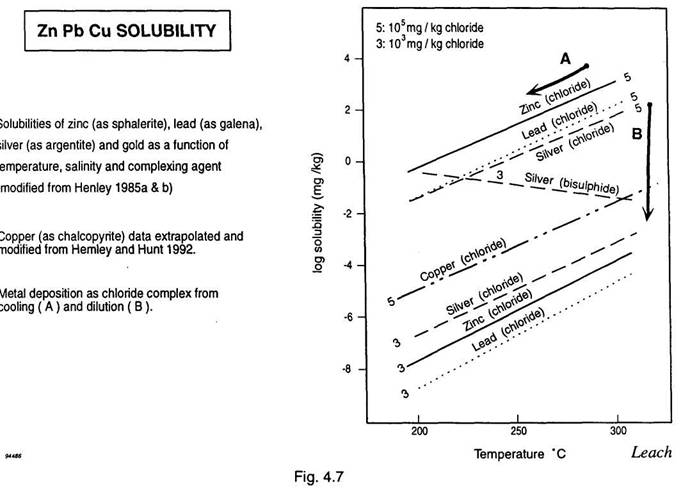
These metals are transported as chloride complexes under most hydrothermal conditions, and their deposition is caused by decreases in temperatures (Fig. 4.5; path A in Fig. 4.7), salinities (path B in Fig. 4.7) and pressure (Henley, 1985a, 1985b).
d) Silver
Silver is transported mainly as a bisulphide in dilute conditions, and as a chloride complex in hotter more saline conditions (Fig. 4.7). Therefore, silver mineralization mimics base metal phases at deeper levels and gold at shallower, epithermal levels. Most high sulphidation systems are remarkably low in silver implying either that hot, very acidic fluids, are Ag-depleted, or as is more likely the case, Ag-complexes are much more soluble than gold under low pH conditions (Fig. 4.7). Silver mineralization is however significant in the Wetar high sulphidation deposit, Indonesia (Sewell and Wheatley, 1994), which possibly reflects an
59
Exploration Workshop 'SW Pacific Rim Au/Cu Systems: Structure Alteration & Mineralisation" Corbett G J & Leach T M. 8/96 Edn.
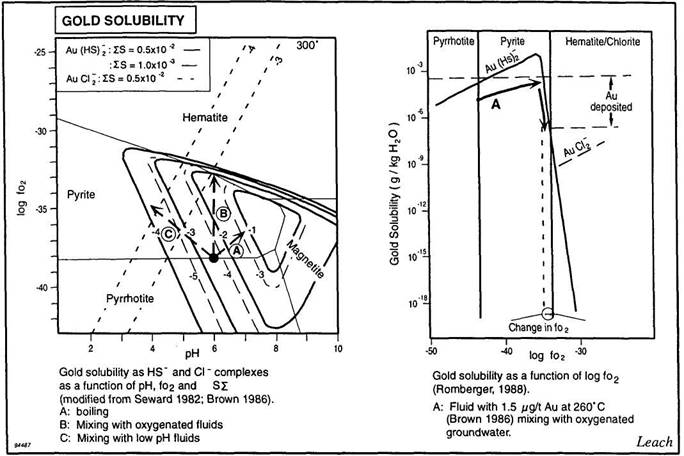
Fig. 4.6
Exploration Workshop "Southwest Pacific rim gold-copper systems: Structure, Alteration, and Mineralization" Corbett G J & Leach T M, 8/96 Edn.
increase in Ag-solubility in low pH environments associated with circulating saline sea water, e) Gold Fineness
The silver content of gold is commonly given as the fineness (=Au/Au+Ag x 1000). Previous workers (Morrison et al., 1991) illustrated that Archean, Slate Belt and Plutonic systems display high and consistent fineness, and porphyry, volcanogenic and epithermal classes exhibited wide fineness variations within each deposit and in the overall types of systems. These apparent wide variations may be explained by:
* widely differing environments in a single class (e. g., Mt. Kasi high sulphidation
system with Hishikari adularia-sericite epithermal system; Wau shallow level
carbonate-base metal system with Guinaoang porphyry copper-gold system,
* bullion data (e. g., Waihi) which incorporates silver from phases other than gold, with
microprobe data on gold grains.
Figure 4.8 illustrates histograms of the fineness of gold on selected southwest Pacific gold ± copper prospects and deposits, based on the classification used for these systems in this manual. The data is derived from unpublished microprobe analyses by Ken Palmer (Victoria University, Wellington, NZ), except where indicated.
There is a systematic decrease in gold fineness at progressively cooler and shallower levels (or distal from the intrusive source), from:
* porphyry copper/skarn systems (average = 920),
* through quartz sulphide (average = 850) and
* carbonate-base metal (average = 765) systems, to
* epithermal quartz silver-gold systems (average = 685).
These zonations therefor indicate that temperature is probably the most important control on gold fineness in intrusion-related gold-copper systems. Wide ranges in gold fineness within a single deposit is interpreted to reflect wide temperature ranges during mineralization: (e. g., at Kidston gold is associated with both quartz-sulphide and carbonate-base metal styles of veining; at Mt Kare gold in the roscoelite-bearing quartz silver-gold systems was deposited over a very wide temperature range (approx. 250°C to >100-150°C).
The fineness of gold in intrusion-related epithermal quartz silver-gold systems, and epithermal adularia-sericite systems is closer to the fineness of gold in carbonate-base metal systems than would be expected from the generally cooler conditions of mineralization. However, many carbonate-base metal systems form at very shallow epithermal levels (e. g., Maniape, PNG; Karangahake, New Zealand) and therefor the gold is silver-rich. In addition, the preferential partitioning of silver into other phases (Ag-sulphosalts, sulphides and tellurides) in epithermal systems could result in less silver being available to be incorporated into the native gold/electrum (Afifi et al., 1988). The similar fineness of gold in intrusive-related quartz gold-silver and adularia-sericite epithermal gold-silver systems reflects comparable environments of gold mineralization, and also possibly the magmatic source to the metals in both systems.
In high sulphidation systems, free gold is only observed in very shallow, epithermal environments. However, even under these cool conditions the fineness of gold is very high (average of 935 for Mt. Kasi, Peak Hill and Zone A at Wafi River). The silver-undersaturated nature of most fluids in southwest Pacific high sulphidation systems is difficult to reconcile and requires further study.
60
Exploration Workshop 'SW Pacific Rim Au/Cu Systems: Structure Alteration & Mineralization' Corbett G J & Leach T M, 8/96 Edn.
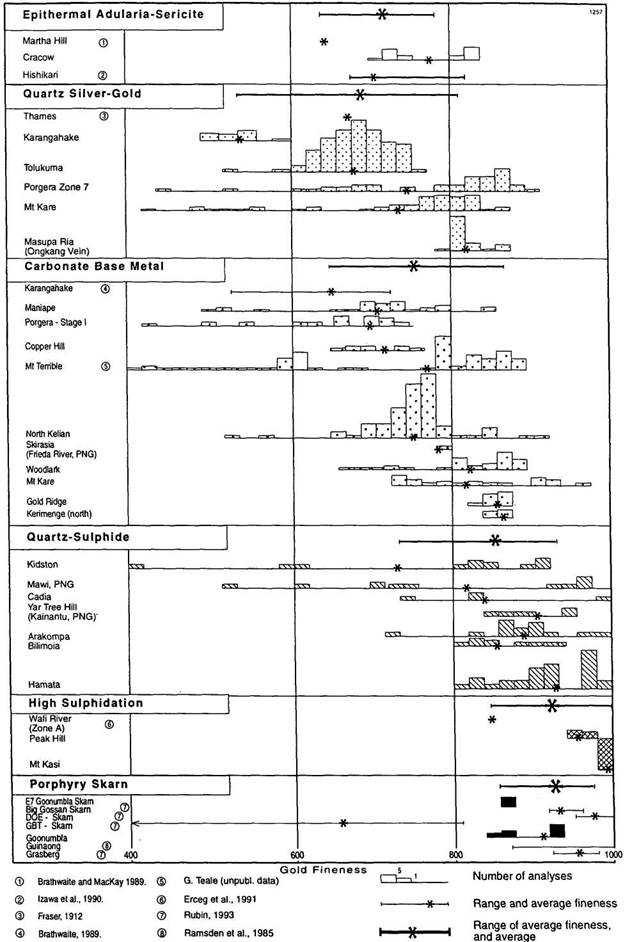
Histograms of gold fineness in southwest Pacific gold - copper prospects and deposits (microprobe analyses by Ken Palmer except where indicated)
Figure 4.8
Exploration Workshop "Southwest Pacific rim gold-copper systems: Structure, Alteration, and Mineralization" Corbett G J & Leach T M, 8/96 Edn.
4 CONTROLS ON HYDROTHERMAL ALTERATION AND MINERALIZATION i) Introduction
The large number of variables which affect the formation of alteration minerals in hydrothermal systems are grouped into six main factors (Browne, 1991):
Temperature
1. Fluid chemistry
2. Concentrations
3. Host rock composition
4. Duration of activity or degree of equilibrium.
5. Permeability
Although these are all more or less interdependent, temperature and fluid chemistry probably display the greatest influence on the styles of hydrothermal alteration.
Increasing temperature favours the stability of progressively more dehydrated mineral species. This is especially evident in clay/sheet silicate mineralogy in which the progressively higher temperatures result in the mineral sequence: smectite, interlayered smectite-illite (with gradually decreasing smectite content), illite and white mica. Similarly, zeolites become more
dehydrated under hotter conditions, as illustrated by the sequence mordenite------- > stilbite —
—> laumontite------- > wairakite.
Temperature also affects the degree of ordering or crystallinity of minerals. Higher temperatures favour the formation of more crystalline phases. Disordered kaolinite forms under ambient conditions, whereas more ordered kaolinite occurs under elevated hydrothermal temperatures, and well crystalline dickite develops under still hotter conditions.
It can be seen from activity diagrams that fluid composition also has a strong influence on the alteration mineralogy, with temperature having a marked affect on the position of phase boundaries. More important than absolute concentrations are the ratios of constituents e. g., aNl7aH+, aK7aH\ For example, in active hydrothermal systems, highly saline brines of the Salton Sea geothermal field (approximately 250,000 ppm total dissolved solids) produce the same alteration assemblages at most temperature ranges as the very dilute fluids (around 3,000 ppm total dissolved solids) of New Zealand, and some Icelandic geothermal fields.
Absolute concentrations in hydrothermal fluids have some affect on the type of alteration mineralogy, since this affects the degree of saturation of the fluid with respect to certain minerals. For example, sulphur, sulphides, and/or sulphates are associated with solfataras, and lepidolite is encountered in the Salton Sea geothermal fields where fluids have high concentrations of lithium.
The host rock composition to some extent controls the type of alteration mineralogy. Skarn mineralogy forms in calcareous host rocks. The secondary K-feldspar phase adularia is preferentially encountered where host and/or source rocks are potassium-rich (e. g., rhyolite or shoshonite). Paragonite (Na-mica) under certain conditions forms as an alteration product of albite, whereas muscovite forms from altered potassic feldspars. The kinetics or rates of alteration/deposition more commonly affect the crystallinity of the minerals rather than the species formed. Amorphous silica can form at moderately high temperatures where silica-saturated fluids are quenched (e. g., geothermal surface pipework), whereas coarse
51
Exploration Workshop "Southwest Pacific rim gold-copper systems: Structure, Alteration, and Mineralization" Corbett G J & Leach T M, 8/96 Edn.
crystalline quartz forms at the same temperature but under static conditions which permit slow crystal growth.
The duration of the hydrothermal system, or the period during which permeability has remained open, determines whether equilibrium has been established between the circulating fluid and host rocks.
Permeability has the obvious effect of bringing the host rock into contact with circulating fluid. Phyllic and argillic alteration are commonly encountered immediately adjacent to major structures or vein systems where the fluid is at less than neutral pH, due to dissolved gases, whereas propylitic alteration is usually encountered in low-permeability host rocks some distance from the main fluid channelways.
ii) Temperature and pH Controls on Alteration Mineralogy
Temperature and fluid pH are the most important of many factors which influence the mineralogy of hydrothermal systems. Pressure is directly related to temperature, whereas the gas pressure and the ratios of elemental concentrations can be expressed in terms of pH. The other variables (with the local exception of perhaps host rock composition and absolute compositions) have only minor effect on alteration mineralogy.
The most common hydrothermal minerals encountered in Pacific rim active geothermal and hydrothermal ore systems, in a variety of temperature and fluid pH conditions are illustrated in Figure 4.1. This interpretation is derived from a compilation of data from geothermal systems in the Philippines, Japan, USA, Iceland, and New Zealand, in combination with thermodynamic and laboratory experimental work on various mineral phases. Although fluid element concentrations and ratios, and pressures (gas, hydrostatic and lithologic) have been kept constant, in many cases these factors can substantially effect mineral stability ranges. Discussion of variations in these factors, which would add further axes to this diagram, is beyond the scope of this section. Absolute temperature and pH values have not been included in the axes of Figure 4.1 because of the effects of these other variables on the position of the boundaries between mineral phases. However, the following discussions include the approximate temperature and pH ranges for most of these mineral phases. Different mineral groups categorized by increasing pH of formation on Figure 4.1 are:
a) Silica group minerals
Silica phases are the only significant stable alteration minerals at very low pH (generally below pH 2, Hedenquist et al., 1988), commonly associated with small amounts of titanium-iron phases such as rutile. Under these extremely acid conditions, opaline silica, cristobalite, and tridymite are encountered within surficial environments above the hydrothermal water level, typically at temperatures of <100°C (Leach et al., 1986). Quartz is the main silica phase at high temperatures. In Figure 4.1, quartz or silica (cristobalite, tridymite or amorphous silica) has been included in all mineral assemblages because hydrothermal fluids (in active geothermal systems) are most commonly saturated with respect to SiO2. Exceptions occur in environments where hydrothermal systems are hosted in silica-poor rocks (e. g., basalts, phonolites).
Under higher fluid pH conditions, amorphous silica is encountered at cool conditions. Quartz is almost ubiquitous at higher temperatures, whereas chalcedony locally occurs at intermediate temperatures (generally in the range of 100-200°C), especially under conditions of rapid
52
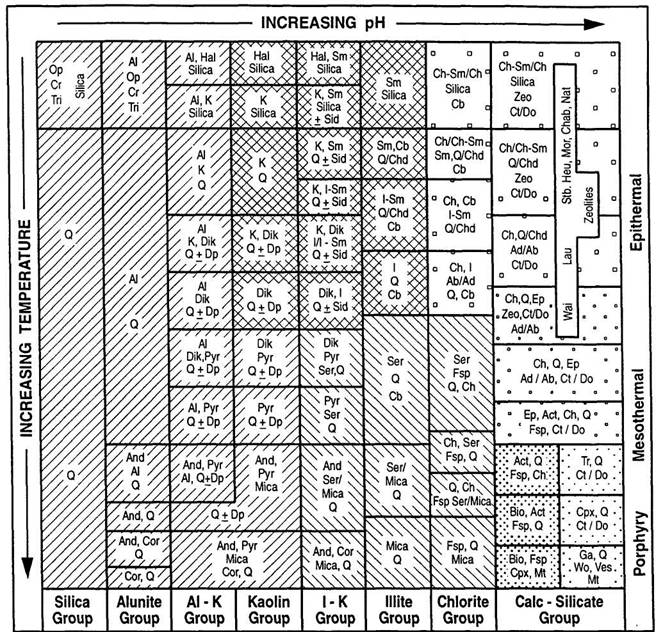
 Mineral Abbreviations:
Ab - albite; Act - actinolite; Ad - adularia; Al - alunite; And - andalusite; Cb - carbonate (Ca, Mg, Mn, Fe)
Ch - chlorite; Chab - chabazite; Chd - chalcedony; Ch-Sm - chlorite-smectite; Cor - corundum;
Cpx - clinopyroxene; Cr - cristobalite; Ct - calcite; Do - dolomite; Dik - dickite; Dp - diaspore; Ep - epidote;
Fsp - feldspar; Ga - garnet; Hal - halloysite; Heu - heulandite; I - illite; I-Sm - illite-smectite; K - kaolinite;
Lau - laumonite; Mt - magnetite; Mor - mordenite; Nat - natrolite; Op - opaline silica; Pyr - pyrophyllite;
Q - quartz; Ser - sericite; Sid - siderite; Sm - smectite; Stb - stilbite; Tr - tremolite; Tri - tridymite;
Figure 4.1 Common Alteration Mineralogy in Hydrothermal Systems |
Ves - vesuvianite; Wai - wairakite; Wo - wollastonite; Zeo - zeolite

deposition. The type of silica phase is also affected by the kinetics of deposition. For example, amorphous silica may be formed at temperatures up to 200°C in rapidly quenched environments (e. g., scales in geothermal surface pipeworks; Brown, 1986).
b) Alunite group minerals
At fluid pH slightly higher than 2, alunite is formed together with the silica phases over a wide temperature range, in association with andalusite at high temperatures (typically > 300-350°C), and corundum occurs at still higher temperatures (Hemley et al., 1980).
Four environments of alunite formation have been identified by Rye et al., (1992), using sulphur and oxygen isotope data. Different styles of alunite can also be identified using simple crystal textures in conjunction with associated alteration minerals and the geological setting:
1. Steam-heated alunite develops under surficial environments by the oxidation of acid
sulphate fluids from H2S gas evolved from a boiling hydrothermal system at depth. This
steam-heated alunite may be encountered down to 1-1.5 km depths, in settings where acid
sulphate fluids descend into waning hydrothermal systems. It occurs as very fine-grained,
poorly crystalline acicular crystals.
2. Supergene alunite develops from the production of sulphuric acid by weathering of massive
sulphide deposits, also occurs as poorly crystalline acicular crystals, and may be distinguished
from steam-heated alunite by its geological setting and common association with iron oxide
weathering products.
3. Magmatic alunite is deposited from volatiles ascending directly from an intrusive source
and commonly occurs in veins and breccia zones, as radiating prismatic crystals. Alunite
formed in close proximity to the parent porphyry can also occur as large irregular crystals
poikilitically enclosing quartz and other phases, or as euhedral rhombic crystals.
4. Liquid alunite is derived from magmatic-dominated liquids and forms well crystallised,
commonly coarse-grained tabular to lath-like crystals infilling fractures, breccia zones, and
leached vughs pseudomorphing phenocrysts or lithic clasts.
c) Kaolin group minerals
The kaolin group of minerals (Fig. 4.1) are derived from higher pH fluids (approximately pH 4), and co-exist with the alunite-andalusite-corundum group of minerals under a transitional fluid pH range (3-4). Halloysite occurs mainly as a supergene weathering product, although there is some evidence (Harvey and Browne, 1991) for hydrothermal-derived halloysite. Zonations of hydrothermal kaolin group minerals with increasing depth and temperature have been identified in Philippine geothermal systems by Reyes (1990b) and Leach et al. (1986). Kaolinite is formed under shallow, low temperature conditions (<150-200°C) and pyrophyllite under deep, higher temperature conditions (<200-250°C), whereas dickite occurs transitional between these two levels and temperature ranges.
Diaspore is locally encountered in intensely silicified zones with alunite and/or kaolinite group phases. Hemley et al. (1980) indicated that diaspore is formed under conditions of silica undersaturation. Since diaspore occurs in zones of intense silicification it is assumed that its formation results from the rapid precipitation of quartz, producing a silica-undersaturated solution.
53
Exploration Workshop 'Southwest Pacific rim gold-copper systems: Structure, Alteration, and Mineralization" Corbett G J & Leach T M, 8/96 Edn.
d) lllite group minerals
At conditions of progressively higher fluid pH (4-6 range) the illitic group of minerals (Fig. 4.1) becomes the dominant phase, co-existing with the kaolin group minerals at transitional fluid pH (4-5). Depth/temperature relationships of the illite group minerals are well documented from both sedimentary basins and active geothermal systems (Steiner, 1977; Browne, 1991; Harvey and Browne, 1991). Smectite occurs at low temperatures (<100-150°C), interlayered illite-smectite at around 100-200°C, illite at approximately 200-250°C, well-crystalline fine-grained mica (sericite) at >200-250°C, and coarse crystalline white mica (typically phengite) at >250-300°C.
The smectite content within the interlayered illite-smectite clays decreases progressively with increasing temperature over the 100-200°C range (Harvey and Browne, 1991). The crystallinity of illite and sericite increases with increasing temperature, and can be monitored by XRD analyses on the peak width, at half the peak height, of the {001} reflection, (i. e., the Kubler Index). Sericite is basically fine-grained muscovite, and both grain size and crystallinity increase at higher temperatures. The changes in sericite/muscovite crystallinity can also be monitored by XRD analyses, with progressive changes from a disordered 1M mica to a well crystallized 2M muscovite with increasing temperature. Although muscovite is the common illite/mica phase present, the sodic phase paragonite is encountered in some systems where the host rock has a high Na:K ratio (e. g., albite as the plagioclase phase). The vanadium mica phase roscoelite, and the chromium phase fuchsite, are deposited from fluids which had source, or migrated through, basic volcanic/intrusive rocks.
e) Chlorite group minerals
Under (slightly acid to) near neutral pH conditions chlorite-carbonate (Fig. 4.1) phases become dominant, coexisting with illite group minerals in transitional environments (pH 5-6; Leach and Muchemi, 1987). Interlayered chlorite-smectite occurs at low temperatures, grading to chlorite at higher temperatures. This transition is encountered at different temperatures in active geothermal systems within different geological settings. Chlorite occurs at significantly lower temperatures in rift environments (e. g., Iceland, Kristmannsdotter, 1984) than in volcanic island terrains (e. g., Philippines, Reyes, 1990a), possibly in response to the effects of either fluid or host rock chemistry. (Chloritic clays co-exist with illitic clays under transitional fluid pH values).
f) Calcsilicate group minerals
The calcsilicate group of minerals (Fig. 4.1) form under neutral to alkaline pH conditions. Zeolites-chlorite-carbonate occur at lower temperatures, and epidote, followed by secondary amphiboles (mainly actinolite) develop at progressively higher temperatures. Zeolite minerals are particularly temperature sensitive. Hydrous zeolites (natrolite, chabazite, mordenite, stilbite, heulandite) form under cool conditions (<150-200°C), while less hydrated zeolites such as laumontite (150-200°C), and wairakite (200-300°C) occur at progressively deeper and hotter levels in the hydrothermal system (Steiner, 1977; Leach et al., 1983). In some systems prehnite (250-300°C; Elders et al., 1982) or pumpellyite are encountered in association with, or in places instead of, epidote.
Epidote occurs as poorly crystalline incipient grains at temperatures of around 180-220°C, and as better crystalline phases at higher temperatures (>220-250°C). Secondary amphiboles (mainly actinolite) appear to be stable in active hydrothermal systems at temperatures >280-300°C (Leach et al., 1983). Biotite is commonly ubiquitous within or immediately adjacent to
54
Exploration Workshop "Southwest Pacific rim gold-copper systems: Structure, Alteration, and Mineralization" Corbett G J & Leach T M, 8/96 Edn.
porphyry intrusions, and in active systems occurs at temperatures of >300-325°C (Elders et al., 1982; Leach et al., 1983). Active porphyry environments are characterised by clinopyroxene (>300°C) and garnet (>325-350°C) assemblages (Elders et al., 1982). However, hydrated garnets are locally encountered at significantly lower temperatures (250-300°C) in the Tongonan geothermal field (Leach et al., 1983). The zonations in skarn mineralogy with temperature are in many ways comparable to those in porphyry copper environments, and are discussed in more detail in Section 5.H.
g) Other mineral phases
Carbonate minerals are encountered over a wide range of pH (> 4) and temperature, and are associated with kaolin, illite, chlorite and calc-silicate phases. A zonation in carbonate species with increasing fluid pH is encountered in many hydrothermal systems (Leach and Corbett, 1993, 1994, 1995) as: Fe-Mn carbonate (siderite-rhodochrosite) coexist with kaolin and illitic clays, mixed Ca-Mn-Mg-Fe carbonates (rhodochrosite-ankerite-kutnahorite-dolomite) occur with illitic and chloritic clays, and Ca-Mg carbonates (dolomite-magnesian calcite-calcite) co-exist with chlorite-calcsilicate mineralogy. This zonation is interpreted to reflect the decreasing mobility of Fe, Mn and Mg at progressively increasing fluid pH (Leach et al., 1986). Carbonate minerals typically extend throughout all levels in hydrothermal systems, from surficial environments to porphyry-related skarn environments.
Feldspar minerals are associated with both chlorite and calcsilicate mineral phases. Secondary feldspars are generally stable under near neutral to alkaline pH conditions. Albite occurs where fluids have a high aNl7aK+ ratio and potassium feldspar a low aNl7aK+ ratio (Browne, 1978). Adularia occurs as a low temperature secondary potassium feldspar species, whereas orthoclase is encountered at high temperatures within the porphyry environment. Browne (1978) demonstrated that adularia preferentially occurs within high fluid flow permeable conditions, and albite under low permeability conditions.
Sulphate minerals are encountered over most temperature and pH ranges in hydrothermal systems. Whereas alunite forms under low pH (<3-4) conditions, anhydrite forms at a higher pH (Reyes, 1985) and temperatures greater than 100-150°C, and gypsum develops in cooler environments (Harvey et al., 1983). Although jarosite commonly forms as a weathering product of sulphides, it also occurs at shallow levels in acid environments in some Philippine active geothermal systems (Leach et al., 1986).
Various hydrothermal mineral phases contain halogen elements (e. g., boron-tourmaline; fluorine, chlorine and phosphorous-apatite), which are indicative of fluids which contain a significant component of magmatic volatiles. These phases are commonly associated with sericite/mica formed at high temperature and moderately low pH conditions.
iii) Alteration Zones Associated with Ore Systems
Alteration assemblages within Pacific rim gold-copper hydrothermal systems have historically been divided into seven main alteration types: advanced argillic, argillic, phyllic, propylitic, sub-propylitic, potassic and skarn. Mineral assemblages are commonly assigned to each of these broad alteration zones with fairly arbitrary boundaries. Although it is considered best to use the alteration mineral assemblages themselves in defining the style of alteration, the classification of these broad alteration types can be beneficial in describing overall characteristics of zoned alteration systems.
55
The mineral assemblages generally assigned to these seven alteration zones have been outlined in Figure 4.1 as:
Advanced argillic alteration consists of the low pH silica, alunite and transitional alunite-kaolin group of minerals.
Argillic alteration assemblages include members of the kaolin (halloysite, kaolinite, and dickite) and illite (smectite, interlayered illite-smectite, illite) group of minerals and associated transitional mineral assemblages, which formed at intermediate pH and low temperature. Transitional low temperature chlorite—illite group mineral assemblages may also be termed argillic.

|
Из за большого объема этот материал размещен на нескольких страницах:
1 2 3 4 5 6 7 8 9 10 11 12 13 14 15 |
