

Партнерка на США и Канаду по недвижимости, выплаты в крипто
- 30% recurring commission
- Выплаты в USDT
- Вывод каждую неделю
- Комиссия до 5 лет за каждого referral
A comparison of apparent salinities (NaCl + gas) of active hydrothermal systems and measured salinities in fluid inclusions in ore deposits illustrates that the fluids in silicic systems in New Zealand are comparable to those in quartz (-adularia) veining which host epithermal gold-silver deposits. The volcanic arc active geothermal systems in the Philippines have fluid chemistries comparable to late-stage mineralized veins associated with porphyry copper, and porphyry-related carbonate-base metal gold deposits. The following section, investigates these active porphyry systems in more detail as a guide to the understanding, exploration, and development of intrusion-related gold-copper ore systems.
Hi) Characteristics of Active Philippine Intrusive-Related Hydrothermal Systems a) Physico-Chemical Zonations of Philippine Geothermal Systems
The following four distinct physical and chemical zones have been identified (Mitchell and Leach, 1991) in active Philippine hydrothermal systems (Fig. 2.3):
1. A Conductive Zone is encountered at depth in many systems, typically within impermeable intrusives or basement sediments. Heat transfer is predominantly by conduction due to lack of fracturing. Pressures exceed hydrostatic and approach lithostatic. Where high-level intrusions have been emplaced into volcanics, impermeable contact nietamorphic assemblages comprise outer biotite-magnetite and inner clinopyroxene ± amphibole ± biotite. Local skarn assemblages are encountered at contacts between intrusives and calcareous sediments (e. g., Palinpinon; Figs. 2.11, 2.12).
15
Exploration Workshop "SW Pacific Rim Au/Cu Systems: Structure Alteration & Mineralization" Corbett G J & Leach T M. 8/96 Edn.
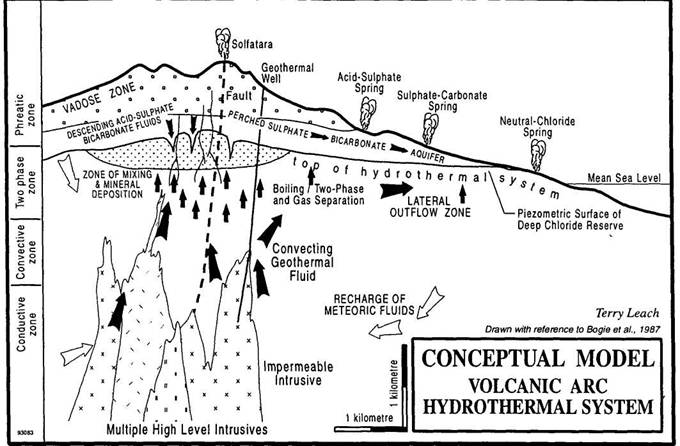
 Fig. 2.3
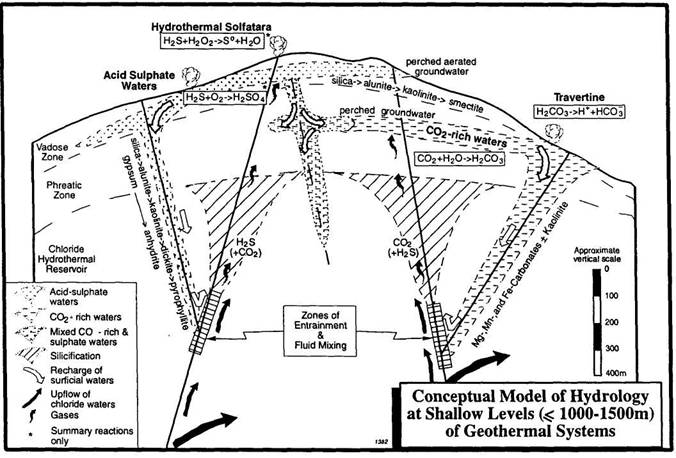
Fig. 2.4
Exploration Workshop "Southwest Pacific rim gold-copper systems: Structure, Alteration, and Mineralization" Corbett G J & Leach T M, 8/96 Edn.
2. A Convective Zone forms within the upwelling plume of all Philippine geothermal systems,
within permeable deep-seated fault zones and shatter zones at the contacts of intrusives. The
fluid is commonly slightly less than neutral pH. The alteration exhibits a zonation from:
potassic (predominantly biotite with minor secondary feldspar) alteration at depth, to various
propylitic zones dominated by actinolite, epidote, or chlorite-zeolites at progressively
shallower levels.
3. A Two-Phase Zone is encountered at shallow levels and outflow zones where the total
pressure (hot hydrostatic + gas) exceeds the saturation pressure of water, resulting in
exsolution of water vapour and other gases (mainly CO2, and lesser amounts of H2S and NH3).
This gas exsolution (or passive boiling) can be initiated at depths of 2 km or more in some
systems (Bogie and Lawless, 1987). Within highly permeable zones such as major faults or
high-level dykes, rapid ascent of fluids results in sudden gas exsolution and vigorous boiling.
However, where fluids permeate rocks of uniform, moderate permeability at shallow depths,
such as pyroclastics or jointed lavas with abundant microfractures, gradual exsolution of gases
results in development of a laterally extensive two-phase zone. Condensation of these gases at
cooler levels causes formation of a moderately low pH condensate fluid and associated
quartz-illitic clay-chlorite ± carbonate ± anhydrite alteration.
4. A Phreatic Zone comprises a number of groundwater aquifers perched above the upper level
of the hydrothermal system (Fig. 2.4), and includes the vadose zone (or zone of aeration).
Gases which have evolved from the two-phase zone at depth mix with these perched
groundwater aquifers to produce acid sulphate, bicarbonate, and steam-heated surficial fluids.
These fluids locally reach the surface to form hydrothermal solfataras characterised by
amorphous silica, tridymite and/or cristobalite and where H2S is immediately oxidised to form
native sulphur and minor hydrated sulphates (e. g., halotrichite).
Acid sulphate fluids are formed by oxidation of H2S within surficial aerated groundwater aquifers, mainly above upflow zones, since H2S is rapidly depleted with respect to CO2 in the outflow zones. Leaching of host rocks at the site of formation of the acid sulphate fluids, at pH <2, produces porous silica alteration consisting of amorphous silica, cristobalite, and/or tridymite. Progressive neutralization in response to wall rock reaction and/or mixing with groundwater forms zones of silica-alunite, silica-kaolinite, and silica-smectite alteration.
Bicarbonate fluids develop by the condensation of CO2 within cool aquifers, both within and above the chloride reservoir/hydrothermal system. The zonation of Fe —> Mn —> Mg —> Ca carbonates and kaolinite —> smectite —> chloritic clay alteration reflect progressive neutralization of the bicarbonate condensate waters. Gypsum is commonly encountered with carbonates at shallow levels in mixed bicarbonate-acid sulphate waters.
b) Waning Stages of the Active Philippine Systems
As intrusions cool and hydrothermal systems wane, the decrease in temperature and reservoir pressure results in draw-down of surficial waters deep into the hydrothermal system. Cool, low pH bicarbonate and acid sulphate waters have been encountered at depths up to 2000 m in some Philippine geothermal fields (Reyes, 1990b). Down-hole pressure/temperature, geochemical, and stable isotope analyses (Robinson et al., 1987) of these waters have confirmed that they are derived from perched aquifers in the phreatic zone.
Mixing of cool, descending, low pH bicarbonate-sulphate surficial fluids and hot silica-saturated deep hydrothermal fluids (Fig. 2.4) results in deposition of carbonates and sulphates (in response to increasing temperatures) and silica (in response to cooling). Since the
16
Exploration Workshop "Southwest Padftc rim gold-copper systems: Structure. Alteration, and Mineralization' Corbet! Q J & Leach T M. 8/96 Edn.
hydrothermal systems are invariably located in technically active areas, major fracture/fault systems may be continually re-opened, permitting descent of surficial fluids to progressively deeper levels. The overall effect is to seal most permeable features and form impermeable caps in the upper levels of these hydrothermal systems.
Vertical zonations from gypsum to anhydrite and Fe —> Mn —> Mg —> Ca carbonates reflect progressive heating and neutralization of descending sulphate and carbonate fluids. These acid fluids have been encountered at significant depths (e. g., up to 1500 m below surface at Bacon Manito) where permeable structures have channelled the descent of acid sulphate fluids, and mineral deposition has isolated these low pH fluids from wall rock reaction and fluid mixing. The vertical zonations of alunite —> alunite + kaolinite -> pyrophyllite and/or diaspore in these structures reflects'the progressive heating and neutralization of the descending acid sulphate fluids.
Cool, dilute, meteoric fluids migrate down major regional structures and provide recharge for the circulating hydrothermal system. As the system cools and wanes these meteoric fluids encroach into hotter regions of the system, producing low-temperature overprinting clay alteration. At cool, shallow levels these fluids contain abundant dissolved oxygen, and are termed oxygenated groundwater recharge. These fluids are important in the formation of high grade epithermal gold-silver mineralization.
c) Magmatic Acid Fluid Environments
Fluids within the Philippine geothermal systems are typically slightly less than neutral fluid pH (5-6 at 250°C) due to significant dissolved gas contents, and are saturated with respect to silica. However, low pH or acidic fluids are generated under certain conditions, and can play a significant part in the formation of Pacific rim ore deposits.
As outlined above, acidic fluids may form in aquifers within the phreatic zone, perched above the main hydrothermal system. These are commonly referred to as steam-heated acid fluids. Bicarbonate fluids are also formed in the two-phase zone at shallow levels as well as in the phreatic zone, and are termed condensate acid fluids. Where sulphide-rich alteration zones are exposed to weathering, oxidation of sulphides can form supergene acid fluids.
Magmatic acid fluids are formed by condensation of SO2 and chlorine gases in magmatic vapour plumes which evolve from intrusives at intermediate depths (2-3 km). Where these fluids directly reach the surface they form magmatic/volcanic fumaroles and solfataras. Geothermal drilling attempts to avoid intersection of these hot corrosive fluids, although as will be described later, exploration of the Vulcan thermal field on Biliran Island encountered magmatic acid fluids at 1 km depth. In the Bacon Manito geothermal field, topaz and enargite mineralization is interpreted (Reyes, 1985) to be indicative of a localised influx of magmatic-rich volatiles into a circulating, meteoric-dominated, near-neutral hydrothermal system. Recent drilling in the Alto Peak (Reyes ct al., 1993) and Mt Pinatubo (Ruaya et al., 1992) geothermal fields intersected zones dominated by magmatic volatiles.
d) Analogues to Ore-Forming Systems
The geological setting, fluid chemistry, metal contents, and zonation of alteration and mineralization, indicate that Philippine geothermal systems are analogues to porphyry-related copper-gold deposits encountered throughout the Pacific rim. Although drilling of active hydrothermal systems in the Philippines has not encountered any economic porphyry copper-gold ore. values of 0.1-0.2 percent copper were identified within potassic alteration at
17
Exploration Workshop "Southwest Pacific rim gold-copper systems: Structure, Alteration, and Mineralization" Corbett G J & Leach T M, 8/96 Edn.
Palinpinon. In addition, boiling hot water seepages in deep adits at the Acupan gold mine, are interpreted to represent the last phases of evolution of a porphyry-related carbonate-base metal gold system.
Scales deposited from deep chloride reservoir fluids in back-pressure plates in surface pipework from Philippine geothermal systems have graded up to tens of percent of copper, percents of lead-zinc, thousands of ppm silver, and hundreds of ppm gold (Mitchell and Leach, 1991). Similar scales in pipework in New Zealand geothermal systems have graded up to percents of gold and silver (Brown, 1986). Fluids in the New Zealand geothermal systems deposit metals comparable to epithermal gold-silver deposits, whereas the deeper levels of volcanic arc systems of the Philippines deposit metals comparable to porphyry copper-gold and porphyry-related carbonate-base metal gold deposits.
Drilling for geothermal energy in magmatic arc hydrothermal fields in the Philippines has enabled the investigation of porphyry-style systems at depths of greater than 3.5 km below surface, and over areas of up 20-50 km2. Multiple high-level intrusives with associated potassic alteration zones and local skarn development have been encountered at temperatures of greater than 350°C, thereby permitting inspection of these potential ore-forming systems during stages of formation. Detailed petrological work has been carried out on these systems, permitting zonations in alteration and mineralization with fluid chemistry to be compared to pressure-temperature measurements at depths from which samples were recovered. The formation conditions of the various mineral phases have therefore been empirically determined.
e) Styles of Philippine Active Hydrothermal Systems
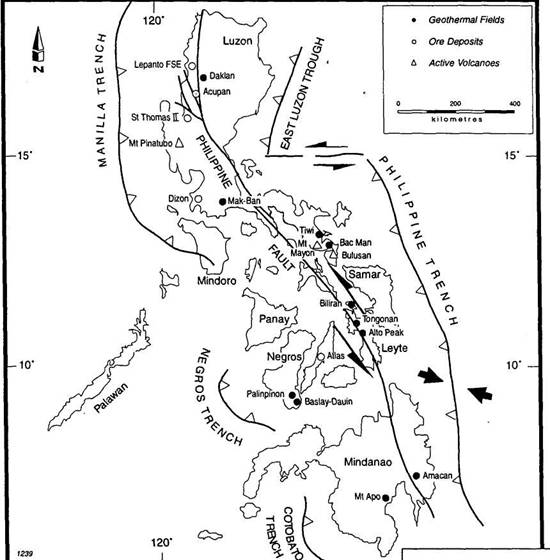
The Philippines is a typical volcanic arc setting for porphyry-related hydrothermal systems (Fig. 2.5). Neogene volcanic arcs parallel the Philippine trench to the southeast and the Manila trench to the northwest, and minor arcs are associated with the Negros and Cotobato trenches in the southwest.
Active hydrothermal systems in the Philippines are not associated with large stratovolcanoes (Bogie and Lawless, 1986) such as Mt. Mayon. Volcanic deposits derived from stratovolcanoes are typically uniform in composition, indicative of a deep (<4-5 km), large, predominantly undifferentiated magma chamber. Circulating meteoric fluids are unlikely to be capable of penetrating impermeable sediments down to the depths of these intrusives.
Active hydrothermal systems in the Philippines are however encountered in the following two main geological/tectonic settings (see Mitchell and Leach, 1991):
1. Large hydrothermal systems which are hosted in thick volcanic or volcaniclastic sequences.
These systems occur within composite volcanic terrains parallel to subduction zones (e. g., Alto
Peak, Palinpinon, Bacon Manito), or within favourable structures, such as dilational jogs and
splays related to major faults (e. g. Tongonan, Biliran). These large convective systems form
extensive alteration haloes which are comparable to porphyry-copper/skarn systems.
2. Hydrothermal systems with restricted fluid flow paths are hosted in dilational structural
settings within competent and relatively impermeable basement metasediments and older
intrusions, in Cordillera regions of Eastern Mindanao and Central Luzon.
18
Exploration Workshop "SW Pacific Rim Au/Cu Systems: Structure Alteration & Mineralization" Corbett G J & Leach T M. 8/96 Edn.
 |
 |
|
Adapted from Mitchell & Leach 1991
PHILIPPINES
Geothermal Fields
Exploration Workshop "Southwest Pacific rim gold-copper systems: Structure, Alteration, and Mineralization" Corbett G J & Leach T M, 8/96 Edn.
0 Evolution of Active Porphyry Systems
Each geothermal system drilled in the Philippines is at a different stage in its evolution, and each one is a "time slice" into the development of intrusive-related hydrothermal systems. Some geothermal systems are very young and have probably been drilled shortly after the emplacement of intrusive heat sources at shallow crustal levels, whereas other systems have been drilled at late waning stages. The following sequence of events is recorded in the various Philippine geothermal systems:
1. Contact metamorphism
It is only when active hydrothermal systems evolve sufficiently to exhibit surface thermal manifestations that they become targets for geothermal energy exploration. All active porphyry systems drilled in the Philippines have already undergone the transfer of heat into the host country rock, initially by conduction and later by some convection, and formed hornfels in the contact volcanics and sediments (e. g., Tongonan and ABC Man), and zoned skarns in calcareous host rocks (e. g., Palinpinon, Alto Peak).
2. Magmatic volatile plume
On Biliran Island (Vulcan region) and Alto Peak, plumes of magmatic volatiles are currently being emplaced into pre-existing zoned skarn and contact hydrothermal alteration assemblages. Down-hole measurements indicate that these magmatic vapours are sourced from a very hot (>400°C), hypersaline fluid which has exsolved during early crystallisation of the high level intrusive heat sources. Disproportionation of reactive gases has locally produced hot acid fluids which have vented directly to the surface as magmatic solfataras (e. g., Vulcan, Biliran Is.). At depth the acidic fluids have reacted with the host rock to form advanced argillic alteration assemblages comparable to those encountered in high sulphidation systems (e. g., Alto Peak, Palinpinon).
3. Convective hydrothermal alteration
Release of heat and fluids from the high level intrusions establishes deep circulating meteoric hydrothermal systems into which magmatic fluids are entrained. These circulating systems create zoned hydrothermal alteration which grades from an inner potassic zone dominated by biotite to peripheral propylitic alteration. The Tongonan geothermal system is interpreted to be at this stage of development. The high fluid temperatures (>340-350°C) and salinities (> 15,000 ppm Cl") suggest that a significant input of magmatic brine from the cooling melt has been entrained into the convecting hydrothermal system. Although only trace base metal mineralization has been deposited from this hot, moderately saline system (Leach and Weigel, 1984), significant mineralization has been produced by flashing fluids from depths of >2.5 km to near ambient conditions within surface pipework (Mitchell and Leach, 1991). It is therefore inferred that the circulating brine at Tongonan is substantially undersaturated with respect to base and precious metals. However, the deposition of significant mineralization can be induced under extreme artificial conditions.
4. Meteoric water collapse
Complete cooling of the intrusive heat source produces a pressure draw-down to considerable depths of cool dilute meteoric waters and shallow, moderately low pH gas condensate (e. g., Palinpinon and Bacon Manito). This results in the formation of a zoned phyllic and later argillic overprint on pre-existing contact hydrothermal alteration. The draw-down of these fluids results in mineral deposition and subsequent progressive sealing of permeable channels at shallow levels, and the development of an impermeable cap on the system. Although late stage systems such as Palinpinon are dilute, the most significant copper mineralization forms in this waning stage of the hydrothermal system.
19
Exploration Workshop "Southwest Pacific rim gold-copper systems: Structure, Alteration, and Mineralization" Corbett G J & Leach T M, 8/96 Edn.
iv) Examples of Active Intrusion-Related Hydrothermal Systems in the Philippines a) Large disseminated systems in permeable structures or composite volcanic terrains
1. Young Systems Dominated by Magmatic Vapours i) Alto Peak geothermal System
Alto Peak geothermal system, in the northern Leyte, is hosted in a volcanic arc which extends along the eastern margin of the Philippine Fault (Fig. 2.6). Drilling within the Alto Peak geothermal system intersected a spatially restricted magmatic vapour plume sourced from a degassing high level intrusion at depth. This vapour plume has been emplaced into a weak, circulating, moderately saline (7500 ppm Cl.) hydrothermal system, and at depth has resulted in the formation of a localised advanced argillic overprint on zoned potassic-propylitic alteration. The following discussion is summarised from Reyes et al., (1993).
The active hydrothermal system at Alto Peak (Fig. 2.7) is hosted in Pliocene to Recent andesite-dacite volcanics and subvolcanic quartz diorite dykes, which pass down into a thick sequence (>2000 m) of Late Miocene to Pleistocene, locally calcareous, marine sedimentary breccias, siltstones, mudstones and hyaloclastites (Binahaan Formation). Basement rocks comprise Cretaceous harzburgite and pyroxenite.
Composite volcanic centres, domes and collapse calderas are developed within a dilational NW trending segments (Alto and Cental Faults) of the Philippine Fault System. Additional permeability within the volcanic-sedimentary sequence is also provided by subsidiary EW, NS, and NE trending faults. Alteration mapping indicates that earlier low temperature clay alteration has been locally overprinted by vertically zoned
epidote-amphibole-biotite-pyroxene mineralogy, indicative of a later influx of considerably hotter fluids. Locally, skarns which formed at the contacts with high level quartz-diorite dykes, display the zonation: garnet-pyroxene —> wollastonite-vesuvianite —> biotite-pyroxene-amphibole —> quartz-biotite-anhydrite ± epidote, and are considered to be in equilibrium with current hydrothermal conditions.
Two wells intersected a near vertical magmatic-derived vapour-rich "chimney", 1 km wide and 2-3 km deep, which connects a deep vapour-dominated zone at depth to a shallow zone of steam heated groundwater. Gas geochemistry, fluid isotope, and fluid inclusion data suggests that the vapour plume contains up to 40-50 percent magmatic component, and is derived from a very hot (>400°C), saline (>17,000 ppm Cl") fluid. It is interpreted that this fluid has been derived from a degassing recent intrusion at depth, also the source of the quartz diorite dykes. Alteration at depth ( m below surface) within this magmatic vapour-rich chimney is localised along fractures and consists of quartz-pyrophyllite-alunite ± diaspore-anhydrite and minor apatite, zunyite and topaz.
The vapour "chimney" is dominated by CO2 as the main gas phase. The lack of acid C1-SO4 in the magmatic waters, despite the local occurrence of magmatic-derived advanced argillic alteration, has been interpreted to indicate that either the conversion of acidic oxidising magmatic to neutral pH fluids is complete, or it is limited to deeper zones.
ii) Biliran
The Vulcan thermal area is aligned for 3-4 km along a suture zone (Vulcan Fault) within possible arc-normal structures formed perpendicular to the Philippine trench and cutting the
20
 Exploration Workshop 'SW Pacific Rim Au/Cu Systems: Structure Alteration & Mineralization* Corbett G J & Leach T M. 8/96 Edn.
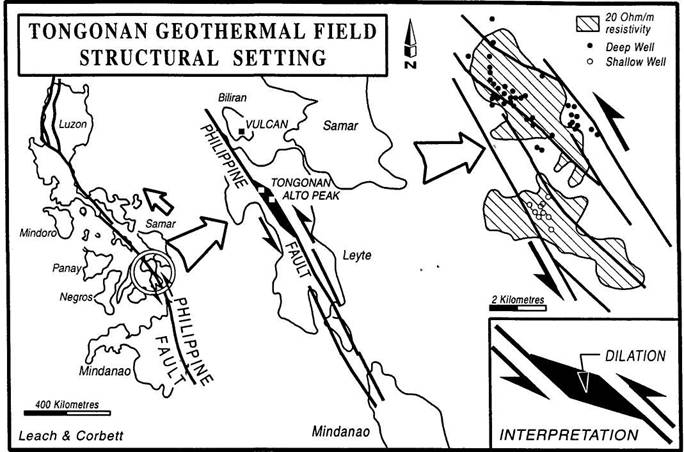
 Fig. 2.6
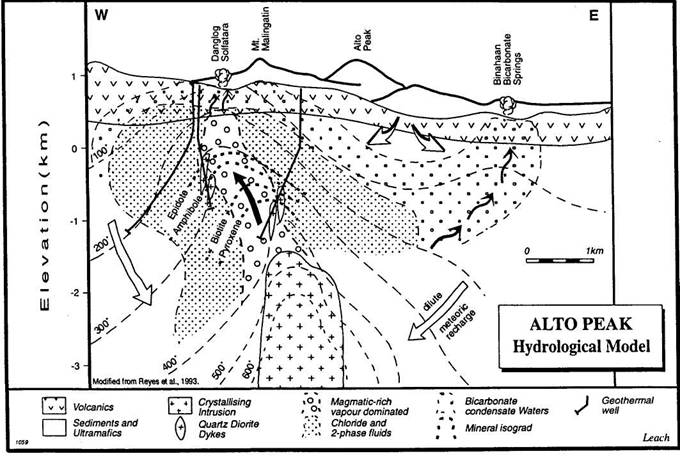
Fig. 2.7
 Exploration Workshop "SW Pacific Rim Au/Cu Systems: Structure Alteration & Mineralisation' Corbett G J & Leach T M, 8/96 Edn.
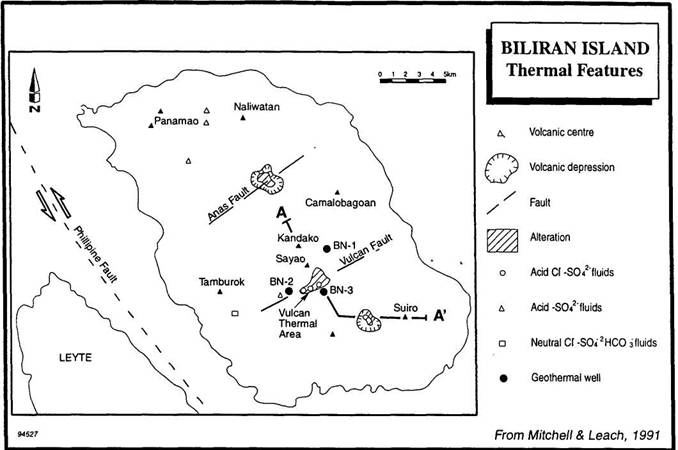
 Fig. 2.8
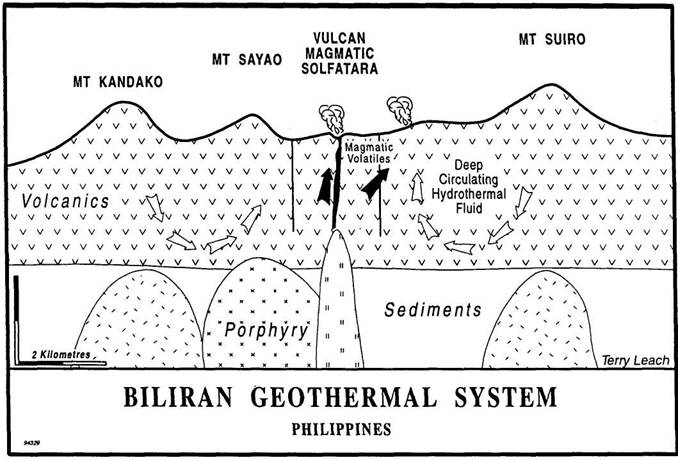
Fig. 2.9
Exploration Workshop "Southwest Pacific rim gold-copper systems: Structure, Alteration, and Mineralization" Corbett G J & Leach T M, 8/96 Edn.
island of Biliran, north of Leyte (Fig. 2.8). The presence of abundant native sulphur, superheated steam, and acid HC1 and SO2 gas condensates, indicate that the Vulcan Fault is directly venting hot magmatic volatiles. The Biliran system therefore represents an active analogue of high sulphidation systems. The system is hosted by basement metamorphics which are overlain by 300 m of calcareous sediments and then by a 1.5-2 km thick sequence of andesitic volcanics and volcaniclastics (Fig. 2.9).
Drilling peripheral to the Vulcan Fault encountered circulating neutral fluids with a significant fluorine content (an order of magnitude greater than in other fields), indicative of a substantial magmatic component. A splay fault from the Vulcan Fault intersected at 1000 m in BN-3 produced very hot (310-320°C), acidic (pH <2 at depth) fluids.
Down-hole temperatures estimated from alteration mineralogy are lower than actual measured temperatures in Biliran wells, implying that the hydrothermal system is still heating up. Exsolution of hot magmatic volatiles to form high sulphidation systems therefore probably occurs during the early stages of porphyry evolution. As for Tongonan, there are no volcanics associated with recent intrusions which might represent the source for heat and magmatic fluid in the current active hydrothermal system. The active high sulphidation system at Biliran illustrates strong structural control for the venting of magmatic volatiles from a degassing magma at depth. Circulating near-neutral hydrothermal convective systems are present outside this structure but have incorporated a significant component of magmatic-derived fluids.
Drilling at Biliran failed to encounter a significantly permeable or extensive hydrothermal system for geothermal exploitation, possibly due to the relatively youthful age of the system.
2. Circulating Hydrothermal Systems ii) Tongonan
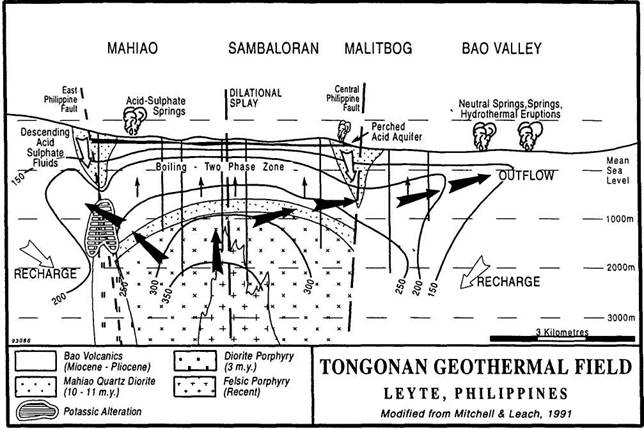
The Tongonan geothermal field is situated in a 12 km long graben formed within a dilational jog in the Philippine Fault, on the island of Leyte (Fig. 2.6). This jog has been active at least since the Miocene, controlling emplacement of a number of intrusions ranging from: a large quartz diorite to granodiorite (10-11 m. y.) pluton between the east and central Philippine Faults, diorite porphyries (3 m. y.) along the margins of this pluton, and recent felsic porphyries and associated high-level dacite plugs and dykes emplaced along dilational splays cutting the diorite pluton (Fig. 2.10). The heat source for the currently active system is interpreted to be the recent stage felsic intrusions which have been emplaced into a thick sequence of Miocene to Pliocene volcanics, and display no associated recent extrusions. 10km to the southeast, the volcanic centres of Mt. Janagdan and Alto Peak are aligned parallel to the trend of subduction along the Philippine Trench.
Relatively flat terrain within the graben has enabled the circulating hydrothermal system to reach close to the surface, with outflows of neutral boiling chloride at lower elevation south to the Bao Valley. This gentle terrain has facilitated only limited formation of acid sulphate fluids above the hydrothermal system, with minor recharge down the branches of the Philippine Fault. Alteration mineralogy in the Sambaloran and Mahiao regions (Fig. 2.11) is generally in equilibrium with the current hydrothermal conditions, implying that the current system is at least stable, and possibly waxing. The high salinity of the fluids (up to 16,000 ppm Cl) reflects a high magmatic component to the system. Argillic to advanced argillic alteration, derived from descending cool low pH fluids, overprints potassic and inner propylitic assemblages associated with diorite intrusions along the branches of the Philippine Fault.
21
Fig. 2.10 |
Exploration Workshop "SW Pacific Rim Au/Cu Systems: Structure Alteration & Mineralization" Corbett G J & Leach T M, 8/96 Edn.
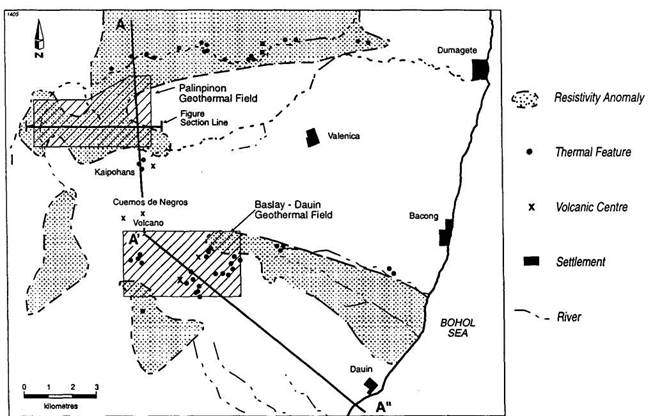
 Setting of the Southern Negros Geothermal Field From Mitchell & Leach 1991
Fig. 2.11
Exploration Workshop "Southwest Pacific rim gold-copper systems: Structure, Alteration, and Mineralization" Corbett G J & Leach T M, 8/96 Edn.
The Tongonan geothermal field illustrates the strong structural control to multiple intrusive events and associated overprinting porphyry-style hydrothermal systems. The large dilational feature which hosts the geothermal system has been reactivated a number of times allowing emplacement of different generations of intrusions. This strong structural control on multiple porphyry-style hydrothermal systems at Tongonan is analogous to the tectonic control on intrusions associated with the Yandera porphyry copper system, PNG (Titley et al., 1978).
3. Collapsing Hydrothermal Systems i) Southern Negros Geothermal Area
Two geothermal systems are associated with the Cuernos de Negros volcanic centre, the northern Palinpinon field and southern Baslay-Dauin field (Fig. 2.11). The volcanic centre comprises twin summit peaks, dacite domes, and parasitic cones to the south and east, and a pyroclastic plateau to the north. The most recent pyroclastic'flows (14,000 years BP) are dacitic and were sourced from a vent 2 km north of the summit craters.
The Palinpinon system is hosted by a 1.5 km thick sequence of Miocene-Recent volcanics which overlie Eocene-Miocene calcareous sediments and early Eocene volcanics and volcaniclastics (Fig. 2.12). A large Miocene monzonite pluton was emplaced into the volcanics and sediments in the western portion of the field. Recent porphyry stocks have been emplaced along the eastern margin of the monzonite, facilitated by movement along a parallel set of north-south trending dilational structures. These structures have also controlled the venting of the recent pyroclastic flows. The porphyry stocks or deeper equivalent intrusions provide the heat source for the currently active hydrothermal system.
Two distinct phases of hydrothermal alteration are encountered (Leach and Bogie, 1982): a relict phase of potassic and advanced argillic alteration in the west, with propylitic alteration to the east, and a current phase of phyllic alteration in the central regions of the system (Fig. 2.12). The potassic zone grades from an inner assemblage of clinopyroxene-biotite, outward to zones of biotite-quartz and actinolite-biotite. In places, zoned hornblende-pyroxene-biotite hornfels occur at intrusive-volcanic contacts. Elsewhere zoned skarns are intersected within calcareous sediments adjacent to porphyry intrusions. Alteration grades vertically and eastward from the potassic zone, through zones of epidote-chlorite, to shallow chlorite-zeolite assemblages.
Advanced argillic alteration was intersected from surface to m depth in the western Sogongon region, and crops out as prominent 2-3 km long ridges aligned north-south along the main regional dilational structures (Fig. 2.12). The volcanics have undergone alteration to intense silicification and zoned kaolinite, alunite, and pyrophyllite-diaspore + tourmaline assemblages. Trace hypogene covellite mineralization is associated with this advanced argillic alteration. These zones of intense silicification and advanced argillic alteration are comparable to the shoulders of high sulphidation alteration formed marginal to porphyry copper deposits (see Section 6.II), and are interpreted to have formed from comparable magmatic vapour plumes which are currently venting at Alto Peak and Vulcan, Biliran Is. Similar porphyry-related silicified ridges extend for 3-4 km along major structures in the Amlan River area 5-6 km north of the Palinpinon geothermal system, as well as in a belt extending north along the island of Negros and into Masbate Island (Mitchell and Leach, 1991).
Phyllic alteration at Palinpinon occurs within shallow gas condensate zones, and comprises sericite-quartz-anhydrite + carbonate + chlorite at deep levels, and illitic clay-quartz-
22
Exploration Workshop "SW Pacific Rim Au/Cu Systems: Structure Alteration & Mineralization' Corbett G J & Leach T M, 8/96 Edn.
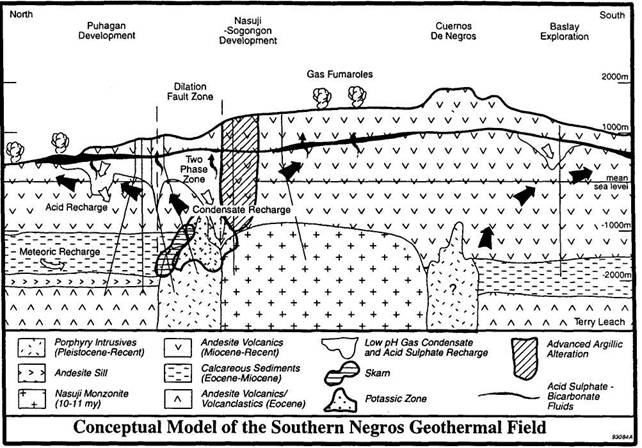
Fig. 2.12
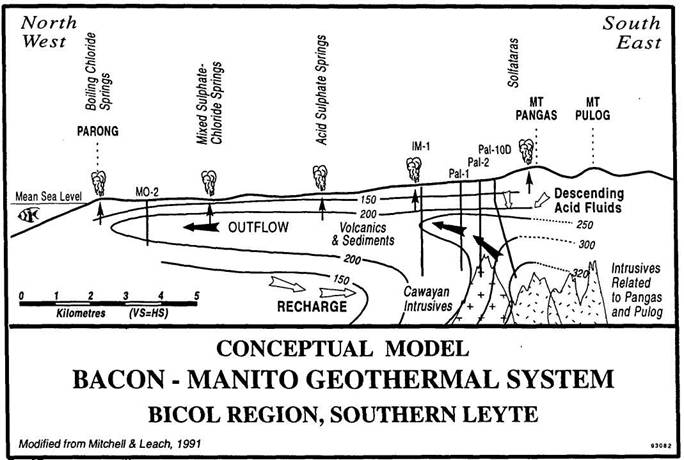
 Fig. 2.13
Exploration Workshop "Southwest Pacific rim gold-copper systems: Structure, Alteration, and Mineralization" Corbett G J & Leach T M, 8/96 Edn.
anhydrite at shallower levels. Phyllic alteration has overprinted the potassic and propylitic zones, in response to draw-down of gas condensate fluids locally into the deeper portions of the system. Elsewhere, localised cool acid sulphate-bicarbonate and dilute meteoric recharge fluids have been encountered at depths up to 2 km, where they have migrated down permeable structures and along contacts with sills and dykes.
The hydrothermal system at Palinpinon exhibits all the major features encountered in porphyry copper deposits throughout the southwest Pacific region. These include skarns, homfels, and potassic alteration zones grading out to propylitic alteration developed during early stages of the hydrothermal system. Advanced argillic alteration and silicification also formed early in the evolution of this active porphyry system and are strongly structurally controlled along faults which facilitated the emplacement of the multiple porphyry intrusions. At present, the Palinpinon porphyry system occurs at an early stage of collapse, such that cool gas condensate fluids are descending in response to pressure draw-down, resulting in phyllic alteration overprint on the existing zoned propylitic-potassic alteration. The relatively dilute (up to 7,000 ppm Cl) nature of these fluids reflects the minor magmatic input at this stage of evolution of the hydrothermal system. Chalcopyrite + bornite are the main copper phases encountered, and copper locally grades up to 0.1-0.2 percent.
The geological setting of Palinpinon has many similarities to the Panguna porphyry copper deposit, Bouganville, PNG (Baldwin et al., 1978), where multiple mineralizing porphyry intrusions were emplaced along the margin of a large quartz diorite pluton. Alteration mineralogy in samples from drilling in the Baslay-Dauin field 6 km to the south, indicates that this system is youthful and possibly related to a separate series of intrusions at depth associated with the Cuernos de Negros volcanics.
ii) Bacon—Manito Geothermal Field, Southern Luzon
The Bacon-Manito geothermal field is situated along the Bicol volcanic arc in southern Luzon, midway between the active large stratovolcanoes of Mayon and Bulusan (Fig. 2.5). The Bacon-Manito hydrothermal system is located within a complex composite volcanic terrain of domes, plugs, and collapsed calderas ranging in composition from dacite to basaltic andesite. Up to 2800 m of volcanics comprising mainly andesites, but ranging from dacite to basalt, overlies a succession of Miocene to Eocene sediments and volcanics (Fig. 2.13). A number of small stocks and plugs intersected at depth by drilling in the Cawayan sector vary from pyroxene gabbro to hornblende quartz diorite.
Thermal features occur over a 15-20 km outflow zone and exhibit a vertical zonation common in volcanic arc geothermal systems. Hydrothermal solfataras occur on the flanks of Mount Pangas in the region of the main upflow, whereas acid sulphate and mixed sulphate-chloride springs vent at intermediate elevations. Boiling chloride springs are encountered at around sea level (Fig. 2.13).

|
Из за большого объема этот материал размещен на нескольких страницах:
1 2 3 4 5 6 7 8 9 10 11 12 13 14 15 |
