

Партнерка на США и Канаду по недвижимости, выплаты в крипто
- 30% recurring commission
- Выплаты в USDT
- Вывод каждую неделю
- Комиссия до 5 лет за каждого referral
i) Emplacement of the FSE quartz diorite stock (9-11 m. y.) into mid Miocene volcaniclastics and the development of quartz stockwork veining and zoned alteration. Biotite alteration extends 100 m from the diorite contact, and grades out to propylitic epidote-calcite-chlorite alteration. These have been overprinted by retrograde chlorite—illite/sericite-clay alteration.
ii) A steep hydrothermal breccia pipe transects the FSE diorite, but is truncated at shallow levels by the Imbanguila Dacite. Alteration in the breccia pipe grades from sericite-tourmaline
91
|
Exploration Workshop "Southwest Pacific rim gold-copper systems: Structure, Alteration, and Mineralization" Corbett G J & Leach T M, 8/96 Edn.
at depth, to anhydrite-alunite (± diaspore, pyrophyllite, zunyite and illite) at shallow levels. This advanced argillic alteration extends beyond the breccia and forms and extensive cap over the FSE porphyry. The alteration grades laterally from: quartz-alunite-zunyite in central zones, through pyrophyllite-diaspore, to margins of illite—chlorite (T. Leach, unpubl. data). The alunite in the hydrothermal breccia has been dated at 6.9-8.5 m. y. (Hedenquist, unpubl. data).
iii) The funnel shaped Imbanguila dacite porphyry has variably been dated at 5.6-7 m. y. (Garcia, 1991) and is associated with a diatreme breccia which mushrooms at shallow levels to the SW (Fig. 6.18). Advanced argillic alteration and associated gold-copper mineralization preferentially occur at the intersection of faults and fractures (of the Lepanto Fault) and the contact between the diatreme and the underlying volcaniclastics. Central zones of vughy to massive quartz grade outward through quartz-alunite-kaolinite, and kaolinite zones to peripheral smectite-illite and chlorite alteration. The dacite porphyry is relatively unaltered except at its margins and in fault controlled quartz-pyrite-anhydrite zones (Easterlies) grading out to quartz-alunite-kaolinite alteration.
iv) The Bato Dacite forms porphyry domes and associated tuffaceous diatreme breccias, and yielded a K-Ar age on biotite of 2.9 m. y. (Sillitoe and Angeles, 1985). Garcia (1991) interprets these dacite units to be post-mineral. To the west of the mine area, quartz-alunite-kaolinite alteration occurs as a 6 km long ridge which defines the lower contact of dacitic units. Alunite in these ridges (Hedenquist, unpubl. data), as well as sericite in the FSE, have been dated at between at 1.4-3.3 m. y.
Three main types of mineralization are recognised (Garcia, 1990, 1991) at Lepanto-FSE:
i) Porphyry style chalcopyrite-bornite mineralization hosted within and adjacent to the FSE quartz diorite is related to the chlorite-illite/sericite-clay overprinting alteration event. Gold occurs as inclusion in, and overgrowing, copper sulphides. This mineralization is interpreted to have been either deposited during, and/or remobilized by, the post-FSE hydrothermal breccia event.
ii) High sulphidation enargite-luzonite mineralization is associated with advanced argillic alteration and hosted within central vughy to massive quartz zones: in alunite-anhydrite zones within the hydrothermal breccia, at the diatreme breccia - metavolcanic contact along the strike of the Lepanto Fault (branch veins or classical ore), in fault controlled alunite-anhydrite zones which cut the dacite porphyry (Easterlies), and in flat lying bodies which replace calcareous sediments (stratabound ore). Kaolin clay alteration hosts copper-gold mineralisation in lenticular to pod-like bodies hosted in permeable breccias (stratiform). Minor chalcopyrite, tennantite and stibnite represent late mineralization phases, and gold occurs in association with tellurides.
iii) Low sulphidation pyrite - and base metal-quartz veins which post date the high sulphidation mineralization.
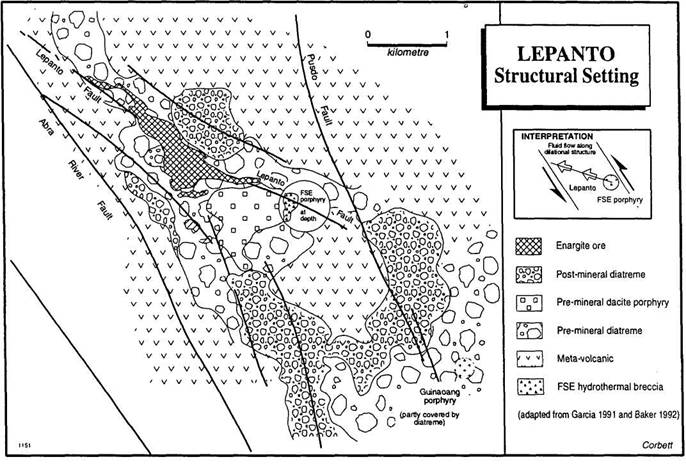
Emplacement of the hydrothermal breccia and the Imbanguila dacite-diatreme dome complex are probably related to emplacement of a high level intrusion at depth beneath, or along the margin of the FSE quartz diorite. Exsolution of reactive magmatic volatiles, and later mineralizing fluids from this same high level intrusion at around 6.5-7 m. y., have produced the zoned advanced argillic alteration and copper-gold-arsenic mineralization in the various settings outlined above. It is postulated that there may have been two upflows of high sulphidation fluids, one associated with emplacement of the hydrothermal breccia and another
92
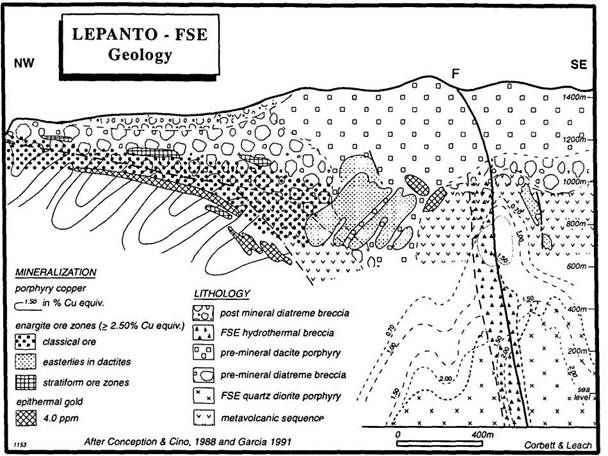
Fig. 6.25
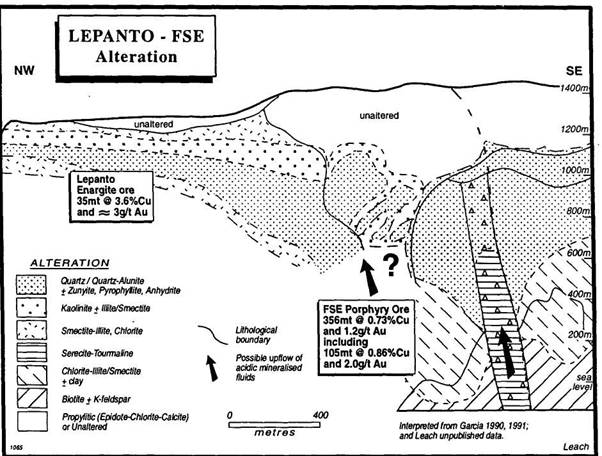
 Fig. 6.26
Exploration Workshop "Southwest Pacific rim gold-copper systems: Structure, Alteration, and Mineralization" Corbett G J & Leach T M, 8/96 Edn.
at depth, to anhydrite-alunite (± diaspore, pyrophyllite, zunyite and illite) at shallow levels. This advanced argillic alteration extends beyond the breccia and forms and extensive cap over the FSE porphyry. The alteration grades laterally from: quartz-alunite-zunyite in central zones, through pyrophyllite-diaspore, to margins of illite-chlorite (T. Leach, unpubl. data). The alunite in the hydrothermal breccia has been dated at 6.9-8.5 m. y. (Hedenquist, unpubl. data).
iii) The funnel shaped Imbanguila dacite porphyry has variably been dated at 5.6-7 m. y. (Garcia, 1991) and is associated with a diatreme breccia which mushrooms at shallow levels to the SW (Fig. 6.18). Advanced argillic alteration and associated gold-copper mineralization preferentially occur at the intersection of faults and fractures (of the Lepanto Fault) and the contact between the diatreme and the underlying volcaniclastics. Central zones of vughy to massive quartz grade outward through quartz-alunite-kaolinite, and kaolinite zones to peripheral smectite-illite and chlorite alteration. The dacite porphyry is relatively unaltered except at its margins and in fault controlled quartz-pyrite-anhydrite zones (Easterlies) grading out to quartz-alunite-kaolinite alteration.
iv) The Bato Dacite forms porphyry domes and associated tuffaceous diatreme breccias, and yielded a K-Ar age on biotite of 2.9 m. y. (Sillitoe and Angeles, 1985). Garcia (1991) interprets these dacite units to be post-mineral. To the west of the mine area, quartz-alunite-kaolinite alteration occurs as a 6 km long ridge which defines the lower contact of dacitic units. Alunite in these ridges (Hedenquist, unpubl. data), as well as sericite in the FSE, have been dated at between at 1.4-3.3 m. y.
Three main types of mineralization are recognised (Garcia, 1990, 1991) at Lepanto-FSE:
i) Porphyry style chalcopyrite-bornite mineralization hosted within and adjacent to the FSE quartz diorite is related to the chlorite-illite/sericite-clay overprinting alteration event. Gold occurs as inclusion in, and overgrowing, copper sulphides. This mineralization is interpreted to have been either deposited during, and/or remobilized by, the post-FSE hydrothermal breccia event.
ii) High sulphidation enargite-luzonite mineralization is associated with advanced argillic alteration and hosted within central vughy to massive quartz zones: in alunite-anhydrite zones within the hydrothermal breccia, at the diatreme breccia - metavolcanic contact along the strike of the Lepanto Fault (branch veins or classical ore), in fault controlled alunite-anhydrite zones which cut the dacite porphyry (Easterlies), and in flat lying bodies which replace calcareous sediments (stratabound ore). Kaolin clay alteration hosts copper-gold mineralisation in lenticular to pod-like bodies hosted in permeable breccias (stratiform). Minor chalcopyrite, tennantite and stibnite represent late mineralization phases, and gold occurs in association with tellurides.
iii) Low sulphidation pyrite - and base metal-quartz veins which post date the high sulphidation mineralization.
Emplacement of the hydrothermal breccia and the Imbanguila dacite-diatreme dome complex are probably related to emplacement of a high level intrusion at depth beneath, or along the margin of the FSE quartz diorite. Exsolution of reactive magmatic volatiles, and later mineralizing fluids from this same high level intrusion at around 6.5-7 m. y., have produced the zoned advanced argillic alteration and copper-gold-arsenic mineralization in the various settings outlined above. It is postulated that there may have been two upflows of high sulphidation fluids, one associated with emplacement of the hydrothermal breccia and another
92

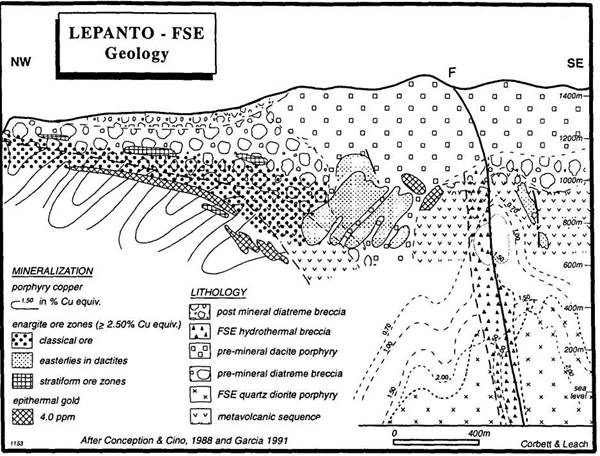
Fig. 6.25
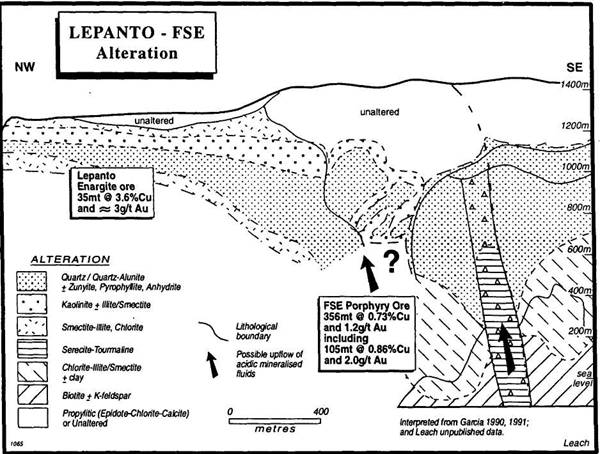
 Fig. 6.26
Exploration Workshop "Southwest Pacific rim gold-copper systems: Structure, Alteration, and Mineralization" Corbett G J & Leach T M, 8/96 Edn.
along the contact of the dacite-diatreme complex. Fluids have outflowed along the NW-trending dilatant structures. Some copper mineralization at Lepanto may have been remobilized from an early porphyry copper event at FSE; and some gold may have been deposited at FSE from the high sulphidation fluids.
Garcia (1991) interprets the base metal-gold mineralization to be related to neutralization of this same hydrothermal system during late stages of activity. The advanced argillic ridges to the west of the mine are interpreted (Garcia, 1991) to be post mineral and associated with a more recent hydrothermal event.
iii) MLXasi, Fiji
The Mt. Kasi Prospect, Fiji (Fig. 1.2) represents a structurally controlled style of high sulphidation alteration and gold (copper) mineralization, formed at a high crustal level and only poorly eroded. This discussion is taken from Corbett and Taylor (1994) and Leach (unpubl. report, 1994). At the time of writing (early 1996) a construction is in progress of a mine which will extract a resourse comprising: 1,048,000 t of eluvial Au @ 1.9 g/t and 1,240,000 t of hard rock @ 3 g/t Au (total of 180,000 oz Au). Workings form 1932 to 1948 produced 261,000 t @ 7.5 g/t Au (63,000 oz Au). Mt Kasi is a high level gold-rich and copper-poor high sulphidation system.
Host rocks comprise Late Miocene lavas and pyroclastics which are intruded by dacite domes. An aeromagnetic high in the vicinity of the Mt. Kasi Prospect may represent a magnetite-bearing altered intrusive at depth and appears to be offset with a sinistral displacement, by NNW trending corridor of structures termed the Mt. Kasi Fault System (MKFS). The high contrast between the resistive silicification and the enclosing conductive clay alteration has facilitated the subsurface mapping of the Mt. Kasi alteration system by CSAMT (controlled source audiomagnetotelluric; Smith and Irvine, 1990) geophysics (Fig. 6.27; Corbett and Taylor, 1994).
Zoned alteration extends from locally steeply-dipping silicification as upflow zones, laterally into outflow features, which were found to be rootless in early drilling. Upflows tend to be localised by intersections of cross structures with the MKFS and palaeo fluid flow directions are apparent from the shapes of upflow-outflow relationships (Figs. 6.27, 6.28). Limited data suggest that outflows might radiate from a central upflow in the vicinity of a dilational jog in the MKFS (Fig. 6.27). The cross faults may provide late - to post-mineral offsets of the alteration in a configuration similar to domino structures (Section 3.vi). The 1100 workings are therefore inferred to represent an upflow to an outflow in the vicinity of the open pit. Other upflow-outflow relationships are apparent at Done Creek and Kasi South (Fig. 6.27).
The overprinting of alteration by mineralization is apparent at Mt. Kasi. The individual fluid upflow-outflow centres derived from the initial vapour-dominated fluid display an alteration zonation grading outwards as assemblages dominated by: a core of residual (vughy) silica, silica alunite, pyrophyllite and peripheral kaolin. Gold and copper mineralization associated with the later liquid-dominated fluid exploited the same plumbing system during continued deformation on the MKFS. Ore forms the matrix to breccias within the competent residual silica and gold (copper) grades are proportional to the matrix content of the breccias. Matrix supported rotational breccias proximal to the fluid upflow zones contain higher gold grades than the peripheral fluidised and crackle breccias in the outflow zones (Corbett and Taylor, 1994; Fig. 6.28). NW trending fractures, slickensided faults and sigmoidal-shaped fluidised breccia zones represent dilational ore-hosting features, and are indicative of a continued sinistral rotation along the MKFS (Fig. 6.28; Corbett and Taylor, 1994).
93

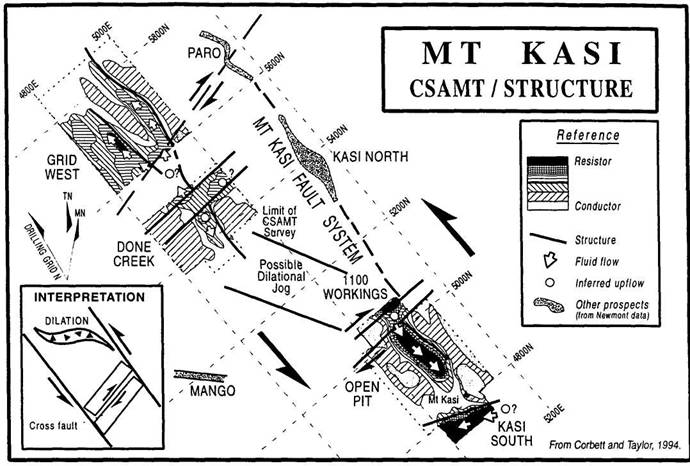
Fig. 6.27
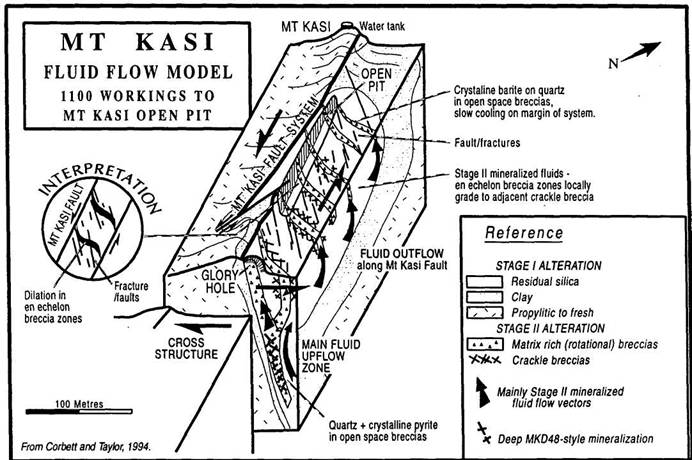
 Fig. 6.28
Exploration Workshop "Southwest Pacific rim gold-copper systems: Structure, Alteration, and Mineralization" Corbett G J & Leach T M, 8/96 Edn.
Alteration at Done Creek defines concentric zones grading outwards from: a core of vughy silica in which cavities are filled by kaolinite ± dickite, to assemblages of quartz-kaolinite-interlayered, illite-smectite and peripheral sub-propylitic chlorite-carbonate. Local alunite infills leached vughs and has been replaced by later kaolinite.
Breccia-hosted gold mineralization consists of an early phase dominated by pyrite-quartz and a later phase of gold-copper mineralization. Ore phases have been deposited in open fractures and leached vughs adjacent to fractures and overgrow earlier quartz and barite. Vertical gradations in mineralogy include: luzonite-tennantite-chalcopyrite at depth to goldfieldite-tennantite at shallow levels (including float boulders). Lateral gradations to chalcopyrite-tennantite-galena-sphalerite in peripheral argillic zones also occur elsewhere at Mt Kasi (Turner, 1986). Bonanza mineralization (locally > 1 percent Au) in float boulders at Done Creek occurs as high fineness (>900) native gold, deposited as inclusions in, and overgrowing, tennantite and goldfieldite, overgrowing pyrite, and infilling vughs in earlier quartz-pyrite veins. Trace gold-tellurides (mainly calaverite) occur as minute inclusions in goldfieldite and tennantite. Inclusions of copper-tin sulphide phases (colusite and hemusite), which contain appreciable vanadium and molybdenum contents respectively, occur in some high grade silicified float.
Mt. Kasi is a high sulphidation system which is exposed at very shallow, epithermal levels based on the dominance of quartz-kaolinite-dickite as the main alteration phases, luzonite-tennantite-goldfieldite as the copper ore phases, and low homogenisation temperatures in barite within mineralized zones (averages of 165-220°; Turner, 1986). The association of bonanza grade gold mineralization with tellurium (± vanadium) in this epithermal high sulphidation system is comparable to the bonanza grade deposits in low sulphidation, intrusive-related, epithermal systems (e. g., Zone VII at Porgera).
Fluid flow models are apparent on outcrop and prospect-scale. Individual fluid upflow-outflow centres vector away from the central portion of the hydrothermal system where a fault jog is inferred from the sinistral rotation on the MKFS (Fig. 6.26). Outcrops of dacite here could be indicative of a magmatic source.
v) Composite Structurally and Lithologically Controlled Gold-Copper High Sulphidation Systems
a) Characteristics
Most high sulphidation gold-copper systems display aspects of both lithological and structural control and those categorised above as lithologically or structurally controlled are in essence end members of a posite controls are evident within different portions of the same system or as changes with time. A diatreme margin could be classed as a permeable lithological contact by some workers or structural contact by others. Dilatant structures which tap the magmatic source, typically control the fluid flow at depth. Upon contact with permeable host rocks a lithological control may be evident, particularly in the upper portions of many systems. One high sulphidation system may demonstrate structural control in some portions and lithological control in others.
Systems which display approximately equal structural and lithological control are Maragorik, East New Britain, PNG; (Corbett et al., 1991; Corbett and Hayward, 1994); Peak Hill, eastern Australia; (Degeling et al., 1995); Bawone-Binebase, Sangihe Is, Indonesia (Corbett unpubl.
94
Exploration Workshop "Southwest Pacific rim gold-copper systems: Structure, Alteration, and Mineralization" Corbett G J & Leach T M, 8/96 Edn.
report, 1993); Temora (Thompson et al., 1986) and Dobroyde (Leach, unpubl. data) in eastern Australia.
b) Examples
i) Peak Hill, Eastern Australia
Although occurring within an Ordovician magmatic arc of the Lachlan Fold Belt, eastern Australia (Walshe et al., 1995), Peak Hill displays features typical of younger high sulphidation gold-copper systems as summarised here from Degeling et al., (1995). The inferred magmatic source for the high sulphidation alteration and mineralization may have been localised by the intersection of NW trending transfer structures which offset the magmatic arc, and the arc-normal Parkes Thrust. Host rocks comprise andesitic volcanics and epiclastic rocks.
An initial lithological control to the high sulphidation alteration is evidenced by the localisation of silicification at the intersections of NW trending structures and permeable host rocks (e. g., Bobby Burns workings, Fig. 6.29). These structures also provide post-mineral offsets to the alteration (e. g., Crown workings, Fig. 6.29), and host possible earlier low sulphidation quartz veins. In addition, NW structures localise fracture controlled mineralization which is best developed in portions of the NW structures which deviate to WNW trends (e. g., Proprietary open pit, No. 2 and Mingelo stopes, Fig. 6.29). The model presented by Degeling et al. (1995) suggests that regional sinistral rotation, possibly on arc-parallel structures such as the Gilmore Suture (Stuart-Smith, 1991), has facilitated the formation of local mineralized WNW-trending jogs where the NW fractures transgress the competent silicification.
Four distinct stages of hydrothermal activity have been recognised at Peak Hill (Fig. 6.30):
Stage I: Quartz veins host gold mineralization at Myall United or McPhails workings north of Peak Hill, and at the Crown workings at Peak Hill, and predate the high sulphidation mineralization. These veins strike NW and exhibit locally higher grades in WNW-trending jogs.
Stage II: This is the main high sulphidation system which developed progressively as follows:
i) An early phase of alteration exhibits a pronounced lithological control in the exploitation of favourable permeable units in the epiclastic/volcanic sequence, over an area of 500 x 1000 m. At Proprietary (Fig. 6.31) the alteration is zoned outwards from a central core of residual vughy to massive quartz which is hosted in steeply dipping fine grained pyroclastic and rimmed by silica-alunite. The silicified zones grade to silica-micaceous clay alteration which is broad to the east and narrow to the west. The micaceous clays are interpreted to have been recrystallised during a post-high sulphidation deformation event, and grade from sericite at depth and in the south, to pyrophyllite at shallow levels and to the north. Trace andalusite co-exists with pyrophyllite at Great Eastern. Silica-paragonite, paragonite-chlorite, chlorite-albite and epidote-albite-chlorite alteration form as progressive zones westward of the silica-micaceous clay alteration, and are hosted in less permeable andesite volcanics. The zoned alteration is interpreted to reflect progressive neutralization and cooling of a hot acid fluid as it migrates away from permeable lithologies. The extent of silicification is greatest closer to the inferred NW feeder structures and dies out moving along the strike of the permeable units, (e. g., at Parkers; Fig. 6.29).
ii) The zoned alteration, and especially the more brittle quartz and quartz-alunite zones, have
95


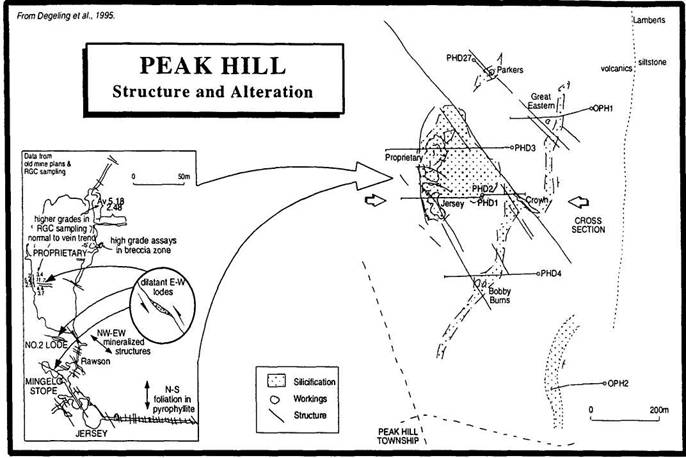
Fig. 6.29
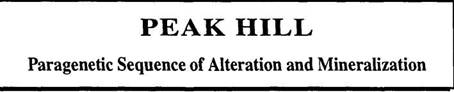
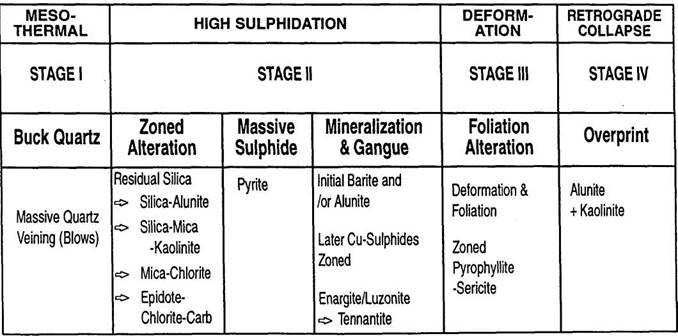
 Fig. 6.30


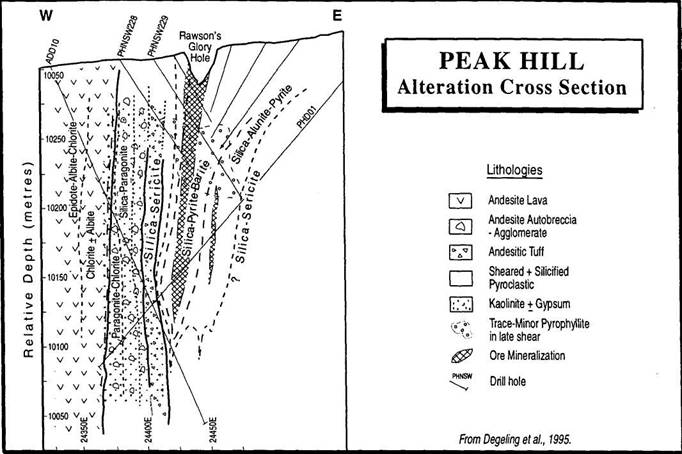
 Fig. 6.31
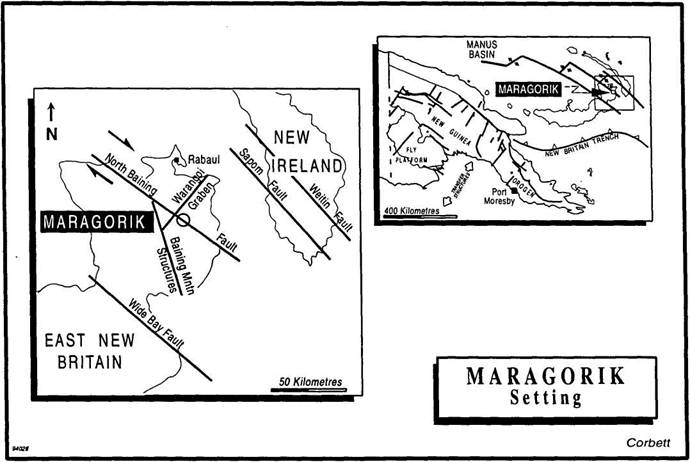
Fig. 6.32
Exploration Workshop "Southwest Pacific rim gold-copper systems: Structure, Alteration, and Mineralization" Corbett G J & Leach T M, 8/96 Edti.
undergone fracturing and local brecciation, accompanied by deposition of quartz-barite ± alunite. In drill hole OPH2, south of Peak Hill, silicified vughy volcanics have undergone intense fracturing and brecciation, and are sealed in a vein breccia of coarse tabular alunite. This style of alunite vein/breccia is common in high sulphidation systems proximal to source intrusions (see section 4.ii. b).
iii) Further fracturing and brecciation was accompanied by deposition of sulphide phases which comprised of earlier massive pyrite, followed by later deposition of copper-gold ore phases. Copper-gold mineralization at Proprietary is localised at the intersection of the central residual silica zones and the NW trending feeder structures. Sub-economic copper mineralization at Proprietary, and to a lesser degree at Parkers, is restricted to a quartz-pyrite-barite zone, and is dominated by tennantite and minor luzonite. Tennantite is locally enriched in tellurium, and trace minute Au-tellurides (calaverite) have been reported as inclusions in some pyrite (Allibone, 1993). High fineness (943-968) native gold occurs with tennantite infilling fractures cutting pyrite. The occurrence of Te-rich mineralogy, tennantite-luzonite copper mineralization, and free gold are indicative of shallow epithermal levels in a high sulphidation system. Chalcopyrite-enargite ± bornite mineralization in the southern region of Bobby Burns implies higher temperature mineralization there, than in prospects to the north.
Stage III: This is the main phase of post-alteration-mineralization deformation and shearing. The zonation in micaceous clay outlined above is inferred to indicate lower pH conditions in the north during deformation.
Stage IV: Late stage deposition of kaolinite and gypsum, and at depth fine grained pseudo-cubic alunite in open cavities and breccia zones, implies a collapse of cool, acidic fluids onto earlier alteration assemblages. In places the pseudo-cubic alunite is slightly deformed, however in most cases undisturbed, indicating that most of the Stage IV retrograde activity was post deformation/shearing.
Information from structure, alteration and mineralization suggest that hot acidic magmatic fluids have been derived from an intrusive source in the vicinity of a magnetic high about 1.5 km to the southeast of Peak Hill. It is interpreted that volatile-rich magmatic fluids migrated along the arc normal NW structures, and caused zoned alteration centred in permeable pyroclastic units. Later mineralized fluids have moved north and east along the same regional structures, and deposited gold-copper mineralization along WNW-EW trending fractures hosted in brittle silicified zones.
ii) Maragorik, East New Britain, Papua New Guinea
The Maragorik Prospect, East New Britain, Papua New Guinea (Fig. 6.32), is a high sulphidation gold-copper system which have undergone only minor erosion (Corbett et al., 1991; Corbett and Hayward, 1994). As extensive ash deposits blanket the region, CSAMT geophysics in conjunction with bulldozer trenching, were utilised to delineate the subsurface geology. At deeper levels fluid upflow occurred along EW structures dilated by the rotation on the bounding major NW structures (Fig. 6.33). At higher levels, the rising hydrothermal fluids have exploited permeable horizons which intersect the upflow structures and demonstrate a lithological control to form ledges of silicification and peripheral clay alteration (Fig. 6.34). Thus, zones of silicification occur as steep and flatly dipping ledges. As is typical of high sulphidation systems, an initial inferred vapour-dominated phase is followed by a liquid-dominated phase. Much of the zoned silica to clay alteration is developed during the early phase of activity. Mineral deposition occurs as a result of brecciation of the competent
96
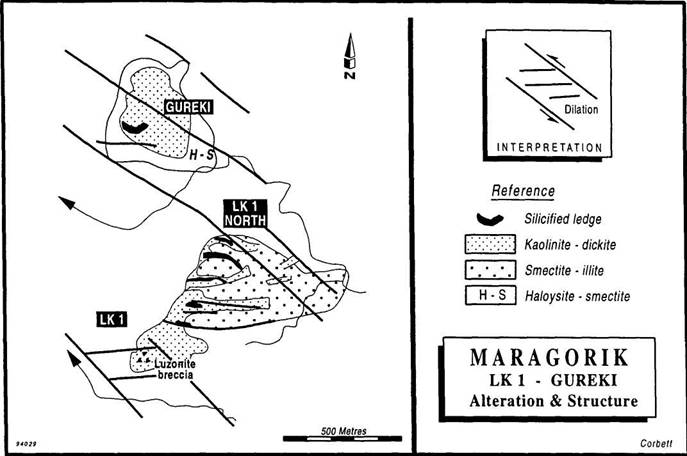
Fig. 6.33
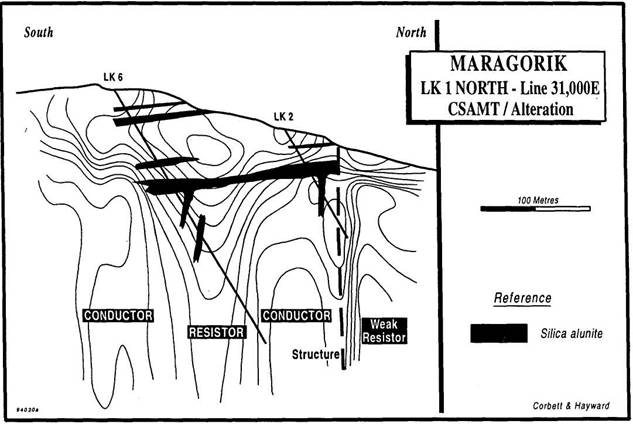
Fig. 6.34
silicification by later phase fluids and is restricted to the ledges proximal to the feeder structures.
Styles of alteration and mineralization are indicative of a very low temperature and hence high level system, characterised by opaline silica, smectite dominated clays and luzonite as the low temperature polymorph of enargite. Although high sulphidation systems are inferred to develop from porphyry-related magmatic fluids, such a source at Maragorik is interpreted to be very deeply buried.
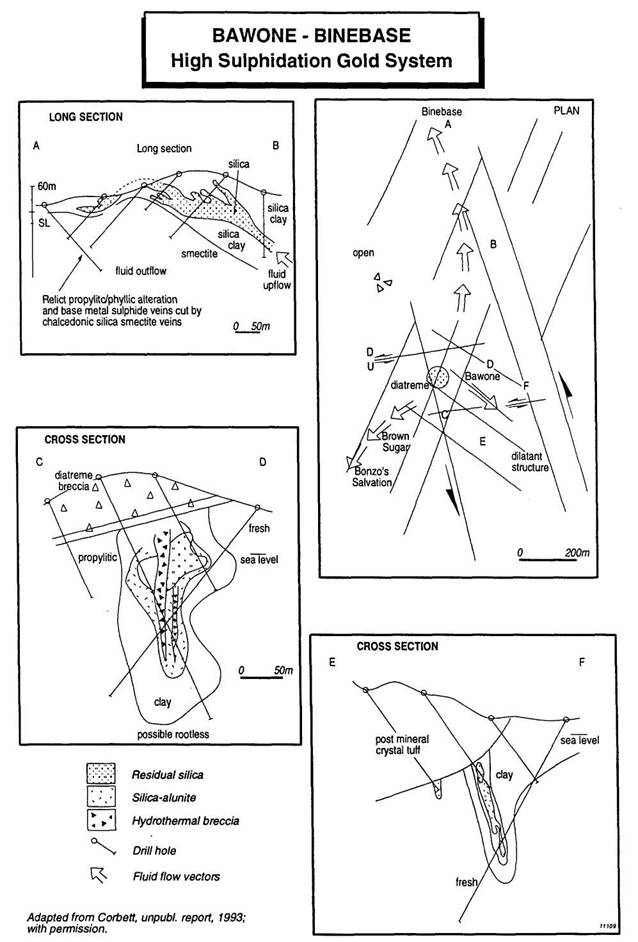
iii) Bawone-Binebase, Sangihe Island, Indonesia
At Bawone-Binebase on Sangihe Island, Indonesia both structurally and lithologically controlled high sulphidation gold-copper mineralization are interpreted to have been derived from the one fluid source and occur within different parts of the same hydrothermal system (Fig. 6.35; Corbett unpubl. report, 1993). Low grade porphyry alteration and mineralization occur at Binebase and elsewhere on Sangihe Island. Low sulphidation mesothermal quartz-sulphide veins are inferred to represent the hypogene source for supergene gold recovered by illegal miners at Taware Ridge. The inferred magmatic source for the high sulphidation system is localised on the margin of a NNW graben by the intersection of thoroughgoing NNE structures, and dilation of ESE structures by sinistral rotation on NNW structures (Fig. 6.35). The intersecting structures have tapped the magmatic source forming a fluid upflow feature.
At Bawone, a fluid flow model is apparent from zoned alteration and gold-copper distribution in several cross sections (Fig. 6.35). Hot magmatic fluids are inferred to have been derived from the vicinity of overprinting diatreme breccias and flowed laterally along the dilatant structures towards the SE. The size of the alteration zones, temperature of formation and metal grades all decline moving from the upflow to outflow settings. Zonations and paragenetic sequences of overprinting alteration and mineralization are typical of high sulphidation systems. The local sharp contacts between: residual silica, silica-alunite and peripheral clay alteration, are indicative of a high level setting or distal relationship to the inferred magmatic source, and typical of an outflow portion of the hydrothermal system. Mineralization occurs as sulphide-rich matrix to fluidised breccias and sulphide infill of vughs in the competent altered residual silica and silica-alunite.
While the bulk of the hydrothermal fluids have flowed to the SE along the dilatant structures, relatively small structurally controlled high sulphidation mineralization occurs to the SW at Brown Sugar and Bonzo's Salvation. Rapid changes in alteration zonation are consistent with fluid quenching and low temperature clays are also indicative of the dilational setting.
The Binebase alteration resulted from the northward migration of hydrothermal fluids along a corridor provided by the intersection of a permeable lapilli tuff unit and thoroughgoing NNE structures. Low temperature alteration assemblages are consistent with the distal relationship to the inferred fluid source at Bawone. Chalcedony becomes increasingly vughy down dip and to the south towards the inferred upflow. As seen in some other lithological controlled systems, there is little distinction between alteration and mineralization resulting from the vapour-dominated phase I fluid, and the later liquid-dominated stage II mineralized fluid. The abundant gypsum and barite also suggest that incursion of seawater could have occurred, possibly from the NW.
97
|
Exploration Workshop "Southwest Pacific rim gold-copper systems: Structure, Alteration, and Mineralization" Corbett G J & Leach T M, 8/96 Edn.
vi) Hybrid High-Low Sulphidation Systems
a) Characteristics
Giggenbach (mun., in Hedenquist, 1987) states that "ascent of volcanic (magmatic) gases and their transition from an oxidised (sulphur as SO2 - high sulphidation) to reduced (sulphur as H2S - low sulphidation) state is 'a battle of the buffers', in which each achieves a partial victory". Hedenquist (1987) postulated that there is a continuum from high to low sulphidation systems, which is dependent on the degree of access of these upwelling fluids to neutralization (and cooling) through reaction with the wall rock and/or circulating surficial waters.
All high sulphidation systems exhibit zoned alteration, which is indicative of this process of cooling and neutralization within subsidiary structures or permeable lithologies. In this environment the magmatic-derived fluids are able to be modified away from the major feeder structures. However, in certain cases the upwelling hot acidic, magmatic-derived high sulphidation fluid becomes cooled and neutralized within the major regional structures themselves. This results in a transition from high to low sulphidation type fluid and the formation of a hybrid deposit type (e. g., Wild Dog, PNG). Elsewhere, the initial hydrothermal fluid may be dominantly high sulphidation, but a later fluid may be low sulphidation in nature. This reflects changes in the chemistry of the fluids which exsolve from the magmatic source during late stage of melt crystallisation, or the mineralized fluid has been modified during its ascent. A superimposed high and low sulphidation system might be the base metal gold veins which cut the high sulphidation system at Lepanto, Philippines (section 6.iv. b), or the banded epithermal quartz veins which cut advanced argillic alteration at Masupa Ria, Indonesia (Thompson et al., 1994).
b) Examples
The enigmatic Wild Dog Prospect, Papua New Guinea (Lindley, 1987, 1988, 1990) displays characteristics of both high and low sulphidation gold systems, and Arribas (1995) notes that Masupa Ria, Indonesia (Thompson et al., 1994) and the Kelly mine, Philippines (Comosti et al., 1990) are examples of possible transitions from high to low sulphidation systems.
i) Wild DogT East New Britain, Papua New Guinea
The Wild Dog Prospect was identified in 1983 during the follow up of anomalies including altered float and pannable gold identified during a regional stream sediment exploration programme (Lindley, 1987). Evaluation of the project by Esso (PNG), City Resources and Highlands Gold Limited continued until the early 1990's. Host rocks comprise andesitic to dacitic lavas and tuffs to which Lindley (1987, 1988) attributes a probable Mio-Pliocene age. Recent ash partly blankets the area.
Wild Dog is one of several alteration zones hosted within the Warangoi Structural Corridor, which transects an inferred Nengmutka caldera (Lindley, 1987, 1990). The caldera is localised within the Baining Mountain Graben structures, which data showing the depth to the mantle (Wiebenga, 1973), may represent the margin of a deep rift (Fig. 6.36, Corbett, unpubl. report, 1990). At prospect scale three NNE trending and west dipping silicified zones occur within the Warangoi Structural corridor as a prominent ridge (Lindley, 1990). NW trending cross structures exploited by the drainage pattern and locally offset the silicified zones as slickensided faults (Corbett unpubl. report, 1990, Fig. 6,37).
98

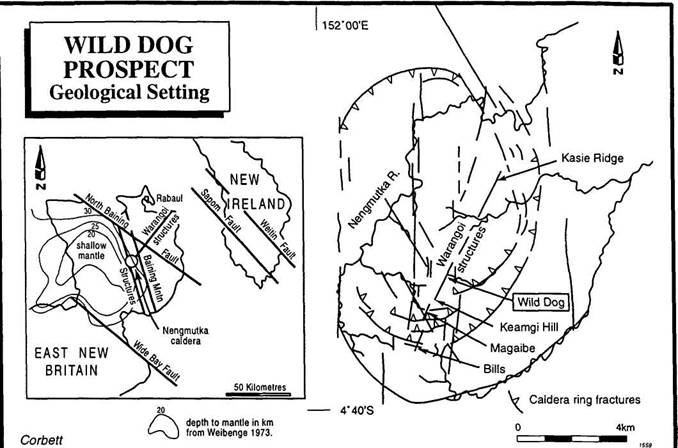
 Fig. 6.36
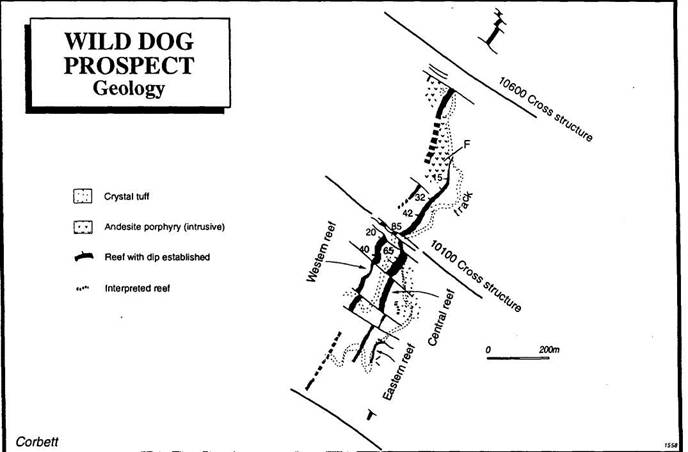
 Fig. 6.37
Exploration Workshop "Southwest Pacific rim gold-copper systems: Structure, Alteration, and Mineralization" Corbett G J & Leach T M, 8/96 Edn.
Two main hydrothermal events are recognised in the prospect area (Fig. 6.38):
i) Replacement silicification of regionally propylitic altered (epidote-pyrite-chlorite) volcanics, produced a dense, grey fine grained chert-like alteration (Lindley, 1990). These steeply dipping silicified zones are unmineralized, pinch and swell up to true widths of 50-70 m, and are aligned NNE parallel to the Warangoi Structure. Alteration mineralogy in the silicified zones and the immediate wall rock is vertically zoned at Wild Dog from: sericite ± pyrophyllite at depth, through sericite, to local sericite ± chlorite at shallow levels. Trace molybdenite mineralization is associated with the silicification event.
Similar structurally controlled silicification is locally encountered along the Warangoi Structure at Keamgi Hill, 2 km SSW of Wild Dog, and Kasie Ridge, 4 km to the NNE (Fig. 6.36). At Kasie Ridge, 300 m lower elevation than Wild Dog, subparallel NNE trending silicified ridges are zoned from: central zones of quartz-alunite ± zunyite ± pyrophyllite + diaspore, through pyrophyllite-sericite ± kaolinite/dickite and sericite ± illitic/kaolin clay, to peripheral chlorite—illitic clay, which grades outwards to regional propylitic alteration. This zonation is comparable to high sulphidation systems encountered elsewhere in the southwest Pacific.

|
Из за большого объема этот материал размещен на нескольких страницах:
1 2 3 4 5 6 7 8 9 10 11 12 13 14 15 |
