

Партнерка на США и Канаду по недвижимости, выплаты в крипто
- 30% recurring commission
- Выплаты в USDT
- Вывод каждую неделю
- Комиссия до 5 лет за каждого referral
Scout drilling in the 1970s defined copper-gold-molybdenum mineralization associated with the Ohio Creek porphyry (Merchant, 1986). The copper mineralization occurs as narrow quartz stockwork veins hosted typically near the intrusion contacts in a quartz diorite porphyry stock which has been emplaced into andesite volcanics. The mineralization does not extend into Lookout Rocks to the south east (Fig. 6.7). Mesothermal auriferous quartz-sulphide veins cut the Ohio Creek porphyry (e. g., Kaiser Reef) and were the target of small scale mining last century.
Immediately southwest of the Ohio Creek porphyry, a number of discrete dipping ledges of advanced argillic alteration form an arcuate series of silicified ridges extending over an elevation of several hundred metres, and for a strike distance of over 1000 m (Figs. 7.45, 6.7). There is a progressive zonation in alteration mineralogy from the NW to SE (Figs. 6.7, 6.8), and grading from depth within the intrusion, to shallow levels along the margins of the intrusion and extending into the volcanics, as:
* propylitic - epidote-chlorite,
* intermediate argillic - chlorite-sericite,
* phyllic - sericite-quartz,
* advanced argillic - pyrophyllite-diaspore-quartz
* silicified ledges with progressively more abundant alunite (in alunite-pyrophyllite)
which form the Lookout Rocks pinnacles,
* argillic - dickite-kaolinite and illitic clays,
* low grade propylitic - chlorite-carbonate ± illitic clays.
Andalusite, trace tourmaline and secondary apatite occur in association with sericite, and lesser pyrophyllite. Continuing to the south and east (Figs. 6.7, 6.8).
The zonations in alteration mineralogy are indicative of a gradual decrease in fluid pH from deeper porphyry levels to shallow levels at the Lookout Rocks. Cooling and neutralization of this hot acidic fluid continued further to the south and east in the argillic and propylitic alteration. The presence of andalusite, tourmaline and apatite demonstrate that the alteration at Lookout Rocks took place at high temperatures from fluids containing a significant magmatic component. It is interpreted therefore that the changes in fluid pH resulted from the progressive disproportionation of reactive magmatic volatiles emanating from the magmatic source. These volatiles have been channelled into the dilatant structures to form the ledges by reaction with ground waters. The occurrence of mesothermal quartz-sulphide veins and of late stage andesite dykes which cut the Ohio Creek porphyry, suggest that either a later intrusion may have been emplaced at depth, or that the parent melt to the porphyry exsolved fluids and metals from depth (Figs. 6.7, 6.8). Gold mineralization in the mesothermal veins is discussed in Section 7.iv. d.2.i
83
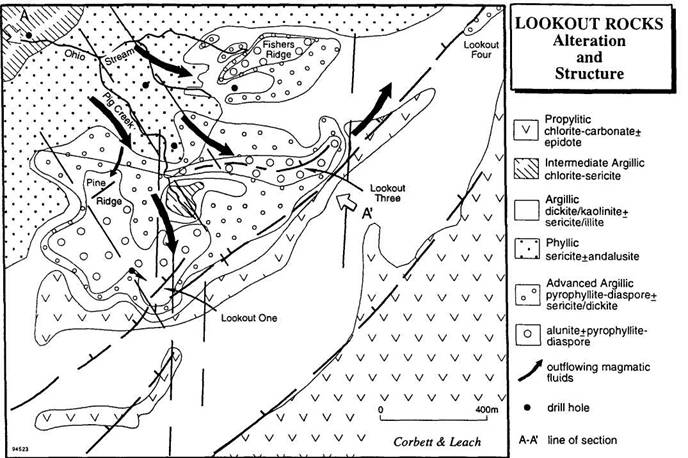
 Fig. 6.7
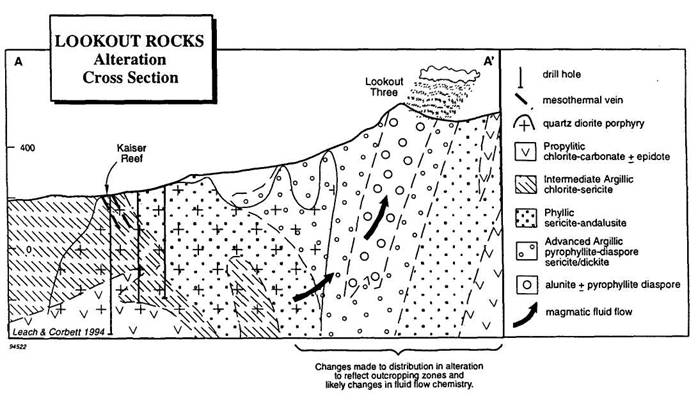
Fig. 6.8
Exploration Workshop "Southwest Pacific rim gold-copper systems: Structure, Alteration, and Mineralization" Corbett G J & Leach T M. 8/96 Edn.
iii) Vuda, Fiji
An area of high sulphidation alteration in the Vuda Valley, eastern Viti Levu, Fiji (Fig. 6.9), has been subject to exploration for porphyry copper and later epithermal gold targets. Minor gold production is recorded from several small, mainly pre-World War II mines located outside the high sulphidation alteration. Some of the early exploration (Corbett unpubl. data; Austpac Gold Prospectus, 1985), has been reinterpreted in the light of new models. Late Miocene shoshonitic lavas, autoclastic breccias dominate as host rocks and recent gravity data is consistent with the extension of intrusive rocks which outcrop in the region to below the alteration zone (Colley and Flint, 1995). The alteration is zoned about feeder structures which occur as arcuate siliceous ridges and may represent caldera ring fractures. Alteration grades laterally through silica-alunite-kaolinite, to pyrophyllite-diaspore and clay dominant assemblages (Figs. 6.9, 6.10). The silica-alunite zone contains fine quartz crystals and weathers to a characteristic crunchy soil under foot. Diaspore is also coarse grained and euhedral. Peripheral clay alteration exhibits rings derived from soaking into the rock adjacent to fractures. Lower temperature alteration including chalcedonic silica to the north, and the overall shape of the system, are indicative of possibly tilting of the system, to expose deeper alteration assemblages in the southern portion (Fig. 6.9).
Alteration studies in association with an extensive programme of trench sampling and diamond drilling in 1985/86 by the Vuda Joint Venture partners, demonstrated that the alteration formed at too high a temperature to be regarded as epithermal (in the then terminology) and is essentially barren. Most gold mineralization occurs outside the high sulphidation alteration, typically with adularia on fractures, and within vughs in relatively fresh rock. Minor alteration-hosted gold may have formed by the overprinting of clay alteration on existing mineralization. The Natalau mine was the main producer with a production of 880 oz Au to 1954 (Colley and Flint, 1995). Here gold is associated with pyrite and base metal sulphides (S. Henderson, pers commun., 1993) on fractures at the margin of a competent mafic dyke. Lawrence (1984) describes the fineness of the Natalau gold as 850, typical of formation in a low sulphidation mesothermal environment, rather than an epithermal setting (see Fig. 4.8). Drilling intersected alteration typical of porphyry environments as phyllic alteration characterised by a sericite-anhydrite-quartz assemblage, best developed in structures reactivated as clay matrix breccias, and propylitic alteration in the footwall of the feeder structures.
It is proposed (Fig. 6.10) that the high sulphidation alteration formed within feeder structures above (subjacent to) a porphyry, evident on the gravity data (Colley and Flint, 1995). Gold mineralization is interpreted to be of the mesothermal quartz-sulphide-style, typical of that which forms peripheral to many Pacific rim porphyry intrusives (Section 7.ii). The presence of gold mineralization in association with adularia on fractures and within vughs, especially on the periphery of the system, led to the interpretation of an epithermal origin. However, potassium-rich shoshonitic host rocks readily deposit secondary K-feldspar, and so the extensive wallrock adularia alteration need not be indicative of gold deposition by boiling in an epithermal environment.
iv) Cabang Kirif Indonesia
Copper mineralization at Cabang Kiri, North Sulawesi, is hosted in quartz stockwork veins which extend from cylindrical quartz diorite porphyry stocks into surrounding metavolcanics (Carlile and Kirkegaard, 1985). Advanced argillic alteration occurs as pervasive alteration within the porphyry intrusives, and structurally controlled in the andesitic host rocks. Alteration is described by Lowder and Dow (1978) as grading outwards through the following
84
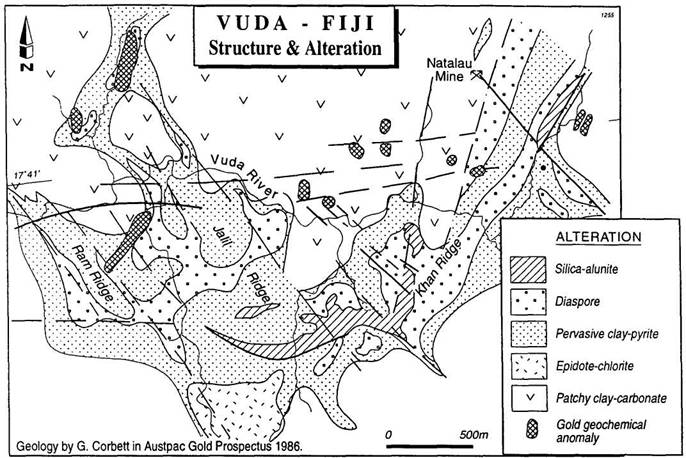
Fig. 6.9
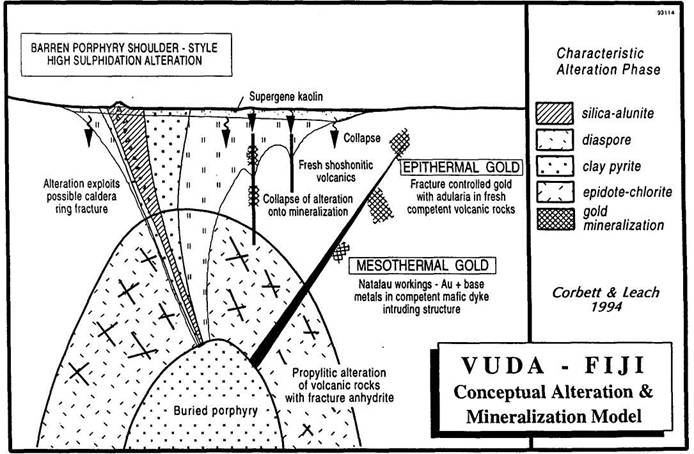
 Fig. 6.10
Exploration Workshop "Southwest Pacific rim gold-copper systems: Structure, Alteration, and Mineralization1' Corbett G J & Leach T M, 8/96 Edn.
assemblages:
* andalusite-corundum-muscovite,
* andalusite-pyrophyllite/muscovite,
* andalusite-pyrophyllite-diaspore,
* diaspore-pyrophyllite,
* diaspore-pyrophyllite-alunite,
* alunite-kaolinite-pyrophyllite,
* silica-alunite-kaolinite.
This zonation in high sulphidation-style alteration is indicative of progressive cooling and decrease in fluid pH away from the porphyry intrusions (Fig. 6.2). In a manner similar to Horse Ivaal and Ohio Creek-Lookout Rocks, significant copper mineralization at Cabang Kiri occurs in andalusite-pyrophyllite zones, but does not extend out into the alunite-bearing assemblages (Lowder and Dow, 1978).
Hi) Lithologically Controlled High Sulphidation Gold-Copper Systems
a) Characteristics
The controls to fluid flow in most high sulphidation systems are governed by a combination of lithological and structural controls and so any classification focuses upon end members only. It is common for fluids to exhibit a structural control in venting from the source intrusion along dilational structures and then, upon contact with a permeable lithology, migrate along that unit and so display a lithological control. Lithologically controlled high sulphidation alteration form as magmatic fluids are focused along permeable host rocks such as coarse grained pyroclastics within a less permeable sequence (e. g., Nansatsu Deposits in Japan, below; Mt. MacKenzie and Clive Creek in eastern Australia; Leach, unpubl. data) or permeable sediments and diatreme breccias (e. g., Wafi in PNG, below). Although the fractured diatreme margin provides a permeable host rock at Lepanto, Philippines (Fig. 6.25) fluid is focused into this setting by a dilational structural environment (Fig. 6.24) and so this classed a predominantly structural control. Disseminated ores are common in lithologically controlled high sulphidation alteration.
In deeper level systems the diffusion and slow neutralization and cooling of upwelling hot acidic fluids may facilitate the formation of relatively broad alteration zones (e. g., Wafi, PNG). Quenching in higher level systems results in the formation of sharp alteration boundaries (e. g., Nansatsu deposits). Although most mineralization is disseminated filling open space or as fracture/breccia ores within the silica core or silica-alunite alteration zones, some broad alteration systems host gold in the halo of clay alteration (e. g., Wafi, PNG).
b) Examples
i) Wafi River Prospect, PNG
The Wafi River Prospect is predominantly a lithologically controlled style of high sulphidation gold system which is hosted in low grade Mesozoic Owen Stanley metasediments (siltstones, litharenites and conglomerates) and a diatreme breccia. The following discussion on the Wafi River high sulphidation system is taken from Leach and Erceg (1990), Erceg et al., (1991), and CRA (1994).
The Wafi Transfer Structure is inferred to have focused overprinting emplacement into the metasedimentary host rocks multiple phases of microdiorite and quartz diorite porphyry
85
Exploration Workshop "Southwest Pacific rim gold-copper systems: Structure, Alteration, and Mineralization" Corbett G J & Leach T M. 8/96 Edn.
intrusions and a diatreme breccia complex (Fig. 6.11; Corbett, 1994). The magnitude of this structure is evident in the manner in which it separates the western and eastern segments of the New Guinea Orogen and offsets the Markham Fault, a plate boundary to the north of Wafi (Corbett, 1994). Although NW trending accretionary structures display a clockwise rotation by the sinistral displacement of the NNE trending transfer structures, other senses of movement are possible during the life of the system.
Surface alteration comprises a 4 km2 ares of concentrically zoned advanced argillic and argillic alteration (Fig. 6.12). It is interpreted that the primary permeability in the sediments (porous coarse grained units, bedding planes and metamorphic quartz veining), enhanced by multiple fracturing events, and in the diatreme complex, has facilitated the dissemination of hot acid fluids over this large area. Alteration ranges outwards dominated by the assemblages:
* residual silica,
* quartz-alunite,
* alunite-pyrophyllite or alunite-dickite,
* pyrophyllite or dickite,
* dickite/kaolinite—illitic clay zones,
*interlayered clay,
* chlorite.
This zonation is indicative of a progressive cooling and neutralization of a hot acidic fluid which was sourced from the east and radiated outward (Leach and Erceg, 1990), to provide the elongate alteration (Fig. 6.12). Zones of significant gold mineralization are encountered around the margins of the diatreme complex (Zones A, B, and D, Fig. 6.12), in structurally controlled breccias (Zone C) which crosscut the diatreme complex, and in distal settings (Malaria and Hesson Creek) aligned along the NE-trending structures. Gold mineralization occurs in two settings and is interpreted to be related to two separate events:
i) An initial phase of disseminated auriferous pyrite mineralization within alunite-dickite and clay zones which is inferred to be related to the initial formation of the zoned advanced argillic alteration, and associated with the influx of hot acidic fluids along the margin of the mineralized porphyry.
ii) A later phase hosted in pyritic fractures and breccias which crosscut the zoned alteration.
Gold mineralization in the Pueblo Viejo high sulphidation system, Dominican Republic, is similarly attributed to two pulses of mineralized magmatic fluids: one associated with disseminated pyrite in clay-alunite alteration zones at depth, and the other hosted in pyritic veins at shallower levels (Muntean et al., 1990). At Lepanto, copper-gold mineralization occurs associated with early clay alteration in stratiform deposits, and in later fractured silicified zones (see Fig. 6.25).
Gold in Zone A at Wafi (>15 Mt at 2.6 g/t Au) is refractory and generally submicroscopic, although a few minute (1-3 micron) inclusions have been observed in pyrite both disseminated in the altered sediments, and infilling fractured and brecciated metamorphic quartz veining. Copper mineralization in Zone A occurs in trace amounts as enargite and luzonite in the quartz-alunite-dickite zones, and as tennantite, with base metal sulphides, in the peripheral argillic zones. Fluid inclusion data on sphalerite associated with the acidic alteration indicates that mineralization took place at cool (200-220°C) epithermal levels.
A blind mineralized porphyry stock was encountered at Wafi 800 m NE of Zone A, beneath a leached cap in the region of the inferred upflow of acidic fluids (Erceg et al., 1991). Copper mineralization occurs predominantly as hypogene covellite, in places intergrown with
86
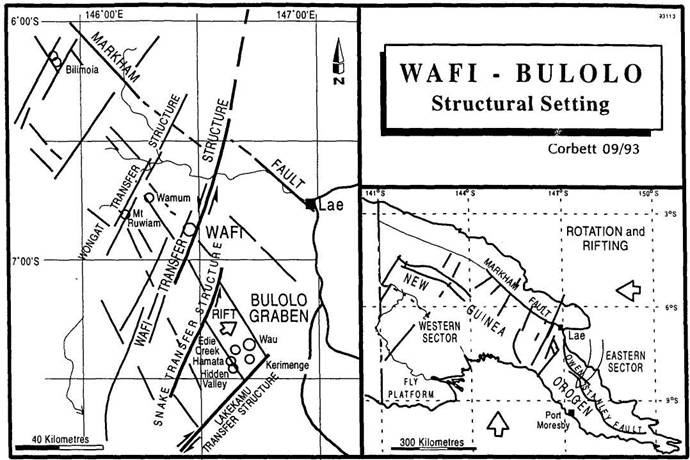
 Fig. 6.11
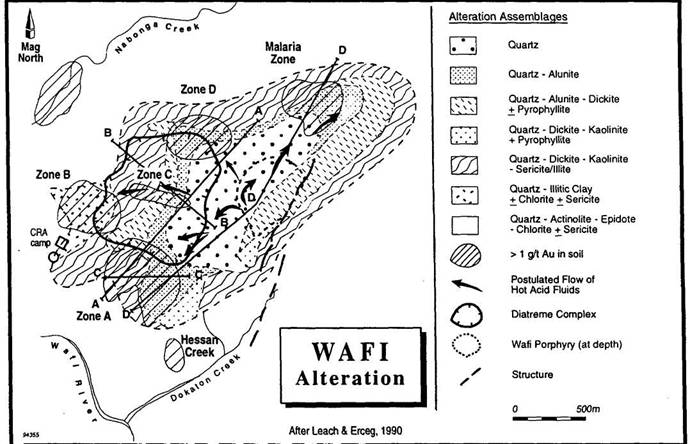
 Fig. 6.12
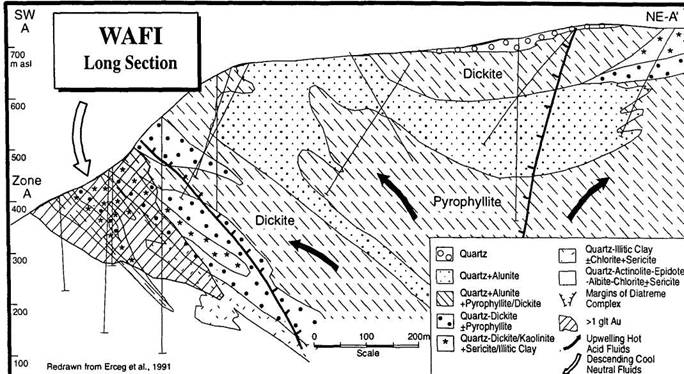
 Fig. 6.13
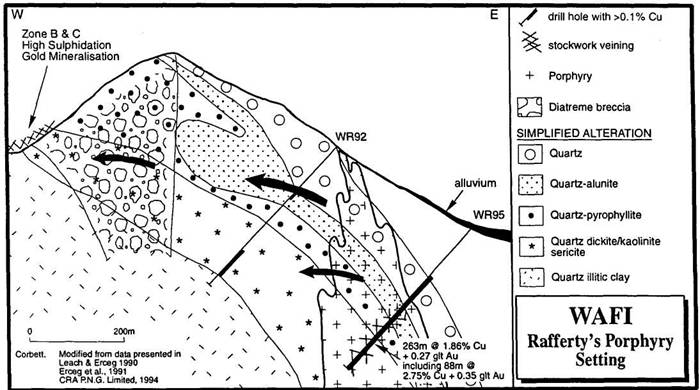
 Fiq. 6.14
Exploration Workshop "Southwest Pacific rim gold-copper systems: Structure, Alteration, and Mineralization" Corbett G J & Leach T M, 8/96 Edn.
chalcopyrite, bornite and pyrite. It appears (Erceg et al., 1991) that the hot acidic fluids were sourced from depth and migrated along the margin of the high grade mineralized quartz diorite stock (Rafferty's Porphyry). The initial drill intercept in the porphyry copper intrusive, drill hole WR 95, yielded published results of 263 m at 1.86 percent Cu and 0.27 g/t Au.
Two main episodes of hydrothermal activity are therefore recognised within the Wafi prospect area (Fig. 6.14):
i) A porphyry copper event which involved emplacement of the Wafi porphyry into the Wafi Transfer Structure.
ii) A high sulphidation event followed uplift of the porphyry resulting in widespread overprinting of the earlier porphyry system. A similar acidic hypogene phase at Butte, Montana (Brimwall and Ghiorso, 1983) and at El Salvador (Gustafson and Hunt, 1975) has been interpreted by these authors to have remobilized pre-existing copper protore to form a secondary covellite-chalcocite ore.
ii) Nansatsu Deposits, Japan
The Nansatsu deposits are located in southern Kyushu, Japan, This text is derived from reviews of the Nansatsu Deposits (Hedenquist et al., 1988, 1994; Matsuhisa et al., 1990; White 1991; Izawa and Cunningham, 1989) and personal observations (Corbett, unpubl. report, 1987). The deposits are characteristically small, mushroom-shaped bodies, with the three current producers, Kasuga (0.15 M oz Au), Iwato (0.21 M oz Au) and Akeshi (0.22 M oz Au). All exhibit low gold grades in the order of 3-4 g/t Au, but locally contain higher gold grades within feeder structures such as Kasuga (Hedenquist et al., 1994) or breccias (Izawa and Cunningham, 1989). The silica-rich ores are used as flux in the copper smelters, from which the gold is extracted.
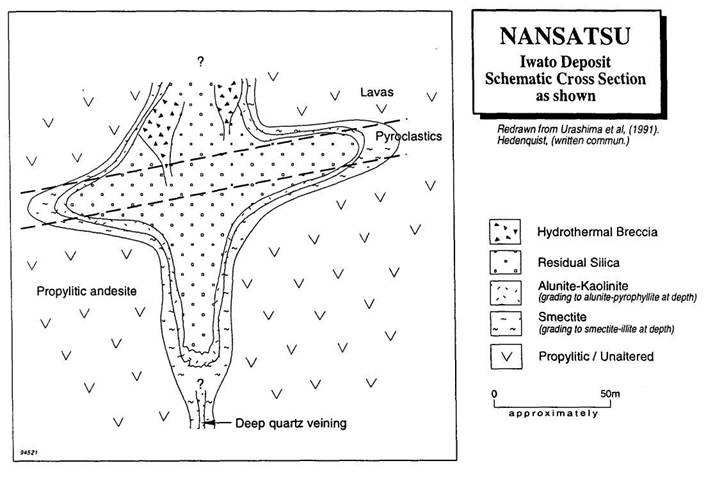
Ages of alteration similar to the Upper Miocene-Pliocene host volcanic sequence, rapid changes of the marginal alteration, and presence of interpreted explosion breccias (Izawa and Cunningham, 1989) all suggest that the Nansatsu deposits formed at relatively high crustal levels. Hot acid magmatic-sourced fluids migrated from feeder structures into more permeable pyroclastic units in the predominantly lava sequence of volcanics, to form tabular or mushroom-shaped silicified bodies (Fig. 6.15). Eruption breccias (Izawa and Cunningham, 1989) provide additional permeability. Cooling and neutralization of those fluids by rock reaction is reflected by a characteristic zoned alteration pattern (Fig. 6.15) which grades from: the core of residual silica through alunite-kaolinite, to the rim of illite and illite-smectite clays with commonly sharp contacts resulting from pH changes (Hedenquist, m.). Gold occurs within the residual silica in association with pyrite, enargite (luzonite), covellite, native sulphur and later iron oxides and displays higher grades in the eruption breccias (Izawa and Cunningham, 1989). Fluid inclusion and clay alteration studies suggest mineralization temperatures consistent with the epithermal environment of 170-210°C (Hedenquist et al., 1994; Izawa and Cunningham, 1989), varying to locally higher temperatures (250-300°C) within deeper levels at Kasuga (Hedenquist et al., 1994).
iii) Miwah, Indonesia
The Miwah high sulphidation system is described by Williamson and Fleming (1995) and Leach (unpubl. report, 1995) from which this discussion is taken. Although Miwah displays characteristics similar to both the Lepanto and Wafi high sulphidation systems, it is classified as exhibiting a predominantly lithological control. Miwah is located in northern Sumatra,
87
|
Exploration Workshop "Southwest Pacific rim gold-copper systems: Structure, Alteration, and Mineralization" Corbett G J & Leach T M. 8/96 Edn.
Indonesia, in a region of dextral strike-slip faulting related to the Sumatra Fault System (Fig. 1.2).
Alteration and gold mineralization are hosted in a sequence of andesitic to dacitic lavas and tuffs of the Pliocene Leuping Volcanics. These volcanics are aligned ENE along the Miwah lineament, and are mirrored by a similar lineation of recent active volcanoes to the north. Dilation on ENE structures is inferred from rotation of the Sumatra Fault system. The Leuping Volcanics have been intruded by porphyritic andesite to rhyodacite dykes and domes (Fig. 6.17) which are dated by K-Ar at 2.9 m. y. The dykes and domes contain a wide variety of xenolith clasts which range from andesite and diorite porphyry, magnetite-rich skarns and calcsilicate rocks. In the south and west regions of the prospect, the volcanics are intruded by a diatreme breccia complex which contains local dacitic material and quartz-veined andesite clasts. Some of the quartz in the veins contain anhydrite and halite daughter crystals associated with liquid - and vapour-dominated fluid inclusions, indicative of formation in an environment proximal to a high level intrusion.
The volcanics, domes, dykes and diatremes have been overprinted by extensive advanced argillic - argillic alteration which is zoned grading outwards as assemblages dominated by:
* vughy to dense quartz-rutile-pyrite,
* quartz-alunite,
* quartz-kaolinite,
* illite-smectite,
* chlorite/chlorite-smectite.
This alteration overprints earlier propylitic, and locally phyllic, alteration. The silicified quartz and quartz-alunite zones (Figs. 6.16) occur in:
* Restricted zones within inferred dilational NNW trending structures which parallel
the Rusa Fault and crop out on the eastern margins of the prospect.
* Less dominant NNE trending structures which crop out as thin ridges and parallel the
Camp Fault.
* Broad zones within the diatreme breccias, possibly as a reflection of the high primary
porosity in the breccia matrix.
* Shallow (up to >100 m thick) north to northeast dipping zones, hosted in volcanics.
The quartz and quartz-alunite have acted as brittle host rocks to subsequent fracturing and brecciation and associated mineralization which changes from early pyrite-rich quartz veining, to later veining and breccia zones composed of brassy pyrite, overgrown by copper sulphide phases. The copper mineral phases are dominated by luzonite at shallow levels to the south, and enargite at deeper levels to the north. Hypogene covellite has been detected locally at depth, whereas tennantite occurs in more distal settings to the east. The copper phases are intergrown with quartz and banded chalcedonic quartz, and locally at depth with alunite. Native sulphur commonly infills open cavities and fractures. The alteration and mineralization indicate relatively cool conditions during the high sulphidation system.
Although there is a close relationship between gold and copper-arsenic contents, gold mineralization is not always associated with enargite/luzonite, and so may have been deposited with earlier pyrite. In recent drilling, Cu:Au ratios increase with depth and to the north. Williamson and Fleming (1990) suggest that a porphyry intrusion may yet be identified as a source for the high sulphidation system. Information from the structure, alteration and mineralization indicate a possible source for hot acidic, mineralized fluids from the north and at depth below the diatreme breccia, and fluid outflow towards the south.
88
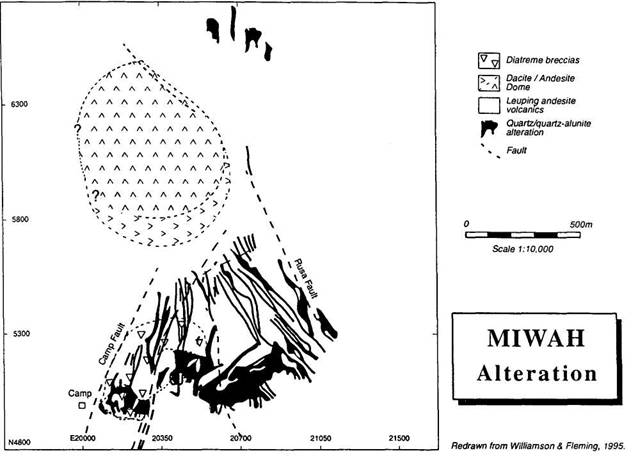
Fig. 6.16
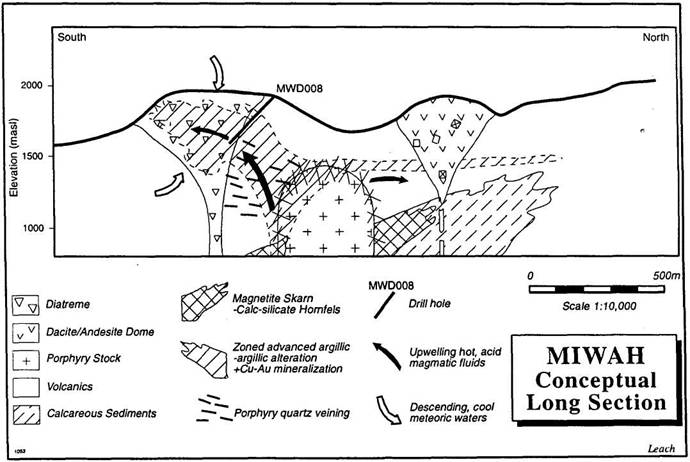
Fig. 6.17
Exploration Workshop "Southwest Pacific rim gold-copper systems: Structure, Alteration, and Mineralization" Corbett G J & Leach T M, 8/96 Edn.
iv) Structurally Controlled High Sulphidation Gold-Copper Systems
a) Characteristics
Structurally controlled high sulphidation systems result from a control on magmatic fluid flow by dilational fault/fracture systems provided, as described in detail below, by: the intersection of permeable lithologies (e. g., Nena, PNG), margins of diatreme breccia bodies (e. g., Lepanto, Philippines), en echelon gash veins within structural corridors (e. g., Mt Kasi, Fiji), or combinations of these and other factors.
In these systems central vughy silica and marginal silica-alunite assemblages in cross-section form bulbous alteration zones surrounded by thin argillic zones which grade out into regional propylitic alteration. Laterally elongate silica-alunite ridges trend kilometres along controlling structures (e. g., Nena, PNG). The overprinting relationships of the alteration derived from a vapour-rich fluid and the subsequent mineralization derived from a liquid-rich fluid may be more clearly evident in the structurally controlled high sulphidation systems. The utilization of the same plumbing system focuses mineralized fluid into the core of the zoned alteration where the competent residual silica readily brecciates in a brittle manner. The surrounding clay alteration is less competent and impermeable and so commonly remains unmineralized and may mask mineralization (e. g, Nena, PNG). The competency contrast aids brecciation of the brittle rocks. Breccias categorised as rotational and fluidised breccias (Section 3.ix. d.l) are indicative of fluid transport in feeder structures and commonly grade to crackle breccias towards the periphery of the mineralized zones. Gold-copper grades are proportional to the matrix content of breccias and so tend to fall off moving away from the structurally controlled fluid plumbing systems; that is, from fluid upflow to outflow zones.
b) Examples
i) Nena, Frieda River Copper, Papua New Guinea
The Nena prospect at Frieda River Copper is an example of a structurally controlled high sulphidation system recently described by Bainbridge et al. (1993) and (1994) from which this discussion is taken. A resource of 45 Mt at 2.7 percent Cu and 0.7 g/t Au has been defined for Nena to April 1995 (Highlands Gold Limited, press release).
Exploration at Frieda River up to 1983 inferred a porphyry copper resource of 860 Mt at 0.47 percent Cu and 0.31 g/t Au within the Koki and Horse-Ivaal deposits, and 32 Mt at 2.35 percent Cu and 0.58 g/t Au within the Nena high sulphidation deposit, located 6 km northeast of the porphyry deposits (Hall et al., 1990). An increase in the understanding of high sulphidation gold-copper mineralization and the relationship to buried porphyry copper deposits, in particular Lepanto, Philippines (Garcia, 1990, 1991) and Wafi, PNG (Leach and Erceg, 1990; Erceg et al., 1991), facilitated a re-evaluation of the Nena mineralization by Highlands Gold Limited in the early 1990s.
The Nena Prospect occurs on the margin of the Frieda River porphyry copper intrusive system which is inferred to have been localised by the NW trending Frieda Fault, formed as a splay fault from the more regional EW trending Leonard-Schultz Fault (Corbett, 1994; Fig. 6.18). An inferred dextral rotation has imparted a dilational character to the set. of structures between the Frieda and Leonard-Schultz faults, and termed the Nena Structural Corridor (Figs. 6.18, 6.19). These structures host a series of silica and silica-alunite ridges which extend for over 10 km from the Horse-Ivaal porphyry copper deposits and include the Nena high sulphidation system and the Horse-Ivaal barren porphyry shoulder (Figs. 6.19, 6.20). The high sulphidation
89


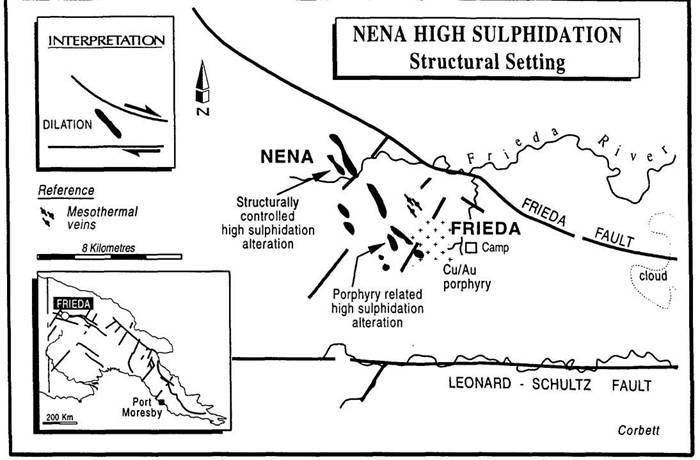
Fig. 6.18
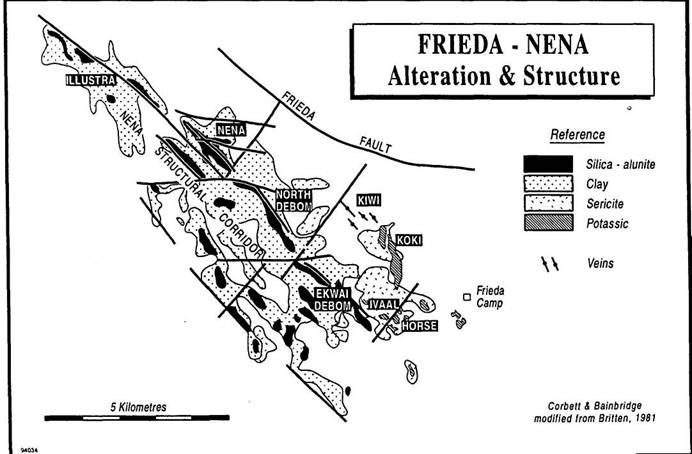
 Fig. 6.19
Exploration Workshop "Southwest Pacific rim gold-copper systems: Structure, Alteration, and Mineralization" Corbett G J & Leach T M, 8/96 Edn.
system at Nena occurs as NW oriented concentrically zoned bulbous alteration (Figs. 6.21, 6.22) which grades outwards as assemblages dominated by:
* vughy (residual) silica,
* quartz-alunite zone (locally sulphur-bearing),
* pyrophyllite-dickite-kaolinite,
* illite-smectite,
* carbonate-gypsum-chlorite.
The alteration is interpreted to have formed from acid leaching by an initial vapour-rich magmatic fluid phase (White, 1991) which migrated laterally in the north to south direction along dilational feeder structures. The gradation from broad central zones of vughy (residual) silica outward to quartz-alunite alteration is postulated to have formed as a response to the progressive cooling and neutralization of this acidic fluid through rock reaction; whereas peripheral thin clay zones are suggestive of rapidly changing fluid physico-chemistry upon mixing with circulating meteoric-dominated fluids. The alteration shows a preference for the permeable volcaniclastic units within a sequence interlayered with lavas such that the intersection of the Nena structure with the pyroclastic unit forms the locus of fluid flow.
Copper and gold mineralization are associated with a later, predominantly liquid, magmatically-derived fluid which has utilised the same feeder structures as the volatile phase, and brecciated the earlier competent vughy silica. Fractures, breccias and open leached vughs have been sealed by initial multiple phases of pyrite. Copper mineralization occurs as late stage sulphides deposited in cavities and fractures in the pyrite, in places intergrown, and locally rhythmically banded with barite. Intense brecciation and local fluidised breccias accompany high grade copper mineralization within the central vughy silica zones; whereas more fracture controlled sulphide deposition results in low grade copper-mineralization in the peripheral quartz-alunite zones.
Initial fluid inclusion studies (Leach, unpubl. reports) on barite associated with copper mineralization indicate that the mineralized fluid was two phase, relatively hot (>300-350°C) and moderately saline (>9-10 wt percent equivalent NaCl). Mineralization developed in response to rapid cooling upon mixing with low temperature (<150-200°C), diluteo(<l-2 wt percent NaCl) meteoric waters.
The copper mineral phases exhibit a lateral zonation (Fig. 6.23) from the northwest Mt. Nena region to the southern regions of the deposit as: hypogene covellite + enargite, through zones of enargite, and luzonite > enargite, to only luzonite at shallow levels. Covellite is early in the paragenetic sequence and is locally altered to enargite. Cu:Au ratios in the sulphide zone decrease from north to south, and at depth to shallow levels in the southern regions. Luzonite becomes progressively Sb - and Te-rich at shallow levels implying solid solution series with stibioluzonite and goldfieldite.
Supergene leaching has resulted in an oxidised gold zone, overlying a zone of supergene covellite-chalcocite enrichment. A distinct hypogene gold phase has not yet been identified, however it is probably associated with the luzonite-goldfieldite series as well as late stage pyrite. Supergene native gold occurs as very high fineness, minute grains which infill fractures in the gold-rich oxide zone.
Palaeo fluid flow directions at Nena are given by:
* The gradation in the morphology of the copper-bearing structures from subvertical feeder zones further north (Fig. 6.21) to concentric outflow pipe-like features (Fig. 6.22).
90

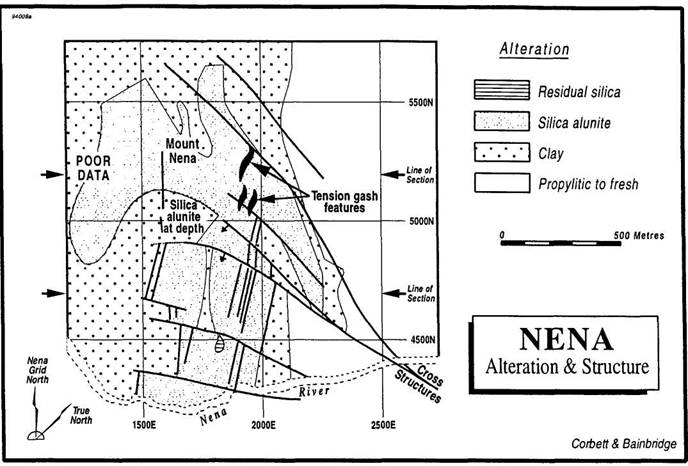
Fig. 6.20
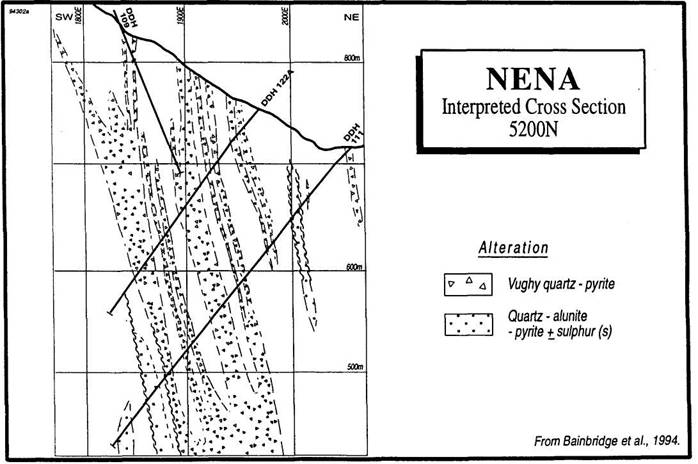
Fig. 6.21
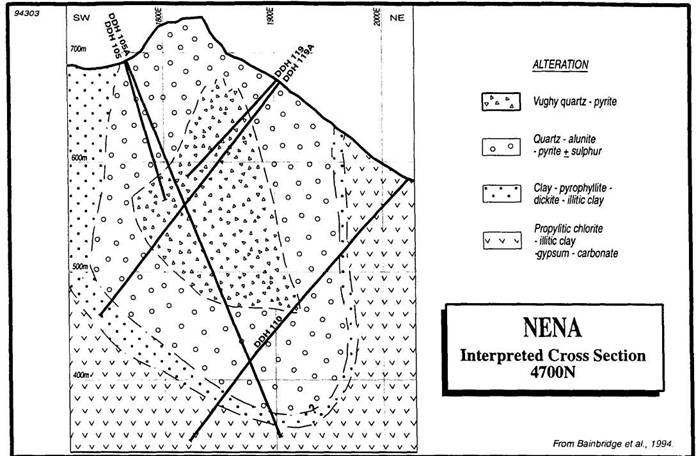
 Fig. 6.22
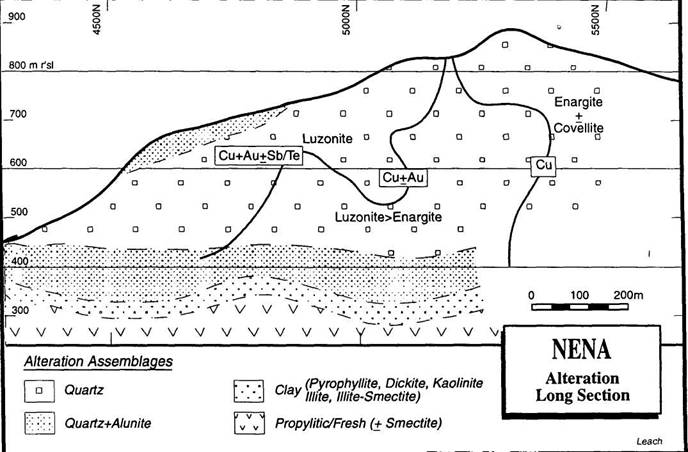
 Fig. 6.23
Exploration Workshop "Southwest Pacific rim gold-copper systems: Structure, Alteration, and Mineralization" Corbett G J & Leach T M, 8/96 Edn.
* Changes in alteration mineralogy (Fig. 6.23).
* The distribution and characteristics of silica-alunite ridges (Figs. 6.19 and 6.20).
* Zonations in copper phases and Cu:Au ratios.
These directions provide a speculation that the high sulphidation fluids and metals could have been derived from a high level intrusion at some depth in the vicinity of Mt Nena, and then flowed laterally to the south along the preferred permeability (Fig. 6.20). This provides for a lateral fluid flow in the order of at least 1 km.
ii) Lepanto-FSEf Philippines
The Lepanto high sulphidation enargite gold deposit (35 Mt at 3.5 percent Cu, and 3 g/t Au) in the Philippines is located 200-400 m to the northwest and 400 m above (Fig. 6.24) the high grade FSE porphyry copper deposit (356 Mt at 0.73 percent Cu, and 1.2 g/t Au).
Structural control for the Lepanto high sulphidation system is provided by the intersection of a throughgoing dilational structure with fracturing at a flatly dipping diatreme margin (Figs. 6.24, 6.25). The Philippine Fault, formed as a major sinistral transpressional terrain boundary with a protracted history of activity, breaks up into several splay faults which parallel the magmatic arc in Northern Luzon (Fig. 2.6; Mitchell and Leach, 1991). NS trending inferred splays, the Abra and Pseudo Faults (Baker, 1992) constrain NW trending structures (Garcia, 1991) in the mine area (Fig. 6.24). The sinistral rotation presented by Baker (1992) for the Pseudo Fault coupled with the Abra Fault could dilate the subsidiary Lepanto Fault (Fig. 6.24) for which Baker (1992) also maps a sinistral rotation. Thus, as shown in Figure 6.24 the enargite ore is elongate along the dilatant Lepanto Fault.
The pyroclastic and dacite porphyry rocks of Garcia (1991) might also be interpreted to represent diatreme breccias and endogenous domes respectively (Baker, 1992; Garcia, mun., 1995), and both pre - and post-mineralization diatremes are inferred (Figs 6.24, 6.25). The outline of the enargite ore in cross section is aligned along the fractured diatreme boundary (Fig. 6.25), and exhibits an overall elongated plate-like shape.
The FSE porphyry may be localised at the intersection of the Lepanto Fault formed as a splay from the arc parallel Pseudo Fault (Fig. 6.24), in a manner similar to the inferred localisation of porphyry mineralization at Frieda, PNG (Fig. 6.18), Chuquicamata, Chile (Boric et al., 1990), and other Philippine porphyry deposits (Sillitoe and Gappe, 1984).
Porphyry copper-gold mineralization at Guinaoang (Fig 6.24), 6 km to the southeast, is hosted at depth in a chorite-sericite altered quartz diorite stock, and at shallow levels in advanced argillic altered volcanics (Sillitoe and Angeles, 1985). A post-mineral diatreme locally cuts altered volcanics at shallow levels.
Garcia and Bongolan (1989), and Garcia (1990, 1991) describe the following events for the development of the Lepanto and FSE deposits (Figs. 6.24, 6.25, 6.26):

|
Из за большого объема этот материал размещен на нескольких страницах:
1 2 3 4 5 6 7 8 9 10 11 12 13 14 15 |
