

Партнерка на США и Канаду по недвижимости, выплаты в крипто
- 30% recurring commission
- Выплаты в USDT
- Вывод каждую неделю
- Комиссия до 5 лет за каждого referral
The Kidston breccia pipe is a teardrop shaped body about 1200 x 800 m, elongate in the trend of the Gilberton Lineament. The breccia types reflect the transition from intrusive breccias with a high proportion of strongly milled, introduced intrusive fragments, to peripheral collapse-style breccias which contain dominantly less milled host rock fragments (Fig. 7.7; Corbett, unpubl. data, 1983). The metamorphic foliation in basement fragments is progressively reoriented as fragments undergo increased milling and rotation away from the pipe margins. The continuation of a geological contact in the basement rocks as differing breccia types is indicative of the collapse nature of the peripheral breccias (Fig. 7.7). Baker and Andrew (1991) delineate a model of overprinting brecciation in which features such as: clasts of quartz-pyrite-magnetite stockwork veining, tourmaline in fragments and breccia matrix, dykes which intrude the breccia, and isotope data, are indicative of an intrusive source at depth. These workers describe insitu exfoliation as a mechanism for the rounded intrusive fragments cited above, and suggest that the pipe did not breach the surface. Rhyolite dykes tend to predate pipe formation, and later quartz feldspar porphyry dykes which transect the breccia, predominantly in the central portion of the pipe, may represent a tapping of a deeper portion of the magma source (Fig. 7.7, Corbett, unpubl. map, 1980; Baker and Tullemans, 1990). Sheeted fractures which form kinked polygonal shapes about the pipe margin cross cut the breccia as a final phase of post-brecciation collapse (Fig. 7.7).
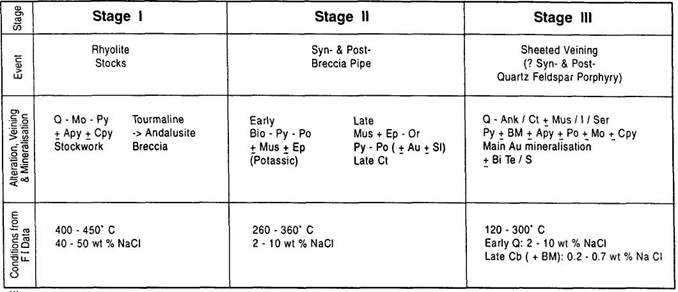
The style of mineralization is evident from detailed work on the Kidston breccias (Baker, 1987; Baker and Tullemans, 1990; Baker and Andrew, 1991). The following three main stages of alteration, veining/brecciation and mineralization have been recognised by these authors at Kidston (Fig. 7.8):
108

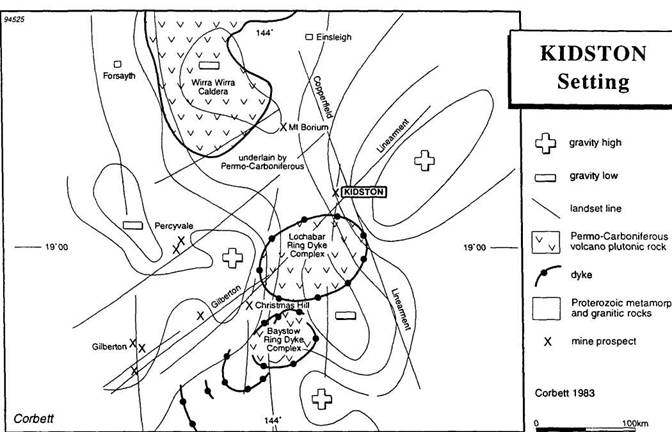
 Fig. 7.6
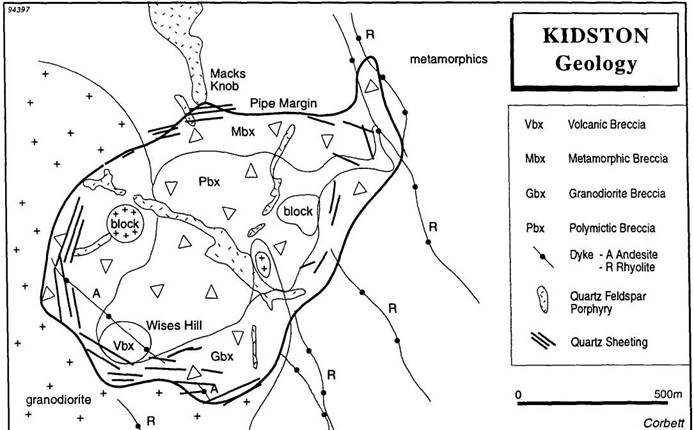
 Fig. 7.7
Exploration Workshop "Southwest Pacific rim gold-copper systems: Structure. Alteration, and Mineralization1 Corbett G J & Leach T M. 8/96 Edn.
Stage I: Rhyolite Intrusion:
Emplacement of a high level rhyolite stock was accompanied by quartz stockwork veins
development and minor molybdenite-pyrite ± arsenopyrite ± chalcopyrite mineralization.
Tourmaline-sericite ± andalusite breccias formed at the margin of the rhyolite stock at Wise's
Hill during late stage volatile exsolution. Fluid inclusion data is indicative of hot (400-500°C)
and hypersaline (>40-50 wt percent NaCl) conditions during Stage I activity at depths of 3
km.
Stage II: Syn - and Post-Breccia Pipe Event:
The breccia matrix at Kidston has undergone alteration to: an early potassic assemblage of biotite ± muscovite ± epidote alteration and pyrite-pyrrhotite mineralization, followed by later muscovite-epidote-orthoclase-calcite alteration (propylitic) and pyrite-pyrrhotite ± sphalerite mineralization. Minor gold mineralization is associated with epidote in the latter phase of activity. Fluid inclusion data indicates that moderately high temperatures (260-360°C) and salinities (2-10 wt percent NaCl) prevailed.
Stage III: Quartz-Carbonate Veins:
This is the main event of gold mineralization and occurs within sheeted veins around the margins of the breccia pipe (Figs. 7.7, 7.9) and is interpreted to have been sourced from the same melt as the post-breccia quartz feldspar dykes.
The sheeted veins consist of subparallel fractures, up to 10 cm wide, which exhibit a depositional sequence of quartz + sericite —> sulphides —> carbonates, typical of quartz-sulphide and carbonate-base metal gold systems elsewhere in the southwest Pacific. Lateral and vertical zonations are recognised in both gangue and ore phases (Baker, 1987; Leach, unpubl. data). Carbonate (mainly ankerite) dominates over quartz at shallow levels, whereas quartz is dominant over carbonate (calcite) depth and marginal to the ore zones at Wises Hill and North Knob. The iron phases are zoned pyrite —> arsenopyrite —> pyrrhotite ± magnetite with increasing depth and laterally away from the ore zones. Sphalerite and galena mineralization is restricted to shallow levels in the ore zones, whereas chalcopyrite persists to depths.
Gold mineralization preferentially occurs in the shallow quartz-ankerite/calcite-pyrite and arsenopyrite zones as inclusions in sphalerite and pyrite, infilling fractures and overgrowing pyrite and marcasite, and as intergrowths with Bi - and Ag-tellurides and galena. High fineness gold (906-911) is associated with quartz-sulphides-Bi-phases, moderately high fineness with carbonate-base metals (768-891), whereas low fineness gold (<500) infills late fractures.
Fluid inclusion and mineral isotope data (Baker and Andrew, 1991) indicate that Stage III quartz and carbonate were derived from different fluids. Quartz was deposited over a broad temperature range (120-300°C) and at relatively saline (2-10 wt percent NaCl) conditions, whereas carbonates were deposited over a similar temperature range but from significantly more dilute (0.2-0.7 wt percent NaCl) waters. Isotope data shows that the carbonates were precipitated from fluids containing a significantly higher meteoric component than the quartz. Two-phase fluid inclusions, indicative of boiling, are absent.
Magmatic-derived mineralized fluids are inferred to have migrated up along sheeted fractures in the Wise's Hill and North Knob areas. Increased fluid flow is anticipated at the intersections of sheeted fractures and those fractures dilated by the extensional tectonism to which the volcanoplutonism is related. Sulphide and gold mineralization in the sheeted veins is therefore postulated to have taken place in response to the mixing of these upwelling saline and
109
Stages of Alteration, Veining and Mineralization at Kidston (data from Baker & Andrew, 1991)
|
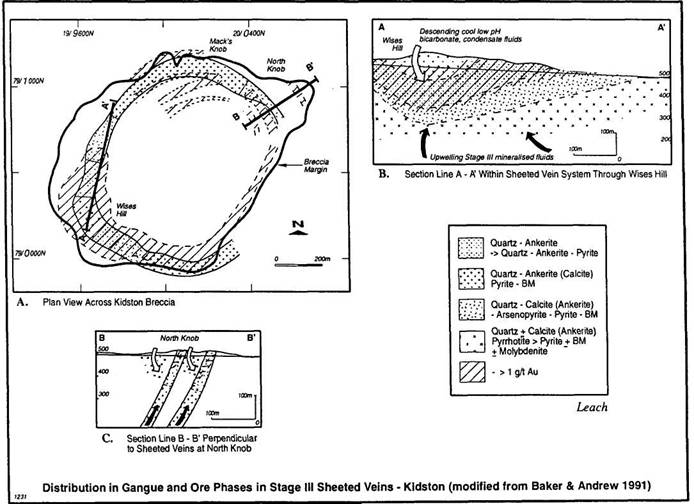
Fig. 7.9 |
Fig. 7.8
Exploration Workshop "Southwest Pacific rim gold-copper systems: Structure, Alteration, and Mineralization" Corbett G J & Leach T M, 8/96 Edn.
magmatic-derived fluids which deposited quartz, with dilute meteoric waters which deposited carbonate (Fig. 7.9). The current level of erosion of the sheeted veins has exposed a system which is transitional from a carbonate-base metal gold style mineralization at shallow levels, to a quartz-sulphide-style mineralization at deeper levels and in zones peripheral to inferred fluid upflow zones.
iii) Bilimoia District, Papua New Guinea
Porphyry intrusion and mesothermal gold bearing veins occur north of Bilimoia village (Fig. 1.2), near Kainantu in the Eastern Highlands of Papua New Guinea (Corbett et al., 1994b). Host rocks comprise Early Mesozoic Bena Bena Formation phyllites which are intruded by syntectonic Karmantina Granite Gneiss and Mid Miocene Akuna Granodiorite (Rogerson et al., 1987). Porphyry copper-gold mineralization elsewhere in the region is associated with Late Miocene Elendora Porphyry intrusions (Rogerson and Williamson, 1985). This area is situated immediately south of the Markham Fault, the suture between the Pacific and Australian plates (Fig. 1.2). Two inferred porphyry centres are localised by the intersection of transfer structures with structures formed parallel to the New Guinea Orogen (Fig. 7.10). Mesothermal veins are hosted within pre-mineral, arc-parallel, structures at Bilimoia, and arc-normal structures at Arakompa (Corbett, 1994; Corbett et al., 1994b).
At Bilimoia the slaty cleavage within the Bena Bena schist basement rocks varies to a crenulation cleavage within the arc parallel structures. As such a foliation must have formed at depths in the vicinity of 5 km (D. Grey, mun., 1992), these represent major arc parallel structures which have been reactivated and mineralized at higher crustal levels. Mineralization extends for strike lengths of up to 2 km along a series of sub parallel structures which occur as: slickensided silicified fault faces, puggy shears, and are locally exploited by dykes or fluidised breccias (Fig. 7.10).
Mineralization is exposed over a vertical extent of over 800 metres on the steep slopes between the Markham Valley and Eastern Highlands. Generally NS trending, higher grade ore shoots occur within or adjacent to the NW trending mineralizing structures, commonly at the intersections of cross structures (Corbett et al., 1994b). The local sigmoidal shapes are consistent with the inference that these ore zones formed as tension gash features during dextral rotation on the controlling structures (Corbett, 1994).
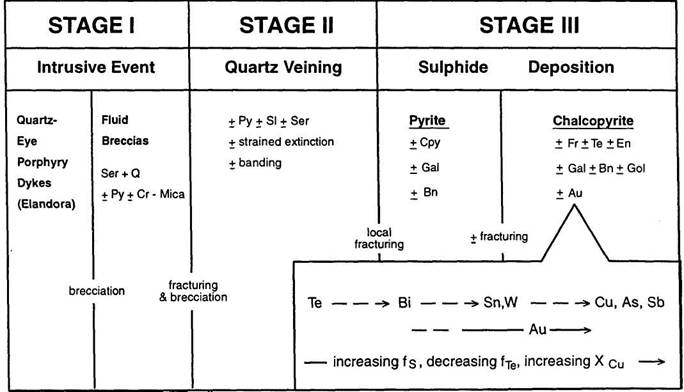
The following three stages of vein and breccia development have been identified at Bilimoia (Fig. 7.11; Corbett et al., 1994b):
1. Shearing and Brecciation:
An initial stage of shearing and fracturing is locally accompanied by fine fluidised breccias composed of quartz-sericite-pyrite, and coarser diatreme breccia-like intrusive fluidised breccias containing dyke fragments which are correlated with the Elandora porphyry of Rogerson and Williamson (1985).
2. Quartz Veins:
A major event of extensive fracturing and brecciation, formed locally polyphasal crackle breccias or open veins, consisting of clear to milky quartz, grading outwards to crustiform or coxcomb quartz which extends into open cavities. The quartz commonly exhibits strained extinction indicative of deposition within a stress regime and in places is accompanied by minor sericite, pyrite and yellow sphalerite. Wall rock phyllites have locally undergone alteration to the Cr-rich micas, mariposite and fuschite. Fluid inclusion data indicates that the quartz veins were deposited from dilute (>2 wt percent NaCl, very locally >3-4 wt percent
110

|
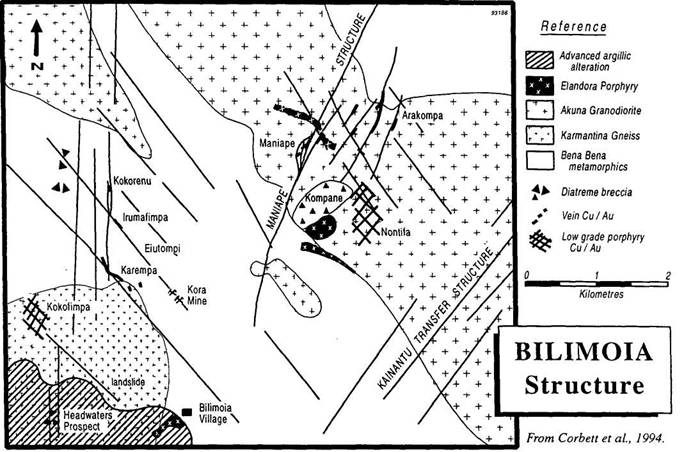
Fig. 7.10 |
 Paragentic Sequence of Veining and Mineralization at Bilimoia
Fig. 7.11
Exploration Workshop "Southwest Pacific rim gold-copper systems: Structure, Alteration, and Mineralization" Corbett G J & Leach T M, 8/96 Edn.
NaCl) waters over a wide temperature range of 210-330°C. There is no consistent zonation in temperatures or salinities over the 700 metre vertical extent of veins. It is therefore interpreted that quartz deposition took place from dilute meteoric waters circulating within deep crustal structures. In places the quartz is chalcedonic, radiating, or fibrous, indicative of rapid quenching conditions. The presence of local interlayered illite-smectite as a wall rock alteration also implies periodic recharge of cool fluids.
3. Pyrite ± Base Metals:
Quartz vein development is followed by deposition of massive to coarse grained pyrite + fine quartz in open cavities and fractures, or in thin fractures cutting the metasediment wall rock. The local intergrowth of pyrite with base metal sulphides (sphalerite, galena, chalcopyrite and tennantite), trace magnetite, and common minute inclusions of chalcopyrite, bornite, and hypogene covellite, are indicative of the development of these veins as a precursor to the main copper-gold mineralization which followed.
4. Copper Mineralization:
Chalcopyrite overgrows pyrite, and in places infills fractured and shattered pyrite with associated fine grained quartz-sericite deposition, and locally forms intricate intergrowths with bornite. At the Karempa (Fig. 7.10), pyrite-chalcopyrite mineralization is accompanied by deposition of topaz-sericite, diaspore-dickite or sulphates (anhydrite, barite). This is indicative of a periodic influx of moderately low pH, sulphate-rich magmatic dominated fluids.
A wide range of mineral phases characterised by W-Sn, Bi-Te-Ag and Cu-As-Sb mineralization accompanies chalcopyrite deposition. These phases are also indicative of the inclusion of late stage fluids with a significant magmatic component, probably derived from emplacement of an Elandora-style silicic felsic porphyry intrusion at depth. The paragenetic sequence of mineralization:
Te--- > Pb, Ag, Bi----- > Sn - W--- > Cu, As, Sb
is consistent with decreasing fTe2 and increasing fS and xCu with time.
The initial deposition of tellurium-rich phases occurs as: native tellurium which is overgrown by tellurobismuthinite (Bi2Te3), followed by lead (altaite - PbTe), and silver (Ag2Te) tellurides. Later bismuth-rich phases include tetradymite (Bi2Te2S), bismuthinite (Bi2S3) and Bi-rich galena. Tin and tungsten phases appear to post date Bi-Ag-Te mineralization. The Fe-wolframite phase ferberite, is relatively common and is overgrown by Sn-Cu phases such as mawsonite (Sn-rich bornite), and a Sn-As-covellite species. Local Cu-Bi-Te sulphides such as aikinite (Cu[Pb, Bi]2S3), goldfieldite (Cu[Te, Sb]S4) and Bi-rich enargite are interpreted to be transitional between the early bismuth-telluride, and late copper phases of mineralization, characterised by chalcopyrite and minor bornite. The infilling of fractures in massive pyrite by native copper, and the formation of covellite and chalcocite, are interpreted represent supergene alteration phases of primary chalcopyrite.
The supergene gold, in oxidised quartz veins mined by the local villagers, commonly exhibits a "mustard" texture, indicative of a primary source association with telluride phases. At depth, the gold occurs as inclusions in chalcopyrite, and as inclusions within, and overgrowing tellurides, bismuthinite, and hessite incorporated within the chalcopyrite. Near the Kora mine (Fig. 7.10), gold is encountered as inclusions in ferberite, and associated pyrite. Primary gold has a fineness of 834-922 (average 858), which is characteristic of quartz-sulphide vein systems formed peripheral to porphyry intrusions elsewhere in the Pacific region (Fig. 4.8). Gold in the Yar Tree Hill prospect, 7-8 km along strike southeast of the Bilimoia quartz vein
111
 | |
 |  |
|
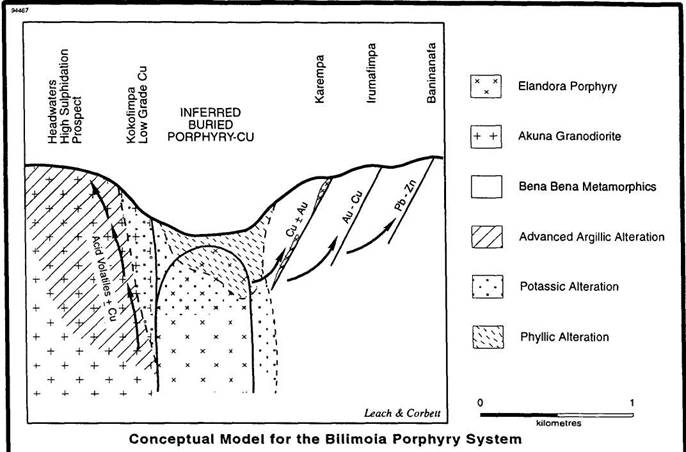
Fig. 7.12 |
 Interpreted Paragenetic Sequence of Arakompa Veining and Mineralization
Fig. 7.13
Exploration Workshop "Southwest Pacific rim gold-copper systems: Structure, Alteration, and Mineralization" Corbett G J & Leach T M. 8/96 Edn.
systems, is also encountered as inclusions in chalcopyrite cutting pyrite, and has a similar fineness (860-940, average 895) to gold at Bilimoia.
It is interpreted that early stage quartz veins and wall rock sericite-fushcite alteration were deposited in response to cooling of dilute meteoric water-dominated fluids which circulated along the deep crustal Bilimoia structures. The chromium (in fuchsite) appears to have been derived from the migration of these fluids through ultramafic host-rocks at depth (ultramafics outcrop to the north-west of the Kainantu region). The emplacement of Elandora porphyries along these structures has resulted in initial intrusion of fluidised breccias, and shallow level felsic dykes as the precursors to the introduction of mineralizing fluids, which resulted in the deposition of chalcopyrite-pyrite-gold and associated Bi-Te-W-Sn-Ag mineral phases.
Zonations in styles of alteration, veins and mineralization at Bilimoia provide vectors which point towards an inferred buried intrusive source for the gold mineralization (Fig. 7.12), in the vicinity of a landslip in phyllic alteration (Fig. 7.10). Potassic alteration hosted in Akuna granodiorite and containing weak copper mineralization at Kokofimpa, is overprinted by phyllic alteration extending SE to Bilimoia village. Magmatic volatiles which evolved to the south and west from the buried porphyry resulted in the formation of the extensive and pervasive shoulder of advanced argillic (high sulphidation) alteration (Fig. 7.10). This is locally transected by structurally controlled enargite mineralization at the Headwaters Prospect (Fig. 7.10). Mineralized fluids migrated along NS structures and laterally along pre-existing NW-SE structures to form mesothermal-style mineralization which displays a progressive zonation as: Cu ± Au, Au-Cu and Pb-Zn, at increasing distances from the inferred porphyry source (Fig. 7.12). Higher gold grade ore-shoots formed within localised dilational jogs and at sites of quenching localised by cross structures.
At Arakompa, mesothermal quartz veins occur proximal to sub-economic porphyry copper-gold mineralization (Fig. 7.10; Corbett, 1994; Corbett et al., 1994b). Host rocks are the mid Miocene basement Akuna Granodiorite, and mineralization may be related to younger Elandora-style porphyry intrusives which crop out in the area (Rogersbn and Williamson, 1985). Pre-mineral NNE trending arc normal structures have undergone dilation during subduction-related compression and so correspond to the tensional vein setting discussed in Section 3.viii. Intersections with NE trending arc parallel structures represent sites of stockwork veining. Local jogs in the controlling faults localise thicker lodes, commonly with elevated gold and copper grades. Most mineralization is confined to fault-controlled gossanous lodes and adjacent pug zones which display some post mineral movement. Both rock types are worked by local miners for supergene gold. Pebble dykes recognised in drill core are indicative of pre-mineral explosive magmatic fluid emplacement along the fault structures, and are cut by quartz and sulphide veins. Some contain exotic basement rock fragments carried up from unknown depths.
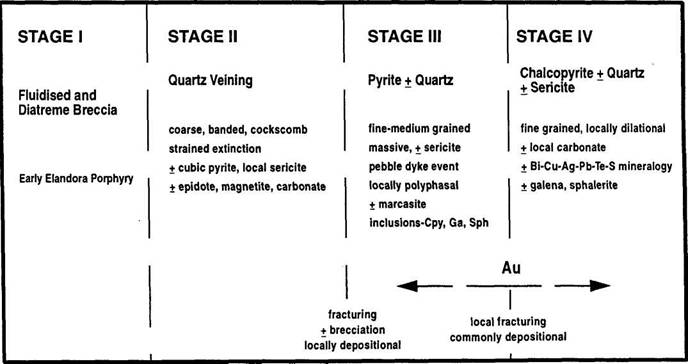
Four stages of veining have been categorised at Arakompa (Figs. 7.13, 7.14; Corbett et al., 1994b) as:
1. Pebble Breccia Dykes:
The Arakompa structures contain breccias comprising well milled fragments of: phyllic altered Akuna granodiorite, hornfelsed sediments, and quite low metamorphic grade phyllites similar to those which crop out at Irumafimpa, and rare early quartz-sericite-pyrite vein clasts.
1. Quartz Veins:
Extensive coarse-grained, cockscomb to locally banded quartz deposition, is accompanied by
coarse cubic pyrite, sericite, as well as local epidote, magnetite, and carbonate, and are locally
112
|
Exploration Workshop "Southwest Pacific rim gold-copper systems: Structure. Alteration, and Mineralization" Corbett G J & Leach T M, 8/96 Edn.
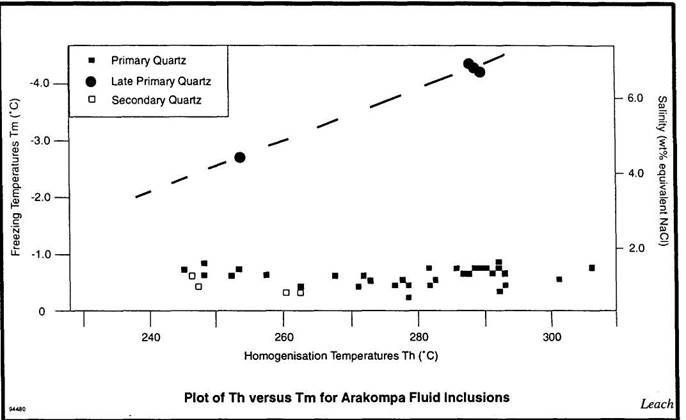
cut by pebble dykes. Fluid inclusion data indicates that the quartz was deposited over a wide temperature range (245-315°C, average 285°C), under local two-phase (boiling) but dilute (< 2 wt percent NaCl) fluid conditions, similar to quartz veins at Bilimoia.
3. Polyphasal Fracturing and Brecciation:
Brecciation of the early quartz veins and pebble breccias is accompanied by deposition of massive fine to coarse grained pyrite, and fine granular quartz. The pyrite commonly contains inclusions of chalcopyrite, bornite, sphalerite, galena and rutile, indicating that this event is a precursor to the Stage 4 mineralizing event. Limited fluid inclusion data on Stage 3 quartz suggests that the brecciation and quartz-sulphide veining took place in response to an influx of fluid at a similar temperature (250-290°C), but of significantly higher salinity (4-6.5 wt percent NaCl), than the earlier quartz veins (Fig. 7.14).
4. Copper-Gold Mineralization:
Chalcopyrite and minor quartz-sericite overgrow the earlier mineral phases. Local fracturing and in situ brecciation has accompanied the copper mineralization. The local deposition of carbonate with chalcopyrite, is indicative of a gradation to a carbonate-base metal style of veining, present at Maniape (Fig. 7.10). A wide array of Bi-Ag-Pb-Cu ± Zn ± Sn telluride and sulphide phases (hessite, tetradymite, bismuthinite, cuporparonite, witticherite and hammerite) were deposited either transitional between Stage 3 pyrite and Stage 4 chalcopyrite, or contemporaneous with the chalcopyrite mineralization (Corbett et al., 1994b). Trace tin phases (stannoidite, kesterite and a Te-cannfieldite) are also associated with chalcopyrite deposition.
Gold at Arakompa occurs as native Au°, generally as inclusions in Stage 3 pyrite and Stage 4 chalcopyrite, and is commonly associated with Ag-Bi-Cu-Pb-Te ± Sn/Zn phases. Gold displays a high fineness (723-995, average 877), characteristic of quartz-sulphide gold systems, transitional between porphyry copper-gold and carbonate-base metal gold systems (Fig. 4.8; Leach and Corbett, 1994, 1995). The higher salinity fluids and presence of Bi-Te phases during Stage 3/4 activity is indicative of a significant influx of magmatic-derived fluids during the formation of mineralization at Arakompa.
The increase in copper contents and fluid inclusion temperatures with depth, further suggests that the mineralized fluids have migrated from a porphyry in the vicinity, and probably below the Arakompa Prospect. These fluids have moved upwards depositing copper and gold into reopened quartz and pyrite-quartz veins at Arakompa, as well as south and west to form the more distal, and dilated, Maniape pre-existing, quartz-pyrite vein structures (see below). A prominent aeromagnetic high at Arakompa may be related to a magnetite-bearing potassic altered porphyry at depth. Weak copper-gold mineralization is associated with outcropping potassic alteration at nearby Nontifa (Fig. 7.10).
The Maniape prospect is discussed as a carbonate-base metal style of gold mineralization in Section 7.iii. j.v.
iv) Hamata, Morobe Goldfield, Papua New Guinea
At Hamata, dipping veins and shears occur in the hanging wall of the Upper Watut Graben Fault (Fig 7.28). The structural and geological setting of alteration and mineralization at Hamata are considered more fully in the discussion of the Morobe goldfield (Section 7.iii. j).
Gold mineralization at Hamata is hosted in Morobe granodiorite and occurs in at least two subparallel zones (Masi and Lower Zone, Denwer et al., 1995; Wells and Young, 1991). The
113
Exploration Workshop "Southwest Pacific rim gold-copper systems: Structure, Alteration, and Mineralization" Corbetl G J & Leach T M, 8/96 Edn.
Morobe granodiorite has undergone intense K-feldspar - sericite alteration within these zones, which overprints high grade propylitic (actinolite-epidote) and local potassic (biotite) alteration. Veins within these zones, which are up to 50 m thick, is diffuse except where 3-4 m wide 'reefs' of pyrite-hematite-magnetite-quartz veins are well developed.
The paragenetic sequence of veining and mineralization at Hamata may be summarised from Denwer et al., 1995 as:
1. Early thin veinlets of magnetite, hematite and pyrite exhibit K-feldspar selvages, and are
overgrown and cut by K-feldspar - quartz veins. The quartz characteristically contains two
phase inclusions and halite daughter phases. Fluid inclusion data indicates that the quartz was
deposited under relatively hot (270-340°C) and periodic hypersaline (up to 35 wt percent
NaCl) to moderately saline (3-7 wt percent NaCl) conditions, indicative of an environment
proximal to a porphyry system.
2. A major stage of massive sulphide-oxide vein development was accompanied by fine
grained quartz-sericite deposition. Specular hematite and coarse lath-like magnetite overgrow
early pyrite. Chalcopyrite locally seals shattered pyrite, and infills fractures with
sericite-pyrite cutting early quartz. Bi-Te (tetradymite) and W (ferberite) mineralization is
associated with pyrite-chalcopyrite deposition. Native gold infills fractures and cavities in
pyrite, is closely associated with Bi-tellurides and has a fineness of 816-991 (average 911).
The style of gold mineralization at Hamata is therefore very similar to that encountered at
Arakompa and Bilimoia.
3. The deposition of local carbonate-base metal sulphide veins in which pyrite, calcite and
chalcopyrite are the dominant phases, is accompanied by minor sphalerite, galena and late
stage arsenopyrite. In places hematite and magnetite deposition locally extends into this
carbonate-base metal phase of alteration.
4. Late stage quartz and/or barite veins contain local arsenopyrite.
The Hamata deposit occurs at a much lower elevation than the other deposits in the Bulolo Graben and may therefore be considered to represent a quartz-sulphide vein system transitional between the carbonate-base metal gold systems (higher) and an inferred buried porphyry copper-gold source for the alteration and mineralization. The Hamata deposit crops out along the strike of the same structure as the Hidden Valley carbonate-base metal gold deposit, but at a several hundred metre lower elevation, in keeping with the overall zoneation of these deposit types.
v) Exciban, Philippines
Gold mineralization in the Exciban deposits, Camarines Norte district, Philippines, displays characteristics typical of porphyry-related quartz-sulphide vein systems. The following discussion is taken from James and Fuchs (1990) and Mitchell and Leach (1991).
Mineralization occurs within a set of steeply dipping NNE-trending structures formed at a high angle to the Larap thrust zone. Early quartz veining is hosted in weakly metamorphosed and locally sheared volcanics and arenaceous sediments. The quartz contains abundant halite daughter crystals indicative of hypersaline fluid conditions. Massive sulphide veining is characterised by pyrite and chalcopyrite, the later commonly as overgrowths and infilling of fractures and cavities in the pyrite. Native gold occurs as inclusions in pyrite and chalcopyrite and is generally associated with bismuth telluride phases (tellurobismuthinite, tetradymite and
114
Exploration Workshop "Southwest Pacific rim gold-copper systems: Structure, Alteration, and Mineralization" Corbett G J & Leach T M, 8/96 Edn.
hedleyite [Bi7Te3]).
James and Fuchs (1990) infer a magmatic-dominated source for the veins and mineralization based on the presence of daughter crystals in fluid inclusions, abundance of telluride phases and high copper content of the veins. Dacite dykes crop out at the surface and are interpreted to represent high level equivalents of the mineralizing porphyry at depth. These workers attributed high cobalt levels in the veins to have been derived from the mafic/ultramafic host rocks at depth.
iii) Carbonate-Base Metal Gold Systems
a) Introduction
A class of porphyry-related gold mineralization, associated with carbonate-base metal veining and breccia infill, forms at intermediate levels between southwest Pacific rim porphyry and epithermal environments (Figs. 7.1, 7.2; Leach and Corbett, 1993, 1994, 1995). Sillitoe (1989) and Handley and Bradshaw (1986) alluded to the existence of this class of deposits in emphasising the magmatic association and noting an overlap between the epithermal and porphyry environments, especially in relation to the Porgera gold deposit. Most deposits within this class have until now been categorised as adularia-sericite epithermal gold-silver, and yet many lack adularia which, where present, is not related to the gold mineralizing events. In addition, many form at levels transitional between epithermal and porphyry environments. This more detailed classification is possible following the upsurge in gold exploration during the 1980's.
Classic low sulphidation adularia-sericite epithermal gold-silver deposits, (e. g., Hishikari and Sado, Japan; Waihi and Golden Cross, New Zealand), are dominated by quartz and adularia within fissure veins. However, much of the gold is not associated with quartz-adularia but occurs in sulphide bands, (ginguro ore in the Japanese literature). Some systems characterised by chlorite, (e. g.. Cracow, eastern Australia), or illite (e. g., Tolukuma, PNG), are inferred to have developed from ore fluids which display typical epithermal meteoric as well as magmatic characteristics. Although carbonate-base metal gold deposits may also form as fissure veins, the associations with base metals high level porphyry intrusions are indicative of a transitional setting between the epithermal and porphyry parison between many deposits in the southwest Pacific rim allows the carbonate-base metal gold deposits to form a class of their own (J^each and Corbett, 1993, 1994, 1995). An understanding of the anatomy and fluid flow paths from the alteration zonation and structure, may point towards high gold grade portions of carbonate-base metal gold systems, or the porphyry source rocks.
b) Definition
Carbonate-base metal gold systems develop distal to porphyry intrusives from the mixing of a magmatic derived fluid with surficial bicarbonate gas condensate waters (Figs. 1.4, 2.4). Mineralization varies from higher grade vein/breccia lode mineralization to bulk low grade fracture or breccia infill styles. Major structures localise hydrothermal systems, and by movement create dilational ore-hosting environments in subsidiary structures. High level porphyry intrusions are commonly spatially associated with ores and may represent competent host rocks. Maar volcano/diatreme breccia complexes and intrusive fluidised breccias, occur as pre-mineral phreatomagmatic explosive events which focus fluids degassing from porphyry bodies at depth, and also create fracture permeability as ore-hosting environments.
115
Exploration Workshop "Southwest Pacific rim gold-copper systems: Structure. Alteration, and Mineralization" Corbett G J & Leach T M, 8/96 Edn.
Base metal contents typically occur as Zn > Pb > Cu, while carbonates exhibit a wide range in chemistry and spatial zonations from Fe-, to Mn-, Mg-, and Ca-carbonates, with increasing depth (Fig. 7.17). Gold mineralization preferentially occurs in association with the Mn/Mg carbonates. There is a progression in time and space (crustal level) from porphyry to epithermal environments. Carbonate-base gold mineralization is commonly preceded by mesothermal to epithermal quartz-sulphide veining, and locally porphyry-related quartz stockwork veining, depending upon the depth of the system. Mineralizing fluids are transitional between dilute circulating meteoric waters, typical of epithermal environments, and high temperature saline porphyry systems.
c) Distribution
Some significant southwest Pacific rim carbonate-base metal gold systems are: in Indonesia, Kelian (5.7 M oz contained gold, van Leeuwen, 1994), Busang (22.5 M oz Au), parts of Mt Muro (1 M oz Au), and Cikotok (> 2 M oz Au); in Papua New Guinea, Porgera mineralization types A, B and E (>6 M oz Au), Mt. Kare, the Morobe Goldfield group of deposits (past production with alluvial 3.7 M oz Au, Lowenstein 1982), including Upper Ridges, Golden Ridges and Golden Peaks at Wau, Edie Creek, Kerimenge (1.8 M oz Au, Hutton et al., 1990), Hidden Valley (2.4 M oz Au, Nelson et al., 1990), Busai and Kulumadau on Woodlark Island (Corbett et al. 1994a), and Maniape at Kainantu (Corbett et al., 1994b); in the Solomon Islands, Gold Ridge; in the Philippines, Acupan (4 M oz Au; Mitchell and Leach, 1991); in eastern Australia, Mt. Terrible (Teale, 1995), and Copper Hill (Leach unpubl. data). Some epithermal gold-silver quartz-adularia-sericite deposits are now recognised to exhibit affinities with carbonate-base metal systems (e. g., Tolukuma, PNG; Cracow, eastern Australia). Carbonate-base metal gold mineralization at the Acupan (4 M oz Au) and Antamok (10 M oz Au), Baguio District, Philippines, overprint uplifted porphyry copper-gold style mineralisation (Mitchell and Leach, 1990).
d) Geological setting
Carbonate-base metal hydrothermal systems form at elevated crustal levels above porphyry copper-gold deposits, and so tend to be associated with higher level, possibly differentiated, porphyry intrusions. Thus, the accretionary prism of moderately eroded island arc terrains is a primary setting for these deposits, especially where competent metamorphic basement rocks fracture to host fracture/vein systems. Intra arc rifts such as the Bulolo Graben (Fig. 7.28; Corbett, 1994), may represent a locus of high level porphyry intrusion, resulting from crustal thinning. Other intrusion centres such as Porgera (Corbett et al., 1995); Mt Kare (Corbett, 1994); Kelian (van Leeuwen et al., 1990); and Kulumadau (Corbett et al., 1994a), are localised by major structures. Kelian, Busang and Mt Muro all occur on a major crustal suture (Fig. 1.2) which separates rocks of different ages and markes the edge of the magmatic arc defiend by Mitchell and Carlile (1994).

|
Из за большого объема этот материал размещен на нескольких страницах:
1 2 3 4 5 6 7 8 9 10 11 12 13 14 15 |
