

Партнерка на США и Канаду по недвижимости, выплаты в крипто
- 30% recurring commission
- Выплаты в USDT
- Вывод каждую неделю
- Комиссия до 5 лет за каждого referral
Magmatic fluids outflow laterally and vertically along regional fracture/fault systems (Henley and McNabb, 1978). It is proposed here that these magmatic fluids are entrained into circulating waters and deposit quartz and K-feldspar/adularia in veins which are a host to later gold and base metal mineralization (chapter 7).
Advanced Argillic Alteration
The intense silicification and advanced argillic alteration along the upper margins of some southwest Pacific porphyry systems are here interpreted to have formed during the exsolution of magmatic volatiles from the crystallising high level stock (Figure 5.5). These zones of advanced argillic alteration have been documented in a number of southwest Pacific porphyry copper systems; e. g., at Batu Hijau (Meldrum et al, 1994), Horse Ivaal, Frieda River (Britten, 1991), Dizon, Philippines (Sillitoe and Gappe, 1984), Cabang Kiri (Carlile and Kirkegaard, 1985), and Lookout Rocks, New Zealand, (section 6.ii. b.l).
Advanced argillic alteration, which is distributed along the margins of the mineralised intrusions, is strongly aligned within bounding structures. Evidence from the Palinpinon active porphyry system, and the solfataras at Biliran (Mitchell and Leach, 1991) indicate that the silicification and advanced argillic alteration may extend from porphyry depths to the surface where they manifest as magmatic solfataras. At Palinpinon, the advanced argillic alteration post dates the formation of zoned potassic-propylitic and skarn assemblages, but pre-dates later phyllic and argillic alteration. In the Alto Peak geothermal field, the acidic alteration has been shown to relate to a hot (<400°C) magmatic-dominated vapour-plume, which is inferred to be currently exsolving from a
67
Exploration Workshop "Southwest Pacific rim gold-copper systems:Structure. Alteration and Mineralization: Corbett GJ & Leach TM. 8/96
crystallising magma at depth, and overprints earlier potassic-propylitic alteration (Reyes et al., 1993).
Alteration in these advanced argillic zones marginal to high level porphyry intrusions is zoned from: biotite in the potassic zone, through zones of K-feldspar and chlorite, sericite-andalusite ± corundum ± tourmaline, pyrophyllite-diaspore, to alunite + kaolinite (e. g. Cabang Kiri, Lowder and Dow, 1978; Frieda River, Britten, 1981, Leach, unpubl. data). This zonation is interpreted to reflect an increase in fluid acidity as reactive magmatic volatiles (mainly SO2 and HC1, and subordinate but locally significant HF) disproportionate and dissociate at progressively cooler conditions away from the crystallizing melt (Rye et al., 1992). These features are discussed in more detail in the high sulphidation section (Section 6).
Stage III: Cooling and Metal Deposition
As discussed above, copper-gold mineralisation in many porphyry copper systems in both the southwest USA (e. g. Beane and Titley, 1981; Reynolds and Beane, 1985; Dilles and Einaudi, 1992) and the southwest Pacific (e. g. Watmuff, 1978; Holtzberger et al., 1996), post-date Stage I potassic/propylitic alteration, quartz veining and advanced argillic alteration (Figure 5.6). Thus mineralization is attributed by many authors to be a result of a progressive change from an environment dominated by magmatic fluids to one that is dominated by cooler and more dilute meteoric waters (e. g., Gustafson and Hunt, 1975; Reynolds and Beane, 1985).
The general sequence of events associated with Stage III cooling and metal deposition in southwest Pacific porphyry systems is illustrated in Figure 5.9 and may be summarised as: quartz --> silicate mineral (potassic, propylitic, phyllic) —> Fe-oxide/sulphide —> mineralisation (Cu-Au ± Mo, Pb, Zn) --> sulphate / carbonate. These minerals occur :
i) in newly formed fractures which crosscut Stage I alteration and quartz veining
ii) in older reopened fractures
iii) in open spaces in Stage I quartz veins (commonly along partings in the central
of the veins)
iv) associated with the alteration of primary and pre-existing secondary feldspars
and mafics in the wallrock.
The quartz is commonly clear to white, and from fluid inclusion analyses (Eastoe 1978; Watmuff, 1978) was deposited from a fluid which was significantly more dilute (<15 weight percent NaCl, and typically <5 weight percent NaCl) and cooler (<300-400°C) than the fluid that deposited Stage I quartz. Where these quartz veins are associated with sericite-chlorite assemblages they are equivalent to the 'D'-type veins of Gustafson and Hunt (1975)
The silicate phases are intergrown with, or commonly overgrow the quartz, and are zoned from early and deep to shallow and late as : potassic minerals (biotite then K-feldspar) --> calc-silicate minerals (actinolite, epidote and zeolites) —> chlorite --> sericite --> illitic clay --> kaolin clay. Some or all these may be present in any one system. Mineralization is intimately associated with these silicate phases, although the ore phases commonly overgrow the silicates (Leach, unpublished data). This spatial and temporal zonation is indicative of progressive cooling and decrease in the pH of the fluids during mineralization (Figure 5.8; Beane and Titley, 1981).
Biotite and K-feldspar are early Stage II minerals which were deposited in thin veinlets (generally <5mm in width) with quartz, magnetite and/or pyrite, and are associated with variable abundances of chalcopyrite (e. g., Yandera, Titley et al., 1978). The occurrence of biotite indicates that the veins and alteration formed under neutral to alkaline conditions at temperatures of >3OO-35O°C (section 4.ii. f). Although K-feldspar is locally intergrown with the biotite, it may also occur in thin veinlets which cut the biotite (Titley et al.,
68
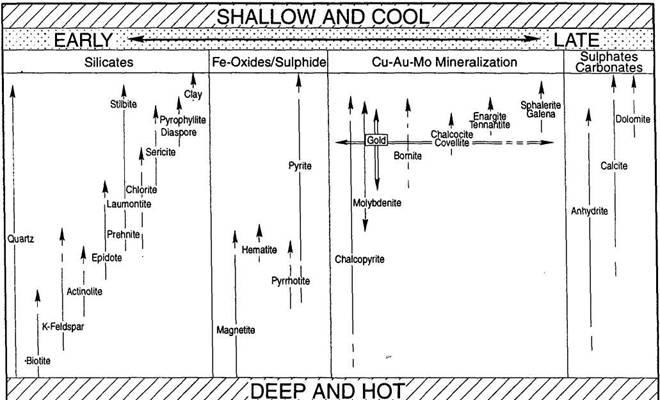

 Spacial and temporal distribution of minerals during Cu-Au mineralization in Southwest Pacific porphyry copper systems.
Exploration Workshop "Southwest Pacific rim gold-copper systems:Structure. Alteration and Mineralization: Corbett GJ & Leach TM. 8/96
1978). The magnetite, which is intergrown with, but commonly overgrows the biotite, may contain inclusions of chalcopyrite and can therefore be distinguished from magnetite that formed during Stage I potassic alteration and igneous magnetite (e. g., Taysan, Leach, unpubl. data). Similar K-feldspar-quartz-magnetite-chalcopyrite veinlets in southwest USA porphyry copper deposits were deposited from less saline fluids (<15 weight percent NaCl) and under cooler conditions (200-450°C) than those for stockwork quartz veins. Isotopic data has shown that these minerals were deposited from mixed magmatic-meteoric fluids (Beane andTitley, 1981; Sheppard, 1971; Reynolds and Beane, 1985).
The calc-silicate mineral phases (actinolite, epidote and zeolites) occur in fractures and in open spaces, replace wallrock minerals (mainly mafics), and post-date the biotite and K-feldspar (Sillitoe and Gappe, 1985; Chivas, 1978; Watmuff, 1978). The paragenetic sequence of actinolite --> epidote --> zeolites (e. g. Cadia, Leach unpubl. data; Taysan, Leach, unpubl. data) is indicative of progressively cooling conditions under near neutral fluid pH conditions (Fig 5.8). The zeolite phase is typically laumontite (e. g. Mamut, Kosaka and Whila, 1978; Cadia, Leach, unpubl. data). In some systems prehnite is early and occurs at deeper levels than the laumontite (e. g. Cadia, Leach, unpubl. data). Elsewhere more hydrated and lower temperatures zeolites such as stibnite (Yandera, Watmuff, 1978) and chabazite (Panguna, Eastoe, 1978) are late, post-mineral and associated with barren calcite veining. Chlorite is typically associated with the above calc-silicates and in many cases replaces early Stage I & II biotite (Sillitoe and Gappe, 1984).
Magnetite, locally with chalcopyrite inclusions, and/or pyrrhotite are in places associated with early actinolite and epidote deposition, however pyrite generally dominates the iron minerals in the calc-silicate assemblages (Watmuff, 1978; Chivas, 1978; Leach, unpubl. data). The association of actinolite with copper minerals indicates mineralization occurred at temperatures >280-300°C. Hematite alteration of magnetite is inferred have occurred during chlorite alteration of biotite at Taysan (Leach, unpubl. data) and Frieda River (Leach, unpubl. data).
Chalcopyrite and minor bornite commonly are associated with the calc-silicate minerals. In many Philippine porphyry copper systems (Sillitoe and Gappe, 1984), at Yandera (Watmuff, 1978) and some southwestern USA deposits (e. g. Ann-Mason, Nevada, Dilles and Einaudi, 1992), the bulk of the copper mineralization is associated with the late stage chlorite-epidote phase of veining and wallrock alteration. The association of epidote and laumontite with the copper sulphides indicates mineralisation took place under near neutral fluid pH at temperatures of 15O-3OO°C (section 4.ii. f)-
Most of the copper-gold mineralisation in the southwest Pacific systems is intimately associated with late chlorite (e. g. Batu Hijau, Irianto and Clark, 1995) and/or sericite or illitic clay (e. g. Copper Hill, Scott, 1978; North Sulawesi, Lowder and Dow, 1978; FSE, Garcia, 1991; Frieda River, Leach, unpubl. data) deposition and wallrock alteration. Copper-gold mineralisation is also predominantly associated with the sericite-chlorite event in porphyry copper deposits in the southwest USA (Beane and Titley, 1981). In this phase of deposition/alteration, chlorite dominates at depth and is early, whereas sericite dominates at shallower levels and is late (e. g. Frieda River, Leach, unpubl. data). The upwards zonation of chlorite to sericite is indicative of a progressive decrease in fluid pH af shallower levels. The change from calc-silicate minerals to chlorite and then to sericite also reflects a decrease in fluid pH during progressively later stages of mineralization (Fig 5.8). Isotopic analyses indicate, that the sericite in many porphyry systems (Sheppard et al, 197'ifFord' and Green, 1977; Eastoe 1978) is derived from meteoric dominated waters. However, Wolfe (1994) interpreted from isotope analyses, that the sericite associated with mineralisation at the E48 stock at Goonumbla was derived from magmatic-dominated fluids, whereas post-mineral sericite was probably formed from a meteoric-dominated water.
69
Exploration Workshop "Southwest Pacific rim gold-copper systems:Structure. Alteration and Mineralization: Corbett GJ & Leach TM. 8/96
Chalcopyrite is more abundant than bornite in chlorite-dominated assemblages, whereas bornite is locally more abundant than chalcopyrite in sericitic assemblages. Bornite is commonly intergrown with, and locally overgrows chalcopyrite. Phases of the intermediate solid solution series (ISS, e. g. idaite) are rare and commonly late, possibly formed under lower temperature conditions (e. g. Wafi River, Leach, unpubl. data). Hypogene chalcocite, covellite, enargite and tennantite generally post-date the bornite, and are restricted to sericitic assemblages at shallow levels in some systems (e. g. Cadia, Leach, unpubl data; Goonumbla, Wolfe, 1994; Frieda River, Leach, unpubl. data), and in peripheral zones of pyrophyllite and diaspore at Dizon (Malihan, 1987).
Molybdenite is generally associated with chlorite-epidote-carbonate deposition and alteration (Watmuff, 1978; Sillitoe and Gappe, 1984). Galena and sphalerite are typically very late and are commonly associated with sericite (e. g. Goonumbla, Wolfe, 1994) and carbonate (e. g. Copper Hill, Scott, 1978) veins and shears which are post-copper mineralisation.
Gold as the native metal, typically occurs as minute (<10-15u,) inclusions in the copper sulphides. More gold occurs with bornite than chalcopyrite (Sillitoe and Gappe, 1984) and is in places enriched in hypogene covellite and chalcocite (e. g. Goonumbla; Wolfe, 1994). It is also more commonly associated with. sericite alteration and related veins rather than with chlorite, calc-sdifcate or potassic assemblages (Leach unpubl. report). Gold generally has" a high fineness (>900, Figure 4.8), although where cooler conditions are evident (e. g., locally at Goonumbla; Leach, unpubl. report) the fineness is lower and more comparable to that encountered in mesothermal vein systems. High gold grades commonly, but not ubiquitously, occur at shallow levels (e. g. Ok Tedi, Rush and Seegers, 1990) or in fault controlled porphyry margins (e. g. Horse Ivaal, Leach, unpubl. report; Didipio, Garrett, 1996) and is here associated with extensive sericite alteration and deposition. High grade gold at Copper Hill is associated with late carbonate-base metal veins, which crosscut porphyry-related quartz veins and pyrite-chalcopyrite-chlorite/sericite veins (Leach, unpubl. report; section 7).
Anhydrite, calcite and locally dolomite commonly overgrow the sulphides in veins/veinlets and wallrock alteration (Leach, unpublished data), although in some prospects the sulphide mineralisation extends into the sulphate and carbonate event (e. g., Frieda River, Leach, unpubl. report). Fluid inclusion data from Frieda River (Eastoe 1979; Leach, unpubl. report) indicate that quartz and anhydrite, which is associated with copper mineralization, was deposited from fluids at significantly lower (100-400°C; average = 230°C) temperatures and which were more dilute (<20-25 weight percent NaCl) than those that deposited the Stage I quartz (Th average = 440°C; salinity >35-40 weight percent NaCl). Isotope analyses indicate that sulphides and anhydrites from Panguna and Frieda River (Eastoe 1983) are in isotopic equilibrium and that the sulphur in the anhydrite is of probable magmatic origin. It is suspected here that the carbonates in southwest Pacific porphyry systems were deposited in response to mixing of magmatic-and meteoric-derived fluids. This is supported by isotopic studies by Zaluski et al. (1994) on calcite associated with sericite and copper mineralization in the Babine porphyry copper deposit, British Columbia.
Stage IV : Phyllic. Argillic and Advanced Argillic Overprint
Pervasive quartz-sericite-pyrite alteration which has an increasing abundance of chlorite at depth, and which post-dates copper-gold mineralisation, overprints other alteration assemblages and veins at shallow levels and along the intrusive margins of a number of southwest porphyry copper systems (e. g., Yandera, Watmuff, 1978; Frieda River, Britten, 1981; Batu Hijau, Meldrum et al., 1994; Goonumbla, Heithersay and Walshe, 1996). Isotopic data from southwest Pacific (e. g. Ford and Green, 1977; Wolfe, 1994; Heithersay and Walshe, 1996) indicates that this sericite is derived from a meteoric-dominated fluid.
70
Exploration Workshop "Southwest Pacific rim gold-copper systems:Siructure. Alteration and Mineralization: Corbelt GJ & Leach TM. S/96
Argillic alteration overprints the sericite-chlorite alteration in a number of porphyry copper deposits (e. g., Batu Hijau, Meldrum et al., 1994; Grasberg, MacDonald and Arnold, 1994; Frieda River, Leach unpubl. report) and is equivalent to the clay in the sericite-clay-chlorite zones at shallow levels in many Philippine systems (Sillitoe and Gappe, 1984). Clays at Yandera are zoned from illite in the central part of the deposit, to illite-smectite in outer zones (Watmuff, 1978). Late quartz-clay-chlorite veinlets cut sulphide veinlets at Yandera, although some may be related to late copper mineralisation (Watmuff, 1978). High grade Cu-Au mineralisation in late chalcopyrite-filled fractures at Grasberg is intimately associated with illitic clay deposition (Leach, unpublished report). Smectite and/or kaolinite ± siderite alteration and deposition in open spaces and fractures in many of the porphyry copper systems (e. g. Cadia and Taysan, Leach, unpubl. report) are inferred, from x-ray diffraction data to be late hydrothermal, although in some cases these clays are of supergene origin. Isotope studies on late argillic alteration in the Babine porphyry copper deposit, B. C. (Zaluski et al., 1994) indicates that the clay there is derived from rock reaction with meteoric waters within a circulating hydrothermal system.
In some porphyry copper systems, renewed igneous activity has taken place during the later stage of meteoric water incursion (Sillitoe and Gappe, 1984). The emplacement of late stage stocks has locally resulted in the formation of diatreme breccia complexes proximal to the mineralised porphyry, and these may post-date and cross-cut copper-gold mineralization (e. g. Dizon; Malihan, 1987). In some circumstances, exsolution of magmatic volatiles from these late stocks may have resulted in overprinting of the mineralized porphyry by hot acidic fluids (e. g., Wafi River, Erceg et al, 1991). Elsewhere, the advanced argillic alteration has been late and metal destructive (e. g. El Salvador, Chile, Gustafson and Hunt, 1975; Island Copper, Canada, Mathias et al., 1995). The relationship between advanced argillic alteration and copper-gold mineralisation is discussed in more detail in the following chapter on high sulphidation systems.
d) Environments for Porphyry Copper-Gold Mineralization
The emplacement of melts at shallow crustal levels is inferred to occur along regional dilational structures and is here interpreted to produce initial zoned potassic-propylitic alteration within a magmatic-dominated regime. Hypersaline brines ( > 25-30 weight percent NaCl) and volatiles were released from the melt as the upper levels cooled and crystallised, and deposited quartz and/or K-feldspar within stockwork and sheeted fracture systems at temperatures of >400-600°C. The release of the fluids from the melt may have been facilitated by the reactivation of the dilational structures through tectonic movement. The cooling of these fluids at shallower levels is inferred to have resulted in the dissociation of dissolved magmatic volatiles and the progressive formation of hot acidic fluids (Rye et al., 1992), and subsequent advanced argillic alteration through rock reaction. These events are postulated to be periods of exsolution of metals from the melt, however it is considered that the intrusion and immediate host rocks at this time were too hot, and the fluids too saline, to provide an environment for metal deposition.
Copper-gold mineralisation in porphyry environments is indicated to have taken place at temperatures of around 2OO-35O°C. Metal deposition is preceded by potassic and calc-silicate and Fe-oxide/sulphide mineral deposition and alteration, and is overgrown by later anhydrite and calcite/dolomite. These minerals infill pre-existing fractures/veins, open cavities and vein partings, new fracture sets or is associated with wallrock alteration. The zonation from early to late and deep to shallow of the silicate minerals of: biotite --> K-feldspar --> actinolite --> epidote --> zeolites --> chlorite --> sericite --> pyrophyllite --> kaolin/illitic clay, is indicative of progressive cooling and decrease in fluid pH during copper-gold mineralization.
71
Exploration Workshop "Southwest Pacific rim gold-copper systems:Structure. Alteration and Mineralization: Corbett GJ & Leach TM. 8/96
This cooling may have taken place solely through heat conduction to the country rock in small mineralised intrusions (e. g. Goonumbla). However in active porphyry copper systems in the Philippines, CO2-rich and dilute groundwaters have been encountered down to depths of up to 1.5-2 km from the surface. These waters have reacted with the host rocks to form similar zoned phyllic and argillic alteration (chapter 2) as described above for porphyry copper systems. The model of an incursion of surfical waters to facilitate the cooling of the upper levels of a larger mineralized porphyry intrusion is also indicated by a meteoric isotopic signature in sericite, and the dilute conditions from fluid inclusion data. The information from active hydrothermal systems suggests that the meteoric waters may have migrated down the same structures as initially facilitated the emplacement of the intrusion to shallow levels (e. g. Bacon Manito geothermal field). It is speculated that this can only take place once the intrusion has already cooled significantly. Pressure draw downs along these structures may have been initiated by renewed intrusion elsewhere within the immediate vicinity (e. g. from Cawayan to Pangas-Pulog, in the Bacon-Manito Geothermal Field, Philippines; section 2.iv. a.3.ii). Other authors (e. g. Gustafson and Hunt, 1975) and computer modelling (Norton and Knight, 1977) suggest that the meteoric waters may have been sourced from the margins of the intrusion.
Copper-gold mineralisation apparently takes place at some significant time period after the intrusion has cooled and crystallised. K/Ar age dating at FSE, Philippines, has indicated the time span between early biotite alteration and late illite associated with copper mineralisation may have been up to 200,000-300,000 years (Arribas et al., 1995). It is therefore speculated that the magmatic fluids and metals associated with mineralisation in a porphyry copper system have probably been exsolved from the cooling and crystallizing of deeper melts of the same shallow level intrusion, or of a much larger parent melt (Figure 5.6).
The metal-bearing magmatic fluids are therefore interpreted to have migrated from the deeper melts along reactivated fractures at the margin of the intrusion. Metal deposition takes place as these fluids enter environments which have cooled to <3OO-35O°C, and in many cases enter fractures, at these shallow levels, which may be saturated with cool and dilute meteoric-derived waters. The cooling of these fluids results in progressive decrease in fluid pH in response to the dissociation of dissolved gases. This change in fluid pH is reflected in the change in the silicate species of: potassic/calc-silicate minerals --> chlorite —> sericite —> pyrophyllite/kaolinite. The decrease in fluid pH may also have been facilitated-by the mixing of low pH CC>2-rich waters.
Southwest Pacific porphyry copper deposits are typically gold-rich (Sillitoe, 1993a). Variations in the Au:Cu ratios of the porphyry copper systems are here interpreted to reflect, in part, a range from hotter environments of mineralization (more copper-rich) associated with potassic and calc-silicate assemblages (e. g., Yandera, PNG) to those at cooler, more mesothermal and meteoric environments (gold-rich, e. g., Dizon and Didipio, Philippines) associated with sericite and/or chlorite assemblages.
ii) Skarn Deposits a) Introduction
Skarns are rocks consisting of Ca-Fe-Mg-Mn silicates formed by the replacement of carbonate-bearing rocks during regional or contact metamorphism and metasomatism (Einaudi et al., 1981) in response to the emplacement of intrusions of varying compositions. Skarns can therefore be regarded as a specific type of aleration within a porphyry environment.
72
Exploration Workshop "Southwest Pacific rim gold-copper systems:Structure. Alteration and Mineralization: Corbett GJ & Leach TM. 8/96
The terms exoskarns and endoskarns are used to describe deposits from sedimentary and igneous/intrusive protoliths respectively. Veins of skarn mineralogy may be present in both intrusions and carbonate sediments. Calcic skarns form by replacement of limestone and produce Ca-rich alteration products such are garnets (grossular-andradite) - clinopyroxene (diopside-hedenbergite), vesuvianite, and wollastonite. Magnesian skarns form by the replacement of dolomite, and produce Mg-rich alteration phases such as diopside, forsterite and phlogopite. Magnetite is common in magnesian skarns since iron is not taken up by the Mg-rich silicates.
Skarns typically have complex mineral assemblages and are polyphasal, with early stages formed at high temperatures which creates assemblages of anhydrous silicates + iron oxides. These are overprinted by later hydrous silicates and sulphides which are formed at lower temperatures. Spatial mineralogical zoning is related to both lateral and vertical distance from the intrusion (i. e., to chemical potential and temperature gradients) and to depth (i. e., to these gradients plus pressure; Meinert, 1993).
Detailed mapping of the distribution of alteration and ore phases provides information about the overall size, characteristics and genesis of a skarn system, and these may provide vectors to help target exploration. Models of skarn zonation are particularly useful in evaluating incompletely exposed or inadequately explored skarn systems.
Skarn deposits are not common in the southwest Pacific region, although significant copper-gold skarn ore bodies occur in the Guning Bijih District, Indonesia (Ertsberg, GBT, IOZ, DOZ, DOM and Big Gossan; Mertig et al., 1994), Ok Tedi, PNG (Rush and Seegers, 1990), and Red Dome, Eastern Australia (Ewers et al., 1990).
As skarns are a specific class of porphyry system, they exhibit the same processes of formation described previously for porphyry copper deposits. However, because the host rocks have a specific chemistry, these processes are manifest in a different manner. The following discussions are a summation of the work by Meinert (1989,1993), Einaudi (1982a, 1982b) and Einaudi et al.(1981).
b) Processes of skarn formation
Skarn evolution occurs in response to three main sequential processes: the prograde isochemical, prograde metasomatic, and late stage retrograde events (Fig 5.10). The isochemical skarn event is equivalent to the formation of zoned potassic-propylitic alteration formed in response to the conductive transfer of heat in porphyry copper systems. The metasomatic skarn event is comparable to the formation of quartz stockwork veining and advanced argillic alteration during exsolution of magmatic fluids from the crystallising porphyry stock. Retrograde skarns are analogous to the collapse of meteoric waters and contemporaneous mineralization events outlined in Section 5.i. e.
1. Prograde Isochemical (metamorphic, contact metamorphic, calc-silicate hornfels) Skarns:
Isochemical skarns form when intrusions are emplaced into calcareous sediments with little or no introduction of chemical components. H2O is released from the intrusion and CO2 from the calcareous sediments. The skarn development is controlled predominantly by temperature and the composition and texture of the host rock, within a predominantly conductive regime.
This contact metamorphism forms zoned thermal alteration aureoles consisting of Ca-Al silicates/hornfels in calcareous shale or marl, Ca-Mg silicates in silty dolomites and calc-silicate marble and/or wollastonite in limestone. Metamorphic minerals are generally fine grained and the metamorphism is likely to be more extensive and/or higher grade around a skarn formed at relatively greater depth than one formed at shallower levels. Isochemical skarns are characteristically confined to the host lithologies, and the bulk
73
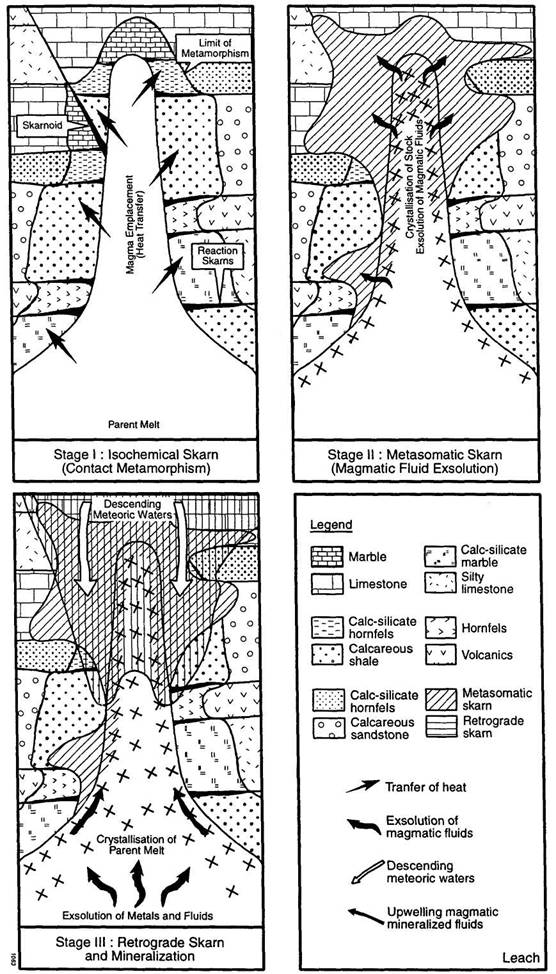
Fig 5.10 Processes in the evolution of skarn deposits (adapted and modified from Meinert, 1993)
Exploration Workshop "Southwest Pacific rim gold-copper systems:Structure. Alteration and Mineralization: Corbett GJ & Leach TM. 8/96
compositions for any given rock type are identical for all alteration zones. These skarns display a wide variety of mineralogy for a given number of elements. The metamorphic stage of skarn development is essentially barren of ore mineralization (Einaudi et al., 1981).
Zonations in mineralogy in response to decreasing temperature, and increasing concentrations of CO2, (i. e. progressively away from the intrusive), can be generalised as follows:
in dolomite -
garnet---- > pyroxene---- > tremolite---- > talc/phlogopite;
in limestone -
garnet---- > vesuvianite + wollastonite---- > marble.
These changes reflect an increasing abundance of quartz + calcite, and an increase in the hydration of mineralogy away from the source intrusion.
The Fe-content of garnets increase toward the intrusion, whereas the Fe:Mg ratio of pyroxenes decrease. Garnet is therefore commonly dark red-brown proximal to the intrusive, becoming lighter brown in more distal settings, and pale green adjacent to fringe marbles (Meinert, 1993).
Reaction (also termed local exchange, bimetasomatic, or calc-silicate banded) skarns form during the metamorphic event by the mass transfer of non-volatile components on a local scale between adjacent lithologies. Skarnoids result from metamorphism of impure lithologies with some mass transfer by small-scale fluid movement (Meinert, 1993).
2. Prograde Metasomatic (infiltration, replacement) Skarns:
The formation of isochemical skarns is followed by the development of a metasomatic or hydrothermal stage characterised by the exchange of H2O, silica, aluminium and iron, which exsolve from the crystallizing intrusive, and CO2, calcium, and magnesium which are derived from the calcareous sediments. The release of magmatic fluids causes hydrofracturing within the cooling pluton and previously formed hornfels/isochemical skarn, and facilitates the ascent of magmatic-dominated fluids along the intrusive contacts, fractures, fissures, faults, sedimentary contacts, pre-skarn dykes and sills, and other permeable zones (Meinert, 1993).
Minerals formed during metasomatic processes overprints, and commonly replaces, earlier metamorphic phases, and is characteristically coarser grained. Metasomatic skams typically contain very few phases for the number of components (mono - or bimineralic assemblages), with the composition of the alteration mineralogy not reflecting the composition or texture of the host lithologies.
Zonations in mineralogy are similar to those encountered in isochemical skarns. Garnets and pyroxenes progressively become more iron-enriched and magnesium-depleted with time. Lower temperature phases commonly overgrow and replace minerals formed under earlier hotter regimes (e. g., pyroxene replacing garnet).
Einaudi et al., (1981) suggest that sulphide and oxide deposition commences during the latter stages of metasomatic skarn development. Magnetite mineralization dominates over sulphides, forming either by replacement of garnet or pyroxene at the intrusive-skarn contact, or in outer zones at the marble-skarn contacts.
74
The influx of acid fluids may inhibit skarn formation in favour of the development of massive pyrite-sulphide replacement bodies and breccia pipes (e. g., Brisbee). In this case wholesale silicification has been superimposed onto earlier calc-silicate skarns.
3. Retrograde
The previously discussed skarns are commonly referred to as prograde skarns, forming end-members of a continuum which shows a progressive transition from early metamorphic to late metasomatic dominated events. Retrograde skarns form when temperatures decline and fluid compositions are dominated by meteoric waters, especially where skarns formed at shallow crustal levels.
Retrograde alteration is characterised by the replacement of earlier prograde anhydrous minerals by late stage hydrous phases such as epidote, amphiboles, chlorite and clays; and this reflects the leaching of calcium, and introduction of volatiles. Unlike metasomatic skarns, retrograde skarns have complex multiphase mineral assemblages. Einaudi et al., (1981) list the following as typical retrograde alterations:
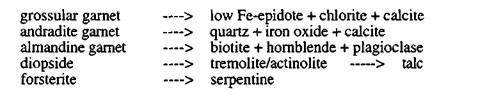
This is the main mineralization event. Sulphides and iron oxides occur as disseminations in, and in veins which crosscut, prograde skarns, or as massive replacements of marble. In the same manner outlined for porphyry copper systems, sulphide mineralization and retrograde alteration in skarn deposits is typically structurally controlled and crosscuts prograde skarns, in some cases extending beyond the skarns. Sulphide assemblages of pyrite-chalcopyrite-magnetite occur proximal to intrusions, and in distal settings bornite-chalcopyrite dominate. This reflects a decrease in total iron concentration during later stages of skarn development. The sulphides are interpreted to have been deposited in response to either decreasing temperatures, neutralization of the hydrothermal solution (especially at the marble contact), or changes in oxidation state of the fluids. The association of most ore phases with late stage retrograde assemblages can be interpreted to either:
i) indicate that the prograde skarn is merely a reactive host rock for later mineralising fluids which were derived from a deep parent melt, or
ii) indicate that there has been remobilization of sulphides which were deposited during prograde events.
Elsewhere ore mineralization appears to post-date all skarn phases and this possibly indicates that the sulphides were derived from a different or separate intrusion.
c) Skarn Ore Deposits
Ore deposits which are hosted in skarns are classified as skarn deposits. The following most commonly used classification of skarn deposits is on the basis of the dominant metal, i. e., Cu, Au, Pb-Zn, Fe, Mo, W and Sn (Einaudi et al., 1981; Meinert, 1993; Einaudi, 1982a; Einaudi, 1982b).
Copper-gold skarns (e. g., Ertsberg, Ok Tedi) and gold (e. g., Red Dome) skarns are the most economically significant skarn deposits in the southwest Pacific rim, and are associated with shallow level calc-alkaline porphyritic intrusions. Copper skarns are typically dominated by andradite (Fe-rich) garnets, with massive garnet proximal to the intrusion, which grades outward via zones which contain an increasing abundance of
Exploration Workshop "Southwest Pacific rim gold-copper systemstStructure. Alteration and Mineralization: Corbett GJ & Leach TM. 8/96
pyroxene (Fe-poor), to distal vesuvianite and/or wollastonite near the marble contact. The garnet grades from red-brown, to light brown, to green, and yellow with increasing distance from the pluton. Chalcopyrite dominates mineralization close to the porphyry, whereas bornite occurs in wollastonite zones near the marble contact. Intense retrograde alteration is common and typically epidote-actinolite/tremolite replaces prograde garnet. The presence of specular hematite may reflect a shallow oxidising environment of formation.
Gold skarns (e. g., Red Dome) are associated with diorite-granodiorite plutons and commonly contain sub-economic Cu, Pb, and Zn. Potassium-feldspar, scapolite, vesuvianite, apatite and Cl-rich amphiboles are common. Arsenopyrite and pyrrhotite are the main sulphide phases which indicate a reducing environment. Most of the gold occurs as electrum in close association with bismuth and telluride minerals. Gold skarns can form in distal portions of large skarn deposits, the proximal parts of which commonly represent significant copper skarn deposits.

|
Из за большого объема этот материал размещен на нескольких страницах:
1 2 3 4 5 6 7 8 9 10 11 12 13 14 15 |
