

Партнерка на США и Канаду по недвижимости, выплаты в крипто
- 30% recurring commission
- Выплаты в USDT
- Вывод каждую неделю
- Комиссия до 5 лет за каждого referral
alteration includes members of the kaolin (pyrophyllite-andalusite) and illite (sericite-white mica) mineral groups, and associated transitional assemblages, which along with sericite-mica-chlorite assemblages formed in higher temperature conditions.
Subpropylitic alteration zones include low temperature chlorite-zeolite, and with propylitic alteration are generally assigned to higher temperature chlorite-epidote-actinolite alteration assemblages. In some cases actinolite-bearing assemblages have been termed "inner propylitic".
Potassic alteration zones are those which contain biotite-K-feldspar-actinolite + clinopyroxene mineral assemblages.
Skam mineralogy consists of zoned calc-silicate mineralogy such as Ca-garnet, clinopyroxene, and tremolite.
iv) Controls on the Deposition of Gangue Mineral Phases
The main non-ore or gangue mineral phases which are deposited directly from solution in ore-forming systems are silica minerals (predominantly quartz) and carbonate minerals, with local abundances of sulphate mineral species. The following sections outline the main factors which control the deposition (and dissolution) of these mineral phases in hydrothermal systems.
a) Silica minerals
Temperature is the major control on the deposition of silica mineral species, with subordinate influence of pressure, salinities, pH, kinetics of deposition, and complexing agents (Fournier, 1985a). In epithermal to mesothermal environments (i. e., <300-350°C) quartz will deposit upon cooling, with a solubility maximum occurring around 350°C (Fig. 4.2). Therefore, rapid quenching in the upper regions of an upflow hydrothermal fluid will produce a silica cap to that system. Between 300-350°C, decreases in pressure and salinity have a moderate effect on quartz deposition, whereas below 300°C, the effects are minor except under drastically changing conditions.
At shallow levels in an epithermal system (<100-150°C) various silica mineral species may be deposited, including amorphous silica, cristobalite, tridymite, chalcedony and quartz. Although quartz is the least soluble of all the mineral phases, the rates of change in temperature control the mineral species formed. For example, amorphous silica is deposited as silica sinters under rapidly cooling conditions, where boiling hydrothermal fluids at <200°C rapidly cool to less
56


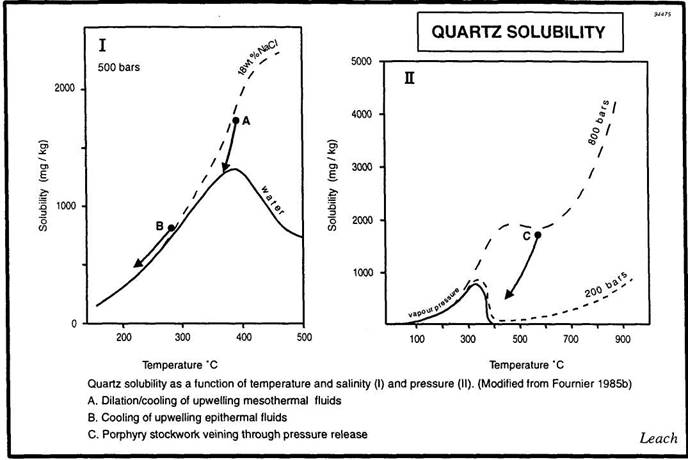
Fig. 4.2
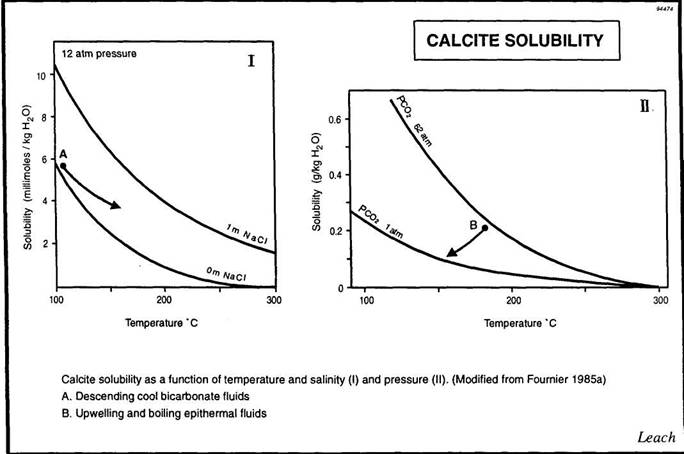
 Fig. 4.3
Exploration Workshop 'Southwest Pacific rim gold-copper systems: Structure, Alteration, and Mineralization' Corbet! G J & Leach T M, 8/96 Edn.
than 100°C in surficial environments. Cristobalite and chalcedony form under progressively slower cooling environments. Silica mineral species recrystallise to quartz with time and/or increasing temperature. Fine-grained silica, especially thin colloform banding, forms under rapid quenching conditions, whereas well-formed drusy (crystalline) quartz forms under slow cooling conditions within open spaces.
Under acidic conditions the reaction of low pH fluids with (feldspars and mafic phases) wall rock results in the breakdown of many mineral phases and causes excessive silica supersaturation. Therefore, silicification always accompanies acid leaching. In addition, sulphate-silica complexes in low pH fluids facilitate silica supersaturation (Fournier, 1985a). Deposition of sulphate minerals such as alunite or barite, may therefore result in extensive silica deposition.
At high temperatures (>300-400°C), both pressure and fluid salinity, as well as temperature have major controls on silica deposition (Fig. 4.2), such that quartz solubility increasing substantially with increasing pressure and temperatures. Therefore, rapid pressure drops possibly associated with a change from lithostatic to hydrostatic pressures in a porphyry environment (see section 5.i. c.ii) result in excessive silica saturation, and the associated development of quartz stockwork veining (Fig. 4.2). Additional quartz veining results from the mixing and subsequent dilution of this saline fluid with circulating dilute meteoric-dominated waters.
b) Carbonate minerals
The solubility of carbonate minerals in an aqueous solution (at pH 4-8) is best given by the equation:

The greatest control to carbonate deposition occurs with increasing temperature, whereas dilution and pressure drop display only secondary effects on carbonate deposition (Fig. 4.3; Fournier, 1985b). Therefore, carbonate deposition is promoted at shallow levels by the heating of descending bicarbonate fluids. If a fluid, which contains significant concentrations of dissolved CO2 (PCO2), boils rapidly, then release of CO2 promotes carbonate deposition (Fig. 4.3), typically as bladed carbonate (Simmons and Christenson, 1994). This release of CO2 is accompanied by an increase in fluid pH which will inhibit quartz deposition. Bladed carbonate in many cases is subsequently replaced by quartz in response to dissolution of carbonate and deposition of silica upon late stage decrease in fluid temperatures. Thus many epithermal systems exhibit quartz pseudomorphing platy carbonate textures.
At pH <4 dissolved CO2 gas is the only carbonate aqueous species present in equilibrium with gaseous CO2 and so carbonates are dissolved below this pH range. With progressively increasing pH, HCO3' dominates, and at pH >8 the CO3'2 dominates (Ellis and Mahon, 1977).
The controls to carbonate solubility under saline conditions are not well documented. However, comparisons with sulphate solubility, and the observed deposition of carbonate minerals from magmatic brines in porphyry environments (see Section 5), suggest that carbonate solubility may drop with decreasing temperature under saline conditions.
57
Exploration Workshop "Southwest Pacific rim gold-copper systemsiStructure. Alteration and Mineralization: Corbett GJ & Leach TM. 3/96
5 GOLD-COPPER SYSTEMS IN PORPHYRY ENVIRONMENTS
I: PORPHYRY COPPER-GOLD SYSTEMS a) Structural setting
The major portion of the gold and most of the copper resources of the southwest Pacific rim occur within porphyry copper-gold deposits formed in subduction related I-type volcanoplutonic arcs (Sillitoe, 1992). A variety of subduction related arc settings for porphyry intrusion at plate margins are distinguished by Sillitoe (1992) and described in detail in Section 3.ii. Although magmatic arcs which host porphyry intrusions are typically described as having formed during orthogonal or oblique convergence and associated subduction, most arcs demonstrate changes in style through time.
The shapes of vein systems formed peripheral to many porphyry intrusions are indicative of emplacement during a relaxation of orthogonal compression resulting in localised extension (e. g., Batu Hijau, Indonesia, Meldrum et al., 1994; and others, Corbett, unpublished, data). Similarly, porphyry emplacement is inferred to have been promoted by changes from orthogonal to oblique compression. The Chuquicamata porphyry copper in northern Chile is localised by a splay which is indicative of a component of strike slip deformation on the Falla Oeste (West Fault) (Boric et al., 1990). The structure of many of the Ordovician porphyry-related gold-copper occurrences in New South Wales suggests that these formed during an episode of sinistral oblique compression (transgression) (Corbett, unpublished, data). Thus, changes in the nature of subduction have promoted porphyry emplacement.
Major structures localise porphyry intrusions within magmatic arcs (Section 3.iii; Figs. 1.2, 3.2). Transfer structures account for variations in the dip of subducting plates and the rates of subduction and localise melts derived from deep crustal settings and focus overprinting intrusions. A series of transfer structures which transect the Island of New Guinea localise porphyry intrusions at Grasberg, Porgera and Wafi (Fig. 3.3; Corbett, 1994). Arc-parallel or accretionary structures localise porphyry intrusions at splays (e. g., Far South East and others in the Philippines, Sillitoe and Gappe, 1984; Chuquicamata, Chile, Boric et al., 1990; Frieda River, Papua New Guinea, Corbett, 1994) or at intersections with transfer structures (La Escondida, Chile; Corbett, unpublished, data.).
Tectonic environments characterised by oblique compression and settings within splays are ideal loci for the formation of sheeted quartz veins in porphyry-environments (Section 3.viii). Although much of the stockwork veins in porphyry systems occurs as random vein arrays, sheeted veins formed in dilational settings provide a mechanism for the transport of pregnant fluids from large bodies of magma into settings of ore deposition (e. g., Goonumbla, Eastern Australia). Porphyry systems emplaced in environments of orthogonal compression tend to display radial fracturing indicative of the exploitation of conjugate and other fractures (e. g., Grasberg; Kavalieris, 1994).
b) Early models of alteration and mineralization zonation
Extensive exploration for porphyry copper deposits took place during the 1960-80 period prior to the gold boom of the 1980s. The application of alteration zonation models developed during that time contributed towards the discovery of the Kalamazoo (Lowell, 1991a) and La Escondida (Lowell, 1991b) porphyry copper deposits.
The temporal and spatial zonations in alteration and mineralisation associated with porphyry copper deposits is commonly attributed to a progressive change from a hydrothermal system dominated by magmatic fluids, to one which is dominated by
61
Exploration Workshop "Southwest Pacific rim gold-copper systems:Structure. Alteration and Mineralization: Corbett GJ & Leach TM. 8/96
meteoric waters (e. g. Gustafson and Hunt,. 1975; Beane and Titley, 1981; Reynolds and Beane, 1985). The interaction of these two cogenetic yet chemically different fluids is believed to be the cause of mineralization in response to decreasing temperature and salinity as well as variations in pH and oxygen and sulphur fugacity (Barnes, 1979; Hemely and Hunt, 1992). Copper mineralization in porphyry copper deposits in southwest USA has been illustrated to have taken place in response to this mixing at temperatures of <350°C (Nash, 1976; Beane and Titley, 1981; Reynolds and Beane, 1985).
While many of the porphyry copper deposits that occur in Chile and the western USA are primarily copper deposits, most southwest Pacific examples such as Dizon in the Philippines, Grasberg in Indonesia and Ok Tedi and Panguna in PNG, are gold rich (Titley, 1978) and so are described as porphyry copper-gold deposits (Sillitoe, 1993). Although many porphyry copper deposits in the southwest Pacific do not contain recoverable molybdenum, it is still commonly present in appreciable levels (Titley, 1978).
No single model can adequately portray the alteration and mineralization processes that have produced widely different styles of porphyry copper deposits (McMillan and Panteleyev, 1988). Because of this, a number of models have been put forward to illustrate the alteration and mineralization encountered in porphyry copper systems in different geological settings.
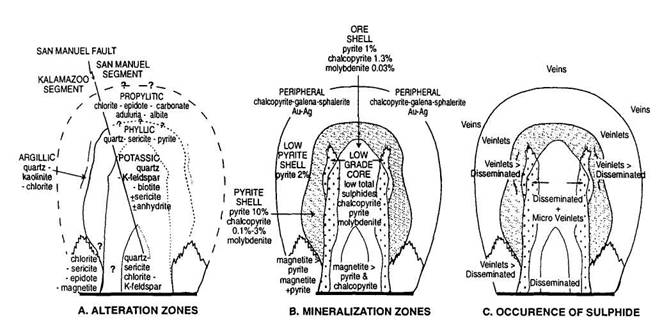
From their work on the San Manuel-Kalamazoo porphyry copper deposit in the southwestern USA, Lowell and Guilbert (1975; Fig 5.1) suggest that this porphyry copper system exhibits zoned hydrothermal alteration assemblages which grade from centre to periphery as:
* quartz core - quartz, sericite, chlorite, K-feldspar,
* potassic zone - quartz, K-feldspar, biotite, + sericite, + anhydrite,
* phyllic zone - quartz, sericite, pyrite,
* propylitic zone - chlorite, epidote, carbonate, adularia, albite.
Sulphides are also zoned within the shell-like alteration zones and grade from a centre as:
* ore zone - pyrite, chalcopyrite, magnetite on the periphery of the potassic
alteration in contact with the phyllic alteration,
* low grade core - central lower grade equivalent of the ore shell,
* pyrite zone - pyrite » chalcopyrite which rims the ore shell within the phyllic
alteration, to a peripheral
* low pyrite shell.
Sillitoe and Gappe (1984) developed a model based on the study of 48 variably eroded Philippine porphyry systems which are hosted in calc-alkali intrusions and volcanic rocks (Fig 5.2). While the setting of copper-gold mineralization is much the same as in the Lowell and Guilbert Model, the Sillitoe and Gappe Model includes features unique to the southwest Pacific environment. These include :
* caps of advanced argillic alteration,
* diatreme breccia associations,
* intramineral intrusions,
* presence of the mineralizing system an apophysis to a late-mineral intrusion,
* the SCC alteration (defined as sericite, clay, chlorite) which occurs instead of
the phyllic (sericitic) and appears to represent transition from the potassic
(K-silicate) to advanced argillic alteration zones.
Porphyry copper deposits hosted in alkalic igneous rocks in British Columbia display aspects of alteration and mineralization which are significantly different from those which are hosted in calc-alkalic intrusions and volcanic rocks (Lang et al., 1995). These differences are:
62
Porphyry copper model from Lowell and Guilbert 1975
Redrawn from Lowell and Guilbert 1975
|
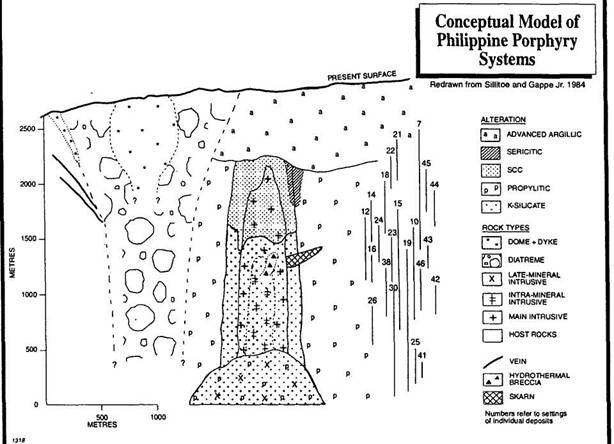
Fig. 5.2 |
Fig. 5.1
Exploration Workshop "SouthwesI Pacific rim gold-copper systems:Structure. Alteration and Mineralization: Corbett GJ & Leach TM. 8/96
i) alteration which is dominated by albitic (sodic) and calc-silicate (garnet, diopside, actinolite, epidote) minerals in addition to biotite and K-feldspar ii) the paucity of sericitic/phyllic, argillic and advanced argillic assemblages iii) the abundance of magnetite associated with mineralization iv) the near absence of quartz and the abundance of carbonate as alteration minerals.
Like southwest Pacific porphyry systems, the alkalic porphyry systems of B. C. are molybdenum-poor and gold-rich. Lang et al.(1995) suggest that the differences in alteration styles between the calc-alkali-and alkali-hosted porphyry systems may be related to differences in the composition of the fluid which is derived from magmas of different compositions. The Dinkidi porphyry copper deposit in the Didipio region of eastern Luzon, Philippines, is also hosted in alkali intrusions and exhibits some of the features described above (Garrett, 1996).
Porphyry copper deposits form within dynamic hydrothermal systems in which there are continually changing conditions creating multiple phases of overprinting events (Gustafson, 1978). This is implicit in the Sillitoe and Gappe model, since the low temperature clays and higher temperature sericite in the SCC zone indicate that several distinct stages of alteration took place under significantly different physical and chemical conditions.
Gustafson and Hunt (1975) developed a model for the progressive evolution of the El Salvador porphyry copper deposit in Chile (Fig 5.3). They postulated that initial emplacement of mineralizing porphyries at approximately 2 km depth under lithostatic pressures, facilitated the formation of potassic alteration and the development of quartz stockwork veining under very hot (>400-500°C), highly saline conditions. In order to explain the subsequent progressive changes to lower temperature conditions during phyllic and argillic to advanced argillic alteration, they proposed a change from lithostatic to hydrostatic conditions (Fig 5.4). This change was interpreted to have been brought about by the influx of deep circulating meteoric dominated fluids.
c) Model of polyphasal overprinting events in southwest Pacific porphyry copper systems
Studies in active porphyry systems in the Philippines (Mitchell and Leach 1991; chapter 2 this volume) indicate that hydrothermal systems form over a prolonged timespan, which range from an initial emplacement of the intrusion, to a sequence of events which involves exsolution of fluids from the cooling melt, followed by influxes of meteoric waters at progressively lower temperatures. Some of the overprinting events in the Philippine active porphyry systems result from deposition and alteration from descending fluids of different chemistries, and temperatures from shallow levels, rather than the insitu development of these fluids (Reyes, 1990; Mitchell and Leach 1991). The descent of these fluids is interpreted to have been brought about by the pressure draw-down during waning of the hydrothermal system (chapter 2).
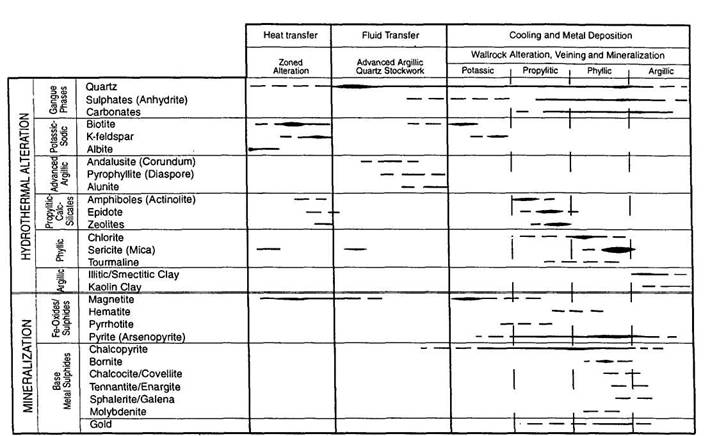
The following section describes a conceptual model for the progressive development of porphyry copper systems in the southwest Pacific region (Figures 5.5 and 5.6). A generalized paragenetic sequence of alteration and mineralization in southwest Pacific porphyry copper systems is illustrated in Fig 5.7.
It is not possible to present a suitable static model which represents the features encountered in all the southwest Pacific porphyry copper systems. Rather, it is considered more beneficial to describe possible processes which are involved in the evolution of a porphyry copper system, and then to apply these process to the development of a genetic model which can satisfy the individual characteristics of each system.
63
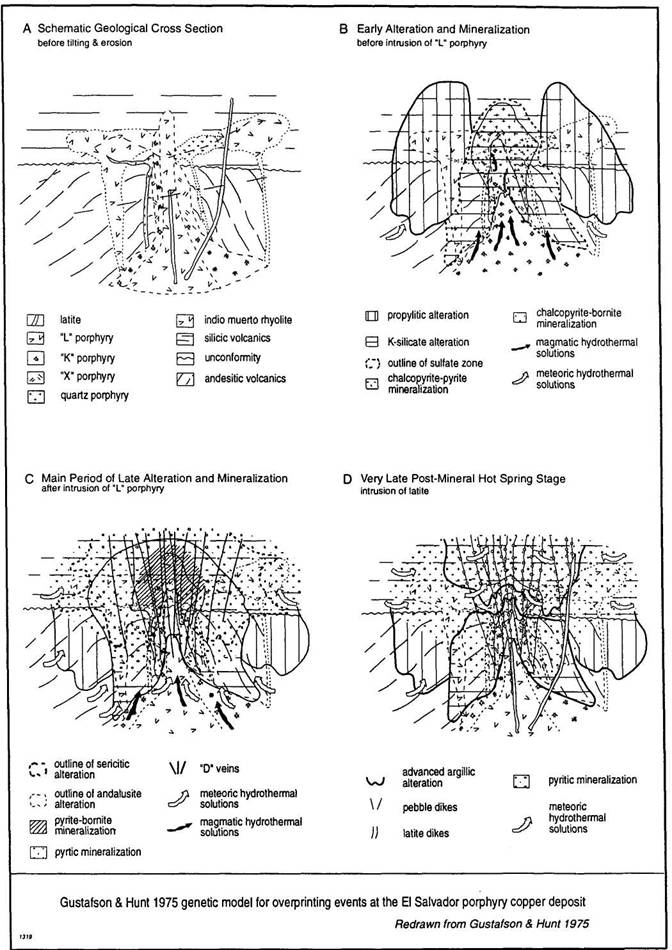
 Fig. 5.3
|
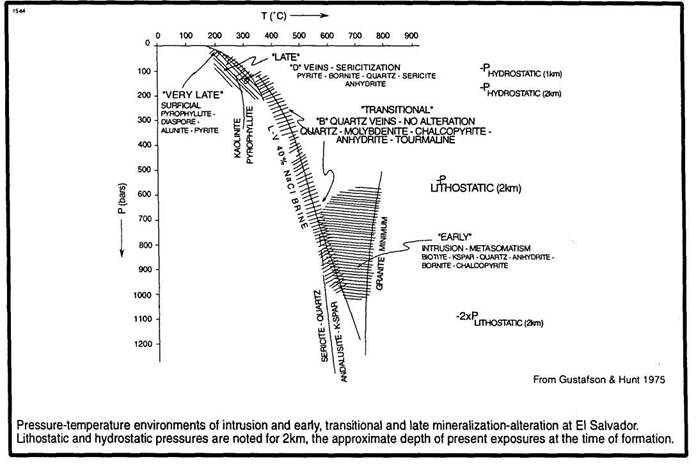
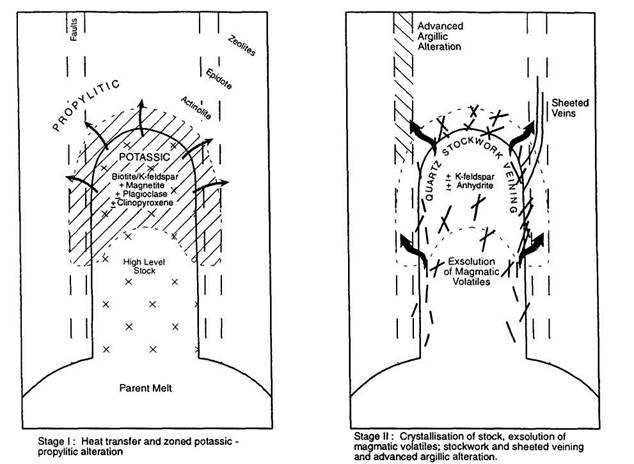
Fig 5.5 Early stages of development of southwest Pacific porphyry copper systems.
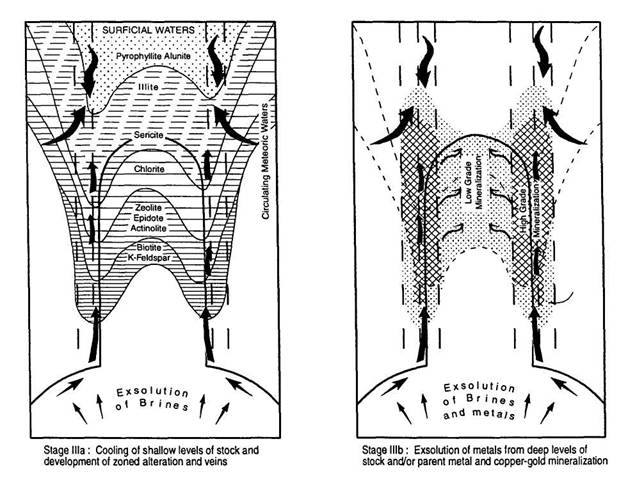
Fig 5.6 Late stages of cooling and mineralization in southwest Pacific porphyry copper systems.
|
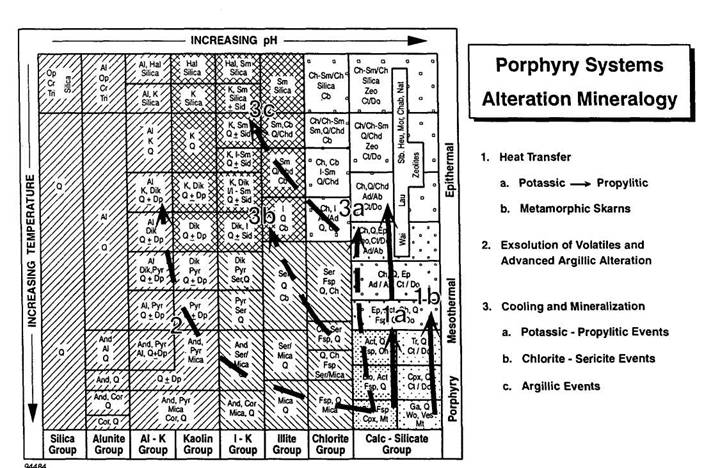
Fig 5.8 |
Fig 5.7 " Generalised Paragenetic Sequence of Alteration Veining and Mineralisation in Southwest Pacific Porphyry Cu-Au Systems
Exploration Workshop "Southwest Pacific rim gold-copper systems:Structure. Alteration and Mineralization: Corbett GJ & Leach TM. 8/96
In a similar manner to Beane and Titley (1981) and Reynolds and Beane (1985), it is proposed that there are two major stages during the evolution of a southwest Pacific porphyry copper system. These are:
* a 'prograde' sequence of events associated with emplacement and cooling of a
melt at shallow (<2 km depth) crustal levels, as an apophysis from a larger
magma source, and the exsolution of magmatic fluids and metals from the upper
levels of that porphyry stock. These prograde events have here been divided into
the initial formation of zoned potassic-propylitic alteration (Fig. 5.2) followed by
a later event of quartz vein development and advanced argillic alteration (Fig 5.3).
* a 'retrograde' sequence which involves the subsequent cooling of the intrusion,
to the extent that the porphyry stock (and its hosts rocks) becomes an
environment of metal deposition (Figure 5.3 Stage HI). The vast bulk of the
mineralization in porphyry copper systems in the southwest Pacific region (and
for southwest USA porphyry deposits; e. g. Cathles, 1977; Beane and Titley;
1981, Reynolds and Beane, 1985) is interpreted to have developed during this
retrograde event at temperatures of around 250-350°C.
The changes in alteration related to variations in temperatures and fluid pH during these events is illustrated in Figure 5.8.
The following conceptual model of the evolution of porphyry copper systems in the south-west Pacific is therefore presented as a framework to develop site specific models for each individual prospect or deposit.
Stage I. Zoned Potassic-Propylitic Alteration
Initial emplacement of melts at shallow crustal levels and the associated cooling and crystallisation is accompanied by the formation of zoned alteration assemblages formed in response to the transfer of heat from the melt into host lithologies (McMillan and Panteleyev, 1988). This zoned alteration mineralogy, in many of the southwest Pacific porphyry copper systems, grades from an inner potassic zone outward to progressively cooler propylitic alteration assemblages, (e. g. Yandera, Watmuff, 1978; Panguna, Ford, 1978; Fig. 5.5; also for El'Salvador, Gustafson and Hunt, 1975). A similar zonation in alteration mineralogy is associated with the initial emplacement of high level intrusions in active Philippine geothermal systems (chapter 2).
In calc-alkaline magmatic arc systems, the potassic zone is dominated by biotite. The biotite, in some systems (e. g., Yandera), varies from brown to green brown from the core to the margin of the potassic alteration, which is a reflection of an increase in Mg/Fe content (Watmuff, 1978). In areas of crustal rifting and more felsic/silicic intrusions, the potassic zone in the intrusion is dominated by K-feldspar (e. g. Goonumbla, Heithersay and Walshe, 1996; Cadia, Newcrest, 1996; Dinkidi, Garrett, 1996). In both environments, secondary quartz and plagioclase are subordinate to the biotite. Secondary clinopyroxene is intergrown with biotite in the central potassic zones in the St. Thomas II porphyry copper deposit (Coote, 1993) and the Palinpinon active porphyry copper system, Philippines (Reyes, 1990). Magnetite is almost ubiquitous in the potassic zone, and is interpreted to reflect neutral to alkaline, reducing conditions.
The early potassic zone alteration commonly exhibits hornfelsic textures (McMillan and Panteleyev, 1988) and have a composition similar to that of primary magmatic biotites (Watmuff, 1978). Isotopic studies (Sheppard et al., 1971; Ford and Green, 1977) illustrate that the biotite is formed from magmatic fluids, and may have formed in response to reaction between the melt and primary hornblende (Burnham, 1979). Later biotite occurs in veinlets and is more Mg-rich (Watmuff, 1978). This change in the style and composition of alteration is here inferred to indicate that there is a gradation from heat being transferred from the melt initially through conduction (contact metamorphic), to
64
Exploration Workshop "Southwest Pacific rim gold-copper systems:Struciure. Alteration and Mineralization: Corbett GJ & Leach TM. 8/96
later episodes where heat commences to be transferred through hydrothermal convection, possibly associated with the early exsolution of magmatic fluids.
Alteration zones distal to the central potassic core reflect progressively cooler conditions (Fig. 5.5). Secondary amphiboles, typically actinolite in calc-alkaline environments, locally occur with biotite in the outer potassic zones, and with epidote in the inner propylitic alteration zones (e. g. Philippine systems, Sillitoe and Gappe, 1984; Mamut, Kosaka and Wakita, 1978; Grasberg, MacDonald and Arnold, 1994). At shallower levels, propylitic assemblages of epidote-chlorite-albite-carbonate grade upward and outward into zones dominated by chlorite and progressively more hydrated zeolites which form under low temperature conditions (e. g. Yandera; Watmuff, 1978). Prehnite (e. g. Cadia, Leach, unpublished data), and very rarely pumpellyite (Leach, unpublished reports), are encountered in some epidote-bearing propylitic assemblages. Although magnetite is locally abundant in the propylitic zones, pyrrhotite (e. g. Mamut, Kosaka and Wakita, 1978) and/or pyrite dominate in these cooler, less reducing, and locally lower pH environments. In places magnetite and/or pyrrhotite produce significant geophysical magnetic anomalies within the propylitic alteration zones (e. g., Batu Hijau; Meldrum et al., 1994),
In the central portions of many of the intrusions, potassic alteration grades with increasing depth through zones of propylitic alteration (commonly with actinolite) to zones of increasingly weaker alteration, and in some cases to a relatively unaltered core (e. g. Dinkidi, Garrett, 1996). Elsewhere, the deep propylitic alteration assemblage is dominated by albite (e. g., Yandera, Watmuff, 1978; Batu Hijau, Indonesia; Meldrum et al., 1994). This albitisation of plagioclase has been interpreted to have formed during the late stage crystallisation of the melt (Watmuff, 1978), since all other alteration events post-date the albite. Albitisation of plagioclase at deep levels in porphyry systems has also been documented at the Ann-Mason deposit, Nevada, although there it is late in the sequence of events and is inferred to be related to the incursion of non-magmatic fluids (Dilles and Einaudi, 1992).
Stage II: Stockwork and Sheeted Quartz Veins
The cooling and crystallisation of the melt results in fracturing, especially around the carapace of the intrusion, and this fracturing is accompanied by the exsolution of magmatic volatiles (Henley and McNabb, 1978). Pressure within the cooling magma may have locally exceeded lithostatic pressure and this may initiate fracturing in the brittle host rocks (Burnham, 1979). Tectonic movements are inferred to have facilitated this fracturing of the carapace and may have locally promoted a sudden pressure drop (section 3.viii). As outlined in section 4, a change from lithostatic to hydrostatic pressures at 2 km depth, and an accompanying drop in temperature upon boiling, can result in the deposition of quartz from the magmatic fluids into the fractured carapace.
Quartz can therefore be deposited within the fracture network and results in the formation of a stockwork quartz vein system around the carapace of the intrusion (Figure 5.5). However as outlined in section 3.vii, the quartz is also commonly deposited in sheeted fracture systems, typically at the fault controlled margins of the intrusion (e. g. Mamut, Kosaka and Wahila, 1978). In some cases the sheeted quartz veins crosscut the host intrusion and extend up to a few kilometers into the host sediments or volcanics (e. g., Cadia; Newcrest, 1996). Elsewhere the development of these sheeted veins are interpreted to relate to continued reopening of the dilational faults which facilitated the initial emplacement of the intrusion into shallow crustal levels (e. g., Frieda River; Leach, unpublished reports). These sheeted plumbing systems are here inferred to be important in subsequent metal transport.
This Stage II quartz is deposited from a hot, hypersaline two phase fluid. The quartz is commonly a murky light grey-white color due to the large number of both primary and secondary fluid inclusions and minute inclusions of gangue and ore phases. This early
65
Exploration Workshop "Southwest Pacific rim gold-copper systems:Structure. Alteration and Mineralization: Corbett GJ & Leach TM. 8/96
quartz is distinguishable from the clearer and whiter quartz veins formed under cooler, more dilute conditions (Stage II) and which contain fewer fluid and mineral inclusions.
At Batu Hijau, average fluid inclusion homogenisation temperatures in the quartz are highest towards the carapace of the mineralized tonalite, and decrease both with depth and at shallower levels (Coote, 1992). This distribution implies that fracturing and quartz vein development initially took place around the upper margins of the intrusive, then later extended out into the country rock, and inward to the core of the intrusion.
In some systems, the stockwork quartz veins near the carapace of the intrusion locally comprise >20-30 percent of the intrusion (e. g., Grasberg, MacDonald and Arnold, 1994; Batu Hijau, Irianto and Clarke, 1995). This high density of quartz veins implies that a significant abundance of volatiles were released from the melt. In these cases the interpreted original enrichment in volatiles, possibly during melt ascent (Lowenstern, 1994), may have provided the buoyancy necessary to facilitate emplacement at relatively shallow crustal levels.
Two stages of early quartz veining have been recognised by a number of authors in the southwestern USA porphyry copper systems (Nash, 1976; Reynolds and Beane, 1985), and these also occur in porphyry copper systems in the southwest Pacific. Early quartz veins at Goonumbla (Heithersay and Walshe, 1996) formed during late stages of melt crystallisation as evidenced by their local discontinuous ptygmatic morphology which merge with the host intrusion. These are equivalent to the 'A'-type quartz veins of Gustafson and Hunt (1975). Fluid inclusion analyses at Panguna and Frieda River (Eastoe 1978) as well as at Goonumbla (Heithersay and Walshe, 1996), indicate that this early veining formed at temperatures of >6OO-8OO°C, similar to crystallisation temperatures of the melt, and from brines with salinities of >35-40 weight percent NaCl.
The vast majority of the quartz veins commonly exhibit multiple phases of fracturing and sealing within a brittle, fractured, host intrusion (e. g. Panguna, Eastoe, 1978), and therefore post-date crystallization of the melt at that level. They also crosscut the earlier formed potassic and inner propylitic alteration zones, and may be accompanied by K-feldspar alteration of the adjacent wallrock plagioclase of Stage I biotite (Watmuff, 1978; Fig. 5.8).These are equivalent to the 'B'-type quartz veins of Gustafson and Hunt. Magnetite, K-feldspar, biotite and/or albite are locally intergrown with the quartz, and may form as vein selvages to quartz stockwork veins (e. g. Goonumbla, Heithersay and Walshe, 1995). Minute biotite and anhydrite inclusions are also encountered in some quartz stockwork veins (Britten, 1981). In systems associated with alkali intrusions, K-feldspar and/or magnetite are significant components in both the stockwork and the sheeted veins (e. g. Goonumbla, Heithersay and Walshe, 1995; Dinkidi, Garrett, 1996).
Fluid inclusion studies (e. g., Eastoe, 1978; Heithersay and Walshe, 1995), indicate that the majority of the stockwork and sheeted quartz veins were typically deposited from a hot (> 300-500°C), hypersaline (> 25-30 wt percent equivalent. NaCl), two phase (i. e., boiling) brine. Recent work from porphyry systems in the southwest USA (e. g.., Cline and Bodnar, 1994) has shown that during the formation of such quartz veins, the vapour and brine fluids partition separately from the cooling melt. Therefore, the salinity of the liquid-rich brine, as determined from fluid inclusion data, may be an over-estimation of the true salinity of the fluids which exsolved from the melt.
It is evident that the fluids which formed the stockwork quartz veins were significantly enriched in metals. Hematite, magnetite and copper minerals commonly occur as minute phases in the primary saline-rich fluid inclusions (Roedder, 1984). Eastoe (1978) estimated a Cu concentration of l,900ppm from one liquid inclusion in quartz veining at Panguna. Similar concentrations of copper (average = 2,000ppm Cu), in addition to high concentrations of other metals (up to 35,000 ppm Fe, 2700 ppm Zn, and 940 ppm Pb) have been detected in hypersaline brines in primary inclusions in the Questa porphyry molybdenum system, southwest USA (Cline and Vanko, 1995).
66
Exploration Workshop "Southwest Pacific rim gold-copper systems:Structure. Alteration and Mineralization: Corbett GJ & Leach TM. 8/96
However, experimental work (Hemley et al., 1992) has illustrated that solutions at temperatures of 500°C and lkbar pressure are as saturated at similar concentrations (average = 1300ppm Cu) as the fluids which deposited the sheeted and stockwork quartz veins, but at much lower salinities (5.8 weight percent equivalent NaCl). Since the solubility of copper as a chloride complex increases with increasing salinity (Crerar and Barnes, 1976), the hypersaline (>25-30 weight percent NaCl) solutions from which the quartz veins were deposited were therefore probably significantly undersaturated with respect to copper (Roedder, 1984).
This experimental work is supported by detailed petrology on porphyry copper systems in the southwest US (Beane and Titley, 1981; Reynolds and Beane(1985), which indicates that copper mineralisation is not associated with deposition of the quartz veins from these hot (>350-400°C) hypersaline magmatic fluids. This is also the case for southwest Pacific porphyry copper systems (Leach, unpublished reports). Quartz-magnetite stockwork veins at Yandera form a barren core, whereas mineralisation is here associated with later structurally controlled sericite and zeolite veining (Titley et al, 1978; Watmuff, 1978). Early quartz veins at Frieda River, which were deposited at temperatures of >400-500°C from hypersaline brines, are barren and merely provide a brittle host for later mineralization (Leach, unpublished data). Similarly, copper mineralisation at Copper Hill, NSW, is associated with late sericite-chlorite veins which crosscuts the stockwork quartz veins (Scott, 1978).
Therefore, although the early hypersaline fluids contained ore metals when they exsolved from the crystallising magma (Bodnar, 1995), these fluids did not deposit copper (or gold) during formation of the quartz veins. However, the high concentrations of iron in both fluid inclusions (Cline and Vanko, 1995) and high temperature, saline solutions (Hemely et al., 1992), implies that these brines were near saturation with respect to iron oxides as they exsolved from the cooling intrusion. This is supported by the abundance of magnetite found associated with the formation of early potassic-propylitic alteration, and with later quartz and K-feldspar stockwork and sheeted veins.

|
Из за большого объема этот материал размещен на нескольких страницах:
1 2 3 4 5 6 7 8 9 10 11 12 13 14 15 |
