

Партнерка на США и Канаду по недвижимости, выплаты в крипто
- 30% recurring commission
- Выплаты в USDT
- Вывод каждую неделю
- Комиссия до 5 лет за каждого referral
Although the current upflow zone at Bacon-Manito is related to intrusions associated with the domes of Mount Pangas and Mount Pulog, residual hot spots in the Cawayan region imply that previous hydrothermal activity was centred on the Cawayan intrusions. Waning of this heat source has caused draw-down of gas condensate, acid sulphate, and bicarbonate fluids, resulting in progressive overprinting alteration events (Fig. 2.14). The descent of cool, low pH fluids into hotter environments has resulted in widespread deposition of carbonates, sulphates, and silica causing the upper 1000 m to become impermeable. Fingers of acid sulphate and gas condensate fluids have migrated down structures and caldera margins to depths of over 1500 m. These fluids have caused extensive phyllic and local argillic overprinting of potassic
23
Exploration Workshop "SW Pacific Rim Au/Cu Systems: Structure Alteration & Mineralisation" Corbett G J & Leach T M. 8/96 Edn.
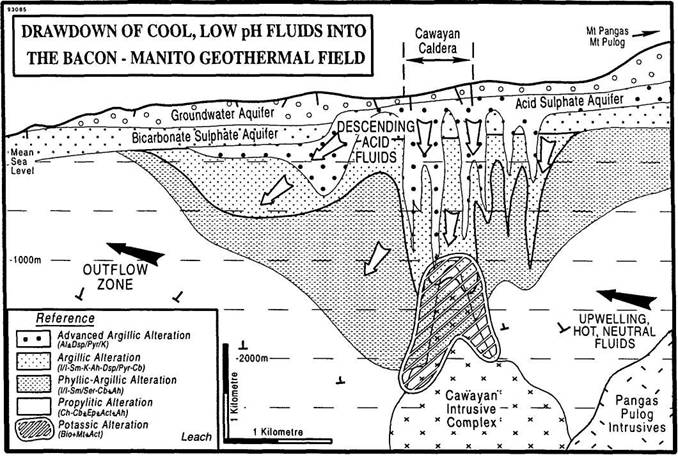
Fig. 2.14
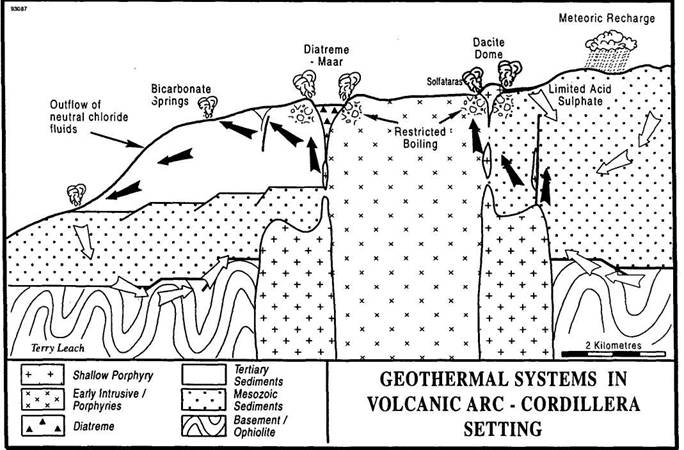
 Fig. 2.15
Exploration Workshop "Southwest Pacific rim gold-copper systems: Structure, Alteration, and Mineralization* Corbett G J & Leach T M, 8/96 Edn.
alteration associated with the emplacement of the Cawayan intrusions.
The multiple high level intrusions, and overprinting potassic-propylitic, phyllic and argillic alteration assemblages at Cawayan, are comparable to similar features recorded in the El Salvador porphyry copper deposit in Chile (Gustafson and Hunt, 1975).
b) Cordillera-Hosted Intrusion-Related Active Hydrothermal Systems
The two main cordillera regions in the Philippines are the Central cordillera in northern Luzon and the Pacific cordillera in eastern Mindanao. These ranges are composed of uplifted early Tertiary sedimentary and volcanic sequences, early arc intrusions (typically of Miocene age and locally containing outcropping porphyry copper deposits), and Mesozoic metamorphic basement complexes. The restricted permeability and recharge at high elevations, together with the emplacement of shallow intrusions within active volcanic arcs, result in hydrothermal systems which have characteristics common to both those encountered in flat silicic volcanic terrains and those in steep volcanic arcs (Fig. 2.15).
Recently-emplaced shallow level plugs and stocks, commonly along contacts of pre-existing intrusions, provide a heat source for the system. Dacite domes, diatreme breccias and associated pyroclastic rocks represent extrusive phases to these plugs and stocks. Meteoric recharge originates at higher elevations than the active hydrothermal system. The restriction of vertical permeability to structures and dome and diatreme contacts causes the fluid to approach the surface within confined upflow features in which upwelling fluids may boil and mix with descending groundwater, bicarbonate, and acid sulphate fluids. Long outflows via dilational structures extend towards dilute neutral chloride springs at lower elevations.
These active hydrothermal systems associated with volcanic arcs in cordillera settings are analogous to porphyry-related quartz-sulphide gold ± copper, carbonate-base metal gold, and epithermal quartz gold-silver deposits.
i) Amacan Geothermal Field
The Amacan geothermal field in north Davao, east Mindanao (Fig. 2.5) is hosted by Mesozoic metamorphic and Early Tertiary sedimentary rocks which are intruded by multiple intrusions ranging from early quartz diorite to later microdiorite porphyry related to a Miocene arc (Fig. 2.16). A quartz diorite porphyry and the adjacent metamorphics host the North Davao porphyry copper deposit.
A number of Pliocene to Recent volcanic plugs and domes are aligned in a north-south trend parallel to regional structures and to subduction east along the Philippine trench. Lake Leonard is interpreted to infill a maar/diatreme breccia complex, and is partly infilled and rimmed by pyroclastic material dated at 1800 years BP (Barnett et al., 1985). The heat source for the active hydrothermal system is interpreted to be the dacite plugs and stocks from which the volcanics are sourced. Thermal manifestations and circulating hydrothermal fluids are restricted to the margins of domes and diatremes, with outflows extending 6-12 km northward, controlled by the north-south regional structures associated with the Philippine Fault. Hydrothermal solfataras are located at the contact of the Ugos dome and around the margins of the Leonard diatreme. Neutral chloride springs occur 100 m below the Ugos steam vents, indicating that the circulating hydrothermal system lies at very shallow depths. Abundant bicarbonate-rich springs in the region deposit spectacular travertine deposits and reflect the high CO2-content of the hydrothermal system. Recharge of these bicarbonate fluids play an important role in the formation of carbonate-base metal gold deposits (see Section
24
 Exploration Workshop "SW Pacific Rim Au/Cu Systems: Structure Alteration & Mineralisation1 Corbett G J & Leach T M, 8/96 Edn.
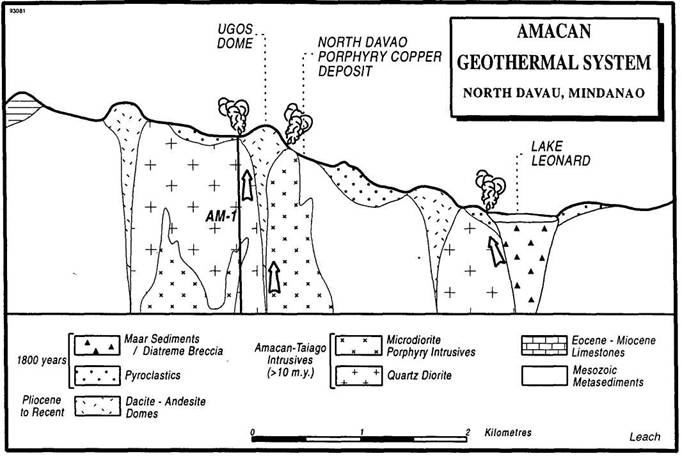
Fig. 2.16
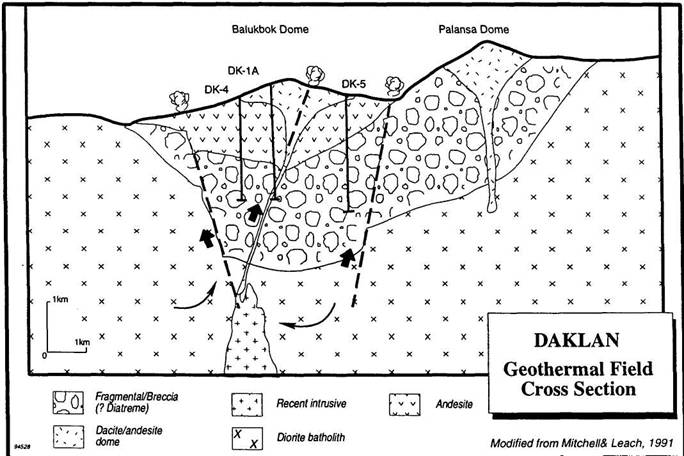
 Fig. 2.17
Exploration Workshop "Southwest Pacific rim gold-copper systems: Structure, Alteration, and Mineralization" Corbett G J & Leach T M, 8/96 Edn.
ii) Daklan Geothermal Field
The Daklan geothermal field, 30 km north of Baguio in the central Cordillera of Luzon (Fig. 2.5), is hosted by Miocene andesite overlying a thick (<2 km) sequence of Early Tertiary volcano-sedimentary breccia which may represent a diatreme breccia (Fig. 2.17). A number of Recent dacite and andesite plugs and domes intrude the volcanic and sedimentary rocks, and are the site of fumarolic activity. Graben faults channel neutral chloride fluids associated with porphyry sources interpreted for the dacites. The only permeability encountered during drilling at the contacts with dykes feeding the Balukbok Dome, provided a relatively saline (2.3 wt percent NaCl equivalent), and relatively hot (260-270°C) fluid.
iii) Acupan
The Acupan gold mine, 15 km southeast of Baguio (Figs. 2.5, 2.19) is hosted in northeast trending structures which cut the 1 m. y. Balatoc diatreme and associated dacite plug (Fig. 2.18). The diatreme and plug (endogenous dome) have been emplaced into a series of Miocene to Pliocene intrusions and andesite volcanics. Hot water seepages are common throughout the upper levels of the Acupan gold mine, and steam and boiling water discharges occur at deeper levels. Geothermal drilling encountered minor permeability within the diatreme at around m depth.
Fluid inclusion data suggest that the water and steam encountered in the mine are manifestations of the dying phase of a once more extensive hydrothermal system associated with the gold mineralization. The styles of alteration and mineralization of the Acupan mine are described in more detail in Section 7.iii on carbonate-base metal gold deposits.
v) Conclusions
1. Types of Active Porphyry Systems
Active geothermal systems in the Philippines provide valuable insights into the process of formation of porphyry copper and porphyry-related gold deposits. Drilling to depths of over 3.5 km, over more than 20-30 km2, enables the development of comprehensive alteration, mineralization, and fluid flow models for these active porphyry systems.
The large porphyry-related geothermal systems at Tongonan, Palinpinon, and Bacon-Manito, are associated either with permeable regional structures or composite volcanic environments. Shallow (<2-3 km) multiple intrusions provide the heat source and a significant component of magmatic fluids for the circulating hydrothermal system. The nature of host rocks may influence the style of alteration and mineralization.
If intrusions are emplaced into piles of relatively permeable fractured volcanic rocks, the widespread permeability causes fluids to become dissemination over a significant rock volume, thereby producing large areas of alteration and mineralization zonation characteristic of most porphyry copper-gold systems.
If intrusions are emplaced into basement sedimentary, metamorphic or intrusive rocks which occur within the cordillera regions of the Philippines, hydrothermal fluid flow will be restricted to permeable structures and intrusive contacts. Extrusions are limited to domes, diatreme/maar volcano complexes, and associated pyroclastic material. The confinement of
25

 Exploration Workshop "SW Pacific Rim Au/Cu Systems: Structure Alteration & Mineralisation" Corbett G J & Leach T M, 8/96 Edn.
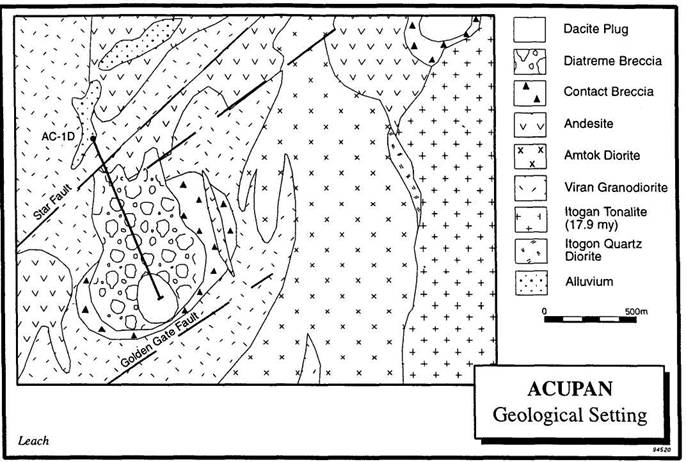
Fig. 2.18
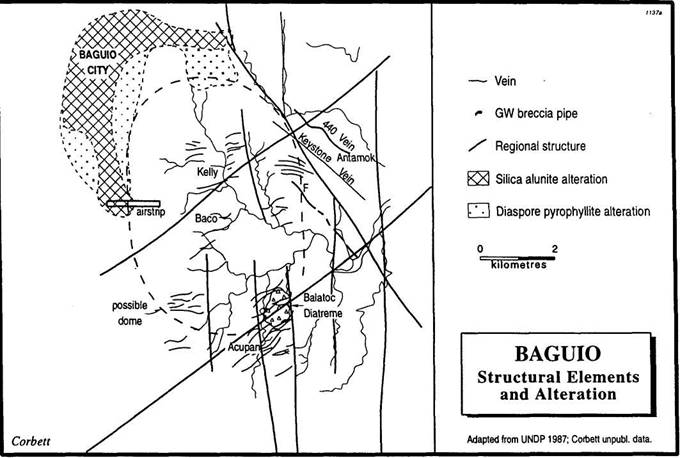
Fig. 2.19
Exploration Workshop "Southwest Pacific rim gold-copper systems: Structure, Alteration, and Mineralization" Corbett G J & Leach T M, 8/96 Edn.
fluids to narrow permeable zones permits fluids to reach near surficial levels where they interact with shallow groundwater and abundant bicarbonate and sulphate waters. This type of active hydrothermal system is analogous to the intrusion-related gold deposits encountered throughout the southwest Pacific rim (see Section 7).
Contrasts in permeability localise different styles of high grade deposits at Hishikari, Japan and Grasberg, Indonesia. In each case competent low permeability rocks have fractured well to host the mineralization and are overlain by permeable volcanic rocks which facilitate the downward movement of hydrothermal fluids which promote mineral deposition. Grasberg is interpreted to have been emplaced into a diatreme breccia by MacDonald and Arnold, (1994) and the Hishikari fissure veins are capped by altered volcanic rocks (Section 8.b. iv).
2. Evolution of Active Porphyry Systems
The geothermal systems in the Philippines have been investigated at various time slices in the evolution of intrusive-related hydrothermal systems. In each case, the initial emplacement of high level intrusions has resulted in conductive transfer of heat during the formation of contact metamorphic hornfels or skarns. Subsequent cooling of the intrusion has been accompanied by exsolution of fluids and formation of magmatic vapour plumes. Fluid flow may be controlled by the same dilational structures which may have facilitated the emplacement of the intrusion. These magmatic vapours vented to the surface as solfataras at Vulcan, and resulted in an advanced argillic overprint to the earlier alteration at Alto Peak.
Convective hydrothermal systems develop when the heat provided by an intrusion at depth, and possibly also venting of magmatic fluids, results in the formation of circulating meteoric-dominated hydrothermal systems at higher crustal levels. Early convective systems are poorly developed and have a high magmatic component (e. g., high fluorine at Biliran), and later ones are well developed and saline (e. g., Tongonan). The convective transfer of heat from the source intrusion results in the formation of zoned potassic-propylitic alteration.
Cooling of the source intrusion and associated pressure draw-down in the hydrothermal system causes the descent of cool relatively low pH gas condensate and surfical acid sulphate-bicarbonate waters (Palinpinon and Cawayan respectively) to depths up to 1.5 km below the surface, and overprinting phyllic and argillic alteration. The deposition of sulphates, carbonates and quartz from the descending waters causes sealing of permeable zones and accelerates the collapse of the hydrothermal system.
3. Porphyry Copper and Epithermal Gold Systems
The close proximity of many Philippine gold deposits to porphyry copper deposits has led many authors to speculate that the gold systems are formed at shallow levels within the same porphyry environment (e. g., Sillitoe and Bonham, 1984). Epithermal gold systems form above and peripheral to porphyry source rocks and telescoping locally juxtaposes these. However in many cases, Philippine porphyry copper-gold deposits are of Miocene age and the epithermal gold deposits of generally Pliocene or younger ages. These deposits are interpreted to have formed in association with arcs of different ages and are separated by an episode of uplift and erosion (Mitchell and Leach, 1991).
Similar factors may localise but systems in the same geological setting. Porphyry copper-gold and epithermal gold deposits occur at the same stratigraphic level, i. e., at or slightly above the interface between andesrtic volcanics and underlying basement sediments. Reactivation of the same structural environment may also contribute to the overprinting.
26
Exploration Workshop "Southwest Pacific rim gold-copper systems: Structure, Alteration, and Mineralization" Corbett G J & Leach T M, 8/96 Edn.
3 STRUCTURE OF MAGMATIC ORE SYSTEMS
i) Introduction
Major regional crustal structures act as conduits for rising porphyry intrusions which are the heat sources for hydrothermal systems. In southwest Pacific settings of oblique_subduction, fluids exsolve from intrusive (porphyry) source rocks and minerals deposit in peripheral settings as veins, fractures, and breccias. Movement on the major controlling structures commonly creates ore-hosting dilational environments in high-angle subsidiary structures. If drilling is planned on grids normal to the more obvious major structures, then in many instances, drill holes intersect the actual mineralized features at unsatisfactorily low angles to the core axis (Fig. 3.4).
Very large quantities of fluid may be required to transport economic quantities of gold. At solubilities of 10 ppb (Fig. 4.6), 10 *~7 litres of fluid (or about equivalent to an Olympic swimming pool) would be required to transport about 3 oz. of gold (Brown, 1986). Optimal mineral deposition is interpreted to be best promoted at the sites of mixing of magmatic and ground waters (Section 4.v. a). The formation of economic gold deposits requires the channelling of considerable quantities of fluid through otherwise impermeable host rocks. Brittle fracturing within competent host rocks in the upper portion of the crust provides permeability for the formation of magmatic arc gold-copper mineralization. Host rocks fracture within dilational structural environments and act as both fissure conduits for mineralized fluids, and as settings for mineral deposition. Fracture-permeability is an important mechanism of fluid flow in pervasive alteration.
The theme - major structures localise ore systems in which ore is hosted within subsidiary high angle structures - is common in many southwest Pacific rim gold-copper systems.
ii) Tectonic setting
Most Pacific rim gold-copper mineralization is associated with Tertiary subduction-related volcanoplutonism, commonly within island arcs which develop at convergent plate boundaries (Sillitoe, 1992). Varying styles of convergence are distinguished by Sillitoe^Q^2) as:
1. Orthogonal convergence,
2. Oblique convergence,
3. Arcs associated with rifting
4. Back-arc extension.
Some terrains exhibit changes in subduction style through time, (e. g. Luzon, Philippines; East New Britain, PNG). We suggest that changes in the style of subduction mayjnitiate_pi)jphyry_ intrusion. and particular. tectonic settings promote the development of certain deposit types.
1. Orthogonal convergence is characterised by orthogonal plate collision and the formation of an island arc in the overlying plate (e. g., northern Chile; Banda Arc, Indonesia; East New Britain, PNG; Fig. 3.1). Some arcs change character to exhibit orthogonal convergence during a limited time (e. g, Northern Luzon, Philippines in the Miocene; Sillitoe, 1992). In these terrains, fluids are constrained within the intrusion and so porphyry copper-gold deposits develop with only minor peripheral vein systems.
27
Exploration Workshop 'SW Pacific Rim Au/Cu Systems: Structure Alteration & Mineralisation" Corbet! G J & Leach T M, 8/96 Edn
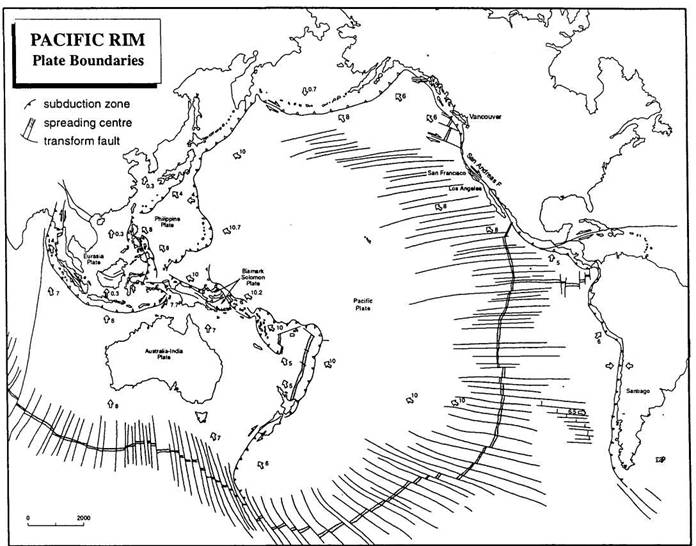
 See also figure 1-2 for detail of the SW Pacific Rim.
Exploration Workshop "Southwest Pacific rim gold-copper systems: Structure, Alteration, and Mineralization" Corbett G J & Leach T M, 8/96 Edn.
2. In settings of oblique, convergence, the plates slide past each other and major transcurrent
fault systems accommodate much of the displacement (e. g., Philippine Fault, Philippines, Fig.
2.4; Sumatran Fault System, Indonesia, Fig. 1.2; Alpine Fault, New Zealand, Fig 7.44; Queen
Charlotte Fault, Canada). There is increasing evidence that regional strike, slip structures
localise porphyry sy§tems_at splays or jogs (e. g., Philippine geothermal systems, section 2;
section iv. b.l herein). Settings of oblique rather than orthogonal convergence, are also liable to
develop dilational structural environments suitable for the formation of mesothermal
porphyry-related mineralization formed peripheral to the porphyry environment. Rising fluids
readily exsolve from porphyry environment to form both low and high sulphidation gold
mineralization (e. g., Lombok Tandai and other deposits along the Sumatran Fault, Indonesia;
Thames goldfield, New Zealand, Fig 7.45; Nena, PNG, Fig. 6.18; Lepanto, Philippines, Fig.
6.24; Cracow, eastern Australia, Fig. 8.7). The dilational character of individual Ordovician
porphyry-related deposits in New South Wales, Australia suggests that mineralization formed
when the arcs dispayed an oblique character (Corbett unpubl. data).
Extensional environments in subduction-related arc settings are described by Sillitoe (1989) as important but variable settings for gold mineralization. There are considerable differences in the manner in which workers categorize southwest Pacific rim extensional settings of mineralization and so further study is required.
3. Intra-arc rifts represent sites of crustal thinning and volcanism. Many workers (Sillitoe,
1992; Mitchell and Garson, 1981) describe the Green Tuff Belt of Japan, which hosts Kuroko
deposits as massive sulphide deposits as of this setting. Elsewhere, localised intra-arc rifts
may host mesothermal carbonate-base metal gold mineralization in association with dacitic
intrusions and phreatomagmatic eruptions. Rotation on transfer structures has formed the
Bulolo Graben, PNG, as a setting of crustal thinning and high level volcanoplutonism which
hosts the Morobe goldfield (Fig. 7.28, Corbett, 1994). Some 3.7 M oz of (mainly alluvial)
gold has been produced at Morobe, and published hard rock reserves of 5.5 M oz remain,
localised by graben-bounding and intra-graben faults (Section 7.iii. j). A jog in the Hauraki
Fault, which separates the Coromandel Peninsula from the Hauraki Graben, hosts the Ohio
Creek porphyry and Thames epithermal goldfield (Figs. 7.44, 7.45).
4. Back-arc extensional environments are described by Sillitoe (1992) as an importantsettings
for adulaffa^sericrfe epithermal gold-silver deposits,. In New Zealand, the back-arc
environment of the Taupo Volcanic Zone (Fig. 8.2) provides a modern analogy for the setting
for Miocene gold mineralization (Fig. 7.44) of Coromandel Peninsula (Henley, 1985b; Henley
and Hoffman, 1987). The terms ensialic marginal basin (Cole, 1984) and intra-arc rift
(Sillitoe, 1992) are also used to describe the Taupo Volcanic Zone. In back-arc settings, as
typical for adularia-sericite epithermal gold-silver deposits, magmatic, heat sources are
inferred to occur at considerable depth and mineralized vein systems are hosted by competent
host rocks: In Japan, the apparent Pliocene to younger ages of many adularia-sericite
epithermal vein systems, association with major structures and basement host rocks, are all
typical of a back-arc environment (e. g. Hishikari, Rubeshibe belt in Hokkaido). Many of the
major structures are reactivated rifts associated with the Green Tuff Belt.
Intrusion-related deposits are also apparent in back-arc settings. The caldera-hosted Emperor Gold mine, Fiji (Eaton and Setterfield, 1889), classified herein as of the epithermal quartz gold-silver style, and the Marian and Didipio porphyry copper-gold prospects, Philippines occur in back arc settings (Sillitoe, 1992).
28
Exploration Workshop "Southwest Pacific rim gold-copper systems: Structure, Alteration, and Mineralization" Corbett G J & Leach T M, 8/96 Edn.
Hi) Major structures
The spatial relationships between major structures and mineralization through geological time are well documented (O'Driscoll, 1986). In magmatic arcs regional structures may localise intrusions and also create dilational structural environmetns which host ore. Major structures may demonstrate protracted histories of activity as: pre-mineralization controls on basin sedimentation in host rocks, pre-mineralization intrusion or breccias, through syn-mineralization localization of ore systems, and post-mineralization deformation of ore deposits. Pre-existing fractures systems are common ore environments.
Major structures in subduction-related Pacific rim settings (Figs. 3.1, 3.2) may be classified as:
1. Accretionary
2. Transfer structures
3. Conjugate transfer structures
4. Transform faults
1. Accretionary (arc-parallel) structures form parallel to the subducting plate margin and in part define the structural grain of the accretionary prism. In settings of oblique subduction, arc-parallel structures may form as steeply dipping transcurrent faults which display predominantly strike slip components of displacement (e. g., Philippine Fault, Philippines; Sumatran Fault System, Indonesia). Differing styles of deposits may be exposed at varying levels of erosion. At the deepest levels of erosion, the Domeyko or Western Fault in Northern Chile localises many porphyry systems (Boric et al., 1990; Davidson and Mpodozis, 1991), and the giant La Escondida porphyry was identified by prospecting along that structure (Lowell, 1991b). At mesothermal levels, differing styles of gold deposits are localised by the Gilmore Suture, eastern Australia, and a structural corridor in Kalimantan (van Leeuwen et al., 1992; Fig. 1.2). Epithermal gold mineralization forms in structural environments created by the Sumatran Fault System, and a structural corridor in Southern Hokkaido termed the "Tokuryu Structural Zone (TSZ)" (Corbett, unpubl. data, 1987). The Tongonan geothermal field is related to active porphyry systems localised by the Philippine Fault (Fig. 2.5).
While many accretionary structures may be identifiable as one or more individual crustal discontinuities, others occur as sutures which separate segments of accreted terrains within magmatic arcs. The Kalimantan Suture represents a zone of varying styles of porphyry-related gold mineralization recognised by van Leeuwen et al., (1990). This structural zone forms the terrain boundary between the Kalimantan Magmatic Arc of Mitchell and Carlile (1994) to the west and mainly sedimentary cover to the east (van Leeuwen et al., 1990). Many high level porphyry intrusions and gold occurrences occur along this corridor (Fig. 1.2; Pieters and Supriatna, 1990). Similarly, the Gilmore Suture (Stuart-Smith, 1991) separates rocks of differing ages. The Carlin Trend (Bonham, 1988) is another well known linear belt of deposits.
Cross structures and dilatant zones localise porphyry-systems within accretionary structures, which may extend for hundreds of kilometres. Dilatant zones which develop as flexures or jogs (see Section 3.iii) may display a configuration of flower structures (Lowell, 1987) in profile. Where eroded to porphyry levels these are evident as splays which localise porphyry systems (e. g., the porphyry systems at FSE, Philippines, Fig. 6.22, Baker, 1992; Frieda River, PNG, Fig. 6.18; Corbett, 1994; Chuquicamata, Chile, Boric et al., 1990), and occur as pull-apart basins or jogs at much higher levels into which intrusions are emplaced at depth (e. g., Tongonan geothermal field, Philippines, Fig. 2.5). Gold mineralization occurs in association
29
 Exploration Workshop "SW Pacific Rim Au/Cu Systems: Structure Alteration & Mineralization" Corbett G J & Leach T M. 8/96 Edn.
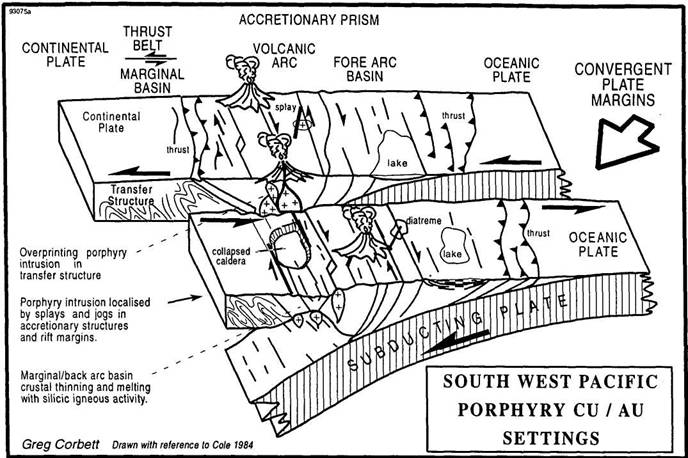
 Fig. 3.2
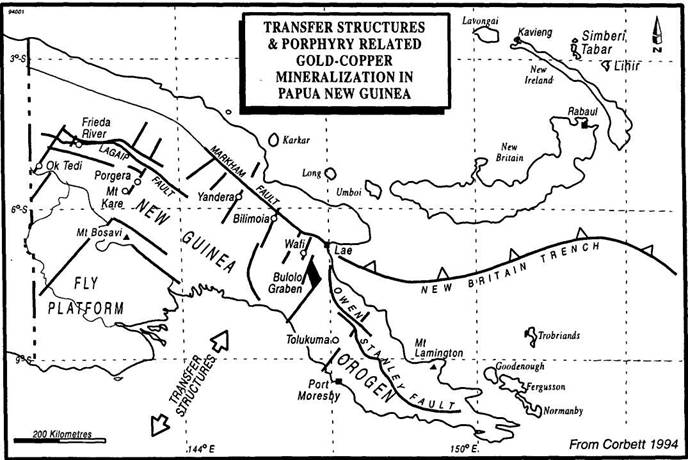
 Fig. 3.3
Exploration Workshop "Southwest Pacific rim gold-copper systems: Structure, Alteration, and Mineralization" Corbett G J & Leach T M, 8/96 Edn.
with pull-apart basins (e. g., Sumatran Fault, Indonesia at Mangani, Kavalieris et al., 1987; and Lampumg, Corbett, unpubl. report, 1993).
2. Transfer (arc-normal) structures accommodate the along-strike or dip variations in linear
detachment faults (Etheridge et al., 1988), and have been expanded using the classification of
Lowell (1987) to also include collision settings. Where at high angles to the accretionary
prism, these structures may separate segments of a subducting slab and so accommodate
variations in the dip or rate of subduction (Fig. 3.2). They may act as deep crustal
discontinuities to facilitate the emplacement of melts derived from considerable depths into
settings at higher crustal levels (e. g., Porgera and Mt Kare are localised by the Porgera
Transfer Structure, PNG, Figs. 3.3, 7.21; Corbett, 1994), or focus overprinting intrusions (e. g.,
Grasberg, Indonesia; Wafi, PNG, Fig. 6.11). Porphyry systems are commonly localised at the
intersections of transfer and accretionary structures. As deep basement features structures,
transfer structures commonly cannot easily be seen to displace folded and thrusted cover rocks
within accretionary prisms, but may be identified as fractures which penetrate the cover rocks
most readily discernible on quality Landsat imagery or aeromagnetic data (Corbett, 1994).
3. Conjugate transfer structures intersect accretionary prisms at moderate angles and may
localise porphyry intrusions at the intersections with accretionary structures. Although formed
in settings of orthogonal compression, (e. g., Banda Arc, Indonesia; and Northern Chile), these
structures may be reactivated as strike slip structures during localised extension at a relaxation
of compression. Conjugate transfer structures commonly host mesothermal vein mineralization
formed peripheral to porphyry intrusives. The strike slip rotation displayed by these structures
may facilitate the formation of higher grade portions of vein systems within localised
dilational zones (Fig. 3.9).
4. Transform faults are defined as strike slip faults which terminate against major tectonic
features such as plate boundaries and commonly separate segments of oceanic spreading
centres (Wilson, 1965; Biddle and Christie-Blick, 1985). Fractures which separate and offset
segments of oceanic ridges are well documented (Fig. 3.1). The San Andreas Fault System,
USA, (Fig. 3.1); Queen Charlotte Fault, Canada, and the Sumatran Fault System, Indonesia
(Fig. 1.2), are all major faults which terminate against spreading centres. The youthful San
Andreas transform Fault System is poorly eroded and so localises gold mineralization formed
at surficial crustal levels at McLaughlin (Tosdal et al., 1993). The more deeply eroded Queen
Charlotte Fault localises the Cinola gold deposit (Corbett, unpubl. data, 1993), and the
Sumatra Fault System hosts many epithermal gold-silver deposits (Fig. 1.2). Rotation on
transform faults has created dilational structural environments which host high sulphidation
alteration in East New Britain, PNG (Fig. 6.32).
iv) Framework for dilational structures from active tectonic environments
Seismic activity, such as earthquakes, results from the interaction of the moving plates about the Pacific rim (Fig. 3.1). In settings of oblique subduction much of the displacement, as the plates slide past each other, may taken up by transcurrent faults. The San Andreas Fault in California (Fig. 3.1) displays some 260 km of strike slip displacement (Crowell, 1962), as a transform fault which separates two segments of oceanic spreading centres (Wilson, 1965). Earthquake epicentre locations indicate that the same major structures, such as the San Andreas Fault, have been reactivated during successive earthquakes (Sibson, 1989).
Modern analogues of plate motions, which impart distinguishable and consistent strike-slip fault rotations at the frequency of earthquake activity, contribute towards a model of ore
30
 Exploration Workshop - SW Pacific Rim Au/Cu Systems: Structure Alteration & Mineralization" Corbett G J & Leach T M. 8/96 Edn.
Exploration Workshop "Southwest Pacific rim gold-copper systems: Structure, Alteration, and Mineralization" Corbett G J & Leach T M, 8/96 Edn.
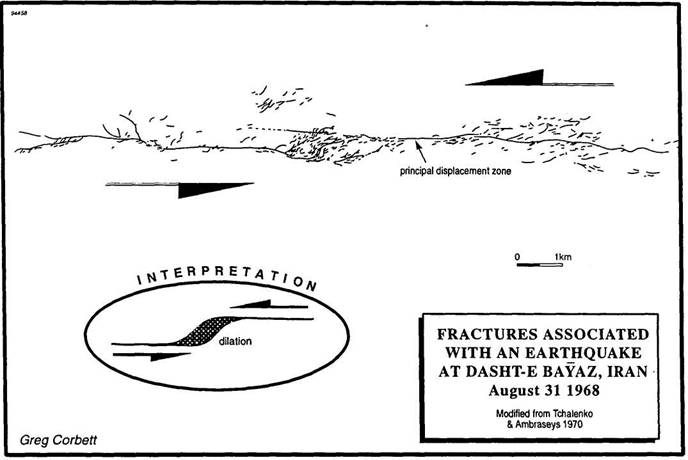
formation. Strike-slip structures are rarely single, straight, linear features, but contain irregularities. During strike-slip deformation irregularities such as bends, or zones where movement changes from one structure to another, may represent sites of compression or dilation (opening). An earthquake at Dasht-e Bayaz, Iran in 1968 provides an excellent example of dilation in such a setting (Fig. 3.4, Tchalenko and Ambraseys, 1970). Here, the displacement of cultural features delineates the direction of movement on a strike-slip fault. Subsidiary structures which link the main faults form a jog between the two major structures. These are analogous to dilatant fissure vein ore systems. Differing styles of dilatant features are described in the literature by a variety of terms (Figs. 3.5, 3.6; Segall and Pollard, 1980; Sibson, 1989). It is important to note the configurations in which subsidiary structures may be dilational or compressional, depending on the direction of rotation of the controlling major structure. Dilational settings within fault systems are important mineralizing environments (Sibson, 1986, 1987, 1992).
Following earthquake rupture, dilational fault systems may become the sites of enhanced flow of fluids derived from considerable depths by a suction pump-like mechanism (Sibson 1987, 1991, 1992). In this model, faults in the active geotectonic Pacific rim settings may display regular displacements with consistent directions. Each time an earthquake movement promotes development of a dilational zone, fluids are squeezed out of the enclosing rocks into the lower pressure regime within the dilational structure (Fig. 3.5). Hot fluids will be forced up the dilational zone and may deposit minerals by: boiling in response to instant depressurisation (flashing), cooling, or mixing with meteoric waters. Typical banded epithermal veins and dilational breccias develop by the deposition of multiple bands of minerals such as quartz and adularia. While boiling of meteoric waters (Henley, 1985a) is favoured as a mechanism for the deposition of quartz, adularia and platy carbonate (commonly subsequently pseuodmorphed by quartz) in epithermal vein systems, gold derived from magmatic sources may be deposited by mixing (see Section 4.vi. a). The important feature of this model is that dilatant fracture systems provide mediums for hydrothermal fluid transport and that repeated fault activation is the mechanism which may produce higher grade ores in many epithermal vein systems characterised by banded veins. Thus, it is possible to transport large quantities of fluids required for the formation gold deposits.
v) Dilational ore environments
In settings of oblique collision much porphyry-related gold-copper mineralization displays associations with inferred dilational features within regional strike slip structures, (e. g., deposits along the Sumatran Fault and Philippine Fault). Similarly, there is an increasing body of evidence that in settings of orthogonal collision and subduction, porphyry intrusion occurs during periods of extension, developed as a result of relaxation of subduction.
a) Aspects
Important aspects of dilational ore systems are:
1. Angular relationship between controlling and dilatant structures
2. Host rock competence.
1. Angular relationships of dilatant tension gash fractures to the controlling fractures should be carefully resolved in planning the orientation of exploration drilling or trenching (Figs. 3.5, 3.6). The regional strike-slip structures which localise an ore system may be mappable over considerable distances and contain some vein mineralization. However, the dilatant tension
31



 Exploration Workshop 'SW Pacific Rim Au/Cu Systems: Structure Alteration & Mineralisation' Corbett G J & Leach T M, 8/96 Edn.
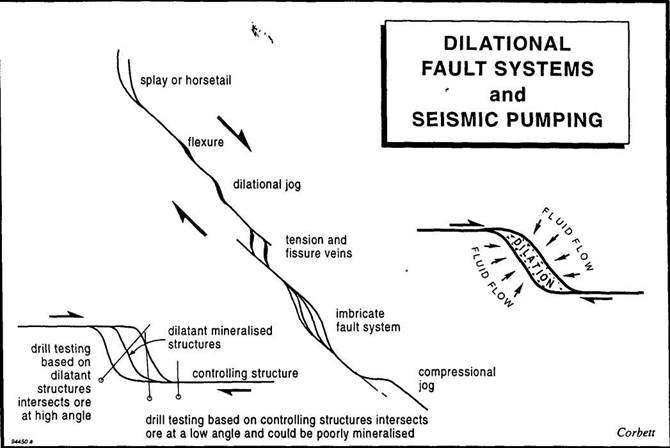
 Fig. 3.5
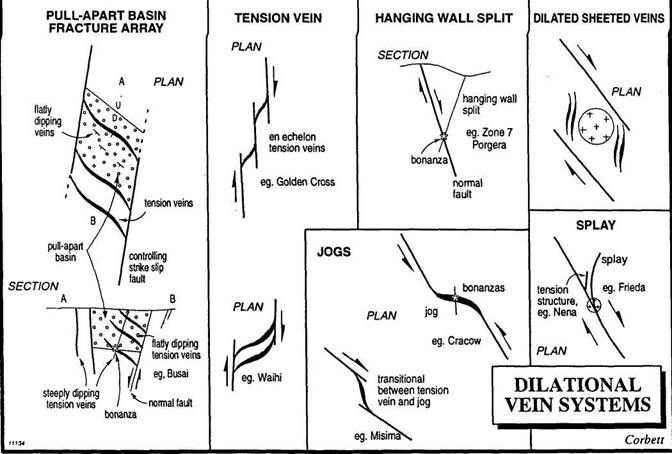
 Fig. 3.6
Exploration Workshop "Southwest Pacific rim gold-copper systems: Structure, Alteration, and Mineralization" Corbett G J & Leach T M, 8/96 Edn.

|
Из за большого объема этот материал размещен на нескольких страницах:
1 2 3 4 5 6 7 8 9 10 11 12 13 14 15 |
