

Партнерка на США и Канаду по недвижимости, выплаты в крипто
- 30% recurring commission
- Выплаты в USDT
- Вывод каждую неделю
- Комиссия до 5 лет за каждого referral
In low sulphidation deposits, magmatic fluids which contain dissolved reactive gases are reduced by rock reaction and dilution with circulating meteoric waters (Simmons, 1995). The resultant fluid is dominated by dissolved salts (mainly NaCl) and by H2S as the main sulphur species. This is interpreted (Giggenbach, 1992) to form at the roots of the low sulphidation hydrothermal system, where circulating meteoric waters acquire magmatic volatiles and probably metals. In this case the sulphur is present at an oxidation state of -2 (dominated by H2S) and was therefore termed by Hedenquist (1987) as "low sulphidation". More recently (White and Hedenquist, 1995), the term "low sulphidation" has been used to indicate the presence of a characteristic style of alteration and suite of minerals (such as sphalerite, galena, chalcopyrite) which form from near-neutral pH fluids. Under these reduced conditions, sulphides are the only secondary sulphur-bearing minerals with pyrrhotite dominant above 300°C and pyrite at lower temperatures (Giggenbach, 1987). Examples of low sulphidation gold-copper deposits include: Lihir and Porgera, PNG; Kelian, Indonesia; Golden Cross and Waihi, New Zealand; Hishikari, Japan; Kidston, Eastern Australia.
It is interpreted herein that there is an evolution from porphyry to low sulphidation-style fluids through progressive mixing of the magmatic-derived fluids with circulating fluids and water-rock reaction. The mixing of low sulphidation mineralized fluids with circulating fluids of different physico-chemical characteristics produces deposits which are zoned vertically and horizontally in relation to the source intrusion, from proximal high temperature to cooler distal settings as: quartz-sulphide gold ± copper, to carbonate-base metal gold, and epithermal quartz gold-silver. Adularia-sericite epithermal gold-silver systems are form mainly from circulating boiling meteoric waters and are characterised by the presence of banded quartz, adularia and quartz pseudomorphing platy carbonate. However, a significant proportion of the gold mineralization in these systems is interpreted herein to result from the quenching by groundwaters of circulating fluids which have incorporated the metals from deep magmatic source rocks.
13
EPOSIT TYPE | STYLES | EXAMPLES | GEOLOGICAL SETTING | STRUCTURE | ALTERATION | VEINING PARAGENESIS | MINERALIZATION |
Adularia-sericite Epithermal Au-Ag | Sinter/breccia | Osorezan, Champagne Pool | fluid upflow zones within dilational settings, | brecciated sinter | shallow argillic/ advanced argillic | polyphasal sinters -> veins ->breccias | electrum, cinnabar realgar, stibnite |
Stockwork/ fissure veins | Hishikari, Cracow, Golden Cross, Walhi | controlled by regional structures varying from fissures at depth to shallow stockworks | stockwork vein/breccia grades downwards to locally brecciated & banded veins | to deep argillic/phyllic and ■ marginal propylitic | colloform/crustiform: i) quartz-adularia - bladed calcite ii) fine-coarse quartz iii) quartz-clay-carbonate iv) clay-sulphates | electrum, silver, Ag-sulphosalts/sulphides, chalcopyrite+Au/Ag-tellurides/selenides | |
Porphyry -Related Low Sulphidation | Quartz-sulphide Au+Cu | Thames, Kainantu Hamata, Cadia Lake Cowal | porphyry setting controlled by regional structures, and veins by dilational environments and proximity to the | banded veins and breccias controlled by dilational environment and rock competency | phyllic overprinting propyiitic/potassic | veining: i) hematite-mgnetite ii) quartz-pyrite - pyrrhotite-As-pyrites iii) chalcopyrite | gold, pyrite, pyrrhotite arsenopyrite chalcopyrite hematite, magnetite, Pb-Bi-Cu-Te phases |
Carbonate-base metal Au | Kellan, Porgera open pit, Wau, Acupan, Woodlark, Karangahake | intrusive | phyllic overprinting propylitic | veining/breccias: i) quartz-adularia/sericite ii) sulphides iii) carbonates | gold, pyrite sphalerite, galena, chalcopyrite, tennantite | ||
Epithermal quartz Au-Ag | Tofuk'uma, Porgera Zone 7, Emperor, MI Kare | phyllic/argillic overprinting propylitic, late advanced argillic | veining/colloform /breccias: i) quartz-sulphides ii) quartz-adularia/carb iii) quartz-chlorite-illite | gold, pyrite sulphosalts, Au/Ag tellurides & selenides, Cu-Pb-Zn sulphides, hematite | |||
Sediment-hosted gold | Bau, Mesel | extensional structures are important | disseminated | decalcification, dolomitisation and silicification | vein+breccias: i) quartz-pyrite ii) quartz-As-pyrites | pyrite, As-pyrite, arsenopyrite, stibnite, orpiment, realgar | |
High Sulphidation | Porphyry shoulder Structurally Controlled | Horse Ivaal, .ookout Rocks, Vuda, Cabang Kid Nena, Lepanto, Mt Kasi | regional structures control intrusive emplacement, and dilational structures host rock permeability and focus fluid from upflow into outflow zones | alteration and mineralization zonations influenced by host rock permeability and dilational structures; ore commonly occurs | zoned potassic, phyllic, to advanced argillic core silicic, to | replacement dominated veins & breccias: | barren to very low grade; covellite-pyrite +enargite vertically zoned: |
Lithologically Controlled | Wafi, Nansatsu Miwah | as breccia matrix | marginal argillic, to peripheral propylitic | i) quartz ii) alunite, barite iii) pyrite | covellite, enargite, luzonite, tennantite, goldfieldite | ||
Composite Structural and Lithological | Sahglhe,~Peal< Rid, Maragorik | iv) Cu-sulphides | lateral zones: as above outward to tennantite, chalco., base metal sulphides | ||||
Porphyry | Porphyry Cu-Au Skarn | 3anguna, Ok Tedi Grasberg, Batu Hijau Ertsberg, Ok Tedi | regional structure control to intrusive emplacement as splays in accretionary structures or along transfer structures, subsurface Datholith topography nfluences breccia ntrusion | Sheeted veins important and fracture mineralization at intrusive margins and breccia matrix infill | early potassic to peripheral propylitic; late phyllic, then argillic overprints zoned isothermal, overprinted by metasomatic, and late retrograde | stockwork: i) quartz-biotite/K-spar ii) sulphides iii) sericite-clay-sulphide veining: ) garnet-pyroxene-etc. i) oxides-sulphides ii) chlorite-carb-quartz | vertical zones: bornite-chalco.-mag., to chalco.-mag. - pyrite, to pyrite-chalco-hem. zoned Cu, to Pb-Zn, to peripheral Au |
Breccia Au | Kidston, Mt Leyshan | as quartz-sulphide Au | as quartz-sulphide-Au | ||||
Alkaline Porphyry Au | Porgera, Lihir | potassic, overprinted by successive phyllic, argillic and advanced argillic | as quartz-sulphide Au | overprinting events: As-pyrite, then base metals, then Au-Ag-Te phases | |||
Table 1. Pacific Rim Cu/Au Systems - Summary of Characteristics and Examples |
Exploration Workshop 'Southwest Pacific rim gold-copper systems: Structure, Alteration, and Mineralization" Corbett G J & Leach T M, 8/96 Edn.
2 GEOTHERMAL ENVIRONMENT FOR SOUTHWEST PACIFIC GOLD-COPPER i) Settings of Active Hydrothermal-Geothermal Systems
Geothermal systems studied over the past decade have provided an increased understanding of the processes which take place during the formation of hydrothermal ore deposits. Geothermal systems are encountered in a wide range of geological settings and each one may be analogous to a distinct style of ore-forming system. These are be classified in terms of their crustal setting and probable heat source (e. g., Henley, 1985a; Fig. 2.1).
Magmatic-sourced geothermal systems occur in association with: oceanic crust along mid-ocean ridges, ocean island volcanoes formed in relation to hot spots, and back arc basins, or volcanic arcs along inter-oceanic subduction zones. Exhalative features associated with sea floor geothermal systems, such as sulphide-rich black smokers, are interpreted to represent analogies to volcanogenic massive sulphide or Kuroko-style ore deposits (Binns et al., 1993, 1995).
Active hydrothermal systems that have a magmatic heat source may be associated with crustal rifting within a continental crust, either in back arc rift zones (e. g., Taupo Volcanic Zone, New Zealand), or in continental rift zones (e. g., East African Rift). As will be shown later in this section, these types of geothermal systems have a geological setting and fluid chemistry comparable to the circulating meteoric waters associated with adularia-quartz veining which host epithermal gold-silver deposits (e. g., Waihi and Golden Cross, New Zealand).
Geothermal systems encountered in volcanic arcs associated with subducting oceanic crust (e. g., Philippines, Indonesia) are actively forming porphyry-related systems. These systems form porphyry copper-gold + molybdenum, skarn, high sulphidation copper-gold, and mesothermal to epithermal base metal-gold deposits.
Geothermal systems are also encountered in continental environments in the absence of any obvious magmatic heat source. Rapid uplift results high geothermal gradients which facilitate the leaching of metals from a thick sedimentary pile by circulating meteoric waters. Fluids migrate along major fault zones associated with plate collisions (e. g., along the Alpine Fault, South Island, New Zealand), and deposited gangue minerals and metals in dilational structural settings as post-metamorphic gold veins (e. g., Macraes Flat, South Island, New Zealand). Rapid deposition in thick sedimentary basins (e. g., southeast USA) results in the heating of connate fluids due to overpressuring. These fluids then remobilize metals, forming deposits such as the Mississippi Valley massive sulphide systems.
ii) Silicic Continental and Volcanic Arc Hydrothermal Systems
There are considerable differences in the geological setting and fluid characteristics between geothermal systems in silicic continental rift environments (e. g., New Zealand), and in volcanic arc environments (e. g., Philippines; Henley and Ellis, 1983).
In geothermal systems typical of those encountered in silicic rift environments, the heat source is considered to be a deeply buried (>5-6 km) granite/granodiorite batholith formed from melted continental crust (Fig. 2.2). Water recharge is derived from meteoric groundwaters and the intrusion supplies heat, chloride, some gases, and possibly other elements. Boiling occurs at shallow levels in response to reduced pressure, forming near-surface gas condensate zones. The upwelling chloride hydrothermal fluid, or chloride reservoir, generally reaches the surface
14

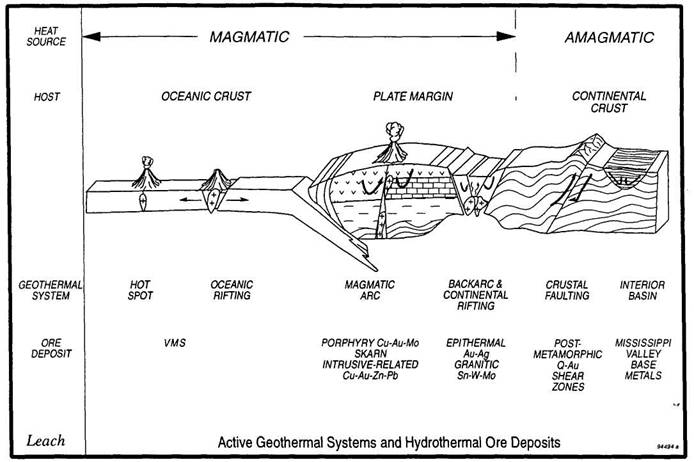
Fig. 2.1
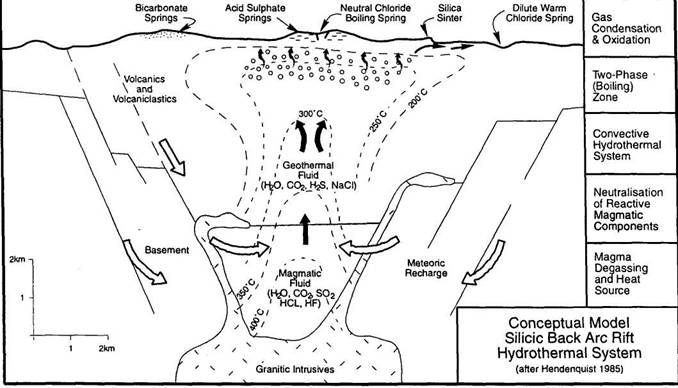
Fig. 2.2
Exploration Workshop "Southwest Pacific rim gold-copper systems: Structure, Alteration, and Mineralization" Corbett G J & Leach T M, 8/96 Edn.
as boiling springs, which deposit silica sinters either above the main upflow zone in hydrothermal eruption craters (e. g., Champagne Pool, Waiotapu, New Zealand), or in outflow zones (e. g., Ohaaki Pool, Broadlands, New Zealand). Minor zones of acid sulphate fluids form where oxidation of H2S occurs above the chloride hydrothermal system.
Active hydrothermal systems associated with volcanic arc terrains display a number of characteristics which are significantly different from those in continental silicic environments (Figs. 2.2, 2.3). In these systems meteoric recharge is typically heated by multiple shallow (<2-3 km) porphyry intrusions, which contribute significant amounts of magmatic gases, solutes, and metals to the circulating system. Steeply inclined and elevated volcanic terrains characterised by permeable pyroclastic sequences, inhibit the upwelling neutral chloride fluid from reaching the surface above the upflow zone. Instead these fluids flow laterally as far as 5-10 km to lower elevations, commonly near sea level. In some cases drilling has not „ encountered circulating chloride hydrothermal systems until up to m below surface. Condensation of CO2 and oxidation of H2S in perched aquifers above the circulating system produces extensive reservoirs of acid sulphate, bicarbonate and mixed fluids.
Fluid chemistry of the deep circulating hydrothermal fluid is also significantly different between silicic continental (New Zealand) and oceanic volcanic arc (Philippines) geothermal systems. Philippine geothermal systems locally contain up to 50 percent magmatic component (Reyes et al., 1993), whereas New Zealand geothermal systems commonly contain <3-4 percent magmatic component (Hedenquist and Lowenstein, 1994). The fluids in New Zealand systems are very dilute (<0.3-0.4 equiv. wt percent NaCl), whereas the Philippine systems are almost an order of magnitude more saline. In addition, the Philippine systems generally exhibit a significantly higher dissolved gas content. The apparent salinity (actual salinity + dissolved gases) of Philippine active hydrothermal systems ranges from 2-6 wt percent NaCl, whereas the apparent salinity of New Zealand systems is generally <1 wt percent NaCl.

|
Из за большого объема этот материал размещен на нескольких страницах:
1 2 3 4 5 6 7 8 9 10 11 12 13 14 15 |
