

Партнерка на США и Канаду по недвижимости, выплаты в крипто
- 30% recurring commission
- Выплаты в USDT
- Вывод каждую неделю
- Комиссия до 5 лет за каждого referral
gash veins are initiated at angles of 45° to the controlling structures and are progressively rotated towards 90° during the strike-slip deformation on the regional structure with which mineralization is associated (Fig. 3.9). Tension gash veins at high angles (approaching 90°) to the controlling structures display the greatest dilation and so commonly exhibit greater thicknesses and higher gold grades. Thus, drill testing normal to the orientation of the controlling structure could be at very low angles to, or essentially parallel to the mineralized gash veins. Erratic results will include anomalously high assays from the few drill holes which might bore down individual veins, while many more may be bored between veins and so will be barren. These problems could be further compounded when vertical drill patterns are used to test vein systems which commonly display subvertical orientations.
2. Competent host rocks which fracture well are required for:
* the formation of fissure-style vein systems,
* fracture controlled permeability in hydrothermal systems.
Fissure vein-style gold-silver deposits form within large-scale tension fractures (discussed below) hosted by competent rocks. In Japan, although epithermal gold deposits occur in the Miocene Green Tuff terrain, basement shales host the fissure vein gold mineralization at Hishikari (6.8 M oz Au) and Konami (2.35 M oz Au), while competent intrusive domes emplaced into volcaniclastic sequences host vein systems at the Sado (2.5 M oz Au) and Chitose (0.9 M oz Au) deposits. At Hishikari, the pronounced contrast between the competent Shimanto Group shale host rocks to the ore and the overlying clay altered and hence incompetent volcanic breccias has constrained mineralization within a 100 m vertical interval at the top of the basement Shimanto Group shales, to produce gold ores of a 80 g/t gold head grade and local bonanza gold grades (Section 8.vii. c.2). In the Coromandel Peninsular of New Zealand, the major fissure vein systems at Martha Hill (5 M oz Au), Golden Cross (1 M oz Au), and Karangahake (4 M oz Au), are hosted within massive andesite lavas while rhyolitic pyroclastics are poorly mineralized. The fissure vein at Karangahake passes to a subeconomic stockwork vein system at the transition from the andesite to the overlying rhyolitic pyroclastic rocks.
Fracture permeability provided by small-scale fracture networks such as crackle breccias (Section 3.viii. c.l) allows fluid flow for the development of hydrothermal alteration and mineralization in competent host rocks. In a complementary manner, pre-existing alteration such as silicification may promote competency. Recent experimental evidence supports field observations that fracture permeability is promoted in extensional settings (Sibson, 1993; Cox, 1994). Thus, magmatic fluid flow may be enhanced in competent host rocks adjacent to controlling fault systems in settings such as hanging wall splits (e. g. Porgera Zone VII, Corbett et al., 1995), or within extensional strike-slip systems (e. g. Nena, PNG, Corbett, 1994).
b) Styles
Differing styles of dilational environments are distinguished and in part display variations indicative of the tectonic setting and levels of erosion of the hydrothermal system (Figs. 3.5, 3.6).
Styles of dilational ore systems include:
1. Splays
2. Tension fractures
32
Exploration Workshop "Southwest Pacific rim gold-copper systems: Structure, Alteration, and Mineralization" Corbett G J & Leach T M, 8/96 Edn.
3. Jogs
4. Hanging wall splits
5. Pull-apart basins
6. Pull-apart basin fracture arrays
7. Domes
8. Ore shoots
9. Pre-existing structures
10. Sheeted fractures
1. Splays or horsetail features develop along strike-slip structures as localising agents for
porphyry intrusion (e. g., Frieda Copper, PNG, Fig. 6.18; FSE, Philippines, Fig. 6.24;
Chuquicamata, Chile). Splays which localise porphyry intrusions at depth probably propagate
upwards in dilational settings to form pull-apart basins in higher level epithermal
environments. Similarly, flower structures which are evident in profile in strike-slip or wrench
faults display pronounced vertical variations (Lowell, 1985). While positive flower structures
form in compressional settings, negative flower structures host basins.
2. Tension fracture/veins (McKinstry, 1948) form as dilational features within competent host
rocks between strike-slip faults, and are typically orientated in the direction of principal stress
(Figs. 3.9, 3.10), and commonly occur as en echelon arrays (Fig. 3.6). A variety of other terms
used are:
* tension gash is also valid for tension fractures, particularly where fractures display a
sigmoidal character (McClay, 1987; Figs. 3.6, 3.9),
* fissure is used by some workers to emphasise the steeply dipping nature of many
mineralized tension fractures,
* strike-slip duplex structures (Woodcock and Fisher, 1986) applies to similar features.
Tension veins are the most predominant form of dilational ore-hosting environment for epithermal gold-silver vein systems. Examples are well developed in the Coromandel Peninsular of New Zealand (e. g., Waihi, 5 M oz Au, Figs. 3.6, 8.6; Golden Cross, 1 M oz Au, Figs. 3.6, 8.2; Thames goldfield New Zealand, 2 M oz Au; Figs. 7.44, 7.45). Others include Mt Kasi, Fiji (Fig. 6.28); Maniape, PNG (Fig. 7.36); the relationship of the 12 km long Nena Structural Corridor to the controlling structures (Figs. 3.6, 6.19). These systems most strongly demonstrate the manner in which regional strike-slip structures localise ore systems, but are themselves essentially barren (Figs. 3.5, 3.6).
Tension gash veins terminate along strike and so prospecting should focus on the identification of new veins across strike (e. g., Waihi; Figs. 3.6, 8.6). Tension gash veins are initiated at moderate angles to controlling structures and during mineralization rotate into higher angles to the controlling structure. Thus, great care should be paid to the planning of the orientation of drilling programmes.
3. logs form as bends in a throughgoing structure, which as dilational features, may host
mineralization and may therefore be distinguished from tension veins. While some deposits
clearly occur in jogs within a single structure (e. g., Karangahake, New Zealand; Cinola,
Canada, Corbett, unpubl. data), many are less obvious as discrete jogs (Cracow, eastern
Australia, Figs. 3.6, 8.7), and some are transitional to tension vein settings (e. g., Umuna Lode,
Misima, PNG, Fig. 3.6). A major jog in the Philippine Fault hosts the Southern Negros
geothermal field which is derived from actively intruding porphyry systems (Fig. 2.6).
4. Hanging wall splits form above dipping fault structures and are best propagated in
extensional settings characterised by normal faults. Many traditional models for hot spring-
33
Exploration Workshop "Southwest Pacific rim gold-copper systems: Structure, Alteration, and Mineralization" Corbett G J & Leach T M, 8/96 Edn.
style epithermal vein systems utilise hanging wall splits (Bonham, 1988). Hanging wall splits are important loci of mineralization at Porgera (Fig. 7.23, Corbett et al., 1995) and Tolukuma (Fig. 7.48, Corbett et al., 1994c), and in both cases bonanza gold grades occur at the intersection of the normal fault and hanging wall splits.
4. Pull-apart basins or grabens and half-grabens form as parallelogram-shaped features in
settings where the focus of movement crosses from one parallel strike-slip structure to another
(Fig. 3.6). Many pull-apart basins occur along the Sumatran Fault (Pudjowalujo, 1990), and
are associated with epithermal gold-silver vein systems (Kavalieris et al., 1987; Corbett
unpubl data). Pull-apart basins fill with epiclastic sediments which, as permeable host rocks,
may readily undergo alteration in settings where intrusives are emplaced into basins (e. g.,
Cinola, Canada and others, Corbett, unpubl. data). Epithermal vein systems may form in
dilational environments within more competent basement host rocks adjacent to the pull-apart
basins (e. g., Way Linggo and Semung, South Sumatra, Indonesia, Corbett, unpubl. report,
1993).
5. Pull-apart basin fracture arrays are fracture patterns recognised in several vein systems.
These are characterised by steeply-dipping tension veins formed by rotation on controlling
structures and flatly dipping veins, which may have been initiated as extensile fractures
(Ramsay and Huber, 1987, p. 563), and enhanced within the extensional environment (Fig.
3.6). The steeply dipping tension veins may locally exhibit higher gold grades and act as fluid
flow feeders for the flatly dipping veins which tend to contain lower grade ores (e. g., Busai,
Woodlark, PNG, Figs. 7.32, 7.33, Corbett et al., 1994a; Ohui, New Zealand, Corbett, unpubl.
report, 1995). Similarly, gold mineralization at Lake Cowal, eastern Australia (2.44 M oz Au),
occurs in a setting of strike-slip deformation adjacent to the Gilmore Suture, and is best
developed in flatly dipping dilational quartz-carbonate-sulphide filled veins adjacent to
steeply dipping structures (North Limited, 1995). At Waihi, New Zealand (Fig. 8.6), the
Empire vein dips more shallowly than the Martha vein, and is locally parallel to a normal
fault. The Antamok vein system, Baguio, Philippines (10 M oz Au) displays a configuration of
NW trending steeply dipping higher grade veins and intervening lower grade shallowly
dipping veins (Sawkins et al., 1979; Damasco and Guzman, 1977). The NW veins are inferred
to have developed by sinistral rotation on controlling NS trending structures, which are
parallel to the Philippine Fault, and act as feeder structures to the intervening veins (Fig.
2.19).
7. Domes formed in basement rocks are inferred by some workers to be favourable settings for
mineralized vein systems (Mitchell and Carlile, 1994). The Hishikari vein system is aligned
along the intersection of a throughgoing linear identifiable for some distance on remote
sensing imagery (Corbett, unpubl. data, 1987) with a dome in basement Shimanto Group
shales. Similarly, Mitchell and Carlile (1994) infer a dome to localise the Acupan (4 M oz Au)
and Antamok (10 M oz Au) vein systems in the Baguio District, Philippines (Fig. 2.19). While
each are constrained between strike-slip structures, Antamok represents a pull-apart basin
fracture array, and Acupan occurs as en echelon tension gash veins aligned along a regional
structure, similar to Hishikari. The presence of a shoulder of barren high sulphidation
alteration at Baguio (Fig. 2.19, UNDP, 1987; Mitchell and Leach, 1991) and a rhyolite of
roughly the same age as mineralization at Hishikari (Izawa et al., 1990; section 8.vii. c) are
each indicative of porphyry intrusives at depth below the domes.
8. Ore shoots commonly develop as zones of increased vein width and gold grade, formed by
localised increased dilation within vein systems. Ore shoots occur as:
* Intersections of veins with diatreme breccias localise high grade ores (e. g., the GW breccias at Acupan, Philippines, Sawkins et al., 1979; Tolukuma, PNG, Fig. 7.50,
34
Exploration Workshop "Southwest Pacific rim gold-copper systems: Structure, Alteration, and Mineralization" Corbett G J & Leach T M, 8/96 Edn.
Corbett et al. 1994c; possibly Mangani, Indonesia, Kavalieris et al., 1987). These are sites of increased mixing of fluids derived from magmatic source rocks and travelling along the fractured diatreme margins.
* Shoots which form along dilatant vein/fracture systems at the intersections of cross
structures represent sites of higher fluid flow (e. g., Karangahake, New Zealand;
Cracow eastern Australia, section 8.vii. c.2; Thames goldfield, New Zealand, Section
7.iv. d; Bilimoia, PNG, Section 7.ii. d).
* Small scale jogs in linear veins.
* Rotations of vein segments constrained between domino faults (below, Fig. 3.9).
9. Pre-existing structures may be reactivated as dilatant ore hosts by changes in the stress
regime, typically in mesothermal vein systems adjacent to porphyry source rocks (e. g.,
Bilimoia and Arakompa, PNG, Section 7.ii. d; Tolukuma, PNG, Section 7.iv. d.3; Batu Hijau,
Indonesia).
10. Sheeted fractures form in porphyry and porphyry-related breccia environments in which
they may be dilated to represent favourable ore hosts described below.
vi) Fracture systems
Many dilatant ore-hosting structural environments display a history of activity extending from pre - to syn-mineralization and commonly display some post-mineralization deformation of the ore system. These structures may be reviewed in the light of fracture models. Several workers have considered the original Riedel Shear Model (Riedel, 1929; Tchalenko, 1970; Tchalenko and Ambraseys, 1970; Wilcox et al., 1973; Bles and Feuga, 1986; and many others). Great care should be exercised in the application to exploration examples of the Riedel Shear Model, which was developed from experimental work and applies to fractures developed in sedimentary cover overlying a strike slip fault in crystalline basement rocks (Fig. 3.7).
The Riedel Shear Model defines a set of specific structures which develop during strike slip deformation of this type (Fig. 3.8). Experimental data indicates that the Riedel shears (R or synthetic shears) form first and take up any early displacement. Conjugate (R1 or antithetic) shears form later and display only minor displacements opposite to the overall rotation. The P shears form last but take up much of the overall final shear displacement, especially in major fault zones. Tension gash veins are initiated at higher angles to the R shears (45°) and are progressively rotated and dilated by rotation on the shear zone (Fig. 3.9). Continuing movement on the controlling structures rotates the tension gash through the orientation in which dilation takes place to a compressional orientation, whereupon new gash structures will be initiated (Fig. 3.9). Tchalenko and Ambraseys (1970) recognised a similarity between the Riedel experiments and fracture patterns developed in association with the modern earthquake at Dasht-e Bayaz (Fig. 3.4).
The Riedel shear model is most relevant to Pacific rim exploration in the manner in which tension gash veins develop, commonly in en echelon arrays. These are intimately related to the ore hosting dilational environments in epithermal vein systems described above. For instance the Golden Cross mine, New Zealand occurs as an en echelon vein array constrained between NS structures (Fig. 8.2). The Taranaki-Hippo and Golden Cross vein systems were mined in the Nineteenth century while the Empire vein is obscured by the Omahia andesite, and so was identified more recently. This vein is currently being mined as a resource 0.9 M oz Au (Section 8.vii. c.2). Tension gash veins always display angular relationships to strike-slip
35
 Exploration Workshop "SW Pacific Rim Au/Cu Systems: Structure Alteration & Mineralization" Corbett G J & Leach T M, 8/96 Edn.
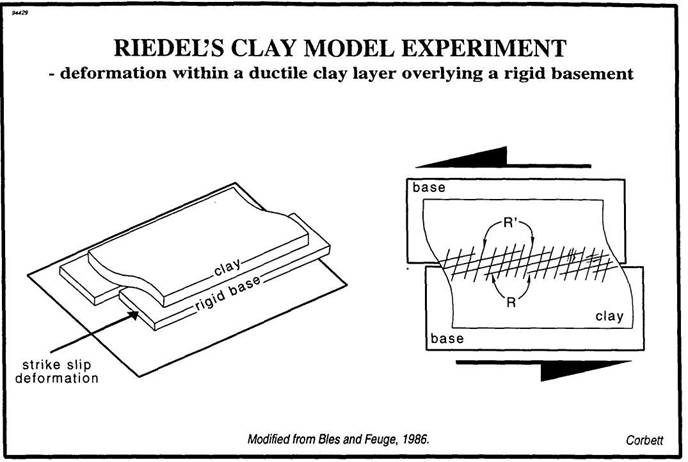
Fig. 3.7
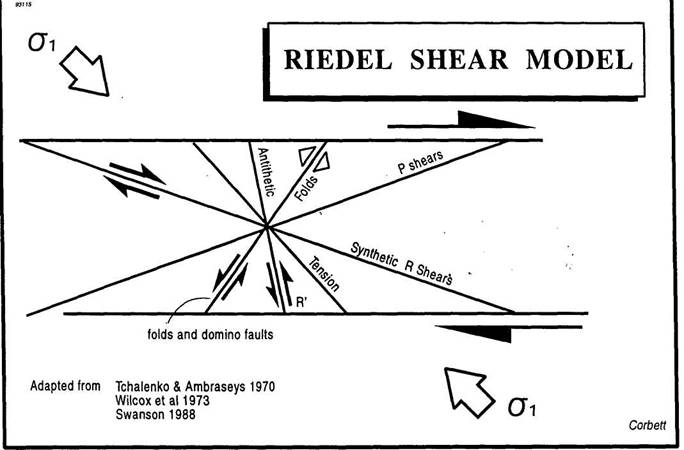
 Fig. 3.8
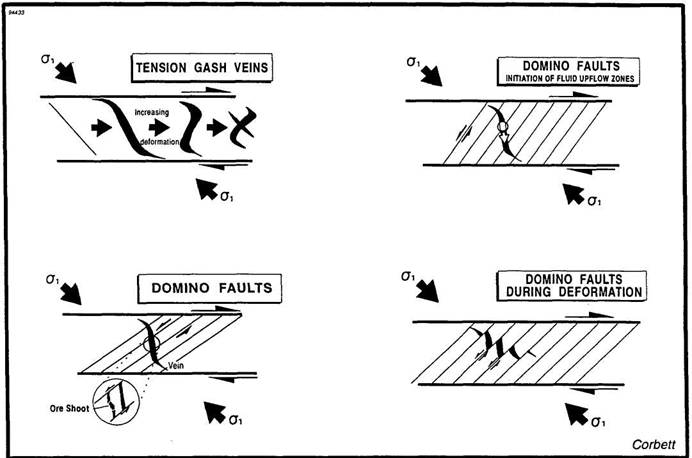
 Fig. 3.9
Exploration Workshop "Southwest Pacific rim gold-copper systems: Structure, Alteration, and Mineralization" Corbett G J & Leach T M. 8/96 Edn.
structures typical of dilation and are so distinguished from compressional fractures (Figs. 3.5, 3.9).
The fracture elements of the Riedel shear model may also be described in terms of a simple compression model (Fig. 3.10). During compression, conjugate fractures are oriented at angles <45° either side of the principle stress. Angles in the order of 60° between conjugate fractures are common (Hobbs et al., 1976), in strike-slip settings (Bles and Feuga, 1986). Tension fractures form parallel to the orientation of compression and bisect the conjugate fractures and in these settings may not display the sigmoidal shape typical of tension gash veins (Fig. 3.10). During compression or extension, rotation on conjugate structures may result in the development to tension gash veins or jogs within the conjugate fractures, which may represent higher grade dilatant portions of vein systems (Fig. 3.10).
As pointed out earlier, there is a growing body of evidence that porphyry intrusion takes place during a relaxation of compression (extension) in magmatic arcs. Pre-existing conjugate fractures commonly host mesothermal vein mineralization formed peripheral to porphyry intrusives. Higher grade zones develop in jogs within conjugate or tension gash veins formed between conjugate structures, and their shape is indicative of the orientation of rotation on the conjugate fractures (Fig. 3.10). The orientations of dilational portions of conjugate vein systems adjacent to the Batu Hijau porphyry in the Banda Arc, Indonesia (Meldrum et al., 1994) are indicative of intrusion during an extensional regime. Similarly, at the Grasberg porphyry copper-gold deposit in the same setting, quartz stockwork veins conform to orientations consistent with the activation of major local structures, including conjugate fractures (Kavalieris, 1994; Corbett, personal observation with G. MacDonald, 1994). Fracture orientations at the Frieda Porphyry are also indicative of formation during extension and in an opposite stress regime to pre - and post-mineralization compression (Asami and Britten, 1980).
Tension fractures aligned within the orientation of compression, commonly as reactivated pre-mineralization structures, may host copper-gold mesothermal vein mineralization proximal to porphyry environments (e. g., Arakompa, PNG, Fig. 7.10).
Empirical observations of many Pacific rim vein systems (Corbett, unpubl. data.) suggests that a set of cross structures may conform to a model in which these structures both influence ore formation and act as post-mineralization offsets. The parallelism has caused them to be termed domino faults. The orientation of these structures is inconsistent with either a P or R' shear in the Riedel Model. Rather, they coincide (Fig. 3.8) with the position in which folds or X fractures of Logan et al., (1979) and Swanson (1988), which are initiated as conjugate fractures during layer-parallel extension. These structures are inferred to have formed early during extension and may therefore have been activated during continuing deformation associated with mineralization. Fluid upflow features have been recognised at the intersections of domino faults and dilatant tension gash structures (Fig. 3.9). Domino faults are more commonly noted as providing post-mineralisation offsets to vein systems during strike-slip deformation, by acting as block faults to facilitate shortening and so offsets. Similar fractures are noted to facilitate block rotations between faults at the Mesquite Mining District California (Willis and Tosdal, 1992) and elsewhere by Hanmer and Passchier (1991). Rotation on the domino faults is opposite to that of the bounding strike-slip structures. Activation of the domino faults during the mineralization in epithermal vein systems may cause enhanced dilation in vein segments, constrained between these structures to form ore shoots (Fig. 3.9).
The same domino cross structures:
* localise fluid upflow zones during extension, typically in magma fluid dominated
36
Exploration Workshop "SW Pacific Rim Au/Cu Systems: Structure Alteration & Mineralisation" Corbett G J & Leach T M, 8/96 Edn.
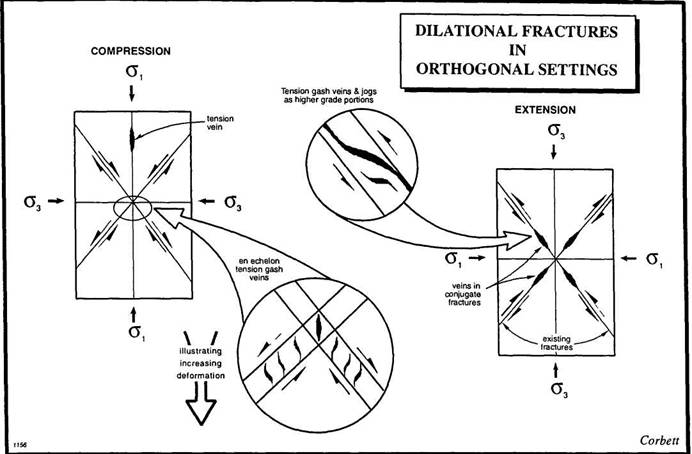
 Fig. 3.10
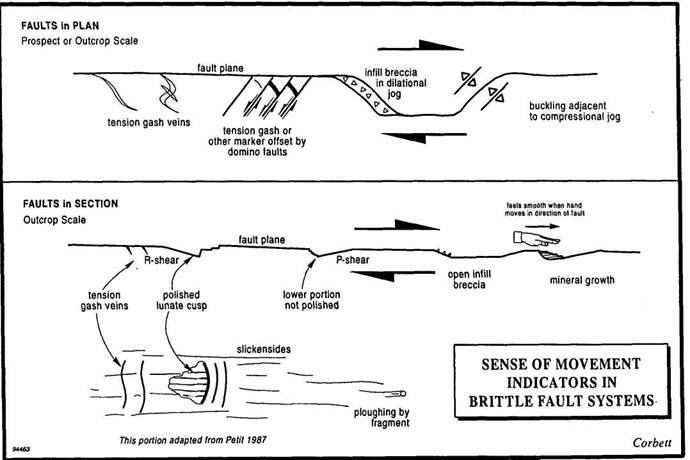
 Fig. 3.11
Exploration Workshop "Southwest Pacific rim gold-copper systems: Structure, Alteration, and Mineralization" Corbett G J & Leach T M, 8/96 Edn.
systems (e. g., Mt Kasi, Fiji),
* form high grade shoots in banded vein systems (e. g., Semung, Indonesia),
* act as post-mineral vein offsets (e. g., Tolukuma, PNG).
vii) Shear sense indicators
An understanding of the sense of displacements of faults may be an important exploration tool at different scales.
On a regional scale, the displacement on many major structures may be predicted from the tectonic setting. For example, structures parallel to the Philippine, Sumatran, or San Andreas Faults are likely to display rotations consistent with those major structures, as governed by plate movements (Fig. 3.1). Thus, in terrains dominated by strike-slip structures of consistent orientation, dilatant subsidiary structures should also display consistent orientation. The McLaughlin gold deposit is localised by strike-slip movement on structures parallel to the San Andreas Fault (Tosdal et al., 1993; Donnelly-Nolan et al., 1993). A prospecting tool may emerge from an understanding of the regional structure. If the direction of movement on a controlling regional structure is known, it might then be possible from the orientation of subsidiary structures to distinguish which structures are more likely to be dilatant and mineralized from those which are in compressional orientations and hence unmineralized (Fig. 3.5). This procedure assumes consistent senses of rotation.
In the Coromandel Peninsula, New Zealand, it has long been recognised that most vein systems trend northeast (Christie and Brathwaite, 1986). This is caused by dextral rotation on the Coromandel Peninsula derived from movement of the Pacific plate against the Australian plate (Fig. 7.44). Fissure vein systems such as Martha Hill, Golden Cross, Tui, and Karangahake are hosted within dilatant subsidiary structures.
At the prospect scale, shear sense indicators are also discernible from the application of the Riedel Shear Model to fracture systems recognised during field mapping. The orientation of dilatant versus compressional subsidiary structures and domino faults may provide sense of movement indicators on major structures, and assist in the exploration for faulted-off vein systems. Recognition of the direction of movement on weakly mineralized major structures may aid in the identification of the orientations of dilational subsidiary fractures and assist in the planning of trenching or drilling programmes (Fig. 3.5). High-grade ore shoots formed within a domino fault model may also represent important exploration targets.
Outcrop scale sense of shear indicators may be indispensable in the determination of offsets of vein-style ore bodies, particularly in underground mines. Slickensides, scratch marks, ploughed striations, or grooves and crystal growths, are indicators of whether a fault displays dip-slip or strike-slip rotation. However, the sense of which block is up/down or left/right as defined by irregularities in the slickensides is more difficult. Petit (1987) categorised secondary fractures in terms of the Riedel shear model as P, R or T shears to provide direction of movement indicators. These features may be difficult to identify in outcrop. Plough marks or mineral growth fibres provide easily discernible indicators of the direction of movement (Fig. 3.11). The "smooth-rough" rule suggests that when a hand is run over fibres within a fault, the direction which feels smooth, is that of block movement (Mawer, 1992).
37
Exploration Workshop "Southwest Pacific rim gold-copper systems: Structure, Alteration, and Mineralization" Corbett G J & Leach T M, 8/96 Edn.
viii) Porphyry - and intrusion-related fracture patterns
In compressional arcs porphyry intrusions are inferred to have commonly been emplaced during a relaxation of compression (extension). Similarly, in settings of oblique subduction, porphyry intrusions are localised at dilatant features (splays or jogs) within accretionary structures, or at the intersections with cross structures such as transfer structures. Many porphyry gold-copper ore bodies are inferred to have formed as apophyses to larger magma sources at depth from which much of the mineralization has been bled (Section 5.c). The low and high sulphidation gold-copper mineralization discussed herein is derived from magmatic source rocks, but occurs outside the porphyry environment. Fracture systems are therefore important in fluid transport from the magma source to sites of deposition, and mineral deposition.
A common ore hosting environment in porphyry-related Pacific rim mineral systems is sheeted fractures formed in association with porphyry intrusion which become dilated by syn-mineral deformation. The integration of studies of fracture patterns resulting from intrusion emplacement (Phillips, 1974; Koide and Bhattacharji, 1975) with those of dilational structural environments (above) may aid in the evolution of models for ore deposition.
Fracture systems associated with porphyry intrusion occur as:
1. Reactivation of existing fracture/breccia systems,
2. Radial fractures, commonly exploited by radial dykes,
3. Ring fractures and dykes,
4. Sheeted fractures,
1. Existing fractures and breccias are common mediums of fluid transport in porphyry
systems. These may have been reactivated as dilational features during porphyry intrusion and
the subsequent evolution of fluids, and may reflect the dilational structural environment into
which the porphyry was emplaced. Many mineralized porphyry copper-gold deposits are
inferred to represent cylindrical-shaped apophyses to larger magma sources at depth (e. g.,
Goonumbla, eastern Australia, Heithersay et al., 1990; Grasberg, Indonesia, MacDonald and
Arnold, 1994; Philippine deposits, Sillitoe and Gappe, 1984). The fractured and brecciated
contacts to the apophyses are common mediums of fluid transport. Stockwork quartz veins
formed during porphyry emplacement may be cut by later fractures which transport fluids and
metals.
2. Radial fractures formed by the initial porphyry intrusion are commonly exploited by dykes
(Fig. 3.12). The radial pattern may be modified by any pre-existing structural grain and can
extend for some distance from the porphyry source. The fracture pattern of mineralization at
Grasberg is indicative of the enhancement of regional throughgoing fractures as conjugate
joints and the exploitation of these by mineralized fluids (Kavalieris, 1994).
3. Ring dykes commonly form as late stage intrusives which exploit concentric fractures
formed by magma contraction in caldera ring fracture settings. In settings such as Emperor
gold mine (Eaton and Setterfield, 1993) ring fractures form hosts for mineralization developed
in distal settings to the porphyry source, especially at the intersections with cross structures.
4. Sheeted fractures and veins are an important mechanism of fluid transport in many
porphyry copper-gold and porphyry-related breccia gold systems. The term sheeted fractures
has been used in the geological literature to describe parallel fractures which form as flat lying
extension joints in granitic rocks (Price, 1966; Hobbs et al., 1976). These probably form as a
38

 Exploration Workshop "SW Pacific Him Au/Cu Systems: Structure Alteration & Mineralisation" Corbett G J & Leach T M, 8/96 Edn.
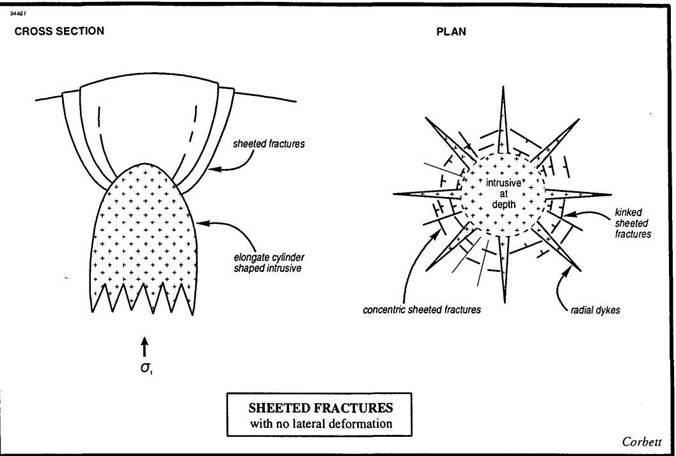
 Fig. 3.12
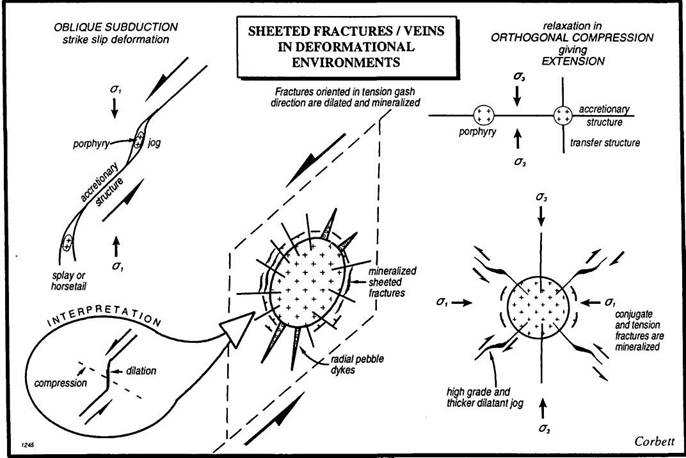
 Fig. 3.13
Exploration Workshop "Southwest Pacific rim gold-copper systems: Structure, Alteration, and Mineralization" Corbett G J & Leach T M. 8/96 Edn.
result of erosion-induced stress release, particularly in glaciated terrains (Price, 1966). More dynamic stress inducted structures are of interest to the exploration geologist in porphyry terrains. These conditions may give rise to steeply dipping sheeted fracture/veins which overlie porphyry systems as important ore hosts.
Sheeted fracture/veins
Many mineralized porphyry intrusives occur as cylindrical-shaped apophyses to larger magma sources (e. g., Goonumbla, eastern Australia, Heithersay et al., 1990; Grasberg, Indonesia, MacDonald and Arnold, 1994; Philippine deposits, Sillitoe and Gappe, 1984). The forceful vertical emplacement of the cylindrical intrusive causes cone-shaped sheeted fractures to form in the overlying rocks (Phillips, 1974). Cone-shaped sheeted fractures ring the top of the intrusive as kinked straight segments, dipping moderately inward close to the intrusive and steepening at higher levels and further from the intrusive (Fig. 3.14). There is a small element of horizontal stress near the intrusive but only a vertical component at higher levels. Concentric fractures propagate above intrusions with high interstitial fluid pressures compared to lithostatic pressures and form concave upward shapes (Koide and Bhattacharji, 1975). Stockwork fractures form in the carapace and sheeted fractures predominate above the intrusive margins. These are well placed to act as plumbing systems for fluids which migrate along the margins of the intrusive and into the overlying sheeted fractures (especially where dilated, see below). Overprinting intrusives and the vertical nature of the apophyses promote the development of sheeted fractures within earlier intrusives, which become hosts for later mineralization, derived from intrusions at depth. Large-scale sheeted fractures accommodate collapse as caldera ring fractures. Others act as a locus of intrusion of breccia systems and so may form funnel-shaped breccia pipes.
The term stockwork breccia/fracture/veins is distinguished from sheeted fractures and used to describe more randomly oriented network veins such as the quartz veins which characterise porphyry systems. Although the overall geometry is similar, the presence of veins distinguishes stockwork veins from crackle breccias (below). The random stockwork veins form in settings where stress regimes are not pronounced, typically in the upper portions of porphyry intrusions, whereas sheeted veins are inferred to form overlying porphyry margins (Fig. 3.12), or marginal to subvolcanic breccia pipes (Fig. 3.15).
Role of "retrograde boiling"
"Retrograde boiling" is probably better termed the exsolution of volatiles due to crystallization of a melt (Shinohara and Kazahaya, 1995). This is an important process in the formation of copper-gold mineralization within the porphyry environment as well as in fracture and breccia systems above the source porphyry (Phillips 1973, 1986; Burnham, 1985). A detailed discussion of retrograde boiling is given by Burnham (1979) and summarised by Pirajno (1992). Many mineralised porphyry systems occur as apophyses into which volatiles have collected from larger magma bodies at depth. Cylindrical shaped intrusions are noted by many workers (e. g. Philippines, Sillitoe and Gappe, 1984; southwest USA, Lowell and Gilbert, 1970; Grasberg, Indonesia, MacDonald and Arnold, 1994; Goonumbla, eastern Australia, Heithersay et al., 1990). Volatile-rich intrusions display lower viscosities and so are emplaced more easily to higher crustal levels, as apophyses. Intrusions form a carapace comprising the chilled margin surrounded by thermally metamorphosed country rock and then progressively cool inwards. The marked reduction in confining pressure, and hence solubility, as a magma emplacement to a high crustal level promotes an exsolution of volatiles. This is termed first boiling by Pirajno (1992).
39
Exploration Workshop 'Southwest Pacific rim gold-copper systems: Structure, Alteration, and Mineralization" Corbett G J & Leach T M, 8/96 Edn.
The exsolution of volatiles results in a volume increase as the cooling intrusive separates into crystal and the volatile components. This may be accentuated by the collection of volatiles in the apophyses to a larger body of cooling magma. Intrusives forcibly emplaced to high crustal levels will cool more quickly. At these levels the lithostatic confining pressure is lowered, but partly compensated for by the increased tensile strength of the carapace of the inward cooling magma. The carapace essentially seals the system and encloses the saturated and overpressured fluids. Traditional models (Phillips, 1973; Burnham, 1979) focus upon fracture of the carapace at the point at which the vapour pressure exceeds load pressure + surface tension + tensile rock strength. Disruption by faults which control porphyry emplacement in tectonically active magmatic arcs may fracture the carapace before that point is reached. The disruption of the overpressured carapace dramatically lowers the vapour pressure, prompting additional exsolution of volatiles. The pressurised fluids may escape as:
* explosive breccias,
* promote hydraulic fracturing of the carapace,
* sheeted fractures.
Explosive breccias are discussed below. Rocks which have undergone hydraulic fracturing provide a large surface area for alteration by the venting hydrothermal fluid, commonly as injection breccias (below). Quenching in response to rapid changes in conditions may promote metal deposition (e. g., high gold grades breccias at Lihir, PNG, Moyle et al., 1990). The margins of cylindrical intrusions are overlain by conical sheeted fractures which propagate upwards. The rapid depressurisation dramatically lowers the solubility of quartz (Fig. 4.2) which infills fractures as veins.
Dilated sheeted fractures
Many southwest Pacific rim porphyry systems are emplaced into active plate margins and localised along regional accretionary (arc-parallel), strike-slip structures by jogs, splays, or intersections with transfer (arc-normal) structures (Fig. 3.13). The stress environment active during initial intrusion commonly continues during sheeted fracture formation, degassing of the intrusive, and mineralization. In environments of oblique collision, and associated strike-slip deformation on regional controlling structures, the sheeted fractures aligned along the tension gash orientation become dilated and mineralized while others undergo compression (Fig. 3.13). These preferentially dilated sheeted fractures which overlie intrusives represent a medium which may host mesothermal vein mineralization. Many porphyry systems display differing intensity of sheeted fracture development in relation to the regional stress regimes. Dilatant structures not only focus the upward moving magmatic fluids but also host ground waters, to promote mineralization by mixing.

|
Из за большого объема этот материал размещен на нескольких страницах:
1 2 3 4 5 6 7 8 9 10 11 12 13 14 15 |
