


Партнерка на США и Канаду по недвижимости, выплаты в крипто
- 30% recurring commission
- Выплаты в USDT
- Вывод каждую неделю
- Комиссия до 5 лет за каждого referral
Modal Verb | Example/s | Explanation |
May I... ? | May I (please) borrow your pen? | May I and Could I are used to request permission. They are equally polite. |
Can I... ? | Can I borrow your pen? | Can I is used informally to request permission, especially if the speaker is talking to someone s/he knows fairly well. Can I is usually considered a little less polite than May I or Could I. |
Response | Certainly. | Often the response to a polite request is an action, such as a nod or shake of the head, or a simple "uh-huh." |
2. Polite Requests with "You" as The Subject
Modal Verb | Example/s | Explanation |
Would You... ? | Would you pass the salt (please)? | The meaning of would you and will you in a polite request is the same. Would you is more common and is often considered more polite. The degree of politeness, however, is often determined by the speaker's tone of voice. |
Could you...? | Could you pass the salt (please)? | Basically, could you and would you have the same meaning. The difference is slight. |
Can you...? | Can you (please) pass the salt? | Can you is often used informally. It usually sounds less polite than could you or would you. |
Response | Yes, I'd ( I would ) be happy to | A person usually responds in the affirmative to a polite request. If a negative response is necessary, a person might begin by saying "I'd like to, but...." (e. g I'd like to pass the salt, but I can't reach it"). |
Formal style: Mrs. Brown, may I stay at your house till Wednesday? – 1. Yes, you may. 2. No, you may not. / I'm afraid it's not possible.
Less formal: Could I stay here till Wednesday? – 1. Yes, of course. / Certainly. / Yes, you can. 2. I'm afraid it's not possible. / Sorry, you can't.
Informal: Can I stay here till Wednesday? – Sure.
The phrase "be allowed to"
The substitute phrases "be allowed to do something, be not allowed to do something" can be used for describing permission in the present, future, and past.
I am not allowed to leave the house. | Мне не разрешено покидать дом. |
You will be allowed to see the patient soon. | Вам разрешат увидеться с больным скоро. |
Note: | Примечание: |
CAN and MAY are also used in polite offers, often in an offer of help. Examples: Can I help you? (less formal) – May I help you? (more formal). Can I help you with anything? Can I help you with your home assignment? Can I help you (to) wash the dishes? Can I help? Can I offer you a drink? | CAN и MAY также употребляются в вежливых предложениях чего-то, часто в предложении помощи. Примеры: Can I help you? (менее официально) – May I help you? (более официально). Могу я вам помочь чем-нибудь? Могу я вам помочь с вашим домашним заданием? Могу я вам помочь вымыть посуду? Могу я помочь? Могу я предложить вам напиток? |
The phrase "Would you mind" | Фраза "Would you mind" |
The phrase "Would you mind" is widely used in making requests and asking for permission. | Фраза "Would you mind" широко употребляется для обращений с просьбами и спрашивания разрешения. |
Request to do something: Would you mind + gerund | Просьба сделать что-то: Would you mind + герундий |
Would you mind opening the window? (Meaning: You ask someone to open the window.) – Of course not. / Not at all. | Вы не возражали бы открыть окно? (Значение: Вы просите кого-то открыть окно.) – Конечно, нет. / Ничуть (не возражаю). |
The phrase "Do you mind" | Фраза "Do you mind" |
In everyday English, the structure "Would you mind" is sometimes changed to "Do you mind". The structure "Do you mind" is a little less polite than "Would you mind". | В разговорном английском, конструкция "Would you mind" иногда меняется на "Do you mind". Конструкция "Do you mind" несколько менее вежлива, чем "Would you mind". |
Do you mind opening the window? | Вы не возражаете открыть окно? |
The phrase "I would like" | Фраза "I would like" |
The phrase "I would like" expresses preference or desire to do or get something and is used in certain situations as a polite substitute for requests. In questions, "Would you like" is often used as a polite offer. | Фраза "I would like" выражает предпочтение или желание сделать или получить что-то и употребляется в ряде ситуаций как вежливый заменитель просьб. В вопросах, "Would you like" часто употребляется как вежливое предложение чего-то. |
Requests in the form of negative questions | Просьбы в форме отрицательных вопросов |
As a rule, polite requests in English are not asked in the form of negative questions. Polite requests in Russian are usually in the form of negative questions. Russian students often make mistakes in requests in English because of this difference. | Как правило, вежливые просьбы в английском языке не задаются в форме отрицательных вопросов. Вежливые просьбы в русском языке обычно бывают в форме отрицательных вопросов. Русские студенты часто делают ошибки в просьбах на английском языке из-за этой разницы. |
Generally, negative questions have some emotion in them, e. g., surprise, expecting yes for an answer, mockery, annoyance, complaint. Requests in the form of negative questions can often sound impolite. Learners of English should avoid making requests in the form of negative questions. Examples of impolite requests, with the meaning they convey and the reaction they might provoke: | Отрицательные вопросы обычно содержат в себе какую-то эмоцию, например, удивление, ожидание ответа «да», насмешку, раздражение, жалобу. Просьбы в форме отрицательных вопросов могут часто звучать невежливо. Изучающим язык следует избегать обращения с просьбами в форме отрицательных вопросов. Примеры невежливых просьб, со значением, которое они передают, и реакцией, которую они могут вызвать: |
Can't you give me a cup of tea? (Meaning: I'm surprised that you haven't offered me a cup of tea.) – Of course I can give you a cup of tea! I just didn't know that you wanted tea. | Разве вы не можете мне дать чашку чая? (Значение: Я удивлен, что вы не предложили мне чашку чая.) – Конечно, я могу вам дать чашку чая! Я просто не знал, что вы хотите чай. |
Won't you help me? (Meaning: I see that you don't want to help me.) – Of course I will help you! Have I ever refused to help you? | Разве вы мне не поможете? (Значение: Я вижу, что вы не хотите мне помочь.) – Конечно я помогу вам! Разве я когда-нибудь отказывался вам помочь? |
EXERCISE:
A. Read the statements and change it into request using modal verbs above.
1. I want a glass of water.
2. Lock the door, please.
3. Pass the book over there.
4. Do you want me to help you?
5. Bring me my note book. 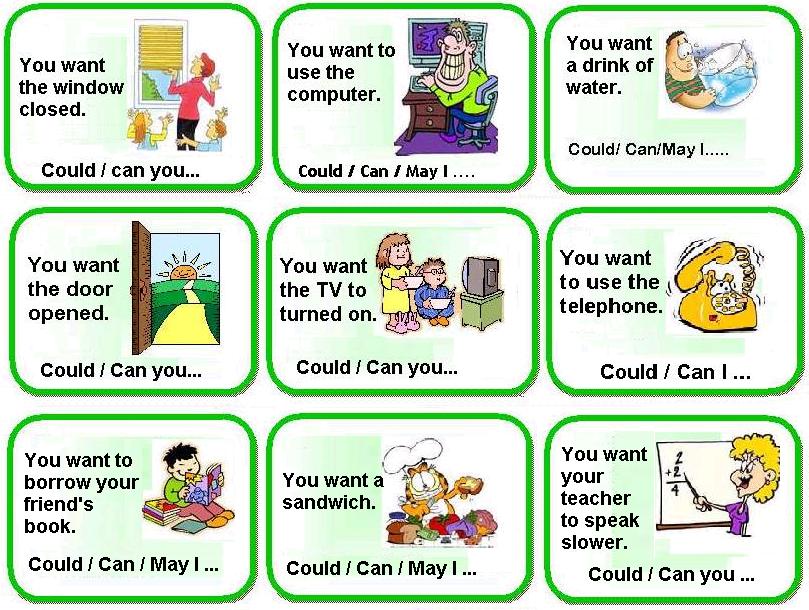
B. Make a request using the pictures below.
C. Requests
Choose the most appropriate answer for expressing the idea specified in parentheses.
1. I speak to Mr. Smith, please? (Formal polite request)
 Can
Can May
May Would
Would Would you mind if
2. you open the window, please? It's hot in here. (Polite request)
 Could
Could Couldn't
 Won't
Won't Wouldn't
3. buying two loaves of bread on your way home? (Polite request)
 Could you
 Will you
 Would you
 Would you mind

|
Из за большого объема этот материал размещен на нескольких страницах:
1 2 3 4 5 6 7 8 9 10 11 12 13 14 15 16 17 18 19 20 21 22 23 24 25 26 27 28 29 30 31 32 33 34 35 36 37 38 39 40 41 |
