


Партнерка на США и Канаду по недвижимости, выплаты в крипто
- 30% recurring commission
- Выплаты в USDT
- Вывод каждую неделю
- Комиссия до 5 лет за каждого referral
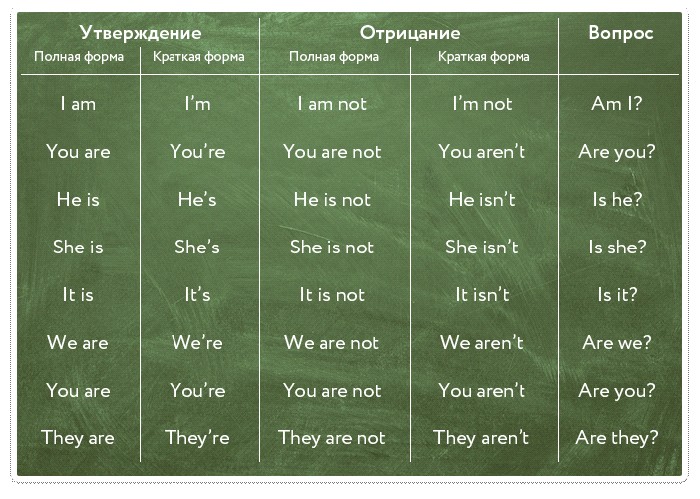
Формы глагола to be
I am in the room.
Я нахожусь в комнате.
The book is on the table.
Книга лежит на столе.
В данных примерах глагол to be является самостоятельным глаголом. Так же, как и в русском языке, глагол to be может быть глаголом-связкой в именном сказуемом (в значении "есть").
В отличие от русского языка, в английском языке глагол-связка никогда не опускается, поскольку английское предложение имеет строго фиксированный порядок слов: подлежащее (subject) +сказуемое (verb) + дополнение (object)
I am a doctor.
Я врач. (Я есть врач.)
The weather is bad.
Погода плохая.
They are from Paris.
Они из Парижа.
Итак, глагол-связка to be в английском предложении никогда не опускается, т. к. он входит в именное сказуемое, и его место после подлежащего. На русский же язык глагол to be в данных случаях не переводится:
I am happy.
Я счастлив.
The book is interesting.
Книга интересная.
He is our teacher.
Он наш учитель.
Глагол to be не требует вспомогательного глагола для образования вопросительной или отрицательной формы.
Чтобы задать вопрос нужно поставить глагол to be перед подлежащим:
Am I happy?
Is the book interesting?
Is he our teacher?
Для образования отрицательной формы достаточно поставить отрицательную частицу not после глаголаto be:
I am not happy.
The book is not interesting.
He is not our teacher.
В разговорной речи отрицательная частица not часто сливается с глаголом to be, образуя сокращения:
is not = isn't
are not = aren't
Также глагол to be может сокращаться, сливаясь с личным местоимением:
I am = I'm
We are = we're
He is = he's
Complete what Brenda says about herself on the picture.
Use is or are. My name (1) ______ Brenda Foster. I (2) ______ on the left in the picture. I (3) ______ ten years old and I (4) ______ in the fifth form. My birthday (5) _____ on the first of January. I (6) ______ from Santa Monica, California, USA. I (7) ______ American. My phone number (8) ______ 235-456-789. I live at 16 Park Street. My post code (9) ______ LA 30 SM. I’ve got a sister and a brother. Their names (10) ______ Gina and Paul. Gina (11) ______ 16 years old and Paul (12) ______ only three. I’ve also got a dog. His name (13) ______ Spot. He (14) ______ on the right in the picture. My Mum (15) ______ a doctor. She works at a hospital. My Dad (16) ______ a driver. He works in Los Angeles. We (17) ______ all friendly in our family.
Fill in is, are, He’s, She’s, l’m, They’re.
How _____ your mum? — _______ fine, thanks. How _____ your parents? — _____ OK. How _____ you? — _____ very well, thank you. How _____ your uncle? — _____ fine, thanks. How _____ your children? — _____ OK. How _____ Liz? — _____ fine, thanks. How _____ your cousin? — _____ very well, thank you
Write in was / were
1._______ your mum tired yesterday?
2. _______ you hungry yesterday evening?
3._______ it cold yesterday?
4._______ your teacher sad yesterday?
5._______ your pet hungry yesterday?
Вставьте глагол to be в нужном времени. (Present Simple / Past simple / Present Perfect / Future Simple)
Present Simple
Past Simple
«When you ________ a small child, _________ you happy?» «Yes, I ________. I ________ very happy.» They (not) ________ ready for the lesson last Tuesday. The days_________ cold and wet last September. There ________20 pupils in our class last year.Present Perfect
13. I ________ill for the last few weeks.
14. Where _______ John _________ all day?
15. They (not) ________ to this part of the country.
16. «________ she________ to America? » «No, she ________.»
Future Simple
17. He ________ 13 years old tomorrow.
18. I ________ back home at 6 o’clock.
19. We __________ at the library at that time.
20. They __________ here at 3 o’clock. 21. They ________ happy to see us.
Вставьте глагол tobe в нужном времени. (Present Simple / Past simple / Present Perfect / Future Simple)
A
Hello! Му name ________ Alan. I________ thirteen. My friend’s name ________ David. He ________ thirteen, too. We ________ from Belarus. Last summer we ________ at the seaside. The weather ________ sunny. There________ many people on the beach. We had a good time. I hope next summer it ________ sunny and warm, too. There________ a lot of nice days. I ______ never ________ to other countries. Some day in future I ________ lucky to visit London and my holidays ________ great.
B
1. The animals ________ in danger. 2. There ________ only a few mountain gorillas in the world now. 3. It ________ the thirty-first today. 4. The wind ________ strong yesterday. 5. We________ at the end of Cliff Road when Alan fell down. 6. What ________ the weather like yesterday? 7. I hope your leg________ better soon. 8. ________ you________ at home tomorrow? 9. _______ you ever________ to London? 10. I ________ ill for a week.
Переведите предложения на английский язык.
Simple Present – Present Progressive
Simple Present | Present Progressive |
infinitive I speak | form of 'be' and verb + ing I am speaking |
Exceptions | |
Exceptions when adding 's' :
Example: he can, she may, it must
Example: do - he does, wash - she washes
Example: worry - he worries | Exceptions when adding 'ing' :
Example: come - coming
Example: sit - sitting
Example: travel - travelling (British English)
Example: lie - lying |
Simple Present | Present Progressive |
in general (regularly, often, never) Colin plays football every Tuesday. present actions happening one after another First Colin plays football, then he watches TV. | right now Look! Colin is playing football now. also for several actions happening at the same time Colin is playing football and Anne is watching. |
Signal words | |
|
|
Note: The following verbs are usually only used in Simple Present: |
Simple Present | Present Progressive |
action set by a timetable or schedule The film starts at 8 pm. | arrangement for the near future I am going to the cinema tonight. |
Simple Present | Present Progressive |
daily routine Bob works in a restaurant. | only for a limited period of time (does not have to happen directly at the moment of speaking) Jenny is working in a restaurant this week. |
Certain Verbs
The following verbs are usually only used in Simple Present (not in the progressive form).
- state: be, cost, fit, mean, suit
Example: We are on holiday.
- possession: belong, have
Example: Sam has a cat.
- senses: feel, hear, see, smell, taste, touch
Example: He feels the cold.
- feelings: hate, hope, like, love, prefer, regret, want, wish
Example: Jane loves pizza.
- brain work: believe, know, think, understand
Example: I believe you.
- Introductory clauses for direct speech: answer, ask, reply, say
Example: “I am watching TV,“ he says
1. Раскройте скобки, употребляя глаголы в Present Continuous илиPresent Simple.
1. He (to work) in the centre of the city.
2. I (to write) an exercise now.
3. You (to go) to school on Saturdays?
4. We (not to dance) every day.
5. They (to play) in the room now?
6. Where he (to live)? – He (to live) in a village.
7. He (to sleep) now?
8. They (to read) many books.
9. The children (to eat) soup now.
10. He (to help) his mother every day.
11. You (to play) the piano well?
12. Look! Kate (to dance) now.

|
Из за большого объема этот материал размещен на нескольких страницах:
1 2 3 4 5 6 7 8 9 10 11 12 13 14 15 16 17 18 19 20 21 22 23 24 25 26 27 28 29 30 31 32 33 34 35 36 37 38 39 40 41 |
