


Партнерка на США и Канаду по недвижимости, выплаты в крипто
- 30% recurring commission
- Выплаты в USDT
- Вывод каждую неделю
- Комиссия до 5 лет за каждого referral
5.3. Самостоятельная работа по теме:
Вопросы для самоподготовки.
1. What does a tooth consist of?
2. How is the junction of crown and root called?
3. What is every tooth composed of?
4. What do you know about enamel?
5. What does it consist of?
6.Where does cementum meet enamel?
7. What is cementum?
8. Is dentine sensitive to pain?
9. What does pulp contain?
10. What is the pulp chamber?
11. What supporting structures can you name?
1.2. Упражнения по теме.
Ask questions to the italicized words:
1. The root is the part hidden inside the jaw.
2. The microscope shows that it consists of long solid rods.
3. Cementum is similar in structure to bone.
4. Cementum meets enamel at the neck of the tooth.
5. Dentine is very sensitive to pain.
6. The pulp is purely soft tissue.
7. The outermost layer of the pulp is lined with the special cells.
8. The alveolar process is covered with gum.
9. Periodontal membrane acts as a shock absorber.
10. It consists mainly of bundles of fibers.
Insert prepositions or adverbs:
1. Every tooth consists... a crown and one or more roots.
2. It is insensitive ... pain.
3. Any damage caused... decay or injury is permanent.
4. They are cemented together... the interprismatic substance.
5. The prisms run roughly... right angles... the surface.
6. Cementumn is similar... structure to bone.
7. Dentine occupies the interior... the crown and root.
8. Vessels and nerves of the pulp pass... the root canal... the crown.
9. The outermost layer of the pulp is lined... special cells.
10. They run... the full thickness of dentine.
11. A tooth is inserted... the jaw... its root.
12. Any tooth is attached... its socket... the jaw... a soft fibrous tissue called the periodontal membrane.
5.4. Итоговый контроль знаний: Тестовые задания по теме.
1. ЗАПОЛНИТЕ ПРОПУСКИ:
EVERY TOOTH CONSISTS ... A CROWN AND ONE OR MORE ROOTS.
1) at
2) in
3) by
4) of
2. ЗАПОЛНИТЕ ПРОПУСКИ:
A TOOTH IS INSERTED ... THE JAW.
1) in
2) on
3) at
4) down
3. ЗАПОЛНИТЕ ПРОПУСКИ:
THE PULP IS PURELY …. TISSUE.
1) like
2) strong
3) hard
4) soft
4. ЗАПОЛНИТЕ ПРОПУСКИ:
THE ROOT IS THE PART HIDDEN …. THE JAW.
1) inside
2) outside
3) under
4) on
5. ЗАПОЛНИТЕ ПРОПУСКИ:
THE …. OF THE PULP ARE RESPONSIBLE FOR PAIN.
1) vessels
2) colour
3) nerves
4) sizes
Ситуационные задачи по теме.
1. Опишите состав пульпы и объясните, что делает ее чувствительной.
2. Объясните своему товарищу, который опоздал на занятие, что такое дентин.
6. Домашнее задание для уяснения темы занятия
Подготовить сообщение о системе медицинского образования в Институте стоматологии КрасГМУ. Составить резюме.
Вопросы для самоподготовки.
1. What does a tooth consist of?
2. How is the junction of crown and root called?
3. What is every tooth composed of?
4. What do you know about enamel?
5. What does it consist of?
6.Where does cementum meet enamel?
7. What is cementum?
8. Is dentine sensitive to pain?
7. Рекомендации по выполнению НИРС.
Примерные темы проектов/докладов: «The Structure of a Tooth»,
«The Damages of the Tooth Structure »
Занятие № 9
1. Тема занятия «Two Sets of Teeth. Teeth and Gums».
2. Форма организации учебного процесса: практическое занятие.
3. Актуальность темы для будущих специалистов - стоматологов
обеспечивается ее узкопрофессиональной направленностью.
4. Цели обучения:
Общая цель: студент должен обладать ОК-1,ОК-5,ОК-6,ПК-50.
Учебная цель -
Знать: лексический минимум лексических единиц общего и
терминологического характера по теме занятия «Two Sets of Teeth.Teeth and
Gums», правила употребления артиклей, личных и притяжательных
Уметь: использовать терминологические единицы и терминоэлементы по
теме занятия в диалогической и монологической речи, кратко рассказать о
зубных рядах человека, составлять диалоги.
Владеть: иностранным языком в объеме, необходимом для возможности
получения информации из зарубежных источников, навыками изучающего и
просмотрового видов чтения с минимальным использованием словаря.
5. План изучения темы:
5.1. Контроль исходного уровня знаний.
Фронтальный опрос: проверка знания ключевых слов и синтаксических конструкций модели описания системы.
5.2. Основные понятия и положения темы
Teeth and Gums
Six months or so after birth, the first deciduous teeth (baby teeth, milk teeth) erupt through the gums. A normal child will eventually have twenty baby" teeth, each jaw holding ten teeth: four incisors (for cutting), two canines (for tearing), and four molars (for grinding). The deciduous teeth are lost when the permanent teeth are ready to emerge. Both sets of teeth are usually present in the gums at birth, or shortly afterward, with the permanent teeth lying under the deciduous the time a permanent tooth is ready to erupt, the root of the deciduous tooth above it has been completely resorbed by osteoclasts. The six permanent molars in each jaw have no deciduous predecessors. The shedding of deciduous teeth and the appearance of permanent teeth
follow a fairly consistent pattern.
The thirty-two permanent teeth (sixteen in each jaw holds four incisors (cutting teeth), two canines (cuspid, with one point or cusps), and six molars (millstone teeth). Because the upper incisors are wider than the lower ones, the lower grinding teeth are usually aligned slightly in front of the upper grinders. This arrangement enhances the grinding motion between the upper and lower teeth.
The teeth are held in their sockets by bundles of connective tissue called periodontal ligaments. The collagenous fibers of each ligament extent from the alvelar bone into the cement of the tooth, and allow for some normal movement of the teeth. Nerve endings in the ligaments monitor the pressures of chewing and relay the information to the brain centers involved with chewing movements.
THE FIRST AND SECOND DENTITIONS
The temporary teeth in man are twenty in number: ten in the upper and ten in the lower jaw, placed symmetrically on each side of the mesial line, their formula is: incisors 2/2, cuspidati 1/1, molars 2/2. They receive their names from either their form or their function, thus: incisors - cutters, cuspidati - pointed, molars - grinders. The teeth of the permanent set are thirty-two in number: they therefore contain in their series twelve more than the temporary set. They are arranged in the same manner, namely, an equal number in each jaw, and symmetrically on each side of the mesial line of the mouth. Their formula is: incisors 2/2, cuspidati 1/1, bicuspids 2/2, molars 3/3. The first permanent molars generally appear between 6 and 7 years of age. The last third molars (wisdom teeth) appear between 17 and 20, sometimes later.
Схематическое изображение
зубных рядов взрослого человека: а — incisors (резцы); б — cuspidati (клыки); в — bicuspids (малые коренные зубы); г — molars (большие коренные зубы).
5.3. Самостоятельная работа по теме:
Чтение текста «Two Sets of Teeth». Упражнения по теме.
Organize the following antonyms in pairs:
deciduous nerve
children long
birth weak
short death
strong adults
permanent
Insert the missing words given below:
1. Even tooth has a crown, a neck and a....
2. Dentine is a... tissue, pulp is a.... one.
3. The tooth consists of enamel, cement, dentine and...
4. Teeth have nerves and ...
5. Teeth are very important for... .
(health, soft, blood vessels, pulp, hard, root)
1. Every tooth has a crown, a neck and a... .
2. Dentine is a... tissue, pulp is a.... one.
3. The tooth consists of enamel, cement, dentine and...
4. Teeth have nerves and ...
5. Teeth are very important for... . (health, soft, blood vessels, pulp, hard, root)
Составление диалогов по теме с использованием новой лексики. Коллективная работа: составление резюме по теме (по цепочке).
5.4. Итоговый контроль знаний:
Тестовые задания по теме
ВЫБЕРИТЕ ПРАВИЛЬНЫЙ ОТВЕТ
1. LITTLE CHILDREN HAVE... TEETH.
1) strong
2) deciduous
3) permanent
2. AN ADULT PERSON HAS.. TEETH.
1) weak
2) strong
3) milk
3. OUTER LAYERS ARE ... .
1) dentine and pulp
2) pulp and cement
3) enamel and cement
4. DENTINE IS A ... TISSUE.
1) hard
2) soft
3) nerve
5. THERE ARE... PERMANENT MOLARS IN EACH JAW.
1) six
2) eight
3) four
Ситуационные задачи по теме.
1. Объясните ребенку, что такое молочные зубы.
2.Составьте диалог между любознательным школьником и стоматологом о зубных рядах.
6. Домашнее задание для уяснения темы занятия
Подготовить сообщение о системе медицинского образования в Институте стоматологии КрасГМУ. Составить резюме.
Вопросы для самоподготовки.
1. How many teeth are there in the temporary set?
2. What is their formula?
2. What is the formula of the permanent set?
3. What teeth are the last to appear?
4. Do the teeth remain unchanged throughout life?
7. Рекомендации по выполнению НИРС.
Примерные темы проектов / докладов: "Teeth and Gums", "The First and Second Dentitions."
8. Рекомендованная литература по теме занятия:
- обязательная;
- дополнительная;
- электронные ресурсы.
Приложение 1
Two Sets of Teeth
The Deciduous Teeth
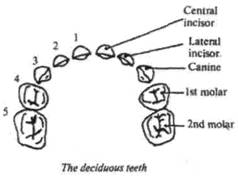
The deciduous teeth are the first set and are also known as milk or temporary teeth. There are twenty of them; ten in each jaw with five on each side. The five teeth on each side of both jaws are named as follows from the front backwards:
central incisor, lateral incisor, canine, 1st molar, 2nd molar. Eruption
 All teeth start developing inside the jaws
and their arrival in the mouth is known as eruption.
Deciduous teeth start developing before birth and erupt after birth. Eruption starts
at six months and is completed at two years. Individual variation is common but
the average ages are as follows:
 Central incisor, 6 months.
Lateral incisor, 8 months.
Canine, 18 months.
1st molar, 12 months
2nd molar, 24 months.
Lower teeth usually erupt before their corresponding upper.
The Permanent Teeth
Permanent teeth are the second and final set. There are thirty-two of them; sixteen in each jaw, eight on each side. Like deciduous teeth, the eight on each side of both jaws have the same names.
Eruption
Permanent teeth start developing at birth.
Eruption commences at six years of age and is completed at eighteen to twentv-five vears.
Eruption times are subject to considerable individual variation but the average ages are:
Central incisor, 7 years.
Lateral incisor, 8 years.
Canine, 9 years (lower); 11 years (upper).
1st premolar, 10 years (lower); 9 years (upper).

|
Из за большого объема этот материал размещен на нескольких страницах:
1 2 3 4 5 6 7 8 9 10 11 12 13 14 15 16 17 18 19 20 21 22 |
