


Партнерка на США и Канаду по недвижимости, выплаты в крипто
- 30% recurring commission
- Выплаты в USDT
- Вывод каждую неделю
- Комиссия до 5 лет за каждого referral
5.4. Итоговый контроль знаний: Тестовые задания по теме. 1 .Дополните фразы, используя предложенные выражения: cause(s) close(s) drink(s) live(s) open(s) speak (s) take(s) place 1. Ann...speaks... German very well. 2. Bad driving.................................. many accidents. 3.1 never........................... coffee. 4. My parents............. in a very small flat. 5. The swimming pool.............. at 9 o'clock and at 18.30. 6. The Olympic Games............. every four years. 2.Дополните фразы, используя предложенные выражения в утвердительной или отрицательной форме: believe eat flow go grow make rise tell translate 1. The earth goes round the sun. 2. Rice doesn't grow in Britain. 3. An interpreter............ from one language into another. 4. The sun ......................... the east. 5. A liar is someone who........... the truth. |
10. What are the diseases the
skeleton can be affected by?
6. Bees............... honey.
7. Vegetarians................ meat.
8. An atheist................... God.
З. Дополните фразы, используя Past Simple указанных глаголов:
clean die enjoy finish happen live open play rain smoke start stay
want watch
I. Yesterday evening I ...watched... television.
2 my teeth three times yesterday.
3. Bernard............. 20 cigarettes yesterday evening.
4. The concert last night........... at 7.30 and.............. at 10 o'clock.
5. The accident............ last Sunday afternoon.
6. When I was a child, I........... to be a doctor.
7.Mozart............. from 1756 to 1791.
8. We.............. our holiday last year. We........... at a very good hotel.
9. Today the weather is nice, but yesterday it.................
10. It was hot in the room, so I......... the window.
II. The weather was good yesterday afternoon, so we............... tennis.
12. William Shakespeare.......... in 1616.
4.Ситуационные задачи по теме. Опишите ситуацию, к которой было бы применимо следующее высказывание: "Не who takes medicine and neglects to diet wastes the skill of his doctors." (Chinese Proverb)
6. Домашнее задание для уяснения темы занятия
Проверка понимания текста (поиск ключевых слов и выражений, ответы на
вопросы)
Выявление ключевых мыслей для составления резюме текста
Письменный тест на знание лексики и грамматики; Подготовить сообщение о системе медицинского образования в Институте стоматологии КрасГМУ. Составить резюме.
7. Рекомендации по выполнению НИРС.
- Примерные темы проектов / докладов: "Congenital and acquired bone diseases" "The backbone" "The skull" "The differences between the male and female human skeletons"
- Тема для кроссвордов: "The bones of the human skeleton"
1.  Занятие №7.
2. Тема: "The Muscles"
3. Форма организации учебного процесса: практическое занятие.
3. Актуальность темы обеспечивается, во-первых, ее параллельным изучением в курсе анатомии человека. Во-вторых, основные речевые конструкции, усвоенные в ходе изучения данной темы, послужат основой при реферировании и аннотировании студентами текстов, описывающих строение других системы жизнедеятельности организма человека. В третьих, лексический минимум, усвоенный студентами, является базовым для работы над рядом последующих тем, предлагаемых программой для изучения(" Teeth and Gums", " The Oral Cavity" и др.).
4. Цели обучения:
Общая цель: студент должен обладать ОК-1,ОК-5,ОК-6,ПК-50.
Учебная цель -
Знать: лексический минимум лексических единиц общего и терминологического характера по теме занятия, правила употребления времен группы Continuous (Active Voice), модальные глаголы can, must may, функции и перевод слова that (those).
Уметь: использовать терминологические единицы и терминоэлементы по теме, кратко рассказать о строении мышечной системы.
Владеть: иностранным языком в объеме, необходимом для возможности получения информации из зарубежных источников, навыками изучающего и просмотрового видов чтения.
5. План изучения темы:
5.1. Контроль исходного уровня знаний.
фронтальный опрос: проверка знания ключевых слов по теме «The Skeleton».
5.2. Основные понятия и положения темы
Тема «The Muscles» предполагает изучение основных типов мышц человека, их строения и функций.
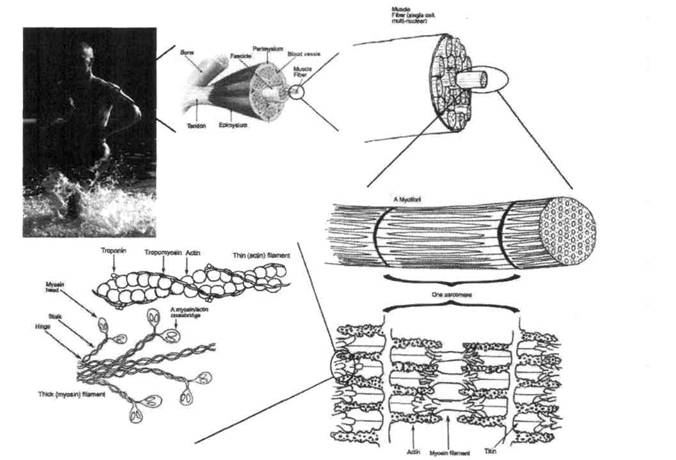
Skeletal muscle structure. Skeletal muscle fibers are multinucleated, with the cell's nuclei located just beneath the plasma membrane. The cell is comprised of a series of
striped or striated, thread-like myofibrils. Within each myofibril there are protein filaments that are anchored by dark Z lines.
The fiber is one long continuous thread-like structure. The smallest cross section of skeletal muscle is called a sarcomere which is the functional unit within the cell. It extends from one Z line to the next attached Z line. The individual sarcomere has alternating thick myosin and thin actio protein filaments. Myosin forms the center or middle of each sarcomere. The exact center of the sarcomere is designated the M line. Thinner actin filaments form a zig zag pattern along the anchor points or Z line.
Upon stimulation by an action potential, skeletal muscles perform a coordinated contraction by shortening each sarcomere. The best proposed model for understanding contraction is the sliding filament model of muscle contraction. Actin and myosin fibers overlap in a contractile motion towards each other. Myosin filaments have club-shaped heads that project toward the actin filaments. Larger structures along the myosin filament called myosin heads are used to provide attachment points on binding sites for the actin filaments. The myosin heads move in a coordinated style, they swivel toward the center of the sarcomere, detach and then reattach to the nearest active site of the actin filament. This is called a rachet type drive system. This process consumes large amounts of adenosine triphosphate (ATP). Energy for this comes from ATP, the energy source of the cell. ATP binds to the cross bridges between myosin heads and actin filaments. The release of energy powers the swiveling of the myosin head. Muscles store little ATP and so must continuously recycle the discharged adenosine diphosphate molecule (ADP) into ATP rapidly. Muscle tissue also contains a stored supply of a fast acting recharge chemical, creatine phosphate which can assist initially producing the rapid regeneration of ADP into ATP. Calcium ions are required for each cycle of the sarcomere. Calcium is released from the sarcoplasmic reticulum into the sarcomere when a muscle is stimulated to contract. This calcium uncovers the actin binding sites. When the muscle no longer needs to contract, the calcium ions are pumped from the sarcomere and back into storage in the sarcoplasmic reticulum.
Control of muscle contraction. Neuromuscular junctions are the focal point where a motor neuron attaches to a muscle. Acetylcholine, (a neurotransmitter used in skeletal muscle contraction) is released from the axon terminal of the nerve cell when an action potential reaches the miscoscopic junction, called a synapse, A group of chemical messengers cross the synapse and stimulate the formation of electrical changes, which are produced in the muscle cell when the acetylcholine binds to receptors on its surface. Calcium is released from its storage area in the cell's sarcoplasmic reticulum. An impulse from a nerve cell causes calcium release and brings about a single, short muscle contraction called a muscle twitch. If there is a problem at the neuromuscular junction, a very prolonged contraction may occur, tetanus. Also, a loss of function at the junction can produce paralysis. Skeletal muscles are organized into hundreds of motor units, each of which involves a motor neuron, attached by a series of thin finger-like
structures called axon terminals. These attach to and control discrete bundles of muscle fibers. A coordinated and fine tuned response to a specific circumstance will involve controlling the precise number of motor units used. While individual muscle units contract as a unit, the entire muscle can contract on a predetermined basis due to the structure of the motor unit. Motor unit coordination, balance, and control frequently come under the direction of the cerebellum of the brain. This allows for complex muscular coordination with little conscious effort, such as when one drives a car without thinking about the process.
Attached to the lower jaw( the mandible) are the muscles of mastication which close the mouth. Muscles opening the mouth are attached to the bone bearing teethjust below the chin. But muscles of the face are different. Many of them are attached to the skin, so if you contract your facial muscles a tiny bit, you can make many different expressions. The tongue is a muscle too. It is attached at only one end and hasl8 muscles that are connected. This makes the tongue very flexible so that we can speak, chew and swallow.
Введение нового грамматического материала: Времена группы Continuous (Active Voice). Модальные глаголы can, must may. Функции и перевод слова that (those).
5.3. Самостоятельная работа по теме:
Выполнение тренировочных упражнений (1, №1, №2 стр. 83). Чтение и перевод текста "The Muscles" (1, стр. 85). Проверка понимания текста (ответы на вопросы). Выявление ключевых мыслей для составления резюме текста. Выполнение грамматических упражнений по карточкам.
5.4. Итоговый контроль знаний:
Письменный тест на знание лексики и грамматики.
Вопросы для самоподготовки:
1. How many types of muscular tissue are there?
2.How do we sometimes call smooth muscles?
3.What is another name of striated muscles?
4.What is the difference between the cardiac and skeletal muscles?
5. Why do we call muscles the active part of the motor apparatus?
6.What groups of muscles are there?
7. How many skeletal muscles are there in the human organism?
8. What structure do the skeletal muscles have? 9.What is the function of the tendons?
lO. What muscles are necessary for manipulating the bones of the skeleton?
Тестовые задания по теме:
Поставьте глаголы в правильную форму: Past Continuous or Past Simple.
1. Jane..... (wait) for me when I......... (arrive).
2. 'What(you'do) this time yesterday?' 1 was asleep.'
3. '(you/go) out last night?' "No, I was too tired.'
4. 'Was Carol at the party last night?' 'Yes, she.... (wear) a really nice
dress.'
5. How fast...... .(you/drive) when the accident. (happen)?
6. John....... (take) a photograph of me while I (notAook).
7. We were in a very difficult position. We... .(not/know) what to do.
8. I haven't seen Alan for ages. When I last.......... (see) him, he.......... (try) to
find a job in London.
9. I............. (walk) along the street when suddenly I....... (hear) footsteps
behind me. Somebody.................................................... (follow) me.
I was frightened and I........................ (start) to run.
10. When I was young,....................... (want) to be a bus driver.
Дополните фразы, используя must и have to:
l. It's later than I thought. I.......... go now.
2. Jack left before the end of the meeting. He......... go home early.
3.1n Britain many children..................... wear uniform when they go to school.
4. When you come to London again, you................... come and see us.

|
Из за большого объема этот материал размещен на нескольких страницах:
1 2 3 4 5 6 7 8 9 10 11 12 13 14 15 16 17 18 19 20 21 22 |
