


Партнерка на США и Канаду по недвижимости, выплаты в крипто
- 30% recurring commission
- Выплаты в USDT
- Вывод каждую неделю
- Комиссия до 5 лет за каждого referral
5.Last night Don became ill suddenly. We.................... call a doctor.
6. You really........................ work harder if you want to pass the examination.
7. I'm afraid I can't come tomorrow. I............... work late.
8.1'm sorry I couldn't come yesterday. I.................... work late.
9. Paul doesn't like his new job. Sometimes he................. work at weekends.
10. Caroline may........................ go away next week.
11. We couldn't repair the car ourselves. We.................. take it to a garage.
12. Julia wears glasses. She................ wear glasses since she was very
young.
Дополните фразы, используя must и can't.
1. You've been travelling all day. You............ be very tired.
2. That restaurant...................... be very good. It's always full of people.
3. That restaurant...................... be very good. It's always empty.
4. You're going on holiday next week. You..... be looking forward to it.
5. It rained every day during their holiday, so they................ have had a very nice
time.
6. Congratulations on passing your exam. You................. be very pleased.
7. You got here very quickly. You............... have walked very fast.
8. Bill and Sue go away on holiday very often, so they................ be short of
money.
Переведите на английский:
1. Мне взять ваш багаж? - Да, пожалуйста.
2. Не открывайте окно. Здесь холодно. Будьте добры, откройте окно. Здесь жарко.
3. Не ставьте здесь машину. Поставьте ее там.
4. Можно мне (разрешите мне) вам помочь? - Спасибо.
5. Идите за мной, пожалуйста.
6. Не идите за мной, пожалуйста.
7. Мне открыть окно? - Да.
8. Можно мне войти? - Конечно.
9. Можно мне сесть здесь? - Да.
10. Мне помочь вам? - Нет, спасибо.
Дополните фразы, используя must, mustn't и needn't.
1. We haven't got much time. We............. hurry.
2. WeVe got plenty of time. We.............. hurry.
3. We have enough food at home so we... go shopping today.
4. Jim gave me a letter to post. I........... remember to post it.
5. Jim gave me a letter to post. I........... forget to post it.
6.There's plenty of time for you to make up your mind. You.... decide now.
7. You................. wash those tomatoes. They've already been washed.
8. This is a valuable book. You........... look after it carefully and you.......
lose it.
9. What sort of house do you want to buy? Something big?' Well, it
be big
- That's not important. But it..... have a nice garden - that's essential.'
Ситуационные задачи по теме.
1. Представьте, что Вы - преподаватель. Скажите, верно ли использовали Ваши студенты время в подчеркнутых словах. Исправьте неверно написанные фразы.
1. Water boils at 100 degrees Celsius. ____
2. The water boils. Can you turn it off? ___
3. Look! That man tries to open the door of your car._____
4. Can you hear those people? What do they talk about?____
5. The moon goes round the earth.__
6. I usually go to work by car.__ .
7. Hurry up! It's time to leave.' 'OK, I come.'
8. I hear you've got a new job. How do you get on?_____
9. I'm feeling hungry. Is there anything to eat?......
10. Are you believing in God? .......................
11.This sauce is great. It's tasting really good........
12. I'm thinking this is your key. Am I right? .................
13.Tom is in his room. He plays the piano......................................
14. Jill is speaking five languages.....................................................
15.1 am looking for my glasses. Where are they?..............................
16.My brother is smoking 20 cigarettes a day...................................
17.1 am not understanding what he is speaking about..............
18.  The man in the dark grey coat is looking like Tom Garrett.............
19. I'm looking out of the window, but I'm not seeing him.................
20. How much is it costing to send a letter to Paris?...............................
21. My parents are never drinking strong coffee...................................
22. The play is beginning at half past seven..........................................
2. Поставьте глаголы в правильную форму, ориентируясь на контекст ситуации (present continuous or present simple).
1. Let's go out. It..................... (not/rain) now.
2. Julia is very good at languages. She........ (speak) four languages very well.
3. Hurry up! Everybody...................... (wait) for you.
4. '............................ (you/listen) to the radio?' - No, you can turn it off.'
5. '............................ (youAisten) to the radio every day?' - No, just
occasionally.'
6. The River Nile........... (flow) into the Mediterranean.
7. Look at the river. It.... (flow) very fast today - much faster than usual.
8.We usually...... (grow) vegetables in our garden but this year we
............. (not/grow) any.
9. How is your English?' - Not bad. It.... (improve) slowly.'
10. Ron is in London at the moment. He......... (stay) at the Park Hotel. He
........ (always/stay) there when he's in London.
11. Can we stop walking soon? I................... (start) to feel tired.
12. 'Can you drive?' 1................ (learn). My father.. (teach) me.'
13. Normally I......... (finish) work at 5.00, but this week I ....... (work) until
6.00 to earn a bit more money.
7. Рекомендации по выполнению НИРС.
- Примерные темы проектов / докладов:
"Types of muscles" "Muscle activity in an anaerobic and aerobic environment"
 Занятие №8
1. Тема занятия «The Oral Cavity. The Structure of a Tooth».
2. Форма организации занятия: практическое занятие.
3. Значение изучения темы. Актуальность темы для будущих специалистов-стоматологов обеспечивается ее узкопрофессиональной направленностью.
4. Цели обучения:
Общая цель: студент должен обладать ОК-1,ОК-5,ОК-6,ПК-50.
Учебная цель -
Знать: лексический минимум лексических единиц общего и
терминологического характера по теме занятия «The Structure of a Tooth» .
Уметь: использовать терминологические единицы и терминоэлементы по
теме, описать структуру зуба человека.
Владеть: иностранным языком в объеме, необходимом для возможности
получения информации из зарубежных источников, навыками изучающего и
просмотрового видов чтения.
Подготовка к диалогической речи.
5. План изучения темы:
5.1. Контроль исходного уровня знаний.
Фронтальный опрос: проверка знания ключевых слов и синтаксических конструкций модели описания системы.
|
5.2. Основные понятия и положения темы.
Введение нового лексического материала. Чтение текста «The Structure of a Tooth»
Structure of the Teeth
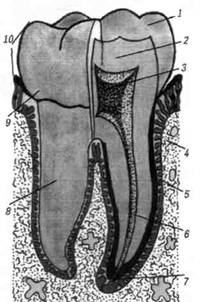
Every tooth consists of a crown, a neck and one or more roots. The crown is the part visible in the mouth and the root is the part hidden inside the jaw. The junction of crown and root is called the neck and
the end of the root is called the apex (Fig. 1). Every tooth is composed of enamel, dentine, cementum and pulp.
Enamel
This is the outer covering of the crown and is the hardest substance in the body. It is insensitive to pain. Unlike most other body tissues it cannot undergo repair; thus any damage caused by decay or injury is permanent. The microscope shows that it consists of long solid rods, called enamel prisms, cemented together by the interprismatic substance. The prisms run roughly at right angles to the surface.
Structure of a tooth 1 — enamel (эмаль); 2 — dentine (дентин); 3 — pulp chamber (полость коронки зуба); 4 — (alveolar process) костная альвеола; 5 — cementum (цемент); 6 — apical foramen (канал корня зуба); 7—periodontal membrane (периодонт); 8—root (корень зуба); 9 — neck (шейка зуба); 10 — crown (коронка зуба).
Cementum
This is the outer covering of the root and is similar in structure to bone. Cementum meets enamel at the neck of the tooth.
Dentine
This occupies the interior of the crown and root, and is very sensitive to pain. Dentine from elephants' tusks is commonly known as ivory but is exactly the same dentine as that found in human teeth.
Pulp Unlike enamel, dentine and cementum, the pulp is purely soft tissue. It contains blood vessels and nerves, and occupies the centre of the dentine. Vessels and nerves of the pulp enter the root apex through the apical foramen and pass up the root canal into the crown, where the space occupied by the pulp is called the pulp chamber. The nerves of the pulp are responsible for pain felt when dentine is drilled or toothache occurs. The outermost layer of the pulp, next to the dentine, is lined with the special cells which formed the dentine. Under the microscope fine prolongations of these cells can be seen passing through tubes in the dentine. They run throughout the full thickness of dentine and, by their origin from the pulp, are associated with its repair processes and sensitivity to pain.
Supporting Structures
Every tooth is inserted into the jaw by its root. The part of the jaw containing the teeth is known as the alveolar process' and is covered with a soft tissue called gum. The jaw bones consist of a dense outer layer known as compact bone and a softer interior called spongy bone.
A tooth is attached to its socket in the jaw by a soft fibrous tissue called the periodontal membrane. This acts as a shock absorber and is attached to the cementum of the root and the compact bone lining the socket. The periodontal membrane contains nerves and blood vessels, but consists mainly of bundles of fibres which pass obliquely from cementum to bone.

|
Из за большого объема этот материал размещен на нескольких страницах:
1 2 3 4 5 6 7 8 9 10 11 12 13 14 15 16 17 18 19 20 21 22 |
